Our Pick: NOD Apiary
Check PriceFall Beekeeping: The Season That Decides Whether They Live
If you buy one thing this fall, buy the treatment: Formic Pro in the 2-dose pack ($30.00) covers a standard two-hive backyard operation once, penetrates brood cappings where most mites are hiding, and used at the right moment in late summer it is the single intervention most likely to determine whether your colonies are alive in March. Everything else on this page matters. This is the one that matters most.
By The BeehiveKits Hive Desk2026-08-2919 min read Fact-checked against verified Amazon listingsHow we research
Here is the biology that makes fall different from every other season, and it is worth reading twice. A summer worker bee lives about six weeks. She works herself to death foraging, and the colony replaces her continuously. But beginning in late summer, as day length shortens and brood rearing slows, colonies rear a different kind of bee: fat-bodied, protein-rich, with enlarged fat bodies and a physiology built for longevity rather than labor. These winter bees live four to six months. They are the entire crew that will carry the colony from October to the first spring brood, and there will be no replacements until the queen starts laying again in late winter.
Now the failure mode. Winter bees are reared in August and September. If a colony is carrying a heavy varroa load during that rearing window, the resulting bees emerge with damaged fat bodies and a load of the viruses varroa transmits, most notably deformed wing virus. They look normal. They do not live six months. They live weeks. So the colony that looked strong in October dwindles quietly through November and December, and in January you open a hive with a fistful of dead bees and plenty of honey, which everyone misreads as starvation or cold. It was August.
That single mechanism explains most winter losses, and it explains why the surveys tracked by the Bee Informed Partnership have reported annual US colony losses in the 40 to 50 percent range in recent years. It also explains the structure of this page: the mite work comes before the feeding, the feeding comes before the wrapping, and the wrapping is a distant third that beginners spend far too much time thinking about.
This is the fall chapter of a four-season set. It follows the summer guide and the spring guide, and hands off to the winter guide. For the year at lower magnification, see the first-year beekeeping calendar. Standard disclosure: no brand paid for placement, some links go to Amazon where purchases may earn us a small commission at no extra cost to you, and prices were verified at publication.
What to know
- Fall is the most consequential season of the four. August and September mite control decides whether the colony sees March, and nothing you do in December can fix it.
- Winter bees are reared from roughly August into September and must live four to six months. A high mite load during that window produces short-lived bees and a colony that dwindles out in midwinter.
- Order of operations: harvest, then treat, then feed, then combine, then reduce and button up. Doing them out of order wastes the warm weather you need.
- Feed 2:1 syrup to a weight target, roughly 40 to 60 lbs of stores in cold-winter regions, and start early enough that bees can dry and cap it before cold nights.
- Combine weak colonies rather than nursing them. Two weak hives make one that overwinters; two weak hives left alone usually make zero.
- Recount mites after treatment. The step almost everyone skips is the one that tells you whether the treatment worked.
- Moisture management outranks insulation. Cold bees survive winter; cold wet bees do not.
At a glance
| Gear | The fall job it serves | When you need it in hand | Price | Check price |
|---|---|---|---|---|
| Formic Pro Varroa Treatment, 2-Dose | Protect the winter bees | August, immediately after supers come off | $30.00 | Check Price |
| Mann Lake Varroa EasyCheck | Count before and recount after | Before you choose a treatment | $30.50 | Check Price |
| KAGZ 1.5-Gallon Hive Top Feeder | Feed 2:1 to weight | Early September in most regions | $37.99 | Check Price |
| GJD Entrance Reducer & Mouse Guard, 4-Pack | Reduce entrances, block rodents | Before the first cold nights | $18.99 | Check Price |
| BeeCastle 10-Frame Candy Board | Backup stores when syrup season ends | October, before you close up | $37.99 | Check Price |
| MayBee Winter Hive Wrap | Cut wind on wooden hives | Late October to November in cold regions | $26.99 | Check Price |
The fall gear stack, matched to the job that demands it

Formic Pro Varroa Mite Treatment, 2-Dose
NOD Apiary · Formic acid polysaccharide strips · label window roughly 50 to 85F · penetrates brood cappings per label
Our verdict: The default late-summer treatment for most US backyard keepers, and the product this entire page is organized around. Its distinguishing property is brood penetration: in August the majority of the mite population is sealed under cappings, and contact treatments simply cannot reach them.
Timing is the whole argument. Winter bees are reared from August into September, and they can only be healthy if the colony rearing them has a low mite load. Formic Pro ($30.00) is applied as strips laid across the top bars, and formic vapor penetrates capped brood cells, which is why it is the mainstream choice for the one treatment that has to work.
Respect the label. The window of roughly 50 to 85F is not a suggestion: applied in a heat wave it can cause brood loss and queen problems, and applied too cold it underperforms. Plan around a moderate stretch in the forecast. And recount two to three weeks after treatment, because a failed treatment you do not know about is worse than no treatment at all. Full chemistry comparison in best varroa mite treatments.
Who should buy it
Every keeper doing the late-summer treatment in a region where the forecast offers a moderate stretch. Two doses covers the standard two-hive backyard start.
What we don't like
The temperature window is a genuine scheduling problem in the Deep South and in a hot August anywhere. Formic also carries known tradeoffs: brood interruption, occasional queen loss, and fumes that demand careful handling and full label compliance.
- Active ingredient
- Formic acid (listed)
- Doses
- 2 (treats two standard hives once)
- Label window
- About 50 to 85F (per label)
- Brood penetration
- Yes, per label
- Supers on
- Per label only; read before use
- Price
- $30.00
Pros
- Reaches mites under brood cappings
- Fits the critical winter-bee rearing window
- Organic-acid chemistry suits rotation plans
- Simple top-bar application, no equipment needed
Cons
- Strict temperature window limits scheduling
- Brood interruption and occasional queen loss are known risks

Mann Lake Varroa EasyCheck
Mann Lake · Purpose-built varroa monitoring vessel · alcohol wash or sugar roll · half-cup sample, about 300 bees
Our verdict: Fall is the season where monitoring earns its keep twice: once to decide whether and how urgently to treat, and once to confirm the treatment worked while there is still time to respond. A consistent vessel is what makes those two numbers comparable.
The recount is the step everyone skips. Treatments fail for ordinary reasons, temperature, timing, application error, and a colony you believe is treated is a colony you will not check again until it is dead. A Mann Lake Varroa EasyCheck ($30.50) makes each count a two-minute job at the hive, which is the difference between a protocol you intend to follow and one you do.
Use the same method and sample size each time so the numbers mean something as a series. Thresholds and interpretation are in Honey Bee Health Coalition guidance, and method comparisons are in best mite monitoring tools.
Who should buy it
Everyone. If you own exactly one hive-health tool, this is it, because every other fall decision depends on the number it gives you.
What we don't like
Alcohol washes kill the sampled bees, roughly 300 of them, which is a real cost to weigh against the colony you are trying to save. Sugar rolls spare the bees but read lower and less consistently.
- Method
- Alcohol wash or sugar roll
- Sample size
- Half cup, about 300 bees
- Construction
- Molded plastic bowl-in-bowl (listed)
- Fall use
- Count before treating, recount 2 to 3 weeks after
- Price
- $30.50
Pros
- Makes the pre and post counts directly comparable
- Fast enough that the recount actually happens
- Works for both wash and sugar-roll methods
- Sealed enough to carry between yards
Cons
- Alcohol washes kill the sample
- Accuracy still depends on disciplined technique

KAGZ 1.5-Gallon Hive Top Feeder
KAGZ · 10-frame Langstroth fit (listed) · 1.5-gallon capacity (listed) · positioned above the cluster
Our verdict: Fall feeding is a volume problem with a weather deadline, and capacity is what lets you meet it. A gallon and a half per fill means fewer trips, less disturbance, and syrup positioned where bees can reach it on the cool days when an entrance feeder is effectively out of service.
Getting a colony from light to heavy can take several gallons of 2:1, delivered before nights turn cold. A KAGZ 1.5-gallon hive top feeder ($37.99) sits directly over the cluster so bees do not have to cross cold space to reach it, and refills take one lid lift rather than a full hive opening in September weather.
It also keeps the syrup inside the hive, which matters more in fall than any other season because robbing pressure peaks in the dearth. Open-air feeding in September is how a yard-wide fight starts. The feeder field is compared in best bee feeders and the top-versus-entrance question in hive top feeder vs entrance feeder.
Who should buy it
Anyone whose colonies are not already at weight in early September, which in a normal year is most backyard keepers with first-year colonies.
What we don't like
It stops being useful once nights turn cold and bees stop taking syrup, so it needs to come off before it becomes a reservoir of fermenting sugar water sitting on the hive.
- Capacity
- 1.5 gallons (listed)
- Fit
- 10-frame Langstroth (listed)
- Position
- Hive top, above the cluster
- Fall syrup
- 2:1 sugar to water by weight
- Price
- $37.99
Pros
- Capacity matches the volume fall feeding requires
- Bees reach it on cool days
- Keeps syrup inside during peak robbing season
- Also serves spring 1:1 feeding
Cons
- Useless once nights turn cold; switch to fondant
- Adds a box height to the stack
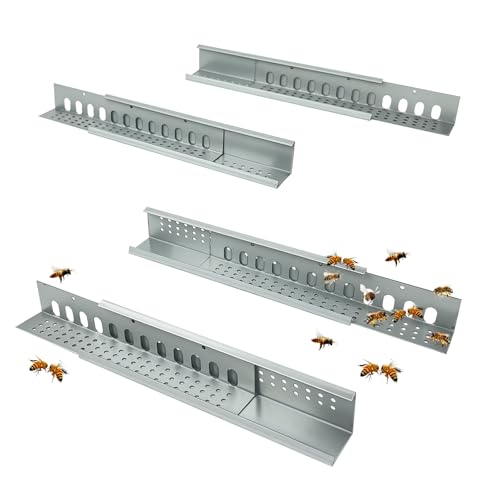
GJD Beehive Entrance Reducer and Sliding Mouse Guard, 4-Pack
GJD · 4-pack stainless steel · sliding adjustable opening (listed) · serves as reducer and mouse guard
Our verdict: The cheapest fall purchase with a real failure mode behind it. A mouse in a wintering hive destroys comb and stresses a cluster that cannot evict her, and the fix costs under five dollars per hive if you fit it before the first cold nights.
Timing is everything with mouse guards: they must go on before rodents start looking for winter housing, because a guard fitted afterward simply locks the mouse in. A GJD entrance reducer and mouse guard 4-pack ($18.99) covers a small apiary and gives you an adjustable opening, so the same hardware handles dearth robbing defense in September and rodent exclusion in October.
Stainless is the right material here because these live outdoors through freeze-thaw cycles for years. Run the smallest practical opening for winter, and add clearing the entrance of dead bees to your winter walk-around, which the winter guide covers. Alternatives compared in robbing screens and entrance reducers.
Who should buy it
Every keeper in a region with a real winter, which is nearly everyone. Four guards means you are covered as the apiary grows.
What we don't like
A small winter entrance can clog with dead bees, so it creates a small ongoing chore. And fitting one late, after a mouse has already moved in, is actively counterproductive.
- Quantity
- 4 guards
- Material
- Stainless steel (listed)
- Opening
- Sliding, adjustable (listed)
- Fit on
- Before the first cold nights
- Price
- $18.99
Pros
- Under five dollars per hive for a real risk
- Doubles as robbing-season entrance reducer
- Stainless survives years of freeze and thaw
- Adjustable opening covers several seasons of use
Cons
- Small winter openings can clog with dead bees
- Useless or harmful if fitted after rodents move in

BeeCastle 10-Frame Beehive Candy Board
BeeCastle · 10-frame Langstroth candy board · sits directly above the cluster · solid feed, usable in cold weather
Our verdict: The bridge between fall feeding and winter emergency feeding. Once nights turn cold, syrup is useless and the only feed a cluster can reach is feed directly overhead. A candy board occupies exactly that position and buys you a rescue option in February.
Fall feeding has a hard weather cutoff, and colonies that fall short of weight after that cutoff need solid feed. A BeeCastle 10-frame candy board ($37.99) sits between the top box and the inner cover, putting sugar within cluster reach without asking the bees to break cluster and travel.
Two secondary benefits worth knowing. Solid sugar above the cluster absorbs some of the moisture the cluster generates, which helps with condensation. And having the board on the hive going into winter means your February emergency response is topping it up rather than assembling something in the cold. Fondant, candy boards, and dry sugar are compared in best winter bee feed.
Who should buy it
Anyone in a cold-winter region, and specifically anyone whose colonies did not reach weight before the syrup window closed. Also good insurance on any first-year colony.
What we don't like
It is not a substitute for a properly provisioned hive; a colony trying to winter on a candy board alone is a colony in trouble. It also adds height and needs a matching configuration to seal properly.
- Fit
- 10-frame Langstroth (listed)
- Position
- Directly above the cluster, under the inner cover
- Feed type
- Solid sugar, usable in cold weather
- Secondary benefit
- Absorbs some cluster moisture
- Price
- $37.99
Pros
- Feed the cluster can reach without breaking cluster
- Works when syrup no longer does
- Helps with winter condensation
- Turns a February emergency into a top-up
Cons
- Not a substitute for reaching weight in September
- Adds height and needs a clean seal

MayBee Winter Bee Hive Wrap
MayBee · Fits 10 and 8 frame hives (listed) · 600D shell (listed) · reusable season after season
Our verdict: Cheap, quick, and genuinely useful in zones 3 to 6 on wooden equipment, provided you have already solved weight and moisture. We rank it third for a reason: a wrapped hive that is light or wet still dies, and a heavy dry hive usually survives unwrapped.
Wind stripping heat through thin pine walls costs the cluster calories, and calories are stores. A MayBee winter hive wrap ($26.99) is a fitted shell that installs in minutes once feeding is done and comes off in March.
Put it on late, as temperatures actually drop rather than during a warm October, and make sure it does not seal your upper vent or moisture management. Insulated poly hive owners skip this purchase entirely. The full winterizing sequence, in priority order, is in how to winterize a beehive and the wrap and stand field is in stands and winter wraps.
Who should buy it
Keepers in genuinely cold regions, roughly zones 3 to 6, running wooden hives in exposed sites, and especially first-year colonies without a proven wintering history.
What we don't like
It cannot fix the two problems that actually kill wintering colonies, light stores and condensation, and a wrap that blocks ventilation can make moisture worse. In mild regions it is money better spent on sugar.
- Fit
- 10 and 8 frame hives (listed)
- Material
- 600D shell (listed)
- Reusable
- Yes, multiple seasons
- Install when
- Temperatures actually drop, not early October
- Price
- $26.99
Pros
- Installs in minutes and reuses for years
- Cuts wind chill on thin pine walls
- Fits both 8- and 10-frame equipment
- Cheap margin in genuinely cold zones
Cons
- Third priority behind stores and moisture
- Unnecessary in mild regions and on insulated hives
Why fall outranks every other season
Say it in one sentence: the colony that dies in January was killed in August.
The reason is winter bees. Through spring and summer a colony runs on a conveyor belt of short-lived workers, each living roughly six weeks, continuously replaced. From late summer that changes. Shortening days, declining forage, and slowing brood rearing trigger the production of a physiologically distinct worker with enlarged fat bodies, high vitellogenin stores, and a lifespan measured in months. These are the bees that will thermoregulate the cluster from October to March. The colony gets one shot at producing them, in roughly a six-week window from August into September, and after that no more bees are made until the queen resumes laying in late winter.
Varroa attacks exactly this. Mites feed on the developing bee's fat body, which is the very organ winter bees depend on, and they vector viruses including deformed wing virus. A pupa parasitized by mites emerges as an adult that is smaller-lived, immunologically compromised, and often visibly deformed at high infestation. So a colony carrying a heavy mite load during winter-bee rearing produces a crew of workers that cannot do the job. The colony looks fine in October, because the bees are there. It dwindles through November and December as those bees die on a summer-bee schedule. And by late January the cluster is too small to hold temperature, and it dies, often surrounded by honey.
The underlying biology, how declining day length and forage shift a colony into producing long-lived workers with enlarged fat bodies, is covered well in the extension literature collected at eXtension Bee Health. This is why we treat "plenty of stores in the dead hive" as a diagnostic pointing at varroa rather than at cold. It is also why the Honey Bee Health Coalition varroa management guidance emphasizes late-summer timing so heavily, and why extension programs across the country push the same message every August.
The practical consequence: the fall calendar counts backward from winter-bee rearing, not from frost. Your treatment needs to be finished before or during the rearing window, not in November when it feels like fall. In most of the country that means the mite decision belongs in August, sometimes late July, and by the time the leaves turn you are already late.
The fall order of operations
Fall tasks have dependencies. Doing them out of order does not just waste effort; it wastes the warm weather several of them require.
- Pull the supers. Nothing else can start while a food crop is on the hive, because treatments are restricted and feeding is off the table.
- Count mites, then treat. Immediately. This is the deadline-driven step, and the deadline is winter-bee rearing.
- Recount after treatment. Confirm it worked. If it did not, you still have time to do something about it.
- Feed 2:1 to weight. Needs warm enough weather for bees to take, dry, and cap syrup, which is why it cannot wait until October in the North.
- Assess and combine. Do this while colonies still have enough population to be worth combining and enough warm days to reorganize.
- Requeen if needed. Only where it is genuinely warranted and there is still time for acceptance and a brood cycle.
- Reduce entrances and fit mouse guards. Before the first cold nights send rodents looking for housing.
- Moisture plan, then wrap. Last, as temperatures actually drop, and in that order of importance.
The compressed version for anyone reading this in a hurry in late August: treat now, feed heavy, combine anything hopeless, and worry about wraps in six weeks.
Job 1: The final harvest, and leaving enough behind
The last honey comes off when the fall flow, if you have one, has ended and the frames are capped. In much of the Midwest and mid-Atlantic that means goldenrod and aster produce a genuine late flow in September, and the honest position is that the fall flow belongs to the bees. It is the cheapest, best-quality winter feed available, it arrives exactly when they need it, and taking it means replacing it with sugar water at your expense.
So the practical rule: harvest the summer crop, leave the fall flow. If you do take fall honey, take only what is genuinely surplus above your weight target, and understand that some fall honeys, notably those with high honeydew content, are considered poorer winter stores in cold regions because they can be harder on the bees' digestive systems during long confinement.
Timing note: pulling supers is the gate on everything else in this list, so do not slow-walk it. A super sitting on the hive in late August while you find a free Saturday is a super that is delaying your mite treatment during the exact window that matters. The clearing and extraction process, if you are doing it for the first time, is in how to harvest honey, and yields are set in context in how much honey per hive.
One more thing: protect the comb you just pulled. Extracted supers stored warm and unprotected are wax moth and hive beetle habitat, and losing your drawn comb over the winter costs you a month of colony labor next spring. Handle it the week you extract, using the approaches in the wax moths guide.
Job 2: Mite treatment, timed to protect the winter bees
This is the job. Everything else on this page is important; this one is decisive.
Count first. A half-cup alcohol wash or sugar roll, about 300 bees from a brood frame, using a consistent vessel such as the Mann Lake Varroa EasyCheck ($30.50). Extension thresholds and Coalition guidance put the action level around 2 to 3 mites per 100 bees, and in the late-summer window we would treat at any meaningful count rather than splitting hairs, because the downside of an unnecessary treatment is small and the downside of a missed one is the colony. Method comparisons are in best mite monitoring tools.
Then treat, promptly. Chemistry choice in fall is constrained by three things: temperature, brood presence, and how long the product needs to work.
| Chemistry | Reaches capped brood | Temperature sensitivity | Typical fall role |
|---|---|---|---|
| Formic acid | Yes, per label | Label window roughly 50 to 85F | The August workhorse when weather cooperates |
| Thymol | No | Needs moderate temperatures; poor in heat | Late-summer alternative in mild weather |
| Amitraz strips | No, but long contact time | Tolerant across a wide range | Extended fall treatment where allowed |
| Oxalic acid | No | Works cold | Late fall or winter, when the colony is broodless |
Our default for the August window is formic acid, because it is the mainstream option that penetrates brood cappings, and in August most of the mite population is under cappings where contact treatments cannot reach it. A Formic Pro 2-dose pack ($30.00) covers two standard hives once. Its constraint is the label temperature window of roughly 50 to 85F, so you need a moderate stretch in the forecast, which in the Deep South can be genuinely hard to find in August. Read the label and follow it exactly; formic is effective because it is strong, and it has known tradeoffs including brood interruption and occasional queen loss.
Where formic will not fit your weather, the alternatives and their tradeoffs are laid out chemistry by chemistry in best varroa mite treatments, with the timing logic in when to treat for varroa and the formic-versus-oxalic decision specifically in oxalic acid vs formic acid.
Then recount. Two to three weeks after treatment, wash again. This is the step almost everyone skips, and it is the only way to know whether the treatment actually worked or whether you have a colony that is now both mite-loaded and out of season. If the number is still high, you have time in September to do something. In November you do not.
Finally, plan the broodless follow-up. Many keepers add an oxalic acid treatment in late fall or early winter when the colony is broodless, because that is the one moment every mite in the hive is exposed on adult bees. That is a winter guide topic, but you should buy the materials now.
Job 3: Feed 2:1 syrup to a weight target
Fall feeding has a different purpose than spring feeding. In spring you feed 1:1 to stimulate comb building and brood rearing. In fall you feed 2:1 by weight, sugar to water, because the goal is storage: thicker syrup means less water for the bees to evaporate and faster capping. The mixing details are in how to feed bees sugar syrup.
The target is weight, not volume. In cold-winter regions the working number is roughly 40 to 60 lbs of stores going into winter, less in the mid-South, more in the far North and at high elevation. Some keepers hit that with a full deep of capped honey plus a partly full second box; others need considerably more. The number that matters is what your local club overwinters on, because it encodes your actual winter length.
The deadline is real and it is temperature, not date. Bees need warm enough weather to take syrup, evaporate it, and cap it. Once nights get consistently cold, they stop taking it, and syrup left in a feeder in October is syrup that ferments. This is why fall feeding starts around Labor Day in the baseline Midwest and earlier in the North, and why a keeper who starts in mid-October has already lost. If you are late, fondant and candy boards are the fallback, which is why we recommend having a BeeCastle 10-frame candy board ($37.99) on hand before you need it.
Delivery method matters at this volume. You may be putting several gallons into each colony, which makes reservoir capacity the deciding feature: a KAGZ 1.5-gallon hive top feeder ($37.99) sits above the cluster where bees can reach it on cool days and refills without opening the nest. Entrance feeders hold less and advertise food at the front door during the season when robbing pressure is highest. The comparison is in hive top feeder vs entrance feeder and the wider field in best bee feeders.
How to read hive weight: the heft test
You do not need a scale, though a luggage scale hooked under the back edge is a genuinely useful upgrade. The standard field method is the heft test: stand behind the hive, hook your fingers under the back edge of the bottom box, and lift, or try to. You are calibrating for one sensation: a hive that is properly provisioned feels like it is bolted down.
Calibrate in September while you still know what a heavy hive is, because the whole value of the heft test in January is that you have a reference point from October. Some keepers write the September heft impression on the hive log; a waterproof log book makes this a habit rather than an intention, and we cover logging in the winter guide.
Rules of thumb worth carrying: a full deep 10-frame box of honey runs roughly 80 to 90 lbs, a full medium roughly 50 lbs, and the boxes themselves plus bees add their own weight, so you are judging total assembly rather than counting frames. If you can lift the back edge easily with two fingers, the colony is light and needs feed. If you strain, you are in the neighborhood.
One caution: heft tells you about total stores, not about where they are. A colony can have plenty of honey at the edges and still starve in a cold snap if the cluster cannot move sideways to reach it. That is called isolation starvation, and it is one of the arguments for having stores directly above the cluster going into winter, which is exactly what a candy board provides.
Job 4: Assess and combine weak colonies
This is the fall job people avoid for emotional reasons, and avoiding it costs them both colonies.
The arithmetic is simple. A colony below a certain population cannot generate enough heat to hold a cluster through winter, and no amount of feeding, wrapping, or hoping changes that. In most cold-winter regions the honest threshold is somewhere around four to five frames of bees going into November, and below that the colony is very unlikely to make it. Two weak colonies combined make one that overwinters. Two weak colonies left alone usually make zero.
Combining is straightforward: find and remove the poorer queen, then stack the queenless colony above the queenright one with a sheet of newspaper between them, slit a few times with a hive tool. The bees chew through over a day or two, by which time the colonies' odors have mixed and they merge without fighting. The full procedure, including how to handle stores and reduce the resulting stack, is in how to combine two hives.
The one exception: do not combine a colony you suspect is sick. A colony that is weak because of American foulbrood, a heavy mite load you have not addressed, or an unexplained collapse should not be merged into a healthy one, because you are moving pathogens rather than adding bees. Diagnose before you combine, using the American foulbrood guide and how to diagnose a deadout as references. A weak colony with a high mite load can be treated and then combined, in that order.
Also worth considering: overwintering a small colony as a nuc rather than in full-size equipment. A five-frame nuc has less volume to heat and can succeed where the same population in two deeps would fail. The approach is in how to overwinter nucs.
Job 5: Requeen, but only if it is genuinely warranted
Fall requeening is a real technique with a narrow window. The case for it: a young queen laying well into fall produces more winter bees and starts laying earlier and stronger the following spring, and a colony headed into winter with a failing queen is a colony with no chance. The case against: introducing a queen takes time for acceptance and then a brood cycle for the benefit to appear, and both need warm weather you may not have.
Requeen in fall when the evidence is clear: spotty brood pattern that is not explained by disease, a drone-laying queen, laying workers, or a queen you know is old and failing. Do not requeen a merely average colony in October on the theory that new is better; the disruption is a real cost at exactly the wrong time.
Practical timing: get it done early enough that the new queen has several weeks of laying before brood rearing shuts down, which in the baseline Midwest means August into early September. Later than that, combining is usually the better answer than requeening. Acceptance is also harder in a dearth, so take full robbing precautions and consider a slow-release introduction. Procedure and cage handling are in how to requeen a hive, and the case for marking her while you have her in hand is in the spring guide.
Job 6: Mouse guards and entrance reduction
Cheap, quick, and genuinely consequential. A mouse that moves into a hive in October builds a nest in the bottom box, destroys comb, urinates on frames, and stresses a cluster that has no capacity to evict her. Colonies do not defend against rodents well in cold weather because the bees are clustered and immobile.
Timing is the whole trick: fit guards before the first cold nights, which is when rodents go looking for winter housing. A guard fitted in November after the mouse moved in is a guard that traps her inside. A four-pack of stainless guards such as the GJD entrance reducer and sliding mouse guard set ($18.99) covers a small apiary and doubles as your entrance reducer, which you want anyway for robbing defense through the fall dearth.
Entrance sizing for winter is a balance: small enough to defend and to keep rodents out, large enough that dead bees accumulating on the bottom board over winter cannot block it entirely. Most keepers run the smallest opening with the understanding that clearing the entrance is a winter chore, which the winter guide covers. Hardware options are compared in robbing screens and entrance reducers.
Two related jobs while you are at the front of the hive: tilt the hive very slightly forward so condensation and rain run out rather than pooling on the bottom board, and strap or weight the lids against winter wind. A telescoping cover that blows off in a January storm is a dead colony.
Job 7: Moisture first, then wrap
Here is the ranking that beginners routinely invert: stores, then moisture, then wind, then insulation. A heavy, dry, wind-sheltered colony survives brutal winters in a thin pine box. A light or wet colony dies inside the most beautifully insulated hive on the market.
Moisture is the one people underrate. A wintering cluster produces water vapor as it metabolizes honey. That vapor rises, hits a cold inner cover, condenses, and rains back down onto the bees. Cold bees survive; cold wet bees do not. The solutions are all about giving that moisture somewhere to go: a quilt box filled with wood shavings that absorbs it, a moisture board, a small upper vent, or an insulated inner cover warm enough that condensation forms on the walls rather than directly overhead. Pick one and use it. This is the highest-value winter-prep item after weight, and it costs less than a wrap.
Then wind. A windbreak, natural or built, is free or nearly so and does much of what a wrap does. Where wind exposure is real and the hives are wooden, a fitted wrap like the MayBee winter hive wrap ($26.99) cuts convective loss through thin walls and is genuinely worth its cost in zones 3 to 6. Put it on late, as temperatures actually drop, not in early October when a warm spell can cook the colony. Insulated-hive owners skip this entirely; the poly versus wood argument is in poly vs wooden hives and the wrap field is in stands and winter wraps.
And keep emergency feed above the cluster. Once syrup season is over, the only feed a cold colony can reach is feed directly overhead. A candy board or fondant sits in exactly that position, which solves both a stores problem and, in the case of a candy board, contributes to moisture absorption. Fondant, candy boards, and dry sugar are compared in best winter bee feed, and the full sequence is in how to winterize a beehive.
The fall shopping list, in the order you will reach for it
This list is ordered by when the job happens, which is also roughly the order of importance.
| Buy | Because | Price |
|---|---|---|
| Mann Lake Varroa EasyCheck | Count before treating, recount after | $30.50 |
| Formic Pro, 2-dose | The August treatment that protects winter bees | $30.00 |
| KAGZ hive top feeder | Moves gallons of 2:1 without opening the nest | $37.99 |
| GJD entrance reducers and mouse guards, 4-pack | Rodents move in before you think they will | $18.99 |
| BeeCastle 10-frame candy board | Feed the cluster can reach after syrup season | $37.99 |
| MayBee winter hive wrap | Wind protection for wooden hives in cold zones | $26.99 |
What we would not buy in fall: a second treatment product to rotate onto within the same season, unless a recount tells you the first one failed; elaborate insulation schemes before you have solved moisture; or replacement bees, which are a winter ordering job covered in the cost index and in where to buy bees.
Fall mistakes that kill colonies
Treating too late. The single most common fatal error. A November treatment does not un-damage the winter bees reared in August and September. If you take one thing from this page: the mite deadline is winter-bee rearing, not frost.
Not recounting after treatment. Treatments fail. Formic applied outside its temperature window underperforms; strips left in too short a time underperform; resistance is real for some chemistries. Without a post-treatment count you are hoping, not managing.
Feeding too late or too thin. Bees cannot dry and cap syrup once nights get cold, and 1:1 in October is asking them to evaporate water they no longer have the warmth to evaporate. Start early, feed 2:1, and switch to fondant or a candy board when the weather turns.
Nursing weak colonies instead of combining them. Sentiment costs you both hives. Combine in September while there is still enough population to be worth combining.
Wrapping instead of fixing moisture. A wrap on a colony with no moisture plan can make things worse by holding humidity in. Solve condensation first.
Taking the fall flow. Goldenrod and aster honey in September is the best winter feed available and it is free. Taking it and then buying sugar to replace it is a poor trade in both money and colony health.
Leaving too many boxes on. A colony wintering in three deeps it cannot fill is a colony heating empty space and inviting pests into comb it cannot patrol. Reduce the stack to what the population justifies.
Assuming a big October colony is a safe colony. Population in October says nothing about whether those bees are long-lived winter bees or short-lived summer bees that will be gone by Christmas. The mite history is what tells you, which is why the whole season is built around it.
Regional adjustments: South, Midwest, North
Fall is the season where the regional differences are most consequential, because the length of the confinement period varies from weeks to half the year.
| South (zones 8 to 9) | Midwest / mid-Atlantic (zones 5 to 7) | North and high elevation (zones 3 to 4) | |
|---|---|---|---|
| Treatment window | Late August to September, heat limits formic | August, sometimes late July | Late July to August, short window |
| Feeding starts | October, often light | Early September | Mid to late August |
| Weight target | Roughly 30 to 40 lbs | Roughly 40 to 60 lbs | Roughly 60 to 90 lbs |
| Wrapping | Not needed | Optional, useful in exposed sites | Standard practice |
| Broodless window | Brief or absent | Usually late fall into winter | Reliable, often extended |
South. Your challenge is not cold, it is that brood rearing barely stops, which means varroa never gets a natural break and the formic temperature ceiling of roughly 85F is a real scheduling problem in an August heat wave. Plan around it: treat in the cooler end of the window, consider chemistries with wider temperature tolerance, and understand that the reliable broodless oxalic window northern keepers enjoy may not exist for you. Weight targets are lower, but do not read that as "feeding optional" during a long fall dearth. More in beekeeping in hot climates.
Midwest and mid-Atlantic. The baseline this page is written to. The characteristic mistake is being lulled by a warm September and a goldenrod flow into thinking there is more time than there is. Treat in August, feed from Labor Day, and be buttoned up by the end of October. The fall flow is real and helpful; it is not a substitute for the mite work.
North. Everything moves earlier and the margins are thinner. Feeding must start in August because the window for bees to dry and cap syrup closes in September. Weight targets are substantially higher and are genuinely the difference between success and a February starvation. Wrapping and moisture management are standard practice rather than options, and overwintering surplus colonies as nucs is a common and effective strategy. Full treatment in beekeeping in cold climates.
What fall is preparing you for
If you do fall correctly, winter beekeeping is almost entirely a spectator sport, and that is the goal. The winter guide is mostly a guide to restraint, because by December every decision that determines the outcome has already been made.
Three things carry over. First, the weight you achieved in September is the fuel budget for the entire winter, and the only thing you can do about it later is emergency feeding with fondant or a candy board, which is a rescue rather than a plan. Second, the moisture configuration you set in October runs unattended for five months, which is why it is worth getting right rather than improvising in January. Third, if the region gives you a reliable broodless period, a late-fall or midwinter oxalic acid treatment cleans up the mites that survived your August work with every one of them exposed on adult bees. Buy the materials now; the timing is covered in the winter guide.
Then plan next year while this year is fresh. December and January are when nucs and packages are ordered and when equipment goes on sale, and the notes you write in October about which colony superseded, which one was light, and which one was mean are the notes that make those decisions well. Then the cycle restarts with the spring guide, and the summer guide after it. For the whole arc in month order, the first-year beekeeping calendar puts every one of these tasks on a timeline.
More gear worth comparing
Beyond this guide: the highest-rated gear across every category and budget, with a live price check on each.



As an Amazon Associate we may earn from qualifying purchases, at no cost to you.
Quick shop: every pick
Skip the scroll: the whole lineup, with a live price check on each.
- Formic Pro Varroa Mite Treatment, 2-DoseProtecting the Winter BeesNOD Apiary · $30.00Check Price
- Mann Lake Varroa EasyCheckThe Count Before and the Recount AfterMann Lake · $30.50Check Price
- KAGZ 1.5-Gallon Hive Top FeederFeeding 2:1 to WeightKAGZ · $37.99Check Price
- GJD Beehive Entrance Reducer and Sliding Mouse Guard, 4-PackRodents and RobbingGJD · $18.99Check Price
- BeeCastle 10-Frame Beehive Candy BoardFeed the Cluster Can ReachBeeCastle · $37.99Check Price
- MayBee Winter Bee Hive WrapWind Protection in Cold ZonesMayBee · $26.99Check Price
How we chose
We ordered the jobs by consequence and by deadline, because fall is the one season where several tasks have hard weather-imposed cutoffs.
The winter-bee mechanism is treated as the organizing fact of the season, since it explains the timing of nearly every other fall decision.
Varroa thresholds, treatment temperature windows, and loss statistics are grounded in extension, Honey Bee Health Coalition, and Bee Informed Partnership sources, linked inline.
Gear picks are limited to items a specific fall job requires. We flag where a cheaper improvised approach is genuinely equivalent.
Prices come from our verified offer table and were checked at publication. Specs we cannot independently confirm are written as listed.
No brand paid for inclusion, and we name the fall purchases we think most beginners overweight.
Key terms
- Winter bees
- Physiologically distinct, fat-bodied workers reared from late summer that live four to six months instead of six weeks and carry the colony to spring. They must be reared by a low-mite colony, which is the reason late-summer varroa treatment is the year's most consequential task.
- Fat body
- The bee's nutrient storage and metabolic organ, enlarged in winter bees and central to their longevity and immune function. Varroa feed on it, which is the mechanism by which mite loads during rearing shorten winter bee lifespan.
- Deformed wing virus
- A common honey bee virus vectored and amplified by varroa. Visible wing deformity indicates a heavy infestation, but subclinical infection shortens lifespan without any visible sign, which is why healthy-looking October colonies can still fail in January.
- Heft test
- Judging a hive's stores by lifting the back edge with two fingers. Calibrate in September, when you know what a heavy hive feels like, so the same test in January gives you a meaningful reading. A hive that lifts easily is light and needs feed.
- 2:1 syrup
- Two parts sugar to one part water by weight, the fall feeding ratio. Thicker than spring 1:1, it requires less evaporation and caps faster, which matters because bees stop taking and drying syrup once nights turn consistently cold.
- Newspaper combine
- Merging two colonies by removing the poorer queen and stacking the queenless colony over the queenright one with slit newspaper between. The bees chew through over a day or two, by which time their odors have mixed and they merge without fighting.
- Isolation starvation
- A colony dying with honey still in the hive because the cluster could not move sideways to reach it during a cold snap. The reason stores directly above the cluster, whether capped honey or a candy board, matter more than total stores alone.
- Broodless window
- The period in late fall or winter when a colony has no capped brood, leaving every mite exposed on adult bees. The one moment oxalic acid works at full effectiveness, and the reason many keepers plan a follow-up treatment after the fall program.
Questions, answered
when should i treat for varroa mites in the fall
In August in most of the country, immediately after the honey supers come off, and sometimes late July in the North. The deadline is winter-bee rearing rather than frost: the bees reared from August into September must live four to six months, and they can only do that if the colony rearing them has a low mite load. A November treatment does not undo damage already done.
why is fall the most important season in beekeeping
Because the bees reared in late summer are the winter bees, a physiologically distinct crew that must live four to six months with no replacements until the queen resumes laying. If they are reared by a mite-heavy colony they emerge damaged and short-lived, and the colony dwindles through midwinter and dies. Nearly every other winter loss traces back to this window.
how much honey does a hive need to survive winter
Roughly 40 to 60 pounds of stores in cold-winter regions, closer to 30 to 40 in the mid-South, and 60 to 90 in the far North and at high elevation. Judge by weight rather than by counting frames, using the heft test, and calibrate your hands in September when you know what heavy feels like. Your local club's number is more reliable than any national figure.
when should i start feeding bees for winter
Early September in the Midwest and mid-Atlantic, mid to late August in the North, and October in the Gulf South. The limit is temperature, not date: bees need warm enough weather to take syrup, evaporate it, and cap it, and once nights turn cold they stop. If you miss the window, switch to fondant or a candy board rather than continuing with syrup.
what ratio of sugar syrup for fall feeding
2:1 sugar to water by weight, which is thicker than the 1:1 used in spring. The heavier ratio requires less evaporation, so bees cap it faster, which matters when the weather window is closing. Spring 1:1 stimulates comb building and brood rearing; fall 2:1 is about getting weight into the hive quickly.
should i combine weak hives before winter
Yes, in most cases. A colony below roughly four to five frames of bees going into November usually cannot generate enough heat to hold a cluster, and combining two weak colonies produces one that overwinters where leaving them alone typically produces none. The exception is any colony you suspect is diseased, which should be diagnosed rather than merged into a healthy hive.
should i requeen in the fall
Only when the evidence is clear: a spotty brood pattern not explained by disease, a drone-laying queen, laying workers, or a queen you know is failing. Do it early enough for acceptance and a brood cycle, which usually means August into early September. Later than that, combining is generally a better answer than requeening.
when do i put mouse guards on beehives
Before the first cold nights, when rodents start looking for winter housing, which in most of the country means late September into October. Fitting a guard after a mouse has moved in simply traps her inside. The same hardware usually doubles as an entrance reducer for robbing defense during the fall dearth.
do i need to wrap my beehive for winter
Only in genuinely cold regions, roughly zones 3 to 6, on wooden hives, and only after you have solved stores and moisture. A wrap cuts wind loss through thin walls, which is worth its modest cost in exposed northern sites. It cannot save a light hive or a wet one, and on insulated poly hives it is unnecessary.
why did my hive die with honey still in it
Most often varroa, not starvation. A colony with a heavy mite load during winter-bee rearing produces short-lived bees, dwindles through midwinter, and dies with stores untouched. The other common explanation is isolation starvation, where the cluster could not move sideways to reach honey during an extended cold snap. Condensation is the third possibility, indicated by mold and water staining.
Filed under Explainer
Keep reading
Winter Beekeeping Guide
What happens after you close the hive: heft tests, emergency feed, condensation, and the broodless oxalic window.
Summer Beekeeping Guide
The season that hands off to this one: the flow, the harvest, and the dearth that precedes fall treatment.
Spring Beekeeping Guide
Buildup, swarm control, splits, and the pre-super mite count that sets up your whole season.
Your First-Year Beekeeping Calendar
Every task in this guide placed on a month-by-month timeline alongside the rest of the beekeeping year.
When to Treat for Varroa
The timing logic in full: thresholds, treatment windows, and how the fall decision differs from every other one.
How to Winterize a Beehive
The buttoning-up sequence step by step, in priority order, from weight and moisture through wraps and straps.