Our Pick: VEVOR
Check PriceThe Best Honey Extractors (2026)
Our pick for most backyard beekeepers is the VEVOR 2/4 frame electric honey extractor at $209.90: a food-grade stainless drum, a motor that replaces an hour of cranking per super, and a capacity that matches the two-to-six-hive apiaries most of our readers actually run, which we cover in depth in our full VEVOR honey extractor review. If you are past ten hives, skip straight to the VIVO 8-frame electric at $449.99, the big-ticket machine in this category and the one we would buy once and keep for a decade. And if you have one or two hives and a tight budget, the VINGLI 2-frame manual at $107.99 extracts the same honey for half the money, it just borrows your shoulder to do it.
By The BeehiveKits Hive Desk2026-08-2816 min read Fact-checked against verified Amazon listingsHow we research
Here is the honest shape of this decision. An extractor spins honey out of uncapped frames with centrifugal force so the drawn comb survives and goes back on the hive, and a colony that gets its comb back skips weeks of wax building and makes more honey next season. That is the whole value proposition, and it scales with hive count: at 2 hives an extractor is a luxury you will love, at 5 it is a sanity purchase, and at 10 or more the question is not whether to buy one but how many frames per load you can afford. We walk that math below, hive count by hive count, before the first product card.
Two quality lines matter more than any spec sheet. First, food-grade stainless steel, because honey is mildly acidic (a pH around 3.9) and sits in the drum for hours; every extractor in this guide lists a stainless drum, and we say so on each card. Second, honest capacity: a "2/4 frame" machine holds 2 deep frames or 4 shallower frames per load, as listed, and marketing has a way of quoting the bigger number. We quote both, every time. Background on how extraction works is on the honey extractor entry if you want the history; the buying logic is all here.
One disclosure, plainly: no brand paid for a spot in this guide and no manufacturer saw it before publication. Links go to Amazon; if you buy through one we may earn a small commission at no extra cost to you, and that never moves a pick. Prices are the verified listings at publication, always check the live page. The extractor is also only one station of harvest day: the uncapping knives, strainers, buckets, and refractometer that feed it are in our companion guide to honey harvesting equipment.
What to know
- Our pick is the VEVOR 2/4 frame electric extractor ($209.90): stainless drum, variable-speed motor, and the right capacity for 2 to 6 hives.
- The VIVO 8-frame electric ($449.99) is the sideliner machine: the category big-ticket pick for 10+ hives, where frames per load is the whole game.
- The VINGLI 2-frame manual ($107.99) is the budget door into extraction: same stainless drum idea, your arm as the motor, right for 1 to 2 hives.
- Decision math by hive count: 1-2 hives, a 2-frame manual; 3-6 hives, a 2/4 or 3-frame electric; 6-10 hives, a 4-6 frame electric; 10+, the 8-frame.
- Tangential baskets extract one face at a time and need a mid-spin flip; radial designs empty both faces at once. Small extractors are mostly tangential, and that is fine at backyard scale.
- Buy stainless, clean it like food equipment, and an extractor outlives your hives: this is a once-a-decade purchase, so size it for the apiary you will have in three years.
At a glance
| Extractor | Best for | Frames per load | Drive | Price | Check price |
|---|---|---|---|---|---|
| VEVOR 2/4 Frame Electric | Our Pick (2-6 hives) | 2 deep / 4 shallow (listed) | Electric | $209.90 | Check Price |
| VIVO 8-Frame Electric | Best for Sideliners (10+ hives) | 8 frames (listed) | Electric | $449.99 | Check Price |
| VEVOR 6-Frame Electric | Best Mid-Size Electric | 6 frames (listed) | Electric | $339.90 | Check Price |
| VEVOR 3-Frame Electric | Best Budget Electric | 3 frames (listed) | Electric | $159.28 | Check Price |
| Honey Lake 3-Frame Electric | Best Compact Electric Alternative | 3 frames (listed) | Electric | $209.99 | Check Price |
| VEVOR 2/4 Frame Manual | Best Manual Overall | 2 deep / 4 shallow (listed) | Hand crank | $110.42 | Check Price |
| TRINFREE 6-Frame Manual | Most Manual Capacity per Dollar | 6 frames (listed) | Hand crank | $119.99 | Check Price |
| VIVO 2-Frame Manual | Best-Built Small Manual | 2 frames (listed) | Hand crank | $129.99 | Check Price |
| VINGLI 2-Frame Manual | Best Budget | 2 frames (listed) | Hand crank | $107.99 | Check Price |
The 2026 extractor shortlist at a glance. Frame capacities are the manufacturers' listed figures (deep/shallow where the maker lists both); prices verified against the live listings on 2026-08-28.

VEVOR 2/4 Frame Electric Honey Extractor
VEVOR · Stainless steel drum (listed) · 2 deep / 4 shallow frames per load (listed) · adjustable-speed motor
Our verdict: This is the extractor we point most readers at, because it sits exactly where most backyard apiaries sit: two to six hives, a few supers per harvest, one person doing the work. The motor removes the worst hour of harvest day, the stainless drum passes the food-grade gate, and the price is close enough to the manual versions that the upgrade math is easy.
The motor is the pick. Extracting by hand is charming for exactly one super. After that, the crank becomes the bottleneck of the whole harvest, and the temptation to spin hard and fast is what blows out comb. The VEVOR 2/4 frame electric extractor solves both problems at once: the adjustable-speed motor lets you start slow on the first face, ramp up gently, and walk away to uncap the next frames while it spins. That last part is the real productivity trick, uncapping and spinning in parallel, and it is only possible when the machine does not need your hands.
The build holds up its end. The drum is listed food-grade stainless, the clear top lets you watch the honey sheet off the comb (you will, it never gets old), and the stand puts the honey gate high enough to fit a bucket underneath, which sounds trivial until you meet an extractor where it does not. Baskets are tangential at this size, so you spin one face, flip the frames, and spin the other; the speed control makes the gentle-first-spin routine easy to get right. For the apiary most people actually have, this is the machine: pair it with a proper uncapping and straining line and two people can clear six supers in an afternoon.
Who should buy it
Buy this if you run 2 to 6 hives and pull a few supers per season: it is the capacity, price, and effort level that matches that apiary exactly. It is also the right first extractor for anyone who plans to grow past two hives, because the motor keeps up long after a manual crank stops being fun.
What we don't like
It needs an outlet, which rules out extracting at an out-yard without a generator or inverter. Tangential baskets mean a mid-spin flip on every load, and the flip is where beginners get sticky fingers on everything. And like every extractor at this price, the fit and finish is workmanlike: expect to rinse metal-polish residue out of the drum thoroughly before first use.
- Frames per load
- 2 deep or 4 medium/shallow (listed)
- Drive
- Electric motor, adjustable speed (listed)
- Drum material
- Food-grade stainless steel (listed)
- Basket style
- Tangential (flip mid-spin)
- Honey gate
- Bottom gate with bucket clearance (listed)
- Power
- Standard household outlet
- Price
- $209.90
Pros
- Electric spin at a near-manual price
- Adjustable speed makes gentle first spins easy
- Honest 4-frame capacity for medium supers
- Stainless drum passes the food-grade gate
- Frees your hands to uncap while it spins
Cons
- Needs an outlet: no off-grid extracting
- Tangential baskets require flipping every load
- Deep-frame capacity is really 2 per load

VIVO Electric 8-Frame Honey Extractor (BEE-V004E)
VIVO · 8 frames per load (listed) · food-grade stainless drum (listed) · electric drive
Our verdict: Past ten hives, extraction stops being a chore and becomes a logistics problem, and the VIVO 8-frame is the answer sized to it. Eight frames per load means a 10-frame super clears in roughly one spin cycle plus a straggler, the electric drive runs while you uncap the next batch, and the big stainless drum is the last extractor drum most sideliners will ever need to buy.
Frames per load is the whole game at scale. Do the arithmetic that matters: ten hives with two medium supers each is roughly 180 to 200 frames in a harvest window. A 2-frame machine processes that in about a hundred loads; the VIVO 8-frame electric extractor does it in about twenty-five. That is the difference between a long weekend with a sticky kitchen and one focused Saturday, and it is exactly why this machine is the big-ticket pick of the category. Nothing else in this guide changes your harvest capacity the way the jump to eight frames does.
The details earn the price. The drum is listed food-grade stainless with a bottom honey gate, the motor spins up smoothly enough to protect comb on the first pass, and the drum size means less foam and splash-over when frames are heavy. It is a big object, roughly a kitchen trash can with ambitions, so plan a storage corner and a helper for moving it. For sideliners, community extraction days, and clubs that share equipment, this is the one we would put our name on: feed it with a real uncapping station and it will be the fastest thing in the room.
Who should buy it
Buy the VIVO 8-frame if you run 10 or more hives, share an extractor across a club or family apiary, or simply refuse to spend more than one day a season extracting. It is also the right call for growing apiaries that will cross ten hives within a couple of seasons: this is a buy-once category.
What we don't like
It is $449.99, which is real money if your harvest is two supers. It is also physically large: storing it, moving it, and cleaning a drum this size are all two-hand jobs. And at backyard volumes the motor spends most of the year waiting, so honest small-apiary keepers should read our decision framework above before paying for capacity they will not fill.
- Frames per load
- 8 frames (listed)
- Drive
- Electric motor (listed)
- Drum material
- Food-grade stainless steel (listed)
- Honey gate
- Bottom gate (listed)
- Model
- VIVO BEE-V004E
- Power
- Standard household outlet
- Price
- $449.99
Pros
- Eight frames per load: harvest day becomes one day
- Stainless drum sized for serious volume
- Electric drive frees hands for uncapping
- The buy-once machine for growing apiaries
- Big drum means less foam and splash at speed
Cons
- $449.99 is overkill for 1-5 hives
- Large footprint to store and clean
- Needs an outlet and a bit of muscle to move
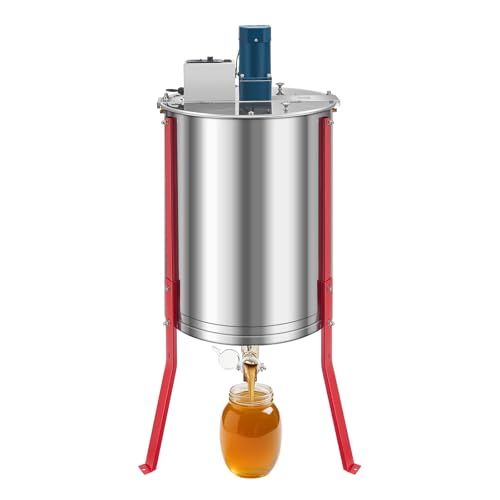
VEVOR 6-Frame Electric Honey Extractor
VEVOR · 6 frames per load (listed) · stainless steel drum (listed) · electric drive
Our verdict: The 6-frame VEVOR is for the apiary that outgrew the 2/4 machines but cannot justify the VIVO: six frames per load clears a medium super in under two spins, the stainless drum and electric drive match the machines above and below it, and at $339.90 it splits the price gap almost exactly. A genuinely sensible middle, not a compromise.
Six frames is more capacity than it sounds. A 10-frame medium super loads into the VEVOR 6-frame electric extractor in two cycles with room to spare, and an 8-frame super very nearly clears in one and a half. For an apiary of six to ten hives, that pace keeps extraction inside a single day without paying VIVO money, and the workflow feels identical to the bigger machine: load, spin, uncap the next set while the motor works, swap.
The build notes mirror its siblings: listed stainless drum, bottom honey gate, a stand that takes a bucket underneath, and the same rinse-before-first-use advice we give for every extractor at this price tier. If you keep bees with a partner or a neighbor and split equipment costs, this size is the classic shared machine: big enough for both harvests, small enough to store in a garage corner between them. Round out the shared kit with a strainer and settling setup and the whole line moves at the extractor's pace.
Who should buy it
Buy the 6-frame if you run 6 to 10 hives, or if two small apiaries are sharing one machine. It is the right size for beekeepers who found the 2/4 class slow last season but cannot fill an 8-frame drum often enough to justify it.
What we don't like
It occupies a middle that not every apiary passes through: many keepers jump from three hives to twelve and skip this size entirely. The drum is nearly as bulky to store as the 8-frame while holding two fewer frames. And as with all machines in this class, confirm your deep frames seat properly; capacity figures are the maker's listed numbers.
- Frames per load
- 6 frames (listed)
- Drive
- Electric motor (listed)
- Drum material
- Stainless steel (listed)
- Honey gate
- Bottom gate (listed)
- Power
- Standard household outlet
- Price
- $339.90
Pros
- Clears a medium super in about two spins
- Meaningfully cheaper than the 8-frame flagship
- Same stainless-and-motor formula as our top pick
- The classic shared-apiary size
Cons
- Nearly the 8-frame's bulk with less capacity
- A narrow band of apiaries actually needs this exact size
- Needs an outlet like every electric here

VEVOR 3-Frame Electric Honey Extractor
VEVOR · 3 frames per load (listed) · stainless steel drum (listed) · electric drive
Our verdict: At $159.28 this is the least expensive electric extractor in the guide, and for one to three hives it is all the machine you need. Three frames per load is modest, but the motor still buys you the parallel workflow (uncap while it spins) that no manual machine can, and the stainless drum keeps the food-grade line intact at the bottom of the price range.
The budget electric argument is about your hands, not your speed. With any manual extractor, you are the motor: one hand cranks while the other steadies the drum, and the uncapping knife waits. The VEVOR 3-frame electric extractor breaks that bottleneck for about $50 more than our favorite manual. While a load spins, you uncap the next three frames, and a two-super harvest that eats an evening on a hand crank fits neatly into a couple of hours. For a small apiary that still wants its Saturday back, that is the entire pitch.
Materials hold the line: listed stainless drum, bottom gate, clear lid. Expect the same first-use ritual as every extractor in this tier, a thorough wash and rinse, and expect to level it and brace the legs, because small drums with spinning loads like to walk across smooth floors. It pairs naturally with a budget harvest line: an inexpensive heated knife and a bucket-strainer setup keeps the whole station under $250 without touching food safety.
Who should buy it
Buy this if you run 1 to 3 hives, want electric convenience at the lowest price, and honestly do not expect the apiary to triple. It is also a smart club loaner or a second machine for out-yard trips where the big extractor stays home.
What we don't like
Small drums are wobble-prone: an unbalanced three-frame load makes itself known, so load symmetrically and brace the stand. Capacity is the real constraint, four loads per medium super adds up fast past three hives. And the price advantage over our top pick is modest for the capacity you give up.
- Frames per load
- 3 frames (listed)
- Drive
- Electric motor (listed)
- Drum material
- Stainless steel (listed)
- Honey gate
- Bottom gate (listed)
- Power
- Standard household outlet
- Price
- $159.28
Pros
- Cheapest electric drive in the guide
- Frees your hands to uncap in parallel
- Stainless drum at a budget price
- Sized (and priced) honestly for 1-3 hives
Cons
- Four loads per medium super gets old past 3 hives
- Small drums wobble when loaded unevenly
- Only ~$50 below our higher-capacity top pick

Honey Lake 3-Frame Electric Honey Extractor
Honey Lake · 3 frames per load (listed) · stainless steel drum (listed) · electric drive
Our verdict: Honey Lake built its name on beginner hive kits, and its 3-frame electric extractor is the natural next purchase for the keepers who started there: same brand, same beginner-first instincts, a listed stainless drum, and a motor that handles the spinning. At $209.99 it costs more than the equivalent VEVOR, so it is the alternative pick, not the default.
Brand continuity is worth something, but count the dollars. If your apiary started with a Honey Lake starter kit, the Honey Lake 3-frame electric extractor completes the set: familiar hardware sensibility, a listed stainless drum, bottom honey gate, and an electric motor doing the work your shoulder would otherwise do. Functionally it competes head-on with the VEVOR 3-frame above, three frames per load, same workflow, same household outlet.
What it does well, it does cleanly: the drum is listed food-grade stainless, the size stores in a closet corner, and three-frame loads suit the one-to-three-hive apiaries Honey Lake kits build. Beginners extracting for the first time will appreciate that the whole machine is unintimidating, load, lid, switch, and the honey gate empties into a standard 5-gallon bucket. Just come in knowing the value math, and if the price gap to the VEVORs closes on the live listing, this pick gets easier to make.
Who should buy it
Buy the Honey Lake 3-frame if you want to stay inside the brand your hives came from, or if the VEVOR listings are out of stock when harvest is close (extractors sell out in August, every year). Right-sized for 1 to 3 hives.
What we don't like
The price is the pick's problem: at $209.99 it matches our top pick's money with less capacity. Three-frame loads carry the same four-spins-per-super arithmetic as any small drum. And brand loyalty aside, nothing on the listed spec sheet beats the cheaper VEVOR 3-frame.
- Frames per load
- 3 frames (listed)
- Drive
- Electric motor (listed)
- Drum material
- Stainless steel (listed)
- Honey gate
- Bottom gate (listed)
- Power
- Standard household outlet
- Price
- $209.99
Pros
- Beginner-friendly load-lid-switch operation
- Listed stainless drum and bottom gate
- Natural companion to Honey Lake hive kits
- Compact enough for closet storage
Cons
- Costs top-pick money for 3-frame capacity
- The VEVOR 3-frame does the same job for less
- Small-drum wobble applies here too

VEVOR 2/4 Frame Manual Honey Extractor
VEVOR · 2 deep / 4 shallow frames per load (listed) · stainless steel drum (listed) · hand crank
Our verdict: If you are extracting by hand, this is the machine to do it with: the same honest 2/4 capacity as our electric top pick, a listed stainless drum, and a geared hand crank, for $110.42. It is the manual extractor we recommend to two-to-four-hive apiaries that want capacity without a cord, and the one we name in our own honey-yield explainer.
Manual extraction is fine; slow capacity is not. The mistake budget buyers make is pairing a hand crank with a 2-frame drum, which doubles the number of loads and the cranking. The VEVOR 2/4 frame manual extractor fixes the arithmetic: four shallow or medium frames per load means a 10-frame medium super clears in three spins, and the geared crank keeps the effort in forearm territory rather than shoulder-destroying territory. For a fit adult with two to four hives, a full harvest on this machine is a pleasant afternoon, not a punishment.
Everything else is the formula done right: listed stainless drum, bottom honey gate with bucket clearance, clear top so you can see when the sheeting stops. No cord also means no location constraints, extract in the garage, the yard, or at the out-apiary. If there is a knock, it is the obvious one: you are the motor, and you cannot uncap while you crank, so a helper roughly doubles your pace. Two people, this machine, and a decent uncapping knife will clear four hives before dinner.
Who should buy it
Buy this if you run 2 to 4 hives, want real capacity without paying for a motor, or extract somewhere without power. It is the best manual machine in the guide and the honest alternative to our electric top pick for exactly $99 less.
What we don't like
You cannot crank and uncap at the same time, so solo harvests move at half an electric machine's pace. Tangential flipping applies, twice per load. And by hive six or seven, everyone who owns this machine starts pricing motors; buy it knowing where the ceiling is.
- Frames per load
- 2 deep or 4 medium/shallow (listed)
- Drive
- Geared hand crank
- Drum material
- Stainless steel (listed)
- Honey gate
- Bottom gate (listed)
- Power
- None needed
- Price
- $110.42
Pros
- Real 4-shallow capacity in a manual machine
- No cord: extract anywhere, including out-yards
- Geared crank keeps effort reasonable
- Stainless drum at a bargain price
- $99 cheaper than the electric equivalent
Cons
- You are the motor: no parallel uncapping solo
- Gets tiring past four hives
- Tangential flip routine on every load

TRINFREE 6-Frame Manual Honey Extractor
TRINFREE · 6 frames per load (listed) · stainless steel drum (listed) · hand crank
Our verdict: The TRINFREE takes the manual formula and stretches the drum: six frames per load, listed stainless construction, and a hand crank, for $119.99. It is the right machine for the keeper with four to six hives, no power at the extraction site, and a strong preference for fewer, heavier loads over many light ones.
Fewer loads matters more than lighter cranking. The slow part of manual extraction is not the spinning, it is the stopping: unloading wet frames, loading the next set, getting the drum balanced again. The TRINFREE 6-frame manual extractor attacks exactly that, clearing a 10-frame medium super in under two loads where a 2-frame machine takes five. Yes, six full frames spin heavier than two, and the first cranks of each load let you know it; but total harvest time drops hard, and that is the number that decides whether extraction day is fun.
At $119.99, only $10 over the VEVOR manual, the capacity math favors the TRINFREE on paper. What keeps it from taking the manual crown is polish: the VEVOR's crank gearing and overall fit are a step ahead, and the smaller drum forgives sloppy loading in a way this one does not. Buy the TRINFREE when the load count is the thing you care about; buy the VEVOR when overall ease wins. Either way, hold the machine to the same standard as your bottling line, and check your honey is actually ready with a refractometer before it goes in jars.
Who should buy it
Buy the TRINFREE if you extract off-grid with 4 to 6 hives and want the fewest possible loads per harvest. It suits patient, methodical keepers who will sort and balance frames, and clubs that want cheap shared capacity without a motor.
What we don't like
Six heavy frames on a hand crank is a real workout at the start of each spin. The wide drum punishes unbalanced loading with wobble. And fit-and-finish trails the VEVOR manual slightly; inspect welds and the gate seal on arrival, and wash thoroughly before first use.
- Frames per load
- 6 frames (listed)
- Drive
- Hand crank
- Drum material
- Stainless steel (listed)
- Honey gate
- Bottom gate (listed)
- Power
- None needed
- Price
- $119.99
Pros
- Most frames per load of any manual pick
- Clears a medium super in under two loads
- Only $10 over the 2/4 manual benchmark
- No power needed anywhere
Cons
- Heavy loads make for heavy cranking
- Wide drum demands careful balancing
- Finish quality a notch below the VEVOR manual
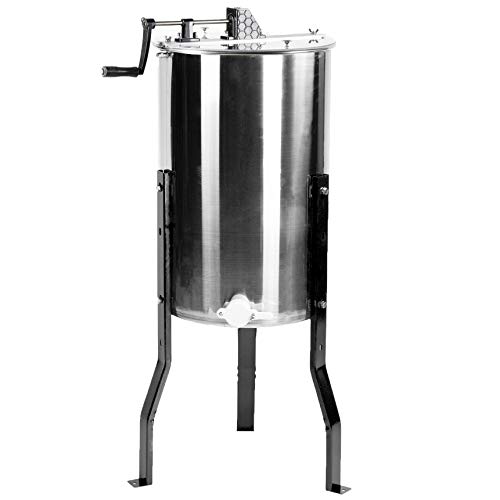
VIVO 2-Frame Manual Honey Extractor
VIVO · 2 frames per load (listed) · food-grade stainless steel (listed) · hand crank
Our verdict: The VIVO 2-frame is the small manual for people who care how equipment feels: the same brand behind our big-ticket 8-frame pick, a listed food-grade stainless drum, and the cleanest fit and finish in the manual tier. Two frames per load caps it at one-to-two-hive apiaries, and $129.99 prices it above bigger-capacity rivals, so this is the quality pick, not the value pick.
Some buyers shop capacity; some shop for the tool they will enjoy owning. The VIVO 2-frame manual extractor is for the second group. VIVO is the most established name in this guide, its 8-frame electric is our sideliner pick, and the small manual carries the same food-grade stainless construction and tighter assembly tolerances that make a machine pleasant across a decade of harvests. The crank turns smoothly, the gate seals properly, and nothing about it feels like it is one season from the recycling bin.
The right way to see this machine: it is the heirloom-adjacent version of the starter extractor, for the keeper who has decided one or two colonies is the plan (a common and sensible plan, as our honey-per-hive explainer lays out, two strong colonies can produce 60 to 120 pounds in a good year). If that is you, buy the well-made small machine and never think about extractors again. If growth is even a maybe, buy capacity instead.
Who should buy it
Buy the VIVO 2-frame if you are settled at one or two hives, value build quality over throughput, and want the small extractor most likely to still be spinning in ten years. A lovely machine for the deliberately small apiary.
What we don't like
It is the most expensive manual in the guide while holding the fewest frames: capacity-per-dollar shoppers should look at the VEVOR or TRINFREE. Five loads per super is the permanent arithmetic. And like all tangential 2-frame machines, the flip-per-load routine never goes away.
- Frames per load
- 2 frames (listed)
- Drive
- Hand crank
- Drum material
- Food-grade stainless steel (listed)
- Honey gate
- Bottom gate (listed)
- Power
- None needed
- Price
- $129.99
Pros
- Best fit and finish of the manual tier
- Listed food-grade stainless throughout
- From the same stable as our 8-frame pick
- Right-sized for a deliberate 1-2 hive apiary
Cons
- Most money for the least capacity here
- Five loads per medium super
- Wrong machine if you might grow

VINGLI 2-Frame Manual Honey Extractor
VINGLI · 2 frames per load (listed) · food-grade stainless steel (listed) · hand crank
Our verdict: The VINGLI is the least expensive machine in this guide that still clears our food-grade bar: a listed stainless 2-frame drum, hand crank, honey gate, $107.99. It exists to answer one question, can a first-harvest beekeeper skip crush-and-strain without spending $200, and the answer is yes, with the usual budget caveats attached.
The alternative to a cheap extractor is not an expensive extractor; it is crushing your comb. First-year and second-year keepers with one hive often default to crush-and-strain, which works but destroys the drawn comb your bees spent weeks building, and rebuilding comb costs a colony real honey production the next season. The VINGLI 2-frame manual extractor is the cheapest way to break that cycle: spin the honey out, return the wet frames to the hive, and your bees start the next season with their comb bank intact.
Capacity math is the small-manual standard: two frames per load, five loads per medium super, a flip in each. For a single hive producing two or three supers, that is a satisfying afternoon; the drum stores in a closet and the price leaves room in the budget for the uncapping knife and strainer you also need. If your apiary stays small, this machine may be the only extractor you ever buy. If it grows, the VINGLI becomes the loaner, and nobody regrets owning a loaner extractor.
Who should buy it
Buy the VINGLI if you have 1 or 2 hives, a first or second harvest coming, and a firm budget: it is the cheapest legitimate extraction in the guide. Also a fine gift for a new beekeeper who is still crushing comb.
What we don't like
Budget-tier assembly: expect to tighten hardware and true the stand yourself. Two-frame capacity is the permanent limit, and the wobble under an unbalanced load is livelier than the pricier drums. It clears our bar; it does not clear it with style.
- Frames per load
- 2 frames (listed)
- Drive
- Hand crank
- Drum material
- Food-grade stainless steel (listed)
- Honey gate
- Bottom gate (listed)
- Power
- None needed
- Price
- $107.99
Pros
- Cheapest real extractor that passes the food-grade gate
- Saves drawn comb that crush-and-strain destroys
- Compact storage between harvests
- Leaves budget for the rest of the harvest line
Cons
- Assembly and finish need owner attention
- Two frames per load, forever
- Livelier wobble than the better-built smalls
More gear worth comparing
Beyond this guide: the highest-rated gear across every category and budget, with a live price check on each.




As an Amazon Associate we may earn from qualifying purchases, at no cost to you.
Quick shop: every pick
Skip the scroll: the whole lineup, with a live price check on each.
- VEVOR 2/4 Frame Electric Honey ExtractorBest OverallVEVOR · $209.90Check Price
- VIVO Electric 8-Frame Honey Extractor (BEE-V004E)Best for SidelinersVIVO · $449.99Check Price
- VEVOR 6-Frame Electric Honey ExtractorBest Mid-Size ElectricVEVOR · $339.90Check Price
- VEVOR 3-Frame Electric Honey ExtractorBest Budget ElectricVEVOR · $159.28Check Price
- Honey Lake 3-Frame Electric Honey ExtractorBest Compact Electric AlternativeHoney Lake · $209.99Check Price
- VEVOR 2/4 Frame Manual Honey ExtractorBest Manual OverallVEVOR · $110.42Check Price
- TRINFREE 6-Frame Manual Honey ExtractorMost Manual Capacity per DollarTRINFREE · $119.99Check Price
- VIVO 2-Frame Manual Honey ExtractorBest-Built Small ManualVIVO · $129.99Check Price
- VINGLI 2-Frame Manual Honey ExtractorBest BudgetVINGLI · $107.99Check Price
How we chose
We rank extractors by the question that actually decides harvest day: how many supers can one person process in an afternoon without wrecking comb or their rotator cuff. Frames per load, drive type, and drum height off the floor (bucket clearance under the honey gate) count for more than any accessory.
Food safety is a pass/fail gate. Honey is acidic and hygroscopic; it sits against the drum for hours. Every pick lists a stainless steel drum, and we flag any part of the machine (gates, baskets, lids) where the listing is vague about materials.
Capacity claims are quoted the honest way: a 2/4 frame machine is a 2-frame machine for deeps. Where a maker lists deep and shallow capacities we print both, hedged as listed. We never grant a marketing number the machine cannot hold in deep frames.
Comb survival matters as much as speed. Tangential baskets spun too hard on the first face blow out comb; we credit machines with speed control (electric) or smooth crank gearing (manual) that make gentle first spins easy.
Cleanup is scored like a chore, because it is one: fewer crevices, removable baskets, a working honey gate at the bottom of a cone-shaped floor. An extractor that is miserable to clean gets used less, and an unused extractor is the most expensive kind.
No brand has bought a placement. Prices come from the verified offer table on the publication date and are re-checked on update; a listing that goes dark or doubles in price loses its slot.
Key terms
- Tangential extractor
- A basket design where frames sit flat against the drum wall, comb face outward. The spin empties one face at a time, so each load gets flipped partway through. Nearly all small (2-6 frame) extractors are tangential.
- Radial extractor
- A design where frames stand like wheel spokes with the top bar outward, so both comb faces empty in one spin with no flipping. Gentler on comb, but it needs a wider drum, so it appears mostly in larger machines.
- Frames per load
- How many frames the basket holds per spin cycle, the single spec that sets harvest speed. Read it honestly: a "2/4 frame" machine holds 2 deep frames or 4 medium/shallow frames, not 4 of everything.
- Honey gate
- The shut-off valve at the bottom of the drum that drains extracted honey into a bucket or strainer. Check clearance: the gate must sit high enough to fit a 5-gallon bucket underneath.
- Food-grade stainless
- Stainless steel suitable for food contact, the standard for any surface honey touches. Honey is mildly acidic, so reactive or galvanized metals are out; every pick in this guide lists a stainless drum.
- Drawn comb
- Comb the bees have already built out on a frame. Extraction preserves it so it returns to the hive; crush-and-strain destroys it. Colonies reusing drawn comb skip weeks of wax-building and store more honey.
- Crush-and-strain
- Harvesting by scraping comb off frames, crushing it, and straining the honey out. Zero equipment cost, but it sacrifices the drawn comb, which is the main reason to graduate to an extractor.
Questions, answered
What size honey extractor do I need for 2 hives?
A 2-frame manual extractor covers 2 hives comfortably: you will pull roughly two to four supers a season, and a machine like the VINGLI ($107.99) or the better-built VIVO 2-frame ($129.99) clears that in an afternoon. If there is any chance you grow to 4 or more hives, buy the VEVOR 2/4 class instead, manual at $110.42 or electric at $209.90, because extractors are a buy-once purchase and capacity is cheap to add now.
Is an electric honey extractor worth it?
From about 3 hives up, yes. The motor costs roughly $100 over the equivalent manual machine and lets one person uncap while the drum spins, which about doubles solo throughput. At 1 to 2 hives the crank time per season is small enough that the money is better spent elsewhere. The most common extractor regret we hear is buying manual at 4-plus hives and upgrading a year later.
What is the difference between a tangential and radial extractor?
Tangential baskets hold frames flat against the drum wall and empty one comb face at a time, so you flip each load partway through. Radial designs hold frames like wheel spokes and empty both faces in one spin, gentler and flip-free, but requiring a wider drum. Small backyard extractors, including most in this guide, are tangential, and that is fine at backyard scale if you spin the first face gently before flipping.
Can you extract honey without an extractor?
Yes, crush-and-strain: scrape the comb off the frames, crush it, and strain the honey through a mesh filter. It costs almost nothing and works fine for a first small harvest. The catch is that it destroys the drawn comb, which the colony then spends weeks and a lot of honey rebuilding. An extractor pays for itself by returning empty drawn comb to the hive; that is the real economics of the $108 entry machines.
How many frames of honey can one hive produce?
A strong established colony in most US regions produces about 30 to 60 pounds of surplus honey in a normal year, roughly one to two full medium supers, or 8 to 20 well-filled frames. First-year colonies usually produce little or no surplus because they are building comb and stores. We break the whole calculation down, region by region, in our honey-per-hive explainer.
Do I need a stainless steel honey extractor?
Yes. Honey is mildly acidic and sits against the drum for hours, so the contact surfaces should be food-grade stainless steel, which every pick in this guide lists. Avoid antique galvanized machines for actual food production, and rinse any new extractor thoroughly before first use to remove manufacturing residues.
How do you clean a honey extractor?
Drain it completely, rinse with cold water first (hot water melts wax into a film that smears everywhere), then wash with warm water and mild soap, rinse until no soap scent remains, and dry fully before storage. Keep high-pressure water away from bearings and the crank or motor assembly. Done after each harvest, this 20-minute routine keeps a stainless extractor food-safe for decades.
When should I extract honey from my hives?
Extract when the frames are ripe: mostly capped with wax, and below roughly 18.6% moisture on a refractometer, the threshold below which honey resists fermentation. Most US beekeepers harvest in mid-to-late summer after the main nectar flow, always leaving the colony enough stores for winter. Our harvesting equipment guide covers the moisture check, and our honey-per-hive explainer covers how much to leave.
What else do I need besides the extractor?
An uncapping knife or fork to open the cells, a strainer, a food-grade bucket with a honey gate for bottling, and a refractometer to verify moisture. Budget $75 to $150 for a solid version of that whole line; the extractor is the expensive station but not the only one. Our best honey harvesting equipment guide ranks every piece in workflow order.
Filed under Buyer's Guide
Part of Honey Harvest
Keep reading
The Best Honey Harvesting Equipment (2026)
The rest of the extraction line: uncapping knives, strainers, settling tanks, buckets, and the refractometer that proves your honey is ready.
How Much Honey Does One Hive Produce?
The yield math behind your extractor sizing: realistic pounds per hive by region, year, and colony strength.
The Best Beehive Frames and Foundation
The frames you will be spinning: deep vs medium, foundation types, and when old comb should retire instead of going back on the hive.
The Best Beehive Starter Kits
Where the honey comes from in the first place: the complete hive kits we would actually put a colony in.
First-Year Beekeeping Calendar
When harvest actually lands in your first seasons, and everything that has to happen before it.
Beekeeping Cost Index
What the whole hobby really costs, and where the extractor fits in the budget.