Our Pick: VEVOR
Check PriceVEVOR Electric Honey Extractor Review (2026)
Verdict up front: the VEVOR 2/4 Frame Electric Honey Extractor is the best value in small electric extraction, and at $209.90 it is the machine we would point most one-to-five-hive beekeepers toward. It holds two deep frames or four shallower frames per load, listed, spins them with a variable-speed motor instead of your shoulder, and its stainless drum with a honey gate does everything a backyard harvest needs. It is not fast, it is not big, and its capacity label deserves a careful read, but at barely $100 over a manual machine it removes the single worst chore in hobby beekeeping.
By The BeehiveKits Hive Desk2026-08-2814 min read Fact-checked against verified Amazon listingsHow we research
 Best Overall
VEVOR 2/4 Frame Electric Honey Extractor with Adjustable Speed
VEVOR · 4.6
$209.90
Here is the chore it removes. Extraction is a two-station job: uncapping frames at one station, spinning them at the other. With a hand-crank machine one person cannot run both, the crank owns your hands, your harvest stretches into an evening, and your arm files a complaint by frame six. A motor breaks that logjam: load the drum, set the speed, and uncap the next round while the machine works. That workflow change, not raw spin power, is what the extra $100 actually buys, and it is why so many second-season beekeepers upgrade.
We reviewed this machine the way we review hives: through ownership, not unboxing. That means the honest capacity math behind the 2/4 label, how the motor and speed dial behave with heavy deep frames, what stainless cleanup is really like in a kitchen, and the colony-count line beyond which this drum becomes the bottleneck and the bigger VIVO 8-frame takes over. No brand paid for placement and none saw this review first; links go to Amazon and may earn us a commission at no cost to you, with all prices verified in late August 2026.
What to know
- The VEVOR 2/4 frame electric ($209.90) is our value pick for powered extraction: stainless drum, variable-speed motor, honey gate, and a listed 2-deep or 4-shallow capacity.
- Read the 2/4 label honestly: with deep frames this is a TWO frame machine per load. The 4-frame number applies to medium and shallow frames.
- The motor is the real product: one person can uncap and spin simultaneously, roughly halving harvest time versus a hand crank at the same drum size.
- Spin gently first: start slow, reverse or reload to balance, and step the speed up as frames lighten, or heavy deeps will walk the machine and blow out comb.
- Cleanup is warm water and patience: food-grade stainless, listed, rinses clean; never pressure-wash bearings or the motor housing.
- Outgrow point: past roughly five to eight production hives, load-by-load extraction eats your weekend, and the VIVO 8-frame electric ($449.99) is the next machine.
At a glance
| Extractor | Drive | Capacity (listed) | Best for | Price | Check price |
|---|---|---|---|---|---|
| VEVOR 2/4 Frame Electric | Electric, variable speed | 2 deep / 4 shallow | 1-5 hives, solo harvests | $209.90 | Check Price |
| VEVOR 2/4 Frame Manual | Hand crank | 2 deep / 4 shallow | 1-3 hives, tight budgets | $110.42 | Check Price |
| VIVO 8 Frame Electric | Electric | 8 frames | 5+ hives, sideliners | $449.99 | Check Price |
| VIVO 2 Frame Manual | Hand crank | 2 frames | 1-2 hives, first harvests | $129.99 | Check Price |
The reviewed VEVOR electric against its manual sibling and the VIVO alternatives. Capacities as listed by manufacturers; prices verified August 2026.
VEVOR 2/4 Frame Electric Honey Extractor with Adjustable Speed
VEVOR · Electric, variable speed · stainless drum and honey gate, listed · 2 deep / 4 shallow frames per load
Our verdict: The VEVOR 2/4 Frame Electric is the value sweet spot of small extraction: a food-grade stainless drum, a variable-speed motor, and a working honey gate for $209.90. Its per-load capacity is honestly small, two deeps or four shallower frames, and its light drum needs balanced loads and patient speed control. Within those limits it turns harvest day from a two-person grind into a one-person process, and that is the whole assignment.
The motor changes who can harvest alone. The VEVOR 2/4 Frame Electric Honey Extractor runs a top-mounted motor with an adjustable speed dial, listed, and that dial is the feature you will actually use: load two heavy deeps, start at a crawl so the machine does not walk, and step the speed up as the outer faces empty and the frames lighten. An extractor works by centrifugal force against fragile wax, so this gradual ramp is not caution theater; slam a full deep to top speed and the comb can blow out of the frame, costing your bees weeks of rebuilding. Run gently, the machine empties a load in a handful of minutes while you uncap the next pair, and a ten-frame medium super becomes an afternoon hour instead of an evening.
First harvest with it teaches you three habits. Bolt or strap the stand down, or park the drum between your feet, because a light stainless barrel with two pounds-heavy deeps aboard will dance until the load balances; pairing frames of similar weight across the drum matters more than any spec. Uncap over a proper surface into a tub, our harvesting equipment guide covers the knife-and-tub chain, and only open the honey gate over a bucket with a strainer, because the gate pours everything, wax flecks included. And harvest only capped frames: honey is ripe below roughly 18.6 percent moisture, the threshold fermentation enforces and a cheap refractometer verifies, and no extractor fixes wet honey.
Cleanup is the quiet win of stainless. The drum, baskets, and gate are listed food-grade stainless, and the routine is unglamorous but fast: let the bees rob nothing, rinse with warm water promptly before honey sets up, avoid soaking the bearing points and motor housing, and towel it dry before storage. Twenty minutes, no solvents, no rust if you dry it. The plastic-drum machines this price used to buy could not say any of that.
Long-term, the question is not durability, it is scale. Light hobby duty is exactly what this machine is built for, and at two to four supers a year it will simply keep working; the motor is the component to baby, so store it dry and indoors. The real horizon is colony count. At one to five hives the load-flip-load rhythm is pleasant; somewhere past five production colonies it becomes the bottleneck of your whole harvest day, and the answer is not a second small drum, it is the radial-scale jump to the VIVO 8 Frame Electric reviewed below. Buy the VEVOR knowing that line exists, and it will not owe you a cent when you cross it, small extractors resell briskly every August for good reason.
Who should buy it
Buy the VEVOR electric if you run one to five hives and harvest alone or want to: it is the cheapest machine that lets a single person uncap and spin in parallel. It is also the right first extractor for anyone who knows hand-cranking is not for them, at only about $100 over the manual equivalent.
What we don't like
Two deep frames per load is genuinely small, and the spin-flip-spin tangential routine doubles handling. The light drum walks under unbalanced heavy loads, the speed dial and motor are value-grade components you should treat gently, and documentation is thin. Past a handful of hives, the capacity becomes the harvest's bottleneck.
- Drive
- Electric motor, adjustable speed (listed)
- Capacity
- 2 deep or 4 medium/shallow frames (listed)
- Spin type
- Tangential: spin, flip, spin again
- Drum
- Food-grade stainless steel (listed)
- Honey gate
- Included, bottom-mounted (listed)
- Stand
- Adjustable-height legs (listed)
- Price
- $209.90
Pros
- Variable-speed motor lets one person run the whole harvest
- Stainless drum, baskets, and gate at a value price
- Gentle ramp-up protects fragile comb for reuse
- Meaningful upgrade over manual for about $100
- Small enough to store on a shelf between Augusts
Cons
- Only two deep frames per load despite the 2/4 name
- Tangential design means flipping every load
- Light drum needs balancing and anchoring
- Value-grade motor and controls, treat with care

VEVOR 2/4 Frame Manual Honey Extractor, Stainless Steel
VEVOR · Hand crank · stainless drum, listed · 2 deep / 4 shallow frames per load
Our verdict: The VEVOR 2/4 Frame Manual is the hero machine minus the motor: same listed capacity, same stainless construction, $110.42. For one to three hives with a helper on the crank, it does the identical job for $100 less. Solo harvesters should read our workflow argument above and think hard before saving that $100.
The honest budget pick, with one hidden requirement: a second pair of hands. The VEVOR 2/4 Frame Manual Honey Extractor shares the electric's essential hardware, stainless drum, tangential baskets for two deeps or four shallower frames, bottom honey gate, all listed, and replaces the motor with a geared hand crank. Cranking is easy for a load or two and genuinely tiring by a full super, and because the crank owns your hands, someone else must run the uncapping station or the harvest simply takes twice as long.
Balance discipline matters even more here than on the electric, since your arm feels every wobble the motor would power through. Pair frames by weight, crank up gradually, flip, and finish. For the full field of hand-crank options, including the smaller VIVO below, our extractor guide ranks the category end to end.
Who should buy it
Buy the manual VEVOR if you have a harvest partner, three hives or fewer, and better uses for $100. It is the same drum doing the same job at crank speed, and thousands of small apiaries never need more.
What we don't like
Solo extraction with it is slow and tiring, the same two-deep and flip-every-load limits apply, and by the time you are wishing for a motor, you will have paid most of the electric's price in shoulder work. Buyers on the fence usually regret saving the $100.
- Drive
- Geared hand crank (listed)
- Capacity
- 2 deep or 4 medium/shallow frames (listed)
- Spin type
- Tangential: spin, flip, spin again
- Drum
- Stainless steel (listed)
- Honey gate
- Included (listed)
- Price
- $110.42
Pros
- Same stainless drum and capacity as the electric for $100 less
- Nothing electrical to fail or store carefully
- Ideal for two-person harvests and small yards
Cons
- The crank owns one person's hands for the whole harvest
- Tiring past a few loads of deep frames
- Same small per-load capacity as the hero machine

VIVO Electric Honey Extractor, 8 Frame Rack (BEE-V004E)
VIVO · Electric · 8-frame rack, listed · stainless drum, the category's big-ticket tier
Our verdict: The VIVO 8 Frame Electric is what outgrowing the VEVOR looks like: four times the deep-frame capacity per spin at $449.99. For five-plus production hives it collapses harvest day to a fraction of the small-drum grind. Under about five hives it is more machine than your honey crop justifies, which is exactly why the VEVOR exists.
Capacity is the only spec that ends bottlenecks. The VIVO Electric Honey Extractor 8 Frame swallows eight frames per load, listed, where the VEVOR takes two deeps, and at scale that ratio is the whole story: a six-hive harvest that eats a weekend on a small tangential drum becomes a long morning here. The bigger drum also runs steadier, mass and a wider stance damp the balance dance that light two-frame machines perform, and established colonies producing the typical 30 to 60 lbs of surplus each keep an 8-frame machine honestly busy.
The costs are the obvious ones: $449.99, real floor space in whatever room becomes your honey house, and a machine that is comically oversized for a two-hive crop. We rank it as the big-ticket tier of the whole category in our extractor guide, and its harvest-room supporting cast, tanks, buckets, and strainers, lives in our harvesting equipment guide.
Who should buy it
Buy the VIVO 8-frame when your colony count clears five and climbing, or from day one if your growth plan is confident and funded. It is the machine that makes sideliner-scale harvests routine instead of heroic.
What we don't like
It is $449.99 and physically large, overkill below five hives, and it makes storage and cleanup proportionally bigger jobs. Buying it prematurely parks a lot of capital in a machine that spins two weekends a year.
- Drive
- Electric motor (listed)
- Capacity
- 8-frame rack (listed)
- Drum
- Stainless steel (listed)
- Honey gate
- Included (listed)
- Tier
- Big-ticket / sideliner
- Price
- $449.99
Pros
- Eight frames per spin ends the small-drum bottleneck
- Heavier, steadier drum under full deep loads
- The standard upgrade path from every 2/4 machine
Cons
- Serious price and footprint
- Unjustifiable under about five hives
- Bigger everything: storage, cleaning, lifting
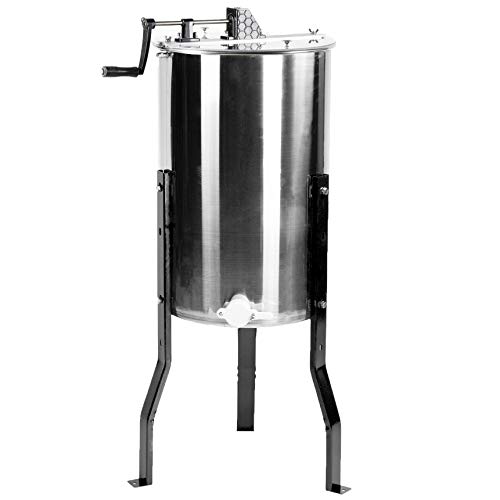
VIVO 2 Frame Manual Honey Extractor, Stainless Steel
VIVO · Hand crank · 2-frame tangential, listed · food-grade stainless drum
Our verdict: The VIVO 2 Frame Manual is the traditional first extractor at $129.99: a food-grade stainless two-frame crank machine, listed, that handles a hive or two's harvest without complaint. Against the VEVOR manual's 2/4 capacity at $110.42 it is hard to recommend on specs, and it stays on this page as the known-brand entry option many beginners still choose.
Simple, stainless, and honest about being small. The VIVO Honey Extractor 2 Frame is the shape of extractor most beekeepers pictured before they priced one: a polished drum, two tangential baskets, a crank, and a gate, all listed food-grade stainless. It empties a first-year harvest fine, spin, flip, spin, repeat, and VIVO's brand presence in beekeeping gear gives some buyers a comfort that the value brands do not.
If you are weighing this against not owning an extractor at all, remember crush-and-strain exists for year one, at the cost of destroying comb your bees spent weeks building, and borrowed club extractors remain the true budget play; our harvest guide walks all three routes honestly.
Who should buy it
Buy the VIVO 2-frame if you find it discounted below the VEVOR manual or you value the VIVO name on harvest gear you already own. One- and two-hive yards will never feel its limits.
What we don't like
It is out-specced by the cheaper VEVOR manual for most buyers, and it shares every small-tangential tradeoff: crank labor, flipping, and two-frame loads that make even a modest harvest a long afternoon.
- Drive
- Hand crank (listed)
- Capacity
- 2 frames, tangential (listed)
- Drum
- Food-grade stainless steel (listed)
- Honey gate
- Included (listed)
- Price
- $129.99
Pros
- Food-grade stainless throughout, listed
- Known brand across beekeeping equipment
- Perfectly adequate for one or two hives
Cons
- Less capacity than the cheaper VEVOR manual
- All the labor of small tangential extraction
- Weak value unless found on discount
More gear worth comparing
Beyond this guide: the highest-rated gear across every category and budget, with a live price check on each.




As an Amazon Associate we may earn from qualifying purchases, at no cost to you.
Quick shop: every pick
Skip the scroll: the whole lineup, with a live price check on each.
- VEVOR 2/4 Frame Electric Honey Extractor with Adjustable SpeedThe Reviewed ExtractorVEVOR · $209.90Check Price
- VEVOR 2/4 Frame Manual Honey Extractor, Stainless SteelAlternative: The Manual SiblingVEVOR · $110.42Check Price
- VIVO Electric Honey Extractor, 8 Frame Rack (BEE-V004E)Alternative: The UpgradeVIVO · $449.99Check Price
- VIVO 2 Frame Manual Honey Extractor, Stainless SteelAlternative: The Entry CrankVIVO · $129.99Check Price
How we chose
We judge extractors on harvest-day reality: honest per-load capacity, how the drive handles full deep frames, balance behavior, and how long a ten-frame super actually takes to empty.
Food contact is a gate, not a preference: drums and gates must be food-grade stainless or food-safe plastic, listed, and cleanable without disassembling bearings into the sink.
We price the workflow, not the sticker: a cheap machine that needs a second person is more expensive than a motor.
Specs we could not verify are written as listed, and every price was checked against the live Amazon listing on the byline date.
No placements were sold, and alternatives get full cards because the right answer at some hive counts is not the hero machine.
Key terms
- Tangential extractor
- A drum whose baskets hold comb faces parallel to the wall, emptying one side at a time: spin, flip the frames, spin again. All four machines in this review are tangential.
- Radial extractor
- A design holding frames like wheel spokes so both faces empty in one spin. Common at larger capacities; the reason big machines are faster per frame, not just per load.
- Uncapping
- Slicing or scratching the wax caps off ripe honey cells before spinning. The second workstation of every harvest, and the reason a motorized spin saves so much time.
- Honey gate
- The shutoff valve at the drum's base that drains finished honey into a strainer and bucket. Open it only over something, a lesson every beekeeper learns exactly once.
- Ripe honey
- Honey bees have dried below roughly 18.6 percent moisture and capped with wax. Uncapped, wet honey ferments in the jar; a refractometer settles arguments.
- Crush and strain
- Harvesting by crushing whole comb through a strainer: zero equipment, total comb destruction. The honest year-one alternative to owning an extractor.
Questions, answered
Is the VEVOR electric honey extractor any good?
Yes, within its size. For $209.90 you get a food-grade stainless drum, a variable-speed motor, and a working honey gate, which is the cheapest credible powered extraction we know of. Its limits are per-load capacity, two deep frames despite the 2/4 name, and value-grade components that reward gentle use. For one to five hives it is our value pick for the category.
How many frames does the VEVOR 2/4 extractor really hold?
Four medium or shallow frames, or two deep frames, listed. The 2/4 label describes both numbers, but deep-frame beekeepers should read it as a two-frame machine. It is also tangential, so every load is spun, flipped, and spun again to empty both comb faces.
Is an electric extractor worth it over a manual one for a hobbyist?
If you harvest alone, usually yes. A hand crank occupies one person completely, so solo manual extraction alternates cranking and uncapping and takes roughly twice as long. The motor lets you uncap while the machine spins. With a regular harvest partner the manual VEVOR at $110.42 does the same job for about $100 less, and that is the honest decision line.
Will spinning break the comb in my frames?
Only if you rush it. Start every load slow, especially heavy deeps, and increase speed as the frames lighten; blowouts happen when full, warm comb meets high speed instantly. Balanced loads matter too, so pair frames of similar weight across the drum. Spun-out comb returned intact is a major asset: bees refill drawn comb far faster than they build new.
How do you clean a stainless honey extractor?
Promptly and gently: drain the last honey through the gate, rinse the drum and baskets with warm water before residue sets up, avoid soaking the bearings and motor housing, and dry everything before storage. Skip soaps unless something got contaminated, then rinse thoroughly. Twenty minutes covers it, and stainless rewards you by not rusting or holding odors.
When do you outgrow a 2 or 4 frame extractor?
Around five to eight production hives for most people. Established colonies average roughly 30 to 60 lbs of surplus each, and moving that crop two deep frames at a time turns harvest into consecutive weekends. The standard next step is an 8-frame electric like the VIVO at $449.99, and used small extractors resell quickly every season, so the upgrade costs less than it appears.
Can I extract honey without an extractor at all?
Yes, two ways. Crush and strain works with zero machinery: cut the comb out, crush it, and strain overnight, at the cost of the drawn comb itself. Many bee clubs also loan or rent extractors, which is the smartest year-one play. First-year colonies often produce little surplus anyway, so most beginners can safely defer the extractor purchase a season.
Do I need to worry about honey moisture before extracting?
Yes. Extract only frames that are fully or mostly capped, because bees cap honey once they have dried it below roughly 18.6 percent moisture; above that it can ferment in storage. If you must pull partially capped frames, check them with an inexpensive refractometer before mixing them into your bottling bucket.
Filed under Review
Part of Honey Harvest
Keep reading
The Best Honey Extractors (2026)
The full category ranked, manual to motorized, including every machine in this review.
The Best Honey Harvesting Equipment
Uncapping knives, strainers, buckets, and tanks: the supporting cast every extractor needs.
How to Harvest Honey
The full harvest-day walkthrough, from pulling supers to bottling, extractor or not.
How Much Honey Per Hive?
Realistic yields by region and colony age, and what they mean for extractor sizing.
The Best Honey Jars and Labels
Where the harvest ends up: jars, squeeze bottles, and labels that sell the crop.
The Best Comb Honey Supplies
The no-extractor harvest: cutters, boxes, and how to produce sections worth a premium.