Our Pick: VEVOR
Check PriceHow to Harvest Honey: From Capped Frame to Sealed Jar
Harvesting honey is a one-day project with two gates in front of it: the frames must be at least 80 percent capped, and the honey underneath must read below roughly 18.6 percent moisture, the line under which honey resists fermentation. Pass both gates and the rest is satisfying mechanical work: clear the bees, uncap the comb, spin the frames, strain, settle, and bottle. The equipment list is shorter than the catalogs imply, and the centerpiece for a hobby apiary is a small motorized extractor like the VEVOR 2/4-frame electric ($209.90), with a $23 refractometer doing the most important job of the day.
By The BeehiveKits Hive Desk2026-08-2820 min read Fact-checked against verified Amazon listingsHow we research
The two mistakes that ruin harvests both come from hurry. Pulling uncapped frames gets you thin, high-moisture honey that ferments in the jar by Thanksgiving. And taking too much gets you a light hive in November: the colony spent the season banking those stores as its winter fuel, and the harvest math starts with what stays, not what leaves. We put numbers on both mistakes below, because they are the difference between a harvest and a mess.
This is the payoff chapter of the hands-on library. The colonies that fill these supers were started in the nuc install or the package install, the inspections that cleared them for supers are taught in how to do a hive inspection, and the honest yield expectations live in how much honey per hive. Standard disclosure, plainly: no brand paid to appear here, and some links go to Amazon, where a purchase may earn us a small commission at no extra cost to you. Prices were verified at publication and drift; check the live listing.
What to know
- Harvest only frames that are at least 80 percent capped, and verify the rest with a refractometer: below roughly 18.6 percent moisture, honey keeps indefinitely; above it, fermentation is a matter of time.
- Leave the colony its winter fuel first: roughly 40 to 60 pounds of stores in cold-winter regions, less in the South. The harvest is what remains after that arithmetic, and first-year colonies often owe you nothing.
- Clear bees with an escape board installed a day or two ahead, plus a brush for stragglers; it beats shaking and fuming for hobby-scale calm.
- Extract the same day you pull supers, in a bee-proof room: warm frames spin easily, and exposed honey in the open yard starts a robbing frenzy.
- The hobby line is simple: uncapping knife, extractor, sieve, bucket with a honey gate. Let gravity do the clarifying: a settled bucket beats fine filtering and keeps the pollen in.
- Return the wet supers to the hives in the evening for cleanup, then store drawn comb protected: it is the most valuable equipment your apiary produces.

VEVOR 2/4-Frame Electric Honey Extractor
VEVOR · Stainless steel drum · electric motor with adjustable stand (listed) · 2/4-frame capacity
Our verdict: The hobby-scale sweet spot: a stainless drum, a motor that holds the slow-then-fast ramp your comb needs, and two-to-four-frame cycles that clear a few supers in an afternoon without the cranking-arm tax of manual machines.
Hand-crank extractors teach you exactly one thing by frame twelve: motors are worth it. The VEVOR 2/4-frame electric extractor ($209.90) brings the motor down to a backyard price, with a food-grade stainless drum, a bottom gate that drains into a sieve-topped bucket, and speed control that makes the gentle first spin, the one that saves your comb, actually gentle.
For one or two hives, the club loaner remains the honest budget answer; for two to five hives harvesting on your own schedule, this is the class we point to first, with the manual and eight-frame alternatives ranked in the extractor guide.
Who should buy it
Backyard keepers with roughly two to five hives who want same-day extraction on their own schedule without hand-cranking or commercial-scale spending.
What we don't like
Tangential loading means flipping frames between spins, the legs want bolting or ballast to stop walking, and listed specs like capacity vary by configuration, so check the live listing.
- Capacity
- 2/4 frames (listed)
- Drive
- Electric motor (listed)
- Drum
- Stainless steel (listed)
- Stand
- Adjustable (listed)
- Price
- $209.90
Pros
- Motorized spin at near hand-crank money
- Stainless drum with bottom drain gate
- Speed control protects fragile comb
- Clears a hobby harvest in one afternoon
Cons
- Frames need flipping mid-cycle
- Wants ballast or bolting when loaded unevenly

Pierce Original Electric Uncapping Knife
Pierce · Electrically heated blade · the long-running standard of the category (listed)
Our verdict: Uncapping is the harvest bottleneck, and a properly heated blade un-bottlenecks it: the Pierce carves cappings off in clean sheets, leaves comb surfaces flat for years of reuse, and outlasts every budget heated knife in the category. The splurge of the line, and the one keepers keep.
A cold knife tears cappings; a heated one carves them, and the Pierce electric uncapping knife ($209.94) has been the reference heated blade for generations of harvest rooms: steady heat along the full blade, long strokes that peel a frame face in seconds, and comb left clean enough that next year's bees just refill it.
It is real money for a tool used a few days a year, which we say plainly: budget heated knives and the hot-water-dip method both exist and both work, ranked honestly in the harvesting equipment guide. This is the buy-once version.
Who should buy it
Keepers harvesting multiple supers a season who want the bottleneck gone and comb preserved, and anyone tired of replacing budget heated knives that drift cold mid-frame.
What we don't like
The price stings for occasional harvests, there is no thermostat dial on the classic design, and a hot blade demands respect and a safe parking spot between frames.
- Type
- Electric heated uncapping knife
- Heritage
- Original of the category (listed)
- Price
- $209.94
Pros
- Carves cappings in clean, fast sheets
- Preserves comb for years of refills
- Buy-once build quality
Cons
- Premium price for a few days of use a year
- Hot blade requires careful handling
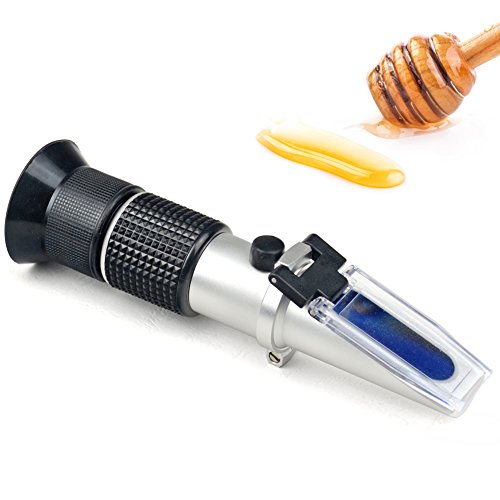
aichose Honey Refractometer
aichose · Honey moisture, Brix, and Baume scales (listed) · optical refractometer with calibration
Our verdict: The most consequential tool on the harvest table costs less than a jar funnel: one drop on the prism reads moisture in seconds, and the 18.6 percent line it checks is the difference between shelf-stable honey and slow-motion mead. No harvest should bottle without one.
Capping percentage is the bees' estimate; the refractometer is the measurement. The aichose honey refractometer ($22.88) reads a drop of honey against a moisture scale in about ten seconds: sample frames before extracting, spot-check the settled bucket before bottling, and bottle knowing the number instead of hoping.
Calibrate it out of the box and note the offset, and it serves for years. Digital alternatives and the rest of the harvest bench are in the harvesting equipment guide.
Who should buy it
Every beekeeper who bottles honey, from the first harvest on. It is the cheapest insurance in the entire hobby.
What we don't like
Optical scales take a minute to learn to read in poor light, and out-of-box calibration is a required step, not a suggestion.
- Scales
- Honey moisture, Brix, Baume (listed)
- Type
- Optical with calibration
- Price
- $22.88
Pros
- Ten-second moisture verification
- Guards the 18.6 percent fermentation line
- Costs less than a batch of jars
Cons
- Needs initial calibration
- Optical scale takes practice in dim light
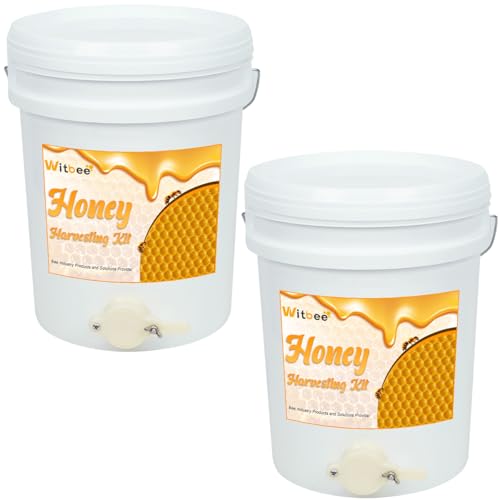
witbee 5-Gallon Honey Bucket with Gate, 2-Pack
witbee · 5-gallon food-grade buckets · leak-proof honey gates (listed) · 2-pack
Our verdict: The unglamorous backbone of the harvest line: gated buckets are the settling tank and the bottling tank in one, and the two-pack enables the correct workflow, one bucket filling under the sieve while yesterday's settles for a clean, ladle-free bottling day.
Every harvest step between extractor and jar happens in a bucket, and gates are what make buckets civilized. The witbee 5-gallon honey bucket 2-pack ($59.99) covers the whole flow: strain into one under the extractor, settle two days, then crack the gate over each jar instead of tipping forty pounds of honey by hand.
Each bucket holds roughly 60 pounds, a good year from an established hive, so the pair covers most backyard apiaries with room to grow. Stainless settling tanks are the eventual upgrade, compared in the harvesting equipment guide.
Who should buy it
Any keeper extracting at home: the fill-one-settle-one workflow needs two gated buckets, and this is two gated buckets.
What we don't like
Gate seals deserve a hot-water test before harvest day, because discovering a weep under sixty pounds of honey is a memorable way to learn, and plastic scratches if scrubbed rough.
- Capacity
- 5 gallons each (~60 lbs honey)
- Gate
- Leak-proof honey gate (listed)
- Material
- Food-grade plastic (listed)
- Quantity
- 2-pack
- Price
- $59.99
Pros
- Settling and bottling in the same vessel
- Two-bucket workflow keeps the line moving
- Gate-fill bottling with no ladling or pouring
Cons
- Test the gate seals before trusting them loaded
- Plastic wants gentle cleaning
When honey is ready: the 80 percent capping rule
Bees answer the readiness question for you, in wax. Nectar arrives at the hive around 70 to 80 percent water, and the bees dry it down, fanning and ripening it until it is honey, then seal each finished cell under a wax capping. A capped cell is the colony's own quality stamp: this one is done. The harvest rule follows directly: pull only frames where at least 80 percent of the cells are capped, and leave frames with big uncapped patches to finish. A frame you hold horizontally and shake over the hive should also pass the shake test: ripe honey stays put, and unripe nectar rains out in droplets. If it rains, it waits.
Why the tolerance for 20 percent uncapped? Because open cells at the rim of a mostly capped frame are usually ripe or nearly ripe, and the refractometer check in the next section catches the exceptions. What the rule really protects you from is the tempting frame that is half sealed and half shiny wet nectar: extract those and you dilute a whole batch below the safety line.
Timing follows your nectar flow, not the calendar, but in most of the US the main harvest lands in mid to late summer, after the spring-summer flow caps and before the fall buildup you should not touch. A colony's first year is usually a non-harvest year, comb building eats the surplus, and that is normal; the season-by-season expectations, region math, and per-hive averages are laid out honestly in how much honey per hive, and the biology of how nectar becomes honey in how bees make honey.
The moisture gate: 18.6 percent and the $23 instrument
Honey's shelf stability is water chemistry: at low moisture, its sugar concentration is high enough that the ever-present yeasts cannot ferment it, which is how honey stays good for years (Wikipedia: Honey). The commonly used line is about 18.6 percent water: below it, honey resists fermentation essentially indefinitely; in the 19-and-up range, fermentation becomes a matter of time and temperature, and by 20 percent you are making accidental mead in a jar with no airlock. US grading favors even lower; good honey typically runs 15.5 to 18 percent.
You cannot see moisture, but you can measure it in ten seconds with a honey refractometer: a drop on the prism, close the lid, read the moisture scale against the light. The aichose honey refractometer ($22.88) is the cheapest important instrument in the harvest line, and the workflow is simple: sample a few frames per super before you commit, especially any with uncapped area, and spot-check the blended honey in the bucket before bottling. Under 18.6, bottle with confidence; over it, options exist, from feeding those frames back to running a dehumidifier over stacked supers for a day or two, but the jar is not one of them.
Harvest math: the colony eats first
Before a single frame leaves the yard, run the winter arithmetic. A colony in a cold-winter region needs roughly 40 to 60 pounds of stored honey to survive to spring, less in the mild South, more in the long-winter North; your local club knows the number for your county. Translate to equipment: a full deep frame holds 6 to 8 pounds of honey and a full medium frame about 3 to 4, so a cold-climate colony wants the equivalent of a heavy deep, or a deep plus a chunk of a medium, left alone. The harvest is everything above that line, and only that.
This is why we harvest from supers, boxes added above the brood chambers specifically to catch surplus, usually above a queen excluder so the comb stays broodless. The brood boxes and their stores belong to the bees, full stop. It is also why late-season restraint matters: honey pulled in September in the North cannot be replaced by the colony, only by you, in sugar, at worse nutrition and real labor, a job covered in winter bee feed and how to winterize a beehive.
A useful reframe for year one and two: the honey you leave is not lost yield, it is next year's colony, and a colony that enters spring strong will out-produce a squeaked-through survivor by more than you harvested from it. Established hives in most US regions average 30 to 60 pounds of true surplus in a decent year; take that, and the winter line takes care of itself.
Clearing the bees: escape boards, brushes, and patience
A full super holds honey and several thousand bees with opinions about it, and separating the two gracefully is half the harvest skill. The gentlest tool at hobby scale is the escape board: a one-way maze you insert under the supers a day or two before harvest. Bees travel down through it to the warm cluster overnight and cannot navigate back up, so you return to supers that are nearly empty of bees and never had a confrontation. Cheap, silent, and it works best in cool nights; its one demand is a second trip to the apiary.
The bee brush handles the rest: pull each frame, one firm downward shake over the open hive to drop the mass of stragglers, then sweep the remainder off with soft strokes and slide the frame into a covered empty box. That covered box matters more than any other detail in this section, because open honey in the yard mid-dearth starts a robbing frenzy in minutes: work with your carry boxes lidded, keep the gaps short, and never leave a frame leaning in the sun. Fume boards, pads dosed with a repellent that pushes bees down out of the super in minutes, are the fast option for bigger yards, with the smell as the tradeoff. Blowers are the commercial answer and overkill at backyard scale. Our picks across all of these live in the harvesting equipment roundup.
The extraction room: bee-proof, warm, and washable
Extract the same day you pull, and do it indoors. The room requirements are exactly three: bee-proof, because forager bees will find an open window screen gap within the hour and bring friends; warm, because honey at hive temperature, 80 to 90 degrees, flows and spins beautifully while cold honey clings to comb, so extract while frames are warm or park the supers in the warmest room you have; and washable, because no matter how careful you are, by evening the floor will be a little bit of a flytrap. A kitchen or a garage with the door down both work; a tarp or rosin paper underfoot converts cleanup from an hour of mopping to a fold and toss.
Stage the line before the first frame: uncapping station over a tub or pan to catch cappings, extractor on a stable base with a bucket under its gate, sieve on the bucket, and a damp towel for hands, because sticky hands drop frames. Cappings are not waste, they are your wax crop, the raw material for candles and salves, so give them a catch pan and let them drain; the honey that weeps off cappings overnight is some of the best of the day.
Uncapping: opening every cell
Extraction cannot pull honey through wax, so every capped cell gets opened first. The classic tool is the uncapping knife drawn along the frame face, slicing the capping layer off in a sheet: stand the frame on end over the catch pan, angle the blade slightly, and carve upward or downward in long strokes, riding the frame's top and bottom bars as depth guides. A heated blade is the difference between carving and tearing, and the Pierce electric uncapping knife ($209.94) is the standard of the category, the original electrically heated knife that glides through cappings and leaves the comb surface clean enough to reuse for years. It is a buy-once tool, and at hobby scale it is also the category's splurge; a plain knife dipped in hot water does the job with more patience, and the middle ground is mapped in the equipment guide.
Whatever the blade misses, low spots in the comb the knife rode over, gets the uncapping fork: a quick scratch of the tines opens the stragglers. Speed matters less than depth control: you are removing the sealing layer, not carving into the cells, because comb you leave intact is comb the bees refill next year without rebuilding. An uncapped frame should glisten wall to wall. Straight into the extractor it goes.
Extracting: the spin
A honey extractor is a centrifuge: frames stand in a rotating basket inside a drum, spin flings the honey out of the open cells against the drum wall, and it runs down to a valve at the bottom (Wikipedia: honey extractor). The technique that saves comb: start slow. A frame spun hard while its far side is still full can blow out the comb from the imbalance, so in a tangential machine (frames flat to the drum wall, the common small-extractor layout) you spin the first side gently, flip the frames, spin the second side to completion, then flip back and finish the first at full speed. Load frames of similar weight opposite each other and the machine stops walking across the floor.
For a backyard apiary, motorized is worth it over hand-crank the first time you face a dozen frames in an afternoon, and the VEVOR 2/4-frame electric extractor ($209.90) is the value pick of the class: a stainless drum, a motor that holds the slow-then-fast ramp better than your cranking arm ever will, and capacity that clears two to four frames a cycle. The full field, hand-crank to the eight-frame class, is ranked in the extractor guide, and if you only harvest a super or two a year, remember the cheapest extractor is the one your beekeeping club loans out.
Open the gate and let the drum drain as you work; a deep pool under the basket drags the spin. Spun frames come out glistening and nearly dry, sticky with a film the bees will clean later, and go back into their supers for the return trip.
Straining: a sieve, not a filter
What comes out of the extractor gate is honey plus flecks of wax, the odd splinter, and the occasional unlucky bee, and one pass through a strainer fixes all of it. The standard tool is a double sieve, a coarse screen over a fine one, sitting on the bucket rim while the extractor drains through it. Strain while the honey is warm and it pours through; cold honey stacks up in the sieve and tests your faith.
Resist the urge to over-filter. A sieve removes debris; fine micron filtering strips out the pollen and the character, and hobby honey's entire premium over the grocery shelf is that character. Raw, sieved, settled honey is the product your neighbors are hoping for. The one refinement worth adopting from day one is the two-container workflow: extractor drains through the sieve into bucket one, and bottling happens later from bucket two, after settling has done its silent work.
Settling: the invisible clarifying step
Give the strained bucket two or three days with a lid on, somewhere warm, and gravity finishes what the sieve started: the microbubbles and wax dust that make fresh-spun honey cloudy rise into a pale foam layer on top, and the honey below turns glass-clear. Skim the foam (it is perfectly edible, spread it on toast in private) and what remains bottles bright and professional with zero equipment beyond patience.
This is where the bucket with a gate earns its place in the line. A food-grade bucket with a honey gate valve at its base, like the witbee 5-gallon honey bucket 2-pack ($59.99), is the settling tank and the bottling tank in one: strain into it, settle in it, then crack the gate over each jar, no ladling, no pouring a forty-pound bucket by hand. Two buckets is the correct number, one filling from the extractor while one settles, and a five-gallon bucket holds roughly 60 pounds of honey, which for scale is a good year from an established hive. Dedicated stainless settling tanks are the upgrade path in the equipment guide.
Bottling: the ten-second pour and the label
Bottling from a gated, settled bucket is the easy victory lap: set the bucket on the counter edge, jar under the gate, open, fill to the shoulder, close, next. Warm honey pours fast and self-levels; work over a sheet pan and even the drips stay civilized. Jar into clean, bone-dry glass or food-grade plastic, and cap tight: honey is hygroscopic and pulls moisture from humid air, which is also why storage is a closed jar in a cupboard, never the refrigerator, where honey crystallizes fastest.
On crystallization, the reassurance to print on your mental label: raw honey crystallizing is proof of realness, not spoilage, and a jar warmed gently in a pan of hot water returns to liquid unharmed. If you plan to give jars away, and you will, the jar itself starts to matter: hexagon jars, skeps, squeeze bottles, and the label question are their own small pleasure, covered in honey jars and labels. And if part of your crop is beautiful capped comb, cut-comb honey skips this whole chapter and sells itself; see comb honey supplies.
Aftermath: wet supers, cappings wax, and sticky everything
The spun frames, called wet supers for the honey film on them, go back to the bees for cleanup, and the method matters: return each super to the hive it came from, in the evening, stacked above the inner cover, and the colony will lick every cell dry within a couple of days, recovering pounds of honey you would otherwise wash down a drain. What you must not do is set wet supers out in the open yard: open feeding sparks robbing, spreads to every colony in range, and can collapse a weak hive in an afternoon. In the hive or nowhere.
The cappings pan renders down to your wax crop: let it drain a day, rinse the honey off, and melt and filter the wax when convenience strikes; a few supers' worth of cappings makes a satisfying stack of one-ounce bars for candle projects. Equipment cleanup is hot-water-only, no soap on anything that touches honey or comb, and everything dries completely before storage.
Then the last quiet job of harvest day: the calendar. Harvest usually lands close to the late-summer varroa checkpoint, and pulling supers is what clears the way for treatments that cannot run with honey on; the timing logic is in when to treat for varroa, and the winter-prep sequence it kicks off is in how to winterize a beehive.
Storing drawn comb: protect the real treasure
Here is the perspective shift that separates second-year keepers from first-years: the honey was the visible crop, but the drawn comb in those supers is the durable one. Comb costs the bees several pounds of honey per pound of wax to build, which means a super of drawn comb is worth twenty-plus pounds of next year's honey in saved construction, and colonies given drawn comb at the flow fill it weeks faster than colonies handed foundation. Protect it accordingly.
The enemy in storage is the wax moth, which tunnels stored comb into webbed ruin, and the defenses are cold, light, and air: freeze frames for 48 hours to kill anything aboard, then store supers where moths cannot thrive, in a chest freezer if you have room, or stacked crisscross in a bright, breezy shed, or sealed with the moth-specific crystals sold for the purpose (never generic mothballs, which poison comb permanently). Dark brood comb draws moths hardest; the white comb of honey supers is less attractive but not immune. Come spring, those protected supers go on at the first flow, and the whole cycle in this guide starts again, several weeks ahead of where you started this year.
How to Harvest Honey
- 1
Confirm the frames are at least 80 percent capped
Harvest only frames where 80 percent or more of the cells are sealed under wax cappings, and shake-test the rest: hold the frame horizontal and shake over the hive, and if nectar rains out, the frame stays. Capping is the bees' own certification that the honey is ripe.
- 2
Verify moisture with a refractometer
Sample honey from several frames and confirm it reads below roughly 18.6 percent water, the line under which honey resists fermentation. Calibrate the refractometer first and spot-check the blended bucket again before bottling.
- 3
Run the winter math and mark what stays
Leave the colony roughly 40 to 60 pounds of stores in cold-winter regions, less in mild climates, before counting anything as surplus. Harvest from supers only; the brood boxes and their stores belong to the bees.
- 4
Clear the bees from the supers
Install an escape board under the supers a day or two ahead so bees exit downward overnight, then shake and brush the stragglers frame by frame into the hive. Keep cleared frames in covered boxes to prevent robbing, and wear full protection.
- 5
Move the supers to a bee-proof room and set up the line
Extract the same day, indoors, in a warm washable space with the door closed. Stage the uncapping station over a catch pan, the extractor on a stable base, and a sieve over a gated bucket under the extractor valve.
- 6
Uncap every cell
Slice the cappings off each frame face in sheets with a heated or hot-water-dipped knife, riding the frame bars as depth guides, and open the missed low spots with an uncapping fork. Save the cappings; they are your wax crop.
- 7
Spin the frames, slow then fast
Load frames of similar weight opposite each other, spin the first side gently, flip and spin the second side to completion, then finish the first side at full speed. Starting slow prevents blowouts that destroy comb you want to reuse for years.
- 8
Strain into a gated bucket
Drain the extractor through a double sieve into a food-grade bucket with a honey gate while the honey is warm. A sieve removes wax and debris; skip fine filtering, which strips the pollen and character out of raw honey.
- 9
Settle for two to three days
Lid the bucket and let it sit somewhere warm while bubbles and wax dust rise into a foam layer, then skim it. The honey below bottles glass-clear with no equipment but patience.
- 10
Bottle into clean, dry jars
Fill jars from the bucket gate, cap tightly, and store at room temperature, never refrigerated. Crystallization over time is natural and reverses with a gentle warm-water bath.
- 11
Return wet supers to the hives in the evening
Stack the spun supers back on their own hives above the inner cover at dusk and let the colonies clean them dry over a couple of days. Never leave wet supers or open honey in the yard, which triggers robbing.
- 12
Freeze and store the drawn comb
Freeze the cleaned frames for 48 hours to kill wax moth stages, then store supers cold, bright, or sealed against moths. Drawn comb is next season's biggest head start, worth roughly twenty pounds of honey per super in saved construction.
More gear worth comparing
Beyond this guide: the highest-rated gear across every category and budget, with a live price check on each.




As an Amazon Associate we may earn from qualifying purchases, at no cost to you.
Quick shop: every pick
Skip the scroll: the whole lineup, with a live price check on each.
- VEVOR 2/4-Frame Electric Honey ExtractorBest Hobby ExtractorVEVOR · $209.90Check Price
- Pierce Original Electric Uncapping KnifeBest Uncapping KnifePierce · $209.94Check Price
- aichose Honey RefractometerBest Moisture Checkaichose · $22.88Check Price
- witbee 5-Gallon Honey Bucket with Gate, 2-PackBest Settling and Bottling Bucketswitbee · $59.99Check Price
Key terms
- Capped honey
- Honey the bees have ripened below fermentation-safe moisture and sealed under a wax capping, their own done stamp. The harvest threshold is frames at least 80 percent capped, with the balance verified by refractometer.
- Refractometer
- The optical instrument that reads honey's water content from a single drop. The critical line is roughly 18.6 percent moisture: below it honey resists fermentation indefinitely, above it fermentation is a matter of time.
- Escape board
- A one-way maze inserted under honey supers a day or two before harvest. Bees pass down to the cluster overnight and cannot return, leaving the supers nearly bee-free without shaking or repellents.
- Uncapping
- Slicing or scratching the wax cappings off honey comb so the extractor can fling the honey out. Done with a heated knife in sheets, with a fork catching the low spots, leaving comb intact for reuse.
- Tangential extractor
- The common small-extractor layout with frames flat against the drum wall, emptying one comb face at a time. Requires the slow-flip-finish spin sequence to avoid blowing out full comb.
- Wet supers
- Supers of freshly spun frames still filmed with honey. Returned to their own hives in the evening for the bees to clean dry; left in the open yard they trigger robbing.
- Cappings
- The sliced-off wax seals collected under the uncapping station: the apiary's wax crop. Drained of honey, rinsed, and rendered into blocks for candles, salves, and foundation.
- Robbing
- Bees from other colonies raiding exposed honey or weak hives, escalating from opportunism to frenzy in minutes during a dearth. The reason harvest happens in covered boxes and wet supers never sit out.
- Drawn comb
- Comb already built out into full cells, the durable asset of harvest: worth several pounds of honey per pound of wax in saved construction, and the biggest head start you can give next season's colonies. Stored frozen or moth-protected.
Questions, answered
How do I know when honey is ready to harvest?
Two checks. First, the frame is at least 80 percent capped, meaning the bees have sealed the ripened cells under wax; a shake test over the hive should rain out nothing. Second, a refractometer reading below roughly 18.6 percent moisture, which is the line under which honey resists fermentation. Pass both and the frame is ready; fail either and it goes back in the hive.
What happens if I harvest honey with too much moisture?
It ferments. Above roughly 18.6 percent water, wild yeasts in the honey can activate, and jars slowly turn fizzy, sour, and foamy over weeks to months. A $23 refractometer prevents the whole failure mode. If you catch high readings before bottling, feed those frames back to the bees or dehumidify stacked supers for a day or two and re-test.
How much honey should I leave for the bees in winter?
Roughly 40 to 60 pounds of stores in cold-winter regions, at the lower end or below in mild southern climates, and your local club knows the county-specific number. In frame terms, that is about a heavy deep box. Harvest only from supers above that line; taking brood-box honey converts your harvest into a fall sugar-feeding obligation at the bees' expense.
Will I get honey the first year of beekeeping?
Usually little or none, and that is normal, not failure. First-year colonies spend the season drawing comb and building population, which consumes most of the surplus. Established hives in most US regions average 30 to 60 pounds in a decent year. Our how-much-honey-per-hive guide runs the honest math by region and colony age.
What is the best way to get bees off honey frames?
An escape board installed under the supers a day or two ahead does most of the work: bees exit downward overnight and cannot return, so you lift nearly empty supers. Shake and brush the stragglers frame by frame into covered boxes. Fume boards with repellent work in minutes for bigger yards, and blowers are commercial-scale tools. Whatever the method, keep cleared frames covered to prevent robbing.
Can I harvest honey without an extractor?
Yes, two ways. Crush-and-strain: cut the comb from the frame, crush it, and let it drain through a sieve overnight, simple and thorough but it destroys the comb, costing next year's head start. Or cut-comb honey: cut capped comb into squares and box it, no equipment at all and premium product. An extractor earns its place by saving the drawn comb, and most clubs loan one.
Do I need to filter my honey?
Strain, yes; filter, no. A double sieve catches wax flecks and debris as the extractor drains, and two or three days of settling in a lidded bucket clears the microbubbles. Fine micron filtering strips out pollen and character, which is exactly the difference between your honey and the grocery aisle. Raw, sieved, and settled is the hobby standard.
Why did my honey crystallize, and is it still good?
Crystallization is natural sugar chemistry, fastest in cool storage and in certain nectar sources, and it is a sign of real raw honey, not spoilage. Set the jar in a pan of warm water until it re-liquefies, and store honey at room temperature in a tightly capped jar, never the refrigerator. Properly dry honey below the moisture line keeps essentially indefinitely.
What do I do with the frames after extracting?
Return the wet supers to their own hives in the evening, stacked above the inner cover, and the bees will clean every cell dry in a couple of days, recovering the honey film. Then freeze the frames for 48 hours to kill wax moth stages and store the supers cold, bright, or moth-protected. Never set wet supers out in the yard: exposed honey starts robbing.
When in the year should I harvest honey?
After your main nectar flow caps, which in most of the US means mid to late summer, and early enough that the colony can rebuild and you can run late-summer mite treatments that require supers off. Avoid harvesting in fall in cold climates: whatever the colony gathers then is winter fuel, and stores you take in September get repaid by you in sugar.
Filed under Explainer
Part of Honey Harvest · How-To Guides
Keep reading
The Best Honey Extractors
Hand-crank to eight-frame electric, ranked by drum, motor, and how much harvest they actually clear.
The Best Honey Harvesting Equipment
The full bench beyond the extractor: knives, forks, sieves, tanks, escape boards, and refractometers.
How Much Honey Does One Hive Make?
The honest yield math by region, colony age, and season, before you buy jars for 100 pounds.
How to Do a Hive Inspection
The frame-reading skill that tells you a super is ready weeks before harvest day.
How to Winterize a Beehive
The sequence harvest kicks off: stores check, mite treatment, and buttoning up for the cold.
Best Honey Jars and Labels
Hexagons, skeps, squeeze bottles, and labels: making the jars worthy of what goes in them.