The Journal · 136 guides
We check the kits so you don't have to guess.
Research-backed reviews, buyer's guides, and comparisons for every kind of beekeeping gear, by The BeehiveKits Hive Desk.
Latest guides
Full archive →
Winter Beekeeping: What to Do, and Mostly What Not to Do
Winter is the season where the best beekeepers do the least. The colony is a self-heating organism running on a fixed fuel budget you set in September, and almost every intervention available to you costs it heat it cannot spare. The real winter jobs are small: heft the hive monthly, keep the entrance clear, add emergency feed if it is light, keep condensation off the cluster, take the broodless mite shot if your region offers one, and spend the rest of the season ordering, building, and planning.
Updated Aug 202618 min read

Raw Honey vs Manuka Honey: Worth the Price?
For everything you actually eat honey for, buy ordinary raw honey. Manuka is a graded, certified, traceable specialty product from one New Zealand plant, and it is priced accordingly. We explain what UMF and MGO measure, run the price per ounce, and say plainly who should buy which.
Updated Aug 202615 min read

The Best Honey Sticks and Straws (2026)
Honey sticks cost more per ounce than a jar and that is fine, because what you are buying is portability. We ranked four worth the money, showed you how to run the cost-per-ounce math yourself, and covered the resale angle for anyone selling honey at a market table.
Updated Aug 202612 min read

Summer Beekeeping: The Flow, the Harvest, and the Dearth
Summer is two seasons wearing one name. The first half is the main nectar flow, when a colony at peak population stores more honey than it will all year and your only real job is staying ahead of it. The second half is the dearth, when forage stops, the yard turns defensive, and everything you do has to be measured against the risk of starting a robbing frenzy. This is the working summer checklist for both halves.
Updated Aug 202618 min read

Spring Beekeeping: The Eight Jobs, In Priority Order
Spring is the only season where the colony is growing faster than you are. Population doubles on a two-week clock, drones appear, swarm pressure builds, and every job you postpone gets more expensive. This is the working spring checklist: what the bees are doing biologically, the eight jobs in the order they must happen, the gear each one demands, the mistakes that cost people their honey crop, and how to shift the whole thing for the South, the Midwest, and the northern tier.
Updated Aug 202618 min read
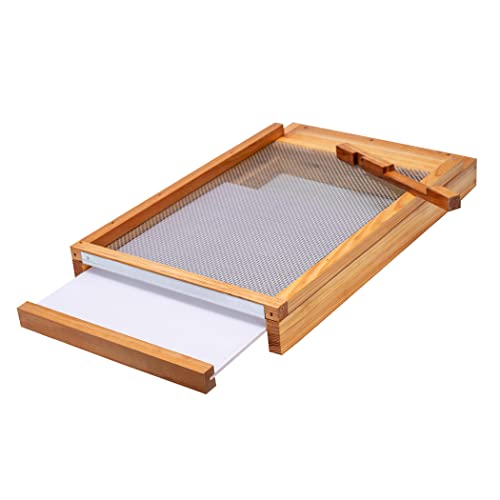
Screened vs Solid Bottom Boards: Which Should You Buy?
The floor of your hive is a $37 decision that gets argued about like a $500 one. Screened bottoms ventilate, let you count mites on a sticky board, and drop beetles out the back. Solid bottoms stop drafts. The answer for most of the United States is one board that does both, and here is why.
Updated Aug 202613 min read

Poly vs Wooden Beehives: Which One Wins
Insulated polymer hives cost roughly twice what pine does and give it back in winter survival and zero maintenance. Wood wins on price, repairability, standardization, and the fact that your mentor owns it. We run insulation, condensation, weight, UV, pests, and ten-year cost.
Updated Aug 202616 min read

Plastic vs Wax Foundation: Which Should You Buy?
One is nearly indestructible and survives an extractor at full speed. The other is what bees prefer and what comb honey demands. We settle which one belongs in your frames, when the other one earns its place, and why the trick that fixes plastic's only real weakness costs about four dollars.
Updated Aug 202614 min read

Package Bees vs Nuc: Which Should You Buy?
A package is three pounds of bees in a screened box with a queen they have never met. A nuc is a small working colony with brood, comb, and a laying queen already in production. For a first-year beekeeper the nuc is worth every dollar of the premium, and this is the full accounting of why.
Updated Aug 202614 min read

Oxalic Acid vs Formic Acid: Which Varroa Treatment
Formic acid is the one chemistry that reaches mites under the cappings, and its label permits use with honey supers on. Oxalic acid is the low-stress knockdown for a broodless or nearly broodless colony. We compare mode of action, brood penetration, queen risk, application, residue, and rotation.
Updated Aug 202617 min read
Italian vs Carniolan Bees: Which Race to Buy
Italians for long warm seasons and steady, predictable buildup. Carniolans for northern winters, frugal clusters, and explosive spring growth. We break down buildup, swarming, temperament, robbing, wintering, and the one caveat that beats race selection entirely.
Updated Aug 202615 min read

How to Overwinter Nucs: The Sideliner's Insurance
A five-frame colony that survives to March is a free replacement queen, a free spring split, and a hedge against the deadout you have not found yet. Making them in time, packing enough feed into a small box, pairing them to share heat, controlling moisture, and splitting them out in April.
Updated Aug 202622 min read

Honey Extractor Size Guide: 2, 4, or 8 Frames?
Sized by hive count, not by ambition. One or two hives: a manual 2-frame. Three to six: an electric 2/4. Seven or more: a radial 8-frame. We explain tangential versus radial, why uncapping is the actual bottleneck, and the club option that beats buying anything in year one.
Updated Aug 202616 min read

Hive Top Feeder vs Entrance Feeder: Which Should You Buy?
An entrance feeder puts a jar of sugar syrup on the doorstep of your hive and announces it to every colony within two miles. A top feeder puts the same syrup inside, where only your bees can reach it. That difference has killed more small colonies than any other feeding mistake, and it decides this comparison.
Updated Aug 202613 min read
What are you after?
Tell us the job and we'll match the gear.Browse by format
Explore by topic
Hive Kits
Every beehive kit worth buying: starter kits, Langstroth, insulated, auto-flow, and observation hives, ranked.
18 guides →
Beekeeping 101
Start here: what a hive costs, what to buy first, and the first-year calendar that keeps a colony alive.
25 guides →
Honey Harvest
Extractors, uncapping tools, buckets, and refractometers: the gear that turns frames into jars.
16 guides →
Hive Health
Varroa treatments, beetle traps, feeders, and winter prep: keeping the colony you started alive.
22 guides →
Protective Gear & Tools
Suits, jackets, gloves, smokers, and hive tools: the working kit between you and ten thousand bees.
7 guides →
How-To Guides
Step by step through every job in the bee yard: installs, inspections, harvest, winter, swarms, and queens.
17 guides →
Honey & Bee Products
Raw honey, manuka, comb, pollen, propolis, and beeswax: what to buy, what the grades mean, and what to make.
17 guides →
Bees & Pollinators
Mason bees, native pollinators, carpenter bee control, and how to help bees without keeping a hive.
12 guides →
Popular tags
Our top-rated beekeeping gear
Whatever you decide, this is the gear we recommend: verified, researched, and ranked. Live price check on each.


As an Amazon Associate we may earn from qualifying purchases, at no cost to you.