Our Pick: BeeCastle
Check PriceScreened vs Solid Bottom Boards: Which Should You Buy?
The verdict: buy a screened bottom board with a removable insert for almost every hive in the United States, and our pick is the BeeCastle Screened Bottom Board at $36.49. It ventilates a hive through a brutal July, gives you a sticky-board surface for mite counts, drops small hive beetles into a trap instead of back onto the comb, and converts to a solid floor in about four seconds when the insert slides in for winter.
By The BeehiveKits Hive Desk2026-08-2913 min read Fact-checked against verified Amazon listingsHow we research
 Upgrade Pick
Apimaye Premium Screened Bottom Board, 10 Frame Langstroth
Apimaye · 4.7
$72.00
The old screened-versus-solid argument assumed you had to choose. You do not. Nearly every screened board sold today ships with or accepts a corrugated or plastic insert, which means the format question collapses into an operating question: when is the insert in, and when is it out. Get that right and you own both bottom boards for the price of one.
One thing we will not do on this page is repeat the biggest myth in the category. A screened bottom board does not control varroa. Mites that fall through do not climb back, which sounds like control and is not, because the fraction that falls on its own is far too small to matter. Screened bottoms are a monitoring surface and a ventilation tool. Treatment is a separate job with a separate calendar, and we say so plainly below.
What to know
- Screened wins for most US climates: summer ventilation, a sticky-board surface for real mite counts, and beetles that fall out instead of hiding.
- Screened bottoms do NOT control varroa on their own. Natural mite drop is too small a fraction of the population to change the outcome.
- The winter draft objection is solved by the insert, not by buying a solid board. In goes the tray in fall, out it comes in spring.
- Sticky boards under a screen are how you measure natural mite drop and check treatment efficacy; the alcohol wash still sets the treatment threshold.
- Screened floors help with moisture, which kills more overwintering colonies than cold does, as long as you also ventilate at the top.
- Our picks: BeeCastle at $36.49 for the standard hive, and the Apimaye Premium Screened Bottom Board at $72.00 for insulated poly setups.
At a glance
| Pick | Fit | Material | Best at | Price | Check price |
|---|---|---|---|---|---|
| BeeCastle Screened Bottom Board | Standard Langstroth | Beeswax-dipped wood, listed | The all-round default | $36.49 | Check Price |
| Honey Lake Metal Screened Bottom | 10-frame Langstroth | Wood with metal screen, listed | Durability in wet climates | $36.99 | Check Price |
| witbee Screened Bottom Board | Langstroth | Beeswax-dipped, listed | Cheapest coated option | $36.33 | Check Price |
| Apimaye Premium Screened Bottom | 10-frame Langstroth | Molded plastic, listed | Insulated and poly hive setups | $72.00 | Check Price |
Four screened boards, plus what the insert does to each. Prices verified against live listings on 2026-08-29; specs listed by the seller.
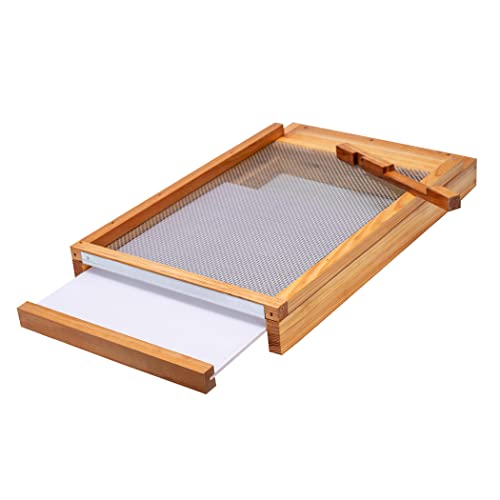
BeeCastle Beehive Screened Bottom Board, Beeswax Dipped
BeeCastle · Screened bottom board, dipped in 100% beeswax (listed), Langstroth fit
Our verdict: This is the board we would put under a colony without thinking twice. At $36.49 it brings a listed beeswax dip that survives weather better than raw pine, a screen coarse enough for beetles and mites to fall through, and a rear slot that takes a sticky board or a solid insert depending on the season.
A hive floor has one hard job and two soft ones. The hard job is holding a stack square and dry off the ground. The soft ones are ventilation and letting you see what falls out of the colony, and that is where the BeeCastle Screened Bottom Board earns its $36.49. The listed beeswax dip matters more than it sounds: bottom boards sit closest to the ground, take the most splash, and rot first, and a dipped board buys years over a bare one.
In practice you will use the tray slot more than you expect. Slide in a greased or oiled sticky board for a 24 or 72 hour drop count, pull it, count mites, and put the hive back together without opening the brood nest. That is a mite check you can run in two minutes on a cold day when a full inspection would be irresponsible.
Come October the same slot takes a solid insert and the board becomes a draft-free winter floor. Pair it with the wraps and stands in our stands and wraps guide, and get it off the ground: a bottom board resting on dirt rots regardless of coating.
Who should buy it
Buy it if you are outfitting a standard wooden Langstroth hive anywhere in the lower 48 and want one floor that handles summer heat, mite monitoring, and winter without a second purchase. It is the default for first hives and the sensible replacement when an old board goes soft.
What we don't like
The insert is a consumable in practice: corrugated trays warp when they get wet and eventually need replacing. And a wax-dipped board still needs to sit on a stand, not on soil, if you want the full lifespan.
- Type
- Screened bottom board (listed)
- Coating
- Dipped in 100% beeswax (listed)
- Fit
- Langstroth (listed)
- Tray slot
- Rear-access for sticky board or solid insert
- Converts to solid
- Yes, with insert
- Price
- $36.49
Pros
- Beeswax dip resists the rot that kills bottom boards first
- Tray slot supports real mite drop counts without opening the hive
- Converts to a solid floor for winter in seconds
- Priced at the category norm despite the coating
Cons
- Insert trays warp over time and need replacing
- Still needs a stand to reach its full service life

Honey Lake Langstroth 10 Frame Metal Screened Bottom Board
Honey Lake · 10-frame Langstroth screened bottom board, metal screen (listed)
Our verdict: At $36.99 this is a straight alternative to our top pick with the emphasis on the screen itself. A metal mesh does not sag, stretch, or get chewed the way lesser screening can, which matters most in humid regions where everything in the yard is trying to soften.
Screens fail before boards do. A stretched or torn screen turns a monitoring tool into an open floor and an invitation to robbers and mice, so the mesh is worth paying attention to. The Honey Lake Metal Screened Bottom Board puts a listed metal screen over a standard 10-frame frame, which is the specification we would choose for the Southeast, the Pacific Northwest, or anywhere the hive lives under trees.
It behaves like any screened board otherwise: tray in for winter and mite counts, tray out for the summer heat. If your apiary sits in a genuinely wet spot, the board is only half the fix; siting matters more, and our placement guide covers drainage, morning sun, and windbreaks.
Who should buy it
Buy it if you keep bees in a humid or rainy region, if your yard is shaded, or if you have already replaced a sagging screen once and would rather not do it again.
What we don't like
Metal screening is heavier and colder to the touch, and the wooden frame around it still needs protection from ground moisture. It costs fifty cents more than our top pick without adding a coating claim.
- Type
- Screened bottom board (listed)
- Screen
- Metal mesh (listed)
- Fit
- 10-frame Langstroth (listed)
- Tray slot
- Yes
- Price
- $36.99
Pros
- Metal screen resists sagging and chewing
- Standard 10-frame fit with no surprises
- Good choice for humid and shaded apiaries
Cons
- No coating claim on the wooden frame
- Marginally heavier than wax-dipped alternatives
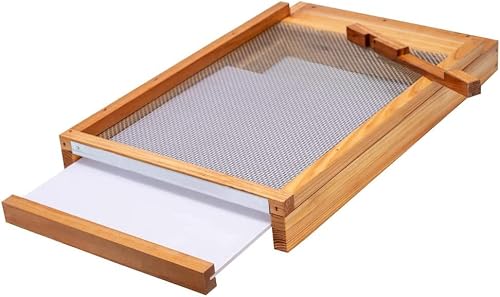
witbee Beehive Screened Bottom Board, Beeswax Dipped
witbee · Screened bottom board dipped in 100% beeswax (listed), Langstroth
Our verdict: At $36.33 this is the price floor for a coated screened board, and the coating is the part you do not want to skip. Buy it when you are equipping a second hive, replacing a rotted floor, or building the spare inventory that swarm season demands.
Every apiary needs one more bottom board than it has hives. Splits happen, swarms get caught, and a soft board discovered mid-inspection is not something you want to solve by mail order. The witbee Screened Bottom Board is the cheapest listed beeswax-dipped option in this comparison, which makes it the natural spare.
It does the same three jobs as our top pick: ventilate, monitor, convert. Keep one in the shed alongside a spare deep and a set of frames and you can hive a swarm the afternoon you get the call. Our swarm guide lists the rest of that kit.
Who should buy it
Buy it as hive number two, as a spare for splits and swarm catches, or as a replacement for a bottom board that has gone soft at the corners.
What we don't like
It is a value board and the milling shows it: check that the entrance edge is straight and that the tray slides freely before it goes under bees.
- Type
- Screened bottom board (listed)
- Coating
- Dipped in 100% beeswax (listed)
- Fit
- Langstroth (listed)
- Tray slot
- Yes
- Price
- $36.33
Pros
- Lowest price here for a coated screened board
- Same monitoring and ventilation function as pricier boards
- Cheap enough to keep as a spare
Cons
- Milling tolerances are value grade
- Worth checking the tray fit on arrival
Apimaye Premium Screened Bottom Board, 10 Frame Langstroth
Apimaye · 10-frame Langstroth screened bottom board, molded plastic (listed)
Our verdict: At $72.00 this costs roughly double the wooden boards and buys a floor that will outlive them all. Molded plastic does not rot at the ground line, the tray runs in a real channel instead of a sawn slot, and it is the correct companion to an insulated poly hive.
Bottom boards are where wooden hives die. They sit lowest, catch the most splash, and hold water in the entrance cut, so the floor is usually the first component a beekeeper replaces. The Apimaye Premium Screened Bottom Board removes that failure mode by not being wood at all.
The tray is the part that justifies the price in daily use. It slides in a molded channel, seats cleanly, and does not swell shut in August the way a damp wooden slot can, which means you actually run the mite counts you intended to run. If your hive is already an Apimaye insulated set, this is the matching floor; if it is wood, treat it as a permanent upgrade rather than a matched component.
The full field of floors, including the solid and slatted options we did not rank here, is in our bottom boards guide.
Who should buy it
Buy it if you run an insulated or poly hive, if you have already replaced a rotted wooden floor and want it to be the last one, or if you monitor mites often enough that a tray which always slides is worth real money.
What we don't like
It is twice the price of a wooden board, and it looks like what it is: molded plastic under a wooden hive is not a beautiful pairing.
- Type
- Screened bottom board (listed)
- Material
- Molded plastic (listed)
- Fit
- 10-frame Langstroth (listed)
- Tray
- Sliding tray in molded channel (listed)
- Price
- $72.00
Pros
- Will not rot, warp, or swell at the ground line
- Tray slides cleanly year after year
- Correct match for insulated and poly hives
- Effectively a buy-once component
Cons
- Roughly double the price of wooden boards
- Plastic under a wooden hive looks mismatched
The short answer
Buy screened. In nearly every US climate a screened bottom board with a removable insert is the better floor, because it gives you summer ventilation, a monitoring surface, and beetle drop-out during the eight months that matter, and then becomes a solid floor for the four months that do not. The only readers we would push toward a permanently solid board are those in the coldest, windiest sites who will never pull the insert anyway, and even they usually benefit from having the option.
The correct mental model: you are not buying a bottom board type, you are buying a bottom board plus an operating schedule. Insert out in spring, insert in for late fall, tray in whenever you want a mite count. That is the whole system, and it costs $36.49 with our top pick.
The full comparison table
| Factor | Screened (insert out) | Screened (insert in) | Solid board |
|---|---|---|---|
| Summer ventilation | Best. Air moves up through the floor | Same as solid | Entrance airflow only |
| Mite drop monitoring | Sticky board under the screen | Sticky board on the insert | Not possible |
| Varroa control | None on its own | None on its own | None |
| Small hive beetle | Beetles fall through to a trap or ground | Beetles land on the tray | Beetles stay in the hive |
| Winter draft | A real concern in wind | Solved | Not an issue |
| Winter moisture | Helps if top ventilation is open | Neutral | Can trap moisture below the cluster |
| Robbing and pests | Screen blocks entry from below | Blocked | Blocked |
| Debris management | Falls out on its own | Collects on the tray | Collects on the floor |
| Cost | About $36 to $72 | Similar or slightly less | |
Note the row that decides the argument: screened with the insert in is functionally a solid board. Solid boards cannot become screened boards. That asymmetry is the entire recommendation.
The mite drop myth, stated plainly
Screened bottom boards were sold for years on the promise that mites which fall through the mesh cannot climb back, so the colony sheds its varroa load over time. The premise is true. The conclusion is not, because the share of the mite population that falls on its own in any given period is small relative to the share reproducing under cappings, and removing a small fraction of a fast-growing population does not change its trajectory.
Current guidance treats screened floors as a monitoring aid, not a control. The Honey Bee Health Coalition Varroa management materials and extension bee-health programs both build their recommendations around measured infestation levels and registered treatments, with an action threshold commonly given as roughly 2 to 3 mites per 100 bees depending on the season. Varroa destructor reproduces inside sealed brood cells, which is precisely where a floor cannot reach it.
What screened floors genuinely give you is a place to put a sticky board. That is not nothing: it is the cheapest, least invasive way to watch a mite population between washes and to check whether a treatment did anything. Our mite monitoring roundup covers the washes and shakers that set the actual threshold, and the treatment timing guide covers what to do about the number.
How to use a sticky board correctly
A sticky board is a sheet that slides into the tray slot under the screen, coated with something mites stick to: petroleum jelly, cooking spray on a corrugated sheet, or a purpose-made adhesive board. Everything that falls out of the colony lands on it, which includes wax cappings, pollen, dead brood, beetles, and mites.
The routine that works: slide the board in, leave it 24 or 72 hours, pull it, and count mites against a grid. Divide by days to get a mites-per-day drop. What that number is good for is trend and treatment verification, comparing this week to last week, or the week after a treatment to the week before it. What it is not good for is setting a treatment decision on its own, because natural drop varies with brood cycle, colony size, and weather. Use an alcohol wash or sugar roll for that call.
Two practical notes. Ants will find a sticky board and so will beetles, so pull it on schedule instead of leaving it in for a fortnight. And in a screened hive with no insert, the board sits below the screen where bees cannot reach it, which is exactly the point: the bees do not clean it and the count stays honest.
Ventilation and summer heat
A colony in a July heat wave spends a substantial share of its labor force on climate control, fanning at the entrance and evaporating water inside the hive to keep the brood nest near 95F. Every bee doing that is a bee not foraging. Opening the floor gives the colony a chimney: air enters low, exits at the top, and the fanning workload drops.
The second summer benefit is nectar curing. Ripening honey means driving moisture out of the nectar until it sits below roughly 18.6 percent water, and moving air through the hive helps. Beekeepers in the South and Southwest often report supers curing faster over screened floors, which is consistent with the physics even if nobody has handed us a controlled trial. Our hot climate guide covers the rest of the summer setup, including shade and water.
If you keep bees where summer highs regularly clear 95F, this section alone settles the question. Pull the insert in April, leave the floor open all summer, and let the colony work on nectar instead of air conditioning.
Small hive beetles, and why the tray matters
The small hive beetle is a scavenger that entered the US in the 1990s and is now endemic across the Southeast and much of the country. Adults hide in cracks the bees cannot reach, larvae tunnel through comb and slime the honey, and a heavily infested hive can be ruined in days. Bees defend by corralling beetles into propolis prisons, which works until the colony gets weak.
Screened floors help in two ways. Beetles knocked off comb during an inspection fall through the mesh instead of scuttling back up, and the tray slot becomes a place to run oil traps that beetles fall into and drown. Neither is a complete answer, and neither replaces the in-hive traps that do the real work. The complete picture, including the corrugated and blaster-style traps that fit between frames, is in our small hive beetle guide.
The important interaction is with colony strength: beetles overwhelm weak colonies and lose to strong ones. Do not run more boxes than the bees can patrol, keep the entrance reduced on a small colony, and never leave supers of wet comb sitting where beetles can work them.
Winter drafts, and how the insert solves them
This is the solid board's best argument and it deserves a fair hearing. A winter cluster generates heat and holds it in a ball; a hole in the floor beneath that ball lets cold air move through continuously, and in a windy site the effect is real. Beekeepers who have left screened floors wide open through a northern winter and lost colonies are not imagining things.
The fix is the insert, not a different board. In late fall the corrugated or plastic tray slides into the slot, and from the colony's point of view the floor is now solid. Nothing else about the hive changes. Come spring you pull it out again. That is the whole procedure, it takes seconds, and it means the screened board is strictly better than a solid one because it has a setting a solid board does not.
Two supporting jobs matter more than the floor either way. Reduce the entrance so wind does not blow straight through the box, and give the hive a way to vent moisture at the top, an upper entrance, a shim, or a quilt box. Our winterizing walkthrough and the winter season guide lay out the order of operations.
Moisture: the thing that actually kills winter colonies
Healthy colonies survive cold. What they struggle with is condensation: a cluster respiring inside a sealed box drives warm wet air upward, and when it hits a cold inner cover it condenses and rains back down on the bees. Cold wet bees die where cold dry bees would not. This is the single most useful thing to understand about overwintering, and it reframes the bottom board argument.
A screened floor with the insert out lets some of that moisture leave downward, but it also lets heat leave, which is why we do not recommend running open floors in a northern winter. The better arrangement is insert in below, ventilation open above, so moist air exits at the top where it belongs. A quilt box, an absorbent shim, or an upper entrance does more for winter survival than any bottom board configuration.
National loss surveys from the Bee Informed Partnership have put annual US colony losses in the range of 40 to 50 percent in recent years, and the causes they point at are varroa, starvation, and queen failure rather than floor design. Fix those three first. The bottom board is a comfort variable, not a survival variable.
The honest case for a solid bottom board
Solid boards are not stupid, and here is their real constituency. If your apiary sits on an exposed ridge in a place with long, hard, windy winters, and you know from experience that you will not remember to manage an insert, a solid floor removes a variable. If you run hives on pallets that get moved by truck, solid floors have fewer parts to lose. If beetles are not a problem in your region and you never run drop counts because you always do alcohol washes, the screen earns you less.
There is also a small brood-nest argument: some beekeepers believe an open floor makes early spring buildup slower because the colony fights a colder cavity while it is trying to expand brood. The evidence is thin and the effect, if it exists, is handled by putting the insert in until the weather turns. Which is, once again, an argument for owning a board that can do both.
What we will not accept is the claim that solid boards are better because screened boards let mites back in. They do not. The screen is a one-way floor either way.
Slatted racks, entrance reducers, and the rest of the floor stack
The bottom board is the base of a small stack of components that all interact. A slatted rack sits between the floor and the bottom brood box, giving bees a place to hang in hot weather, reducing congestion at the entrance, and buffering the brood nest from direct drafts. Beekeepers who add one rarely go back. An entrance reducer narrows the opening so a small colony can defend it, which matters most in the first weeks after installation and again during fall robbing season.
The order from the ground up is: stand, bottom board, optional slatted rack, entrance reducer at the opening, then brood boxes. Get the hive off the soil first, because a bottom board sitting on dirt will rot no matter what it is coated with. Our stands guide covers the base, and the reducers and robbing screens roundup covers the doorway.
Pick screened if / pick solid if
Pick a screened bottom board if: you live anywhere with real summer heat; you want to run sticky board mite counts; small hive beetles exist in your county; you are willing to slide an insert in each fall; or you simply want one floor that covers every situation. Start with the BeeCastle Screened Bottom Board at $36.49, or the Apimaye Premium Screened Bottom Board at $72.00 if you want the last floor you will buy.
Pick a solid bottom board if: your site is genuinely brutal in winter and you will not manage an insert; you move hives on pallets and want fewer loose parts; or you already own solid boards and there is no reason to spend money changing them. A solid floor is a fine floor. It is just a floor with one setting.
Either way: get the hive on a stand, reduce the entrance for small or wintering colonies, and vent at the top in winter. Those three do more than the choice on this page.
What we would actually buy
For a first hive: the BeeCastle Screened Bottom Board at $36.49, on a stand, with the insert stored in the shed until October. That is the whole decision, and it is under forty dollars.
For a second hive or a spare: the witbee Screened Bottom Board at $36.33, kept with a spare deep and a set of frames so a swarm call never catches you short. For a wet or shaded yard: the Honey Lake Metal Screened Bottom Board at $36.99 for the metal mesh. And for anyone running insulated equipment or tired of replacing rotted floors, the Apimaye board at $72.00 is the end of that conversation.
Then go do the thing the floor cannot do: monitor mites with a wash, treat on a threshold, and feed a light colony going into fall. The full field of floors is ranked in our bottom boards guide, and the seasonal jobs are laid out in the fall guide.
More gear worth comparing
Beyond this guide: the highest-rated gear across every category and budget, with a live price check on each.



As an Amazon Associate we may earn from qualifying purchases, at no cost to you.
Quick shop: every pick
Skip the scroll: the whole lineup, with a live price check on each.
- BeeCastle Beehive Screened Bottom Board, Beeswax DippedBest OverallBeeCastle · $36.49Check Price
- Honey Lake Langstroth 10 Frame Metal Screened Bottom BoardBest in Wet ClimatesHoney Lake · $36.99Check Price
- witbee Beehive Screened Bottom Board, Beeswax DippedBest Valuewitbee · $36.33Check Price
- Apimaye Premium Screened Bottom Board, 10 Frame LangstrothBest for Insulated HivesApimaye · $72.00Check Price
How we chose
We judge bottom boards on airflow, whether the mite tray is actually usable in the field, how the entrance sits relative to the floor, and how the board handles standing water and rot.
Varroa claims are grounded in extension and Honey Bee Health Coalition guidance, cited inline, not in the folk arithmetic of mite drop counts.
Materials and dimensions are reported as listed by the seller. We flag coatings as listed rather than asserting coverage we have not measured.
Winter recommendations assume the insert goes in and top ventilation stays open, because moisture, not cold, is the usual killer.
Prices come from live Amazon listings verified on the byline date. No brand paid for placement in this or any BeehiveKits guide.
Key terms
- Screened bottom board
- A hive floor whose center is mesh rather than solid wood, with a rear slot for a removable insert or sticky board.
- Insert (tray)
- The corrugated or plastic sheet that slides under a screened floor to make it functionally solid. In for winter, out for summer.
- Sticky board
- A greased or adhesive sheet placed under the screen to catch and count natural mite drop. A monitoring tool, not a control.
- Natural mite drop
- The number of varroa that fall out of a colony per day without treatment. Useful for trends and treatment verification, not for setting thresholds.
- Alcohol wash
- The standard varroa measurement: roughly 300 bees washed in alcohol, mites counted, expressed as mites per 100 bees. This is what sets treatment decisions.
- Slatted rack
- A framed set of slats between the bottom board and the first brood box that reduces congestion and buffers the brood nest from drafts.
- Entrance reducer
- A wooden or metal bar that narrows the hive opening so a small colony can defend it against robbers and mice.
- Condensation kill
- Winter loss caused by moist air condensing on a cold inner cover and dripping on the cluster. Top ventilation, not floor design, is the fix.
Questions, answered
do screened bottom boards help with varroa mites
Only as a monitoring surface. Mites that fall through cannot climb back, but the share that falls naturally is far too small relative to the mites reproducing under brood cappings to change a colony's infestation level. Use the screen to run sticky board drop counts and check treatment efficacy, and use an alcohol wash plus a registered treatment to actually manage the mite population.
should i leave my screened bottom board open in winter
In most of the United States, no. Slide the insert in for late fall and winter so wind is not moving through the cluster, and instead vent moisture at the top of the hive with an upper entrance, shim, or quilt box. In the deep South some beekeepers leave floors open year round, but if you have real winter, the insert goes in.
screened vs solid bottom board which is better for beginners
Screened, because it does both jobs. With the insert removed it ventilates and lets you count mites; with the insert in it behaves like a solid floor. A solid board has one setting and cannot be converted. For about $36 you get the option value, which is the best argument in the whole comparison.
how do you use a sticky board for mite counts
Coat a corrugated sheet with petroleum jelly or cooking spray, slide it into the tray slot beneath the screen, leave it 24 or 72 hours, then pull it and count the mites against a grid. Divide by the number of days for a mites-per-day figure. Use that number to watch trends and confirm a treatment worked, not to decide whether to treat.
do screened bottom boards help with small hive beetles
They help, but they do not solve it. Beetles knocked loose during an inspection fall through the mesh instead of running back into the hive, and the tray slot can hold an oil trap. Real beetle control still means in-hive traps, keeping colonies strong enough to patrol every box, reducing entrances on weak hives, and never leaving wet comb out where beetles can work it.
will bees get too cold with a screened bottom board
Not in summer, and not in winter if you use the insert. An open floor under a winter cluster in a windy site is a genuine problem, which is why the tray exists. Colonies handle cold well; what they struggle with is cold plus wind plus condensation, and the answers to those are the insert, an entrance reducer, and top ventilation.
what size screen do bottom boards use
Roughly eighth-inch hardware cloth is the standard, which is coarse enough for mites and beetles to fall through but fine enough that bees cannot pass and mice cannot enter. Sellers list mesh differently, so check the listing. A metal screen resists sagging and chewing better than lighter alternatives, which is why we like the Honey Lake board for humid regions.
do you need a slatted rack with a screened bottom board
You do not need one, but many beekeepers who add one keep it. A slatted rack gives bees hanging space in hot weather, reduces entrance congestion, and buffers the brood nest from air coming through an open floor. It sits between the bottom board and the first brood box and is a cheap comfort upgrade rather than a necessity.
how long does a wooden bottom board last
It depends almost entirely on whether it sits on a stand. A coated board kept off the soil with good airflow underneath can last many years; the same board resting on dirt can go soft in two or three seasons because the entrance cut holds water. If you keep replacing floors, either raise the hive or switch to a molded plastic board like the Apimaye.
can you convert a solid bottom board to screened
Not practically. You would be cutting out the floor and fitting hardware cloth and a tray channel, which costs more time than a new screened board costs money. Going the other direction is free: a screened board with the insert in is a solid board. That asymmetry is why we recommend buying screened even if you intend to run it closed most of the year.
Filed under Comparison
Keep reading
The Best Bottom Boards (2026)
The full field of hive floors ranked, including slatted racks and the premium plastic tier.
The Best Mite Monitoring Tools
Washes, shakers, and jars: the tools that actually set your treatment threshold.
When to Treat for Varroa
The calendar and the thresholds, with the temperature windows each product needs.
Small Hive Beetle Guide
How beetles get in, what they ruin, and the traps that work in a real hive.
How to Winterize a Beehive
Insert in, entrance reduced, moisture vented: the order of operations for fall.
The Best Hive Covers and Inner Covers
The other end of the ventilation stack, where winter moisture actually leaves.