Our Pick: Blythewood Bee Co
Check PriceThe Best Robbing Screens and Entrance Reducers (2026)
Our pick is the Blythewood Bee Smart robbing screen (about $18): a purpose-built false front that lets resident bees learn a detour entrance while robbers pile uselessly against the screen where the honey smell exits. When a nectar dearth turns the neighborhood into a robbing economy, that one piece of hardware is the difference between a skirmish at the entrance and a colony stripped dead in an afternoon. Lehman's Stoney Acres screen (about $25) is the wooden heirloom-grade alternative, and the Tough Timbers moving screen (about $28) adds a second job: sealing the colony safely for a hive move.
By The BeehiveKits Hive Desk2026-08-28~13 min read Fact-checked against verified Amazon listingsHow we research
The rest of the guide is the humbler hardware that earns its keep ten months a year: entrance reducers and mouse guards. The GJD stainless 4-pack (about $19) is our reducer pick because its sliding design covers the whole calendar, from a one-bee-width robbing stance to a ventilated mouse-proof winter setting. The BeeCastle metal mouse guard 4-pack (about $20) and the HIMO 6-pack (about $14) round out the shortlist for multi-hive yards on a budget.
Robbing is not rare and it is not gentle. When forage dries up, typically mid-to-late summer in much of the US, strong colonies probe every weaker hive in range, and once a breach starts, the frenzy recruits by the thousand; the behavior is documented plainly in the beekeeping literature, from robbing overviews to the dearth management guidance at bee-health.extension.org. Screens and reducers are cheap; a robbed-out colony plus a mouse-wrecked winter hive is not. This is the highest ratio of catastrophe prevented per dollar in beekeeping.
The disclosure, as always: no manufacturer paid for placement here, and none saw the guide before publication. Some links go to Amazon; if you buy through one we may earn a small commission at no extra cost to you, and it never moves a ranking. Prices are approximate at publication; check the live listing.
What to know
- Our pick is the Blythewood Bee Smart robbing screen (about $18): residents learn the detour, robbers beat themselves against the screen.
- The GJD stainless sliding reducer 4-pack (about $19) is the year-round entrance answer: robbing stance in dearth, mouse guard in fall.
- Mouse guards go on at first frost, before mice move in: metal, not wood, because mice gnaw through wooden reducers.
- The Tough Timbers screen (about $28) does double duty: robbing defense in summer, full closure for moving hives.
- Reduce entrances whenever defense is stretched: dearth, new splits, weak colonies, and every hive from fall through spring.
- Screens and reducers are the cheap half of robbing defense; the other half is behavior: no spilled syrup, no daytime open feeding, no long inspections in dearth.
At a glance
| Product | Type | Listed material | Best for | Approx. price | Check price |
|---|---|---|---|---|---|
| Blythewood Bee Smart Screen | Robbing screen | Screen and frame (listed) | Our Pick: dearth defense | ~$18 | Check Price |
| Lehman's Stoney Acres Screen | Robbing screen | Wood frame (listed) | Premium wooden build | ~$25 | Check Price |
| Tough Timbers Moving Screen | Moving + robbing screen | 10-frame size (listed) | Hive moves plus defense | ~$28 | Check Price |
| GJD Sliding Reducer 4-Pack | Reducer + mouse guard | Stainless steel (listed) | Best all-season reducer | ~$19 | Check Price |
| BeeCastle Mouse Guard 4-Pack | Metal mouse guard | Metal (listed) | Fall mouse-proofing | ~$20 | Check Price |
| HIMO Reducer 6-Pack | Adjustable reducer | 10-frame fit (listed) | Budget multi-hive yards | ~$14 | Check Price |
The 2026 front-door hardware shortlist at a glance. Materials and pack counts are the manufacturers' listed figures; prices are approximate at publication, verified against our offer table in August 2026.

Blythewood Bee Company Bee Smart Robbing Screen
Blythewood Bee Co · Front-mount robbing screen · detour entrance design · fits standard Langstroth entrances (listed)
Our verdict: The Blythewood Bee Smart screen is the tool we install the week a dearth begins. It covers the entrance with screen so the honey scent that recruits robbers exits where no bee can enter, while resident foragers, who navigate by memory rather than smell, learn the offset detour opening within a day. Robbers pile against the screen and burn out; the colony keeps flying. At about $18 per hive it is the cheapest colony insurance in this guide.
Robbing screens exploit the one difference between a robber and a resident: how they find the door. A returning forager navigates to a remembered location and will probe patiently until it relearns a moved entrance. A robber follows the plume of honey scent straight to its source. The Blythewood Bee Smart screen splits those two paths: scent pours out through screen mesh that admits nobody, while the real entrance sits offset behind the false front where only bees that take time to learn the detour, meaning residents, ever find it. Within a day or two the colony commutes normally and the robbers are reduced to buzzing at a window.
Fit and finish are what we expect from Blythewood, a beekeeping-focused supplier whose swarm lure already earns a slot in our swarm catching guide: the frame mounts flat against a standard entrance and holds under the pry of raccoon-curious wildlife. Buy one per hive you intend to feed or split, because a yard where only some hives are screened simply redirects the robbing pressure to the naked entrances. Weak colonies, nucs, and anything freshly requeened get screened first; our requeening guide explains why a queenless or newly queened colony defends worst of all.
Who should buy it
Buy the Blythewood screen for every hive you feed, split, or worry about between the summer flow's end and fall. It is the default robbing defense for backyard yards, and the first thing we hand a beekeeper who has watched a robbing frenzy once.
What we don't like
Residents need a day or two to learn the detour, and a few stragglers cluster on the screen at dusk during the transition. It is one more thing to remove before winter configuration. And a single screen protects a single hive: yards need one per colony, which multiplies the modest cost.
- Type
- Front-mount robbing screen
- Mechanism
- Screened false front with detour entrance
- Fit
- Standard Langstroth entrances (listed)
- Season
- Dearth, feeding, splits, late summer
- Approx. price
- ~$18
Pros
- Defeats scent-following robbers outright
- Residents adapt within a day or two
- Cheap enough to screen the whole yard
- Sturdy mount from a beekeeper-run brand
Cons
- Short learning period confuses foragers at first
- Must come off for winter configuration
- One needed per hive for real yard defense

Lehman's Stoney Acres Robbing Screen
Lehmans · Wood-frame robbing screen (listed) · Stoney Acres pattern · fits standard entrances (listed)
Our verdict: Lehman's Stoney Acres screen runs the same detour-entrance playbook as our pick, executed in a wooden frame that matches the woodenware it mounts on. The wood build takes screws, staples, and repairs the way plastic never will, and it shrugs off the sun-brittleness that eventually claims lighter screens. It costs a few dollars more per hive; beekeepers who plan to run the same equipment for a decade will not mind.
A robbing screen lives outdoors, in the sun, ten feet from a smoker: build quality is not cosmetic. The Lehman's Stoney Acres screen wraps the proven screened-front, detour-door mechanism in a listed wooden frame, and wood changes the ownership story. It mounts flush and rigid against the hive face, it can be screwed rather than pinned in windy yards, and when a corner finally loosens in year six you fix it with a brad instead of replacing it. The Stoney Acres pattern this follows is a design beekeepers have field-tested for years, and Lehman's, a supplier with a long non-electric-goods pedigree, builds it the traditional way.
Choosing between this and the Blythewood is honest coin-flip territory: same mechanism, same day-or-two learning curve for residents, same one-per-hive requirement. The Blythewood wins the yard-scale math at about $18; the Lehman's wins on frame longevity and screw-down mounting for exposed sites. Both defeat the robbers that matter. Whichever you run, the screen comes off when cold arrives and the entrance hardware below takes over; our winterizing guide covers that handoff and the rest of the fall checklist.
Who should buy it
Buy the Lehman's screen if you keep equipment for the long haul, run exposed or windy sites where screw-down mounting matters, or simply prefer wooden gear on wooden hives. It is the durability pick among robbing screens.
What we don't like
It costs the most of the two dedicated robbing screens for the same core function, and wood wants a coat of finish to reach its potential lifespan. Propolis buildup on wooden passages needs an annual scrape. The learning-period caveat of every detour screen applies unchanged.
- Type
- Front-mount robbing screen
- Frame
- Wood (listed), Stoney Acres pattern
- Mounting
- Accepts screws for permanent-yard rigidity
- Season
- Dearth, feeding, splits, late summer
- Approx. price
- ~$25
Pros
- Wooden frame repairs instead of retiring
- Rigid screw-down mounting for windy sites
- Proven Stoney Acres detour design
- Matches and wears like your woodenware
Cons
- Priciest per-hive robbing screen here
- Wants paint or oil for maximum life
- Annual propolis scrape on the passages

Tough Timbers 10 Frame Moving and Robbing Screen
Tough Timbers · 10-frame moving and robbing screen (listed) · closable ventilated entrance · dual-purpose
Our verdict: The Tough Timbers screen is the two-jobs answer: through the dearth it works the entrance like a robbing screen, and on moving day it closes fully, sealing the colony behind ventilation instead of a suffocating block of foam. Anyone who will ever relocate a hive, and most beekeepers eventually do, should own entrance hardware that can lock bees in without cooking them. This is that hardware, with a summer job to pay its way between moves.
Moving a hive is the moment entrance hardware becomes life support. A colony sealed for transport generates serious heat, and the traditional rag-stuffed-in-the-entrance approach has cooked more colonies than robbing ever will. The Tough Timbers moving screen closes the entrance completely behind screen mesh, so the colony is contained but breathing for the truck ride, the two-mile relocation, or the swarm-catch drive home. Fitted to a listed 10-frame entrance and installed the evening before, after flight ends, it turns the most dangerous hour of hive ownership into a routine one.
Between moves, the screen earns its slot working the dearth shift: in its ventilated defensive setting it restricts the entrance the way this category demands, though its detour geometry is less specialized than the Blythewood's pure robbing design. Our honest configuration advice for a settled yard: Blythewood screens for the hives that stay put, one Tough Timbers in the shed for whichever colony has an appointment with a truck. Beekeepers who catch swarms have extra reason to own it, since every catch ends with a colony that must be sealed and driven; our swarm catching walkthrough and nuc and trap guide cover that pipeline end to end.
Who should buy it
Buy the Tough Timbers screen if hive relocation is anywhere in your future: yard rearrangements, out-apiary moves, cutouts, or swarm catches. It is the safety equipment for transport that moonlights as summer defense.
What we don't like
As a pure robbing screen it is less specialized than the dedicated detour designs, and it costs the most in the guide. Full-closure hardware also demands discipline: a colony accidentally left sealed on a hot morning is in real danger, so it comes off on schedule, every time.
- Type
- Moving and robbing screen, dual-purpose
- Fit
- 10-frame Langstroth entrance (listed)
- Closure
- Full ventilated lockdown for transport
- Season
- Moves any time; defense in dearth
- Approx. price
- ~$28
Pros
- Ventilated full closure makes moves safe
- Doubles as dearth-season entrance defense
- One tool covers swarm catches and relocations
- Sturdy build sized to standard 10-frame gear
Cons
- Less specialized than pure robbing screens
- Guide's highest price
- Sealed-hive mistakes are unforgiving; use with discipline
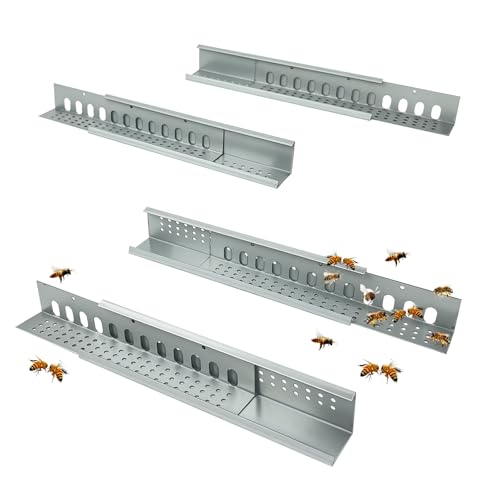
GJD Stainless Entrance Reducer and Mouse Guard, 4-Pack
GJD · Stainless steel sliding reducer (listed) · 4 per pack · reducer and mouse-guard settings
Our verdict: The GJD 4-pack is the entrance answer for the whole calendar: a listed stainless steel slider that adjusts from a wide summer setting to a narrow robbing stance to a ventilated mouse-proof winter position, without swapping parts. Metal is the non-negotiable here, because fall mice gnaw straight through the traditional wooden reducer bar. Four to a pack at about $19 covers the standard backyard yard with a spare.
The wooden notched bar that came with your hive kit has two flaws: mice eat it, and it only knows two settings. The GJD stainless reducers fix both. The sliding design moves through the season with you: open for the main flow when ten thousand foragers a day need the doorway, narrowed when dearth or a new split calls for a defensible gap, and closed down to bee-passable, mouse-proof openings when frosts start and rodents begin apartment-hunting. Stainless steel means the November mouse that would gnaw a wooden reducer into sawdust meets metal and moves on to your neighbor's hive.
Install is a few screws or push-pins into the entrance face, worth doing snugly because raccoons test everything. The one discipline sliding hardware asks is seasonal attention: a reducer left on its narrowest setting during a strong flow bottlenecks foragers and can back congestion into the hive, so widen it when the nectar comes in and narrow it when the calendar or the yard's mood says so. Pair these with a Blythewood robbing screen on the hives you feed and the front-door program is complete for under fifty dollars a yard.
Who should buy it
Buy the GJD 4-pack as the default entrance hardware for any Langstroth yard: it replaces the kit wooden bar with something mice cannot eat and one slider that covers summer, dearth, and winter. Most backyards need exactly one pack.
What we don't like
Sliding hardware needs you to actually adjust it with the seasons; set-and-forget users lose half its value. Metal edges should be checked for burrs before install, and screw mounting takes a few more minutes than wedging in a wooden bar. Fit on nonstandard or narrow entrances should be verified against the listing.
- Type
- Sliding entrance reducer and mouse guard
- Material
- Stainless steel (listed)
- Quantity
- 4 per pack
- Settings
- Open, reduced, mouse-proof ventilated
- Approx. price
- ~$19
Pros
- One slider covers flow, dearth, and winter
- Stainless build defeats gnawing rodents
- Four-pack outfits the standard backyard yard
- Screws down solidly against wildlife
Cons
- Needs seasonal adjustment to earn its keep
- Slower install than a wedge-in wooden bar
- Verify fit on nonstandard entrances

BeeCastle Metal Beehive Mouse Guard, 4-Pack
BeeCastle · Metal mouse guard and entrance reducer (listed) · 4 per pack · fall-through-spring duty
Our verdict: The BeeCastle mouse guards are the single-purpose version of fall entrance duty: metal plates whose openings pass bees and stop rodents, installed at first frost and forgotten until spring. No sliding mechanism to adjust, nothing to misconfigure, one job done completely. For beekeepers who prefer dedicated hardware per season over one adjustable gadget, this 4-pack is the winter half of the entrance program.
There is a case for hardware with no settings. A sliding reducer does everything, and it does everything only if you slide it; a dedicated guard does one thing the moment it is screwed on. The BeeCastle metal mouse guards are that second philosophy: listed metal plates with bee-sized openings that no mouse can pass or enlarge, mounted across the entrance in October and removed at the first full spring inspection. Between those dates there is nothing to adjust, nothing to forget, and nothing a rodent can do about it.
The honest comparison with the GJD slider: the GJD is more versatile across the year; the BeeCastle is more foolproof across the winter. Yards that keep summer entrances managed with robbing screens or the kit reducer often prefer exactly this split: purpose hardware per season. At about $20 for four, the pack matches the standard yard with a spare, and it slots into the same fall visit as wraps and candy boards; our winterizing walkthrough sequences that visit, and our winter feed guide covers what goes on top of the hive the same day.
Who should buy it
Buy the BeeCastle guards if you want fall mouse-proofing that cannot be misadjusted: on at first frost, off at spring inspection, nothing in between. It is the set-and-forget half of a purpose-hardware-per-season entrance strategy.
What we don't like
It is single-season hardware: no robbing stance, no summer role, so it shares shelf space with whatever manages your entrances the rest of the year. Openings and fit should be verified against your entrance dimensions on the live listing, and like all guards it must be installed on a mouse-free hive to help rather than harm.
- Type
- Dedicated metal mouse guard
- Material
- Metal (listed)
- Quantity
- 4 per pack
- Season
- First frost through spring inspection
- Approx. price
- ~$20
Pros
- Zero-adjustment winter protection
- Metal openings mice cannot gnaw or widen
- Bee-passable: workers still haul out dead
- Four-pack covers the standard yard
Cons
- No summer or robbing role
- Must confirm fit on your entrance
- Useless-to-harmful if a mouse is already inside
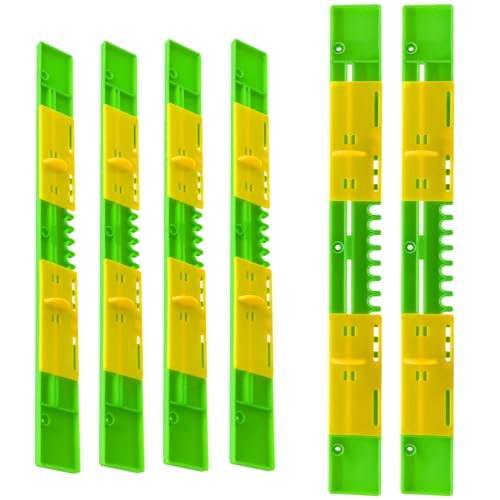
HIMO Adjustable Entrance Reducer, 6-Pack
HIMO · Adjustable 10-frame entrance reducers (listed) · 6 per pack · roughly $2.33 per hive
Our verdict: At about $14 for six, the HIMO reducers cost less per hive than a jar of honey sells for, and they put adjustable entrance control on every colony in a growing yard at once. The build is lighter than the GJD stainless sliders and the guard duty less bombproof, but the core mission, shrinking a doorway to what its colony can defend, is fully served. For expanding yards and nuc-heavy operations, quantity is the feature.
Yards grow faster than hardware budgets, and every new split arrives needing a small entrance immediately. A fresh nuc or split is the most robbable unit in beekeeping: small population, no field force to spare for defense, often being fed, and parked in a yard full of established colonies that outnumber it fifty to one. The HIMO 6-pack means the question of whether the new colony gets entrance protection never touches the budget: six listed adjustable reducers, one on every box that needs it, spares in the toolbox for the swarm you catch in May.
The trade-offs are the honest budget kind: lighter material than the GJD stainless sliders, so treat mouse duty as backup rather than primary, and check fit and seating against your equipment when they arrive, since listed 10-frame sizing meets some variation among hive brands. Our recommended stack for a growing yard pairs these across the many summer entrances with GJD or BeeCastle metal on the winter front line, and a Blythewood screen on anything being fed. Beekeepers scaling up through splits will find the whole expansion toolkit in our nuc boxes guide, and the calendar logic in the first-year calendar.
Who should buy it
Buy the HIMO 6-pack if your yard is growing, you run nucs and splits, or you want adjustable reducers on every entrance without thinking about cost. It is the quantity play for beekeepers who make increase.
What we don't like
The lighter build is a reducer first and a mouse deterrent second; we still want metal guards on winter entrances. Fit varies with hive brand tolerances, so seat each one snugly and check after storms. Durability across seasons will trail the stainless GJD hardware.
- Type
- Adjustable entrance reducer
- Fit
- 10-frame Langstroth (listed)
- Quantity
- 6 per pack
- Cost per hive
- Roughly $2.33 at publication
- Approx. price
- ~$14
Pros
- Cheapest per-entrance control in the guide
- Six-pack covers a growing yard plus spares
- Adjustable openings for nucs through boomers
- Makes protecting every split automatic
Cons
- Lighter build than the stainless competition
- Winter mouse duty better left to metal guards
- Fit tolerance varies with hive brand
More gear worth comparing
Beyond this guide: the highest-rated gear across every category and budget, with a live price check on each.



As an Amazon Associate we may earn from qualifying purchases, at no cost to you.
Quick shop: every pick
Skip the scroll: the whole lineup, with a live price check on each.
- Blythewood Bee Company Bee Smart Robbing ScreenBest OverallBlythewood Bee Co · ~$18Check Price
- Lehman's Stoney Acres Robbing ScreenBest Wooden ScreenLehmans · ~$25Check Price
- Tough Timbers 10 Frame Moving and Robbing ScreenBest for Moving HivesTough Timbers · ~$28Check Price
- GJD Stainless Entrance Reducer and Mouse Guard, 4-PackBest Entrance ReducerGJD · ~$19Check Price
- BeeCastle Metal Beehive Mouse Guard, 4-PackBest Dedicated Mouse GuardBeeCastle · ~$20Check Price
- HIMO Adjustable Entrance Reducer, 6-PackBest BudgetHIMO · ~$14Check Price
How we chose
We judge front-door hardware on the colony's terms: does it shrink the defended perimeter without trapping foragers, blocking drones where it should not, or choking airflow in summer heat.
Robbing screens are scored on the confusion trade: how quickly resident bees learn the detour entrance versus how completely robbers are denied the scent path. A screen that baffles both sides equally fails.
Mouse guards must actually stop mice: metal earns points, wood loses them, because rodents gnaw wooden reducers. Hole and slot sizes are checked against bee passage as listed.
Fit claims are checked against standard Langstroth entrance dimensions, and anything requiring tools beyond a few screws or push-pins at install is noted, because this hardware goes on and off several times a year.
Prices come from our verified offer table; no brand bought a placement, and a two-dollar saving on a guard that lets one mouse in costs a winter's comb.
Key terms
- Robbing
- Bees from other colonies invading a hive to steal its stores, escalating from scouting probes to a mass frenzy that can strip and kill a colony in hours. Triggered by dearth and any advertised weakness at the entrance.
- Robbing screen
- A screened false front over the entrance with an offset detour opening. Residents relearn the new path within a day or two; scent-following robbers pile against the mesh where the odor exits and never find the door.
- Entrance reducer
- A bar or slider that shrinks the hive entrance to an opening the colony's guard force can actually defend. The default tool for splits, dearth, fall, and any colony punching below its weight.
- Mouse guard
- A metal plate with bee-sized openings mounted across the entrance in fall, stopping the rodents that move into clustered hives at first frost. Metal specifically, because mice gnaw through wooden reducers.
- Nectar dearth
- A stretch with little or no forage, typically mid-to-late summer in much of the US. Dearth flips the yard into a robbing economy and is the season screens go on and entrances come down.
- Moving screen
- Entrance hardware that closes the hive completely behind ventilated mesh, containing the colony for transport without suffocating it. The safe replacement for rags and foam blocks on moving day.
- Three-feet-or-three-miles rule
- The relocation rule of thumb: move a hive less than about three feet or more than about two to three miles, because foragers moved any distance between will navigate back to the old site and be lost.
- Bearding
- Bees clustering on the hive face in heat, often a sign the colony needs more ventilation or entrance area. The signal to open up a reduced entrance on a strong hive in summer.
Questions, answered
Do robbing screens really work?
Yes, because they split the two ways bees find an entrance: residents navigate by memory and learn the detour opening within a day or two, while robbers follow honey scent to the screened false front and never get in. Install before or at the start of dearth for best results; even mid-frenzy installation plus a reduced opening usually breaks an attack.
When should I put a robbing screen on my hive?
When the summer flow tapers and dearth begins, and immediately on any colony you feed, split, or judge weak. The screen costs the colony a day or two of relearning the entrance, so installing in calm conditions beats installing mid-attack. Many beekeepers leave screens on from late summer until the fall mouse-guard swap.
When should I reduce my hive entrance?
Whenever defense is stretched: on new packages, nucs, and splits from day one, during nectar dearth, whenever robbing pressure appears, and on every hive from fall through spring. Open the entrance back up for strong colonies during a heavy flow and in extreme heat, when throughput and ventilation matter more than a narrow doorway.
When do mouse guards go on a beehive?
At the first frost warnings of fall, before cold nights push mice to seek warm winter quarters, and after a quick check that no mouse is already inside. They stay on until regular spring inspections resume. Use metal guards specifically; mice chew through the wooden notched reducers that ship with most hive kits.
What size should a winter hive entrance be?
Small and mouse-proof: bee-passable openings that let workers fly on mild days and haul out dead bees, but stop rodents. A reduced entrance also cuts wind scouring into the hive. Pair the small front door with your region's standard upper ventilation approach so moisture still escapes; our winterizing guide covers the full setup.
How do I stop a robbing frenzy once it starts?
Act in minutes, not hours: shrink the victim's entrance to one bee-width, drape a wet sheet over the hive to break the scent trail, and shut down whatever attracted the raiders, usually spilled syrup or an entrance feeder. Ventilated full closure until dusk is the nuclear option. Then screen and reduce the whole yard, because frenzies repeat.
Can I move a beehive a short distance?
Short moves obey the three-feet-or-three-miles rule: foragers moved anything between those distances fly back to the old location and are lost. Either shift the hive a few feet at a time over days, or move it beyond foraging memory (roughly two to three miles), leave it for a few weeks, and bring it back to the new spot.
How do I move a hive without killing bees?
Seal the entrance behind ventilated mesh at night when foragers are home, strap the boxes into one unit, keep the load shaded and ventilated in transit, and open the entrance immediately on arrival. Never plug an entrance with rags or solid foam: a sealed colony generates enough heat to kill itself surprisingly fast.
Do entrance reducers cause overheating in summer?
They can on strong hives in hot weather, because the entrance is part of the ventilation system. Heavy bearding on the hive face is the signal to widen or remove the reducer. The reduce-by-default rule applies to weak colonies, dearth, and winter; a booming hive on a flow in July usually wants its doorway open.
Are robbing screens and entrance reducers worth it for two hives?
Especially for two hives, because small yards feel losses hardest: a robbed or mouse-wrecked colony is half your operation. A screen, sliding reducers, and mouse guards for two hives costs around fifty to sixty dollars total, roughly a third of one replacement package of bees. It is the best-value insurance in the hobby.
Filed under Buyer's Guide
Part of Hive Health
Keep reading
The Best Bee Feeders (2026)
Feeding is the top robbing trigger: the feeders and dearth discipline that keep syrup from starting a war.
How to Winterize a Beehive
Mouse guards and reduced entrances in sequence with wraps, feed, and moisture control.
The Best Winter Bee Feed (2026)
What goes on top of the hive the same fall day the mouse guard goes on the front.
The Best Nuc Boxes and Swarm Traps (2026)
Splits and swarm catches are the colonies that need reduced entrances most: the boxes they live in.
First-Year Beekeeping Calendar
When dearth hits, when screens go on, and when the mouse-guard deadline lands, month by month.
The Best Varroa Mite Treatments (2026)
Robbing spreads mites between colonies: the treatment program that pairs with entrance defense.