Our Pick: YOFAN
Check PriceHow to Requeen a Hive Without Losing the Colony
Answer first: to requeen a hive, you confirm the colony's problem is actually the queen, order a mated replacement before you touch anything, find and remove the old queen, wait 24 hours, install the new queen in her shipping cage with the candy tube plugged for two to four days of scent introduction, and then stay out of the hive for a week. Follow that sequence and published acceptance rates run high; freelance it, and the colony kills a queen that cost you $40 to $60 plus shipping. The gear is minimal: a $9.95 queen catcher clip protects her majesty during handling, and a marking kit under $22 makes every future queen hunt tenfold easier.
By The BeehiveKits Hive Desk2026-08-2820 min read Fact-checked against verified Amazon listingsHow we research
The skill that makes all of it work is understanding one fact: a colony does not recognize its queen by sight or title, but by pheromone. Queen scent is the colony's organizing signal, and a foreign queen dropped straight in smells like an invader and dies balled in a knot of workers within minutes. Every introduction protocol ever devised is a machine for solving that one problem, holding the new queen safe behind screen while her scent slowly becomes the colony's scent. The cage does the diplomacy. Your job is to not rush it.
This guide runs the full sequence: the four diagnoses that justify requeening and the impostors that mimic them, sourcing queens, the queen hunt itself, dispatch, the cage protocols with their timing, what acceptance odds actually look like and what moves them, the raise-their-own alternative when you cannot buy a queen, and marking. It leans on the inspection fundamentals from our hive inspection guide and pairs with the queen-rearing gear roundup for keepers ready to graduate from buying queens to making them. Standard disclosure, as always: no brand paid for placement, and some links go to Amazon, where purchases may earn us a small commission at no extra cost to you. Prices verified at publication.
What to know
- Requeen for four reasons: a failing brood pattern, a drone-laying queen, a hot-tempered colony, or planned replacement of an aging queen.
- Diagnose before you dispatch: laying workers, mite damage, and dearth-season laying pauses all mimic queen failure and are not fixed by a new queen.
- Order the new queen first; the old queen leaves the hive only when her replacement is in hand.
- Introduce with the cage: 24 hours queenless, then two to four days behind the candy plug, then a full hands-off week. Most rejections are caused by rushing one of those three clocks.
- Acceptance runs strongly in your favor with protocol, and worst during a nectar dearth, into laying-worker colonies, and with rushed direct releases.
- A queenless colony with eggs can raise its own emergency queen, at the cost of a month of laying and an unmated gamble; buying is faster and surer.
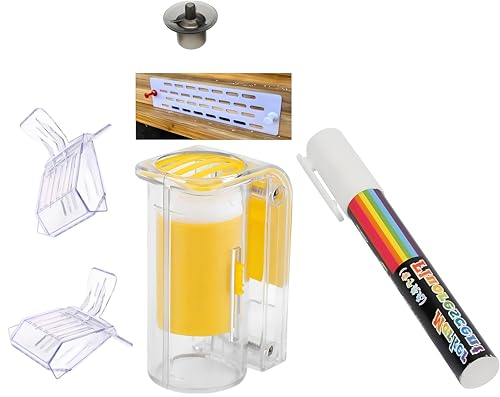
YOFAN Queen Bee Catcher Set, 6-Piece
YOFAN · 6-piece set (listed) · spring clip catcher plus cages · worker-width gaps hold queen only
Our verdict: The tool for the moment the whole hunt builds to: one squeeze closes the clip over the queen on the comb, workers walk out through the gaps, and she is safe while you dispatch, cage, mark, or move her. At $9.95 for a six-piece set, it removes the single clumsiest step in requeening.
Every requeening has a few seconds where the queen is in hand, at dispatch, at marking, during a cage transfer, and those seconds are where fingers fumble and queens get injured or launched. The YOFAN queen catcher set ($9.95) makes them routine: the spring clip closes over her on the comb without lifting a frame edge, gaps sized so attendants leave and she stays.
The set's cages cover the follow-on jobs, holding her during a hive rearrangement or an isolation. Pair it with a marking kit and the queen-handling side of your toolkit is complete for about thirty dollars.
Who should buy it
Anyone requeening, marking, or making splits; it is also the training-wheels tool that makes new keepers actually willing to pick up a queen.
What we don't like
Clip springs on budget sets want a gentleness calibration on drones first, and a carelessly aimed clip edge can catch a leg, so watch her position as it closes.
- Pieces
- 6 (listed)
- Type
- Spring clip catcher + queen cages
- Function
- Catch, hold, transport queen
- Price
- $9.95
Pros
- One-motion catch straight off the comb
- Safer for the queen than fingers
- Set covers catching, holding, and transport
Cons
- Practice on drones before the real catch
- Budget springs vary in tension
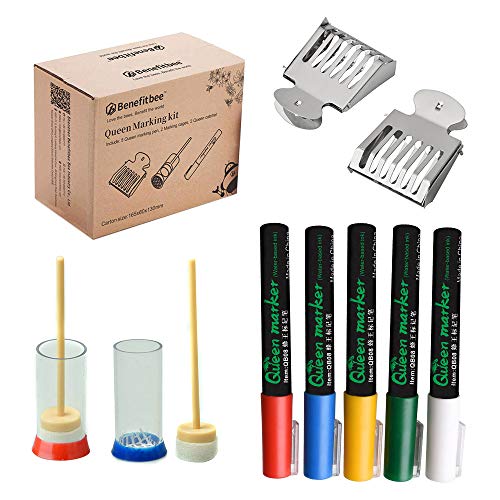
benefitbee Queen Bee Marking Kit
benefitbee · Marking cage with soft plunger · queen marking pens included (listed)
Our verdict: The one-handed version of queen marking: the tube-and-plunger cage presses her gently against mesh while your free hand applies the thorax dot. For the keeper who marks a queen or three a year, this is the whole solution in one box, and the payoff is every inspection for the rest of her life.
Marking is thirty seconds of work that converts every future queen hunt from a search into a glance, and the tube cage is what makes it a solo job: queen in, soft plunger up until she is held still against the mesh, dot of paint on the thorax, one minute to dry, release. The benefitbee marking kit ($21.99) packages the cage and the pens together.
Follow the two rules that matter: thorax only, never head or wings, and fully dry before release so the colony does not groom and ball her over wet-paint smell. Drones are free practice subjects.
Who should buy it
Keepers with one to five hives who requeen occasionally and want the marking step made foolproof; buy the year color you need or the set.
What we don't like
Marker pens want a prime-and-test on cardboard first (first drops run heavy), and a tube cage takes a beat of practice to press gently rather than firmly.
- Cage
- Tube with soft plunger
- Pens
- Queen marking pens included (listed)
- Method
- One-handed press and mark
- Price
- $21.99
Pros
- One-person marking, no assistant needed
- Gentle mesh press keeps the queen unharmed
- Pens and cage in one purchase
Cons
- Test pen flow before it meets a queen
- Plunger pressure takes practice

Qualirey 15-Piece Queen Marking Kit
Qualirey · 15 pieces (listed): 8 pens, 5 clips, 2 bottles · covers international color code years
Our verdict: The value play for anyone planning to keep marking queens: the full color range covers every year of the international code, and five catcher clips mean the yard box, the truck, and the mentee all get one. Less refined than a tube-cage kit, far better stocked per dollar.
The international color code cycles five colors across the decade, and buying pens one year at a time is the expensive way around it. The Qualirey 15-piece kit ($16.99) solves it in one box: eight pens spanning the code colors, five spring catcher clips, and accessory bottles, enough kit to mark this year's white queens and still be equipped when the 2027 yellows arrive.
Run it alongside a press-in cage or the clip-and-careful-hand method; the clips it includes double as spares for dispatch and split work all season.
Who should buy it
Multi-hive keepers, mentors, and clubs; anyone who expects to mark queens across several seasons and wants the colors on hand before they are needed.
What we don't like
Quantity over refinement: pen quality at this price wants testing before live use, and there is no plunger-tube cage in the box, so pair it with one or steady hands.
- Pieces
- 15 (listed)
- Pens
- 8, spanning marking colors
- Clips
- 5 spring catcher clips
- Extras
- 2 bottles
- Price
- $16.99
Pros
- Every year-code color in one purchase
- Five clips outfit yard, truck, and spares
- Cheapest per-piece queen kit going
Cons
- No press-in marking cage included
- Budget pens: prime and test first
Why queens fail, and why requeening is routine maintenance
A queen honey bee can live several years, but her useful life is shorter than her lifespan. She mates once, in her first weeks, storing every sperm cell she will ever have; from then on she is spending down a fixed account, and as it depletes her laying rate falls, her pattern loosens, and her pheromone signal weakens, which is the colony's own cue to replace her. Colonies handle this themselves by supersedure when it goes well. It often does not go well, or does not go fast enough, or happens in October when no drones are flying for the daughter to mate with. Requeening is simply the beekeeper doing the colony's own succession planning on a schedule that suits the colony's survival rather than its luck.
The payoff for treating queens as a managed input is larger than beginners expect, because the queen is the single biggest lever in the hive: she is the colony's entire genetics and its brood engine. A young queen laying at full rate out-populates an old one by thousands of bees at the flow; queen turnover is also the only permanent fix for temperament, and vigorous young queens head colonies that swarm less the following spring, a point the Penn State extension queen introduction guidance makes in recommending regular requeening as standard practice. Many sideliners requeen every year or two on principle. You do not have to go that far, but you do have to stop thinking of requeening as an emergency procedure. It is an oil change, not an engine swap.
Diagnosis one: the failing brood pattern
The classic requeening trigger is the shot brood pattern: instead of solid slabs of capped worker brood with few skipped cells, you find a scatter, capped cells sprinkled among empties like a bad checkerboard, week after week. A failing queen produces it two ways: she runs low on stored sperm, so a fraction of her fertilized eggs simply are not, and workers remove the misfits; or her laying becomes erratic with age. Either way the colony's population curve bends down months before the colony looks weak, which is why pattern-reading at every inspection, covered in the inspection guide, is the habit that catches queen failure while it is still cheap to fix.
Now the crucial caution: a spotty pattern has impostors, and requeening does not fix any of them. Varroa and the viruses it vectors produce shot brood in a mite-sick colony, and a new queen laying into the same mite load will produce the same pattern; count mites before you blame the queen, per the varroa timing guide. Brood diseases like chalkbrood punch holes in patterns. A hard dearth or an early-fall slowdown thins laying naturally. And hygienic-stock colonies uncap and remove mite-infested pupae, making their excellent queens look spotty in exactly the colonies working hardest. The differential: a true queen failure shows a pattern that is spotty across multiple brood cycles, in a colony with controlled mites, decent stores, and no disease signs, often alongside dwindling population and supersedure cells the bees have started themselves. When the bees start queen cups over a bad pattern, they have made the diagnosis for you; your only decision is whether to let them run the succession or to install a bought queen with known genetics.
Diagnosis two: the drone layer (and the laying-worker impostor)
Open a hive and find drone brood in worker cells, bullet-shaped domed cappings protruding from the flat worker comb, and you have one of two very different problems that look identical at first glance. The first is a drone-laying queen: she has exhausted her sperm stores or was never adequately mated, so every egg she lays is unfertilized and becomes a drone. The tell is order in the failure: one egg per cell, centered in the bottom, laid in a coherent if doomed pattern, and a queen you can find on the comb. She cannot be rehabilitated; the colony is manufacturing drones instead of workers and has weeks to live. Requeen immediately using the full protocol below.
The second is laying workers, and getting this one wrong wastes a queen. When a colony has been queenless and broodless for weeks, the absence of brood pheromone lets some workers' ovaries activate, and they begin laying unfertilized eggs everywhere. The tells are chaos: multiple eggs per cell, eggs stuck to cell walls rather than centered on the bottom (worker abdomens are too short to reach), scattered drone brood in patches, and no queen to be found. The trap is that a laying-worker colony believes it is queenright, and its workers will kill an introduced queen with brutal reliability; caging changes little. The honest options, none great: shake out the colony thirty yards away and let the bees drift into your other hives, combine it over newspaper with a strong queenright colony, or run repeated weekly frames of open brood from another hive until the brood pheromone suppresses the layers and the colony will start queen cells, at which point it can be requeened. For a small colony, the shake-out and a fresh start from a nuc is usually the least painful, and the arithmetic on that is in where to buy bees.
Diagnosis three: the hot hive
Some colonies are simply mean, and it is a legitimate, sufficient reason to requeen, because temperament is heritable and the queen is the heredity. A hot hive follows you across the yard after inspections, tags gloves and veil by the dozen on calm sunny days, boils out at the first puff of smoke, and makes mowing within fifty feet a protective-gear event. Before you convict, though, run the checklist of situational excuses: every colony runs hotter in a dearth, before storms, when queenless, during robbing, after skunk visits, and under clumsy handling. The standard is consistent hot behavior across two or three inspections in good conditions. A colony that fails that standard does not improve with your patience; it improves with new genetics, and in suburban yards it is an obligation, not a preference, a point our sting safety guide makes at length.
Requeening a hot hive is the same protocol with the difficulty dial turned up: the colony is huge (hot hives are often excellent producers), the queen hunt is miserable in a boiling box, and defensive colonies are the likeliest to reject a gentle stranger. Practical adaptations: work it on the warmest, calmest, best-flow day available; split the hive into two or three boxes a day beforehand so the queen is somewhere smaller when you hunt (check which box has eggs the next day to narrow it further); consider requeening with a cell or virgin from gentle stock if a mated queen keeps getting balled; and give the caged introduction the slow end of every timing below. The reward compounds fast: within six to eight weeks, as the old queen's last workers age out, the same hive is a different animal wearing the same boxes. Genetics for gentleness are also a thing you can shop for deliberately, which is half the argument of our honey bee stock guide.
Diagnosis four: planned replacement, and the requeening calendar
The fourth reason needs no crisis: the queen is simply old, entering her second or third year, and you are replacing her before her decline instead of after it. Planned requeening trades a known cost, a $40 to $60 queen and an afternoon, against unplanned failure at the worst possible time, and the sideliner consensus lands on requeening either annually or in the second season. A first-year keeper does not need a policy yet; a third-year keeper with dead-out scars usually has one.
Timing matters as much as policy, and there are two good windows. Spring requeening, after the colony is building but before the main flow, gives the new queen a full season to prove out and puts her young laying force in place for the flow, at the cost of buying when queen supply is tightest. Late-summer requeening, July into August, is the connoisseur's window: queens are available and well-mated, a young queen lays later into fall and builds a bigger, younger winter cluster, and colonies headed into winter with first-year queens consistently overwinter better and swarm less the next spring. What to avoid: requeening during a hard dearth (acceptance craters when there is no flow; if you must, feed syrup throughout the introduction), and requeening so late in fall that a failed introduction leaves no time for a second attempt. The one-page version: if you have a choice, requeen in late summer with the fall in mind; the winter-prep logic connects straight into the winterizing guide.
Buying the queen: sources, timing, and what marked costs
Rule one of requeening logistics: the replacement is in hand before the incumbent is removed. Queens ship overnight in cages with attendants and candy, and every day of gap you create between dispatch and introduction is a day the colony spends starting emergency cells you will have to tear down. Sourcing runs through the same channels as bees generally, mapped with vendors and market prices in the where-to-buy-bees guide: reputable regional breeders, the big package producers, and, best of all when available, local breeders whose queens are mated to local survivor stock. Expect roughly $40 to $60 for a mated queen plus overnight shipping, more for instrumentally inseminated or specialty stock. Choose stock deliberately, Italian, Carniolan, Russian, and hygienic lines behave differently, per the bee stock guide, and pay the few extra dollars for a marked queen: the dot proves at every future inspection that the queen you see is the queen you installed, and tells you instantly if she has been superseded.
Handling on arrival: the cage contains the queen, a few attendant workers, and a candy plug. She can wait a day or two if the weather refuses: dark room-temperature storage, a single drop of water on the screen morning and evening, never direct sun, never the refrigerator. Check her on arrival, alive, moving, all legs, and note whether your supplier ships attendants inside the cage (most do) and whether they recommend removing them at installation; opinions differ, some studies find acceptance improves without attendants, and your breeder's instructions outrank internet consensus, this page included.
Finding the queen: the hunt, honestly
Requeening's one genuinely hard skill is the queen hunt, and it is hard because a queen is a slightly longer, balder bee among fifty thousand, actively avoiding light and commotion. Stack the odds before you open the box. Go mid-morning on a calm, warm day, when the foraging shift has emptied the hive of a third of its bees. Use minimal smoke, a puff at the entrance and under the lid only; heavy smoke sends the queen running into corners and cross-country across the hive. Work like a librarian: lift the outer frames gently, then go straight to the frames of eggs and open brood, because the queen is almost always on or near the comb she is currently laying. Scan each frame in an S-pattern, edges first since she runs from light toward the rim, looking not for a bee but for a pattern disruption: the little circle of attendants facing inward around her, the longer amber abdomen, the leggy, deliberate walk. Check the frame's other face and the box walls before setting it down.
When you find her, secure her before anything else, and this is where a one-hand tool earns its keep: a spring clip like the YOFAN queen catcher set ($9.95) closes over her on the comb, admitting workers-width gaps but holding her safely while you decide the next move, which beats fingers for both her safety and yours. If two full passes through the brood nest come up empty: close up and hunt again another day, or use the sieve trick, set the brood boxes apart with a queen excluder between and check three days later which side has new eggs, she is on that side. And know the escape hatch exists: if she simply cannot be found, requeening can proceed with a push-in cage introduction over emerging brood after splitting the colony, but for a first requeening the patient hunt is the path. Practice finding her on every routine inspection long before you need to; that habit, plus marking, makes the hunt a two-minute job forever after.
The dispatch and the 24-hour pause
There is no gentle way to write this part: the old queen has to die, and you are the one who does it. The standard method is quick and certain, pinch her firmly between thumb and forefinger, and done with the clip from the previous section it takes a second and spares you the fumbling that is the actually inhumane version. Do it away from the hive entrance; crushing a queen releases a flood of queen pheromone and alarm cues you do not want broadcast at the doorstep. Two practical notes from the frugal school: a dispatched queen dropped into a small jar of rubbing alcohol becomes swarm lure, the pheromone-infused alcohol is a classic bait-hive attractant that pairs with the trapping program in the swarm guide; and if hindsight is your style, she can instead be exiled to a two-frame nuc as insurance until the new queen proves out, at the cost of running a spare box for two weeks. Squeamishness, though, is not a plan: an old queen returned to the hive out of mercy means the new one dies instead, at $50.
Then comes the step impatience skips: close the hive and wait about 24 hours before introducing the replacement. The colony needs to notice. Within an hour of the queen's removal, the fading of her pheromone ripples through the hive and the colony's whole posture changes, a roaring restlessness you can actually hear; within a day, the bees know they are queenless, and queenless bees are customers. Introduce too soon, while the old scent lingers, and the cage arrives smelling like a rival rather than a rescue. Wait too long, three or four days-plus, and the colony commits to emergency cells of its own, which you will then have to find and destroy, every single one, at installation, since a colony with its own queen cells will often ball the imported queen and wait for its homegrown one. The 24-hour pause is the narrow gate between those failures. Use it to stage the new queen and reread the cage protocol.
The introduction: cage protocols that work
The shipping cage is the whole technology of requeening: screen or perforated plastic that lets the colony touch, smell, and feed the new queen for days while making her unkillable, until the candy plug, chewed slowly open from both sides, times her release for after the introduction has already succeeded. Your job is placement and patience. Placement: hang the cage vertically between two frames in the center of the brood nest, screen face outward into a gap where bees can reach her (never flat against comb, and candy end up or sideways so a dead attendant cannot plug the exit tunnel), pressed snug so it cannot fall. If your supplier recommends removing attendants, do it indoors against a window, where an escaped queen flies to the glass and is easily recaptured. The timing, in the standard protocol: install with the candy exposed, let the workers chew for two to four days, and let her walk out on her own. In the slow protocol for higher-risk cases, hot hives, dearth conditions, expensive queens, install with the cork still over the candy, return at day two or three to check the colony's mood, and only then pull the cork to start the candy clock.
The mood check is a thirty-second read that predicts everything: workers feeding the queen through the screen, calm, in a loose attentive cluster, mean acceptance is underway; workers gripping the cage in a tight ball, biting the screen and wire, so committed you can shake the cage and they hold on, mean the colony is still hostile, and the cork stays in for another two days. When the cage checks calm and the candy goes to work, close the hive and enact the iron rule: no inspection for seven days after release. A newly released queen has not been fully adopted; a clumsy frame-lift, a crushed worker, a whiff of alarm pheromone, and the colony's ambivalence resolves against her in a balling knot. The week of restraint is the protocol's final component, not an aftermath. At day seven to ten, inspect for the only evidence that matters: eggs, one per cell, centered, in a coherent patch. Eggs mean a mated, accepted, laying queen and a finished requeening; a lingering empty broodlessness or torn-down cage means the next section.
Acceptance odds: what moves them, and what to do on a rejection
By-the-protocol introductions succeed most of the time, well upwards of three in four in reasonable conditions and better than that with every advantage stacked, but the distribution is not luck; nearly every variable is one you control. Acceptance improves with: a genuinely queenless, cell-free colony (tear down every emergency cell at installation, and again if you find them at the release check); a nectar flow, or 1:1 syrup fed throughout the introduction to fake one, since fed bees are famously agreeable; smaller colonies (nucs accept almost anything, which is why the pros requeen into nucs and combine later); a laying-age mated queen rather than a virgin; the slow-release cork protocol; and the hands-off week. Acceptance craters with: dearth robbing conditions, laying workers (near-zero, see diagnosis two), lingering queen cells, a colony that was never truly queenless, rushed direct release, and inspections during the honeymoon week. The worst combination going, an August dearth introduction into a strong, hot, cell-building colony, is unfortunately also a common one; feed it, slow it, and consider the nuc route.
When a rejection happens, and you find the queen dead below the cage or simply no eggs and a colony rebuilding emergency cells, triage by what the colony has: if it has started queen cells on brood from the old queen, you can let one run (accepting the emergency-queen timeline of the next section), or tear them down, wait a day, and reintroduce a second purchased queen with the slow protocol and feeding. If it is now broodless and cell-less, it is on the road to laying workers, and speed matters: reintroduce immediately with a frame of open brood from another hive alongside (brood pheromone suppresses layer development and anchors the colony), or combine the whole colony over newspaper with a queenright neighbor and re-split later, which is the no-drama option late in the season. Budget-wise, this is why serious keepers order two queens or keep a queenright nuc as a spare-parts department; the second queen is cheap insurance against the first one's odds, and an argument for graduating into raising a few of your own.
The emergency-queen alternative: letting them raise their own
There is a requeening path that costs nothing and ships instantly: a queenless colony with eggs or larvae under three days old can raise its own replacement, converting young worker larvae into queens in emergency cells. Sometimes you choose this path deliberately, and sometimes, when a hive goes queenless in a month with no queens for sale, it chooses you. The biology is sound; honest accounting is what this section is for. The timeline is the price: roughly 15 to 16 days from egg to emerged virgin, a week to harden and orient, mating flights when weather and drones permit, and eggs at around a month if all goes well, per the standard development schedule laid out in the queen bee biology literature. Call it four to five weeks of zero laying, a population trough that arrives six weeks later at exactly brood-gap depth, plus the compounding gambles: the virgin must survive, fly, dodge birds, find a congregation area stocked with good drones, and mate adequately, and some percentage do not. And you get pot-luck genetics: your gentle Italian colony's emergency queen mates with whatever drones the county provides.
When is it the right call anyway? Early in the season with time to spare, in strong colonies that can afford the trough, when local queens are unavailable, when you actively want local open-mated genetics, or when the colony has already started good cells and the calendar is friendly, in which case the cheapest move is to let them run while you keep a purchased queen as plan B in a nuc. How to help it succeed: leave only two or three of the best cells (big, sculpted, centrally placed on young larvae; a dozen scattered cells breed serial afterswarming and fighting virgins), do not inspect during the emergence and mating window lest you lose the virgin to a panicked flight, and mark the calendar: no eggs by day 28 to 30 means the gamble failed, and you buy a queen before laying workers take the decision away from you. Keepers who enjoy this path at all tend to graduate quickly to doing it on purpose with grafting or cell-punch systems, which is the subject of the queen rearing kit guide.
Marking the new queen (and the color-of-the-year system)
The final act of a requeening, once the new queen is laying and the colony has settled, is thirty seconds of paint that repays itself at every inspection for the rest of her life: marking. A dot of paint on the queen's thorax makes the next queen hunt a scan for a colored dot instead of a search for a slightly-different bee, proves her identity (a marked queen missing and an unmarked queen laying means a supersedure happened behind your back, priceless information), and, via the international color code, records her age on her body: white for years ending in 1 and 6, yellow 2 and 7, red 3 and 8, green 4 and 9, blue 5 and 0. A queen installed in 2026 wears white. Learn the mnemonic the clubs teach: Will You Raise Good Bees.
The technique is deliberately anticlimactic. Wait a few weeks past introduction so handling cannot spook the colony into balling her. Find her, secure her, either in the same YOFAN catcher clip ($9.95) used at dispatch, or better, a one-handed marking tube with a soft plunger that presses her gently against mesh, and touch a small dot of paint to the top of the thorax only: never the head, eyes, wing roots, or abdomen. Let it dry a full minute before release; a wet-painted queen gets groomed and can be balled over the strange smell. Kit-wise this is a solved problem at low prices: the benefitbee queen marking kit ($21.99) bundles the marking cage with pens, and the Qualirey 15-piece kit ($16.99) adds the full color set plus catcher clips for a club-sized toolkit. Practice the whole move on a few drones first, they are stingless, expendable, and exactly as wiggly, and future-you, scanning a ten-frame brood box next July and spotting the white dot in eight seconds, will send thanks.
The requeening playbook on one table
The whole guide compressed, by scenario. Timelines assume a mated purchased queen and the standard cage protocol.
| Scenario | Signature | Play | Timeline to laying |
|---|---|---|---|
| Failing pattern | Spotty capped brood across weeks, mites ruled out | Standard protocol: dispatch, 24 hr, caged intro | About 2 weeks |
| Drone layer | Domed cappings in worker cells, one centered egg per cell, queen findable | Standard protocol, urgently; colony is weeks from collapse | About 2 weeks |
| Laying workers | Multiple eggs per cell, wall-stuck, no queen | Do NOT cage-introduce; shake out, combine, or brood-frame therapy first | 3 to 6 weeks |
| Hot hive | Consistent aggression across calm-day visits | Slow-release protocol, split to find queen, feed throughout | 2 weeks; temperament turns over in 6 to 8 |
| Planned replacement | Queen entering year 2 or 3 | Late-summer window preferred; standard protocol | About 2 weeks |
| No queen available | Queenless with eggs/young larvae present | Emergency cells: cull to best 2 or 3, hands off, day-30 deadline | 4 to 5 weeks, with mating risk |
Whatever the scenario, the same three clocks govern success: 24 hours queenless before the cage goes in, two to four days behind the candy, seven days of restraint after release. Nearly every failed requeening we hear about broke one of the three. Set alarms on your phone; the bees are already keeping perfect time.
How to Requeen a Hive
- 1
Confirm the problem is the queen
Inspect for the true signals: a shot brood pattern that stays spotty across weeks, all-drone brood in worker cells, chronic hot temperament across multiple calm-weather visits, or an aging queen you plan to replace. Rule out laying workers, mite damage, and normal dearth slowdowns first.
- 2
Order the mated queen before touching the hive
Buy a mated, preferably marked queen from a reputable breeder, timed so she arrives when you can work the hive. Store her cool and dark with a drop of water twice daily if you cannot install immediately.
- 3
Find and remove the old queen
On a calm mid-morning while foragers are out, work the brood nest frame by frame with minimal smoke, scanning frames of open brood first. Secure her with a queen catcher clip, then dispatch her, and freeze the body for swarm-lure use if you like.
- 4
Wait 24 hours queenless
Close up and give the colony about a day to notice its queenlessness. Bees that know they are queenless accept a new queen far more readily than bees that still smell their old one.
- 5
Install the caged queen, candy plugged
Hang the shipping cage screen-side out between two brood frames in the nest's center, cork still over the candy for the first day or two if you want the slow protocol, then expose the candy tube so workers chew her out over two to four days. Remove attendants if instructed by your supplier.
- 6
Check release at day 3 to 4, then leave them alone
Briefly verify the cage is empty (or pull the cork to candy if you started corked), watch worker behavior on the cage for feeding versus biting, and then close the hive for a full week. No exceptions: early inspections get new queens balled.
- 7
Confirm laying at day 7 to 10
Look for eggs and young larvae in a tight pattern. Eggs standing one per cell in the nest center mean acceptance. Find the marked queen if you can, but eggs are the real signature.
- 8
Mark her and record the year
If she arrived unmarked, mark her thorax with the international year color at a later calm inspection, using a catcher or marking tube. Log the requeening date, source, and color in your hive records.
More gear worth comparing
Beyond this guide: the highest-rated gear across every category and budget, with a live price check on each.




As an Amazon Associate we may earn from qualifying purchases, at no cost to you.
Quick shop: every pick
Skip the scroll: the whole lineup, with a live price check on each.
- YOFAN Queen Bee Catcher Set, 6-PieceCatching and Handling the QueenYOFAN · $9.95Check Price
- benefitbee Queen Bee Marking KitMarking, the Simple Kitbenefitbee · $21.99Check Price
- Qualirey 15-Piece Queen Marking KitMarking, the Full Color SetQualirey · $16.99Check Price
Key terms
- Supersedure
- The colony's own queen replacement: workers raise a new queen from young larvae while the failing mother still lives, and the daughter takes over. Requeening is the beekeeper running this succession on a chosen schedule with chosen genetics.
- Shot brood pattern
- A spotty, checkerboard pattern of capped brood with many skipped cells, the classic sign of a failing queen once mites, disease, and dearth have been ruled out as impostors.
- Drone-laying queen
- A queen whose sperm stores are exhausted or who never mated adequately, laying only unfertilized drone eggs, one centered egg per cell in an orderly but doomed pattern. Unfixable; requeen immediately.
- Laying workers
- Workers whose ovaries activate after long queenless broodlessness, laying multiple wall-stuck eggs per cell. A laying-worker colony believes it is queenright and reliably kills introduced queens, demanding shake-out, combining, or brood-frame therapy instead of a cage.
- Balling
- The colony's method of killing a rejected queen: a tight knot of workers surrounds her, overheating and suffocating her. The candy-release cage and the hands-off week after release exist to prevent exactly this.
- Candy release
- The timing mechanism of the introduction cage: workers chew through a sugar plug over two to four days, releasing the queen only after her scent has become the colony's. The cork-then-candy variant slows it further for hostile colonies.
- Emergency queen
- A queen the colony raises from a young worker larva after sudden queenlessness. Free and instant to start but a month to laying, with real mating-failure risk and lottery genetics.
- Marked queen
- A queen wearing a paint dot on her thorax in the international year color (white 1/6, yellow 2/7, red 3/8, green 4/9, blue 5/0), making her findable in seconds and any unmarked successor instantly detectable.
Questions, answered
How do you requeen a beehive?
Confirm the queen is the problem, buy a mated replacement, then find and remove the old queen. Wait about 24 hours, hang the new queen's cage between center brood frames with the candy plug exposed, let workers chew her out over two to four days, and stay out of the hive for a week after release. Confirm success by finding eggs at day seven to ten.
How long should a hive be queenless before requeening?
About 24 hours: long enough for the colony to register queenlessness and want a queen, short enough that it has not committed to emergency cells of its own. If the colony has been queenless for days, tear down every started queen cell at introduction, or the bees may ball the new queen and wait for their homegrown one.
How do you know if a hive needs a new queen?
Four signals: a brood pattern that stays spotty across multiple inspections with mites and disease ruled out; drone brood in worker cells with one centered egg per cell; consistently hot temperament across calm-weather visits; or simple age, a queen entering her second or third season. Slowdowns during dearth and mite damage mimic queen failure and are not fixed by requeening.
How long does it take a hive to accept a new queen?
The introduction takes about a week end to end: a day of queenlessness, two to four days caged behind the candy plug, then release. Full adoption takes another several days, which is why the hive stays closed for seven days after release. Expect eggs, the real proof of acceptance, around day seven to ten from installation.
What are the odds a hive accepts a new queen?
Strongly in your favor with protocol: well upwards of three in four, and better with a flow or feeding, a small colony, no lingering queen cells, and the slow cork-then-candy release. Odds crater in dearth conditions, into laying-worker colonies, with rushed direct release, or when the hive is inspected during the week after release.
What happens if you put a new queen in a hive with an old queen?
The colony kills one of them, almost always the newcomer, since the bees are loyal to the pheromone they know. This is why the old queen must be found and removed first, and why a failed hunt cannot be shrugged off. If a supersedure queen is hiding unmarked in the hive, an introduced queen dies the same way, which is one more argument for marking.
Can a hive requeen itself?
Yes, if it has eggs or larvae under about three days old: the colony builds emergency cells and raises its own queen. Budget four to five weeks to new eggs, a real chance of mating failure, and pot-luck local genetics. Leave only the best two or three cells, do not disturb during emergence and mating, and buy a queen if there are no eggs by day 28 to 30.
How do you requeen an aggressive hive?
Same protocol, harder conditions: split the hive a day early so the queen hunt happens in smaller boxes, work the calmest warm day available, use the slow cork-then-candy release, and feed syrup throughout. Temperament does not change at release; it turns over six to eight weeks later as the old queen's workers age out and the gentle queen's daughters replace them.
When is the best time of year to requeen?
Late summer, July into August, is the connoisseur's window: queens are available and well-mated, and a young fall queen builds a bigger, younger winter cluster and swarms less the next spring. Spring works too, before the main flow. Avoid hard-dearth introductions without feeding, and avoid requeening so late in fall that a failure leaves no time for a second attempt.
What does a new queen bee cost?
Roughly $40 to $60 for a mated queen from a reputable breeder, plus overnight shipping, with marked queens costing a few dollars more and specialty or instrumentally inseminated stock well above that. Against the cost of a collapsing colony, or a $150-plus replacement nuc, a timely queen is the cheapest fix in beekeeping.
Filed under Explainer
Part of How-To Guides
Keep reading
How to Do a Hive Inspection
The pattern-reading and queen-spotting fundamentals every diagnosis in this guide depends on.
Where to Buy Bees
Queen sources, market prices, and the supplier homework, for requeening and for starting over.
The Best Queen Rearing Kits
Graduating from buying queens to raising them: grafting tools, cell cups, and complete systems compared.
Types of Honey Bees
Italian, Carniolan, Russian, and hygienic stock compared, because requeening is your genetics lever.
How to Catch a Swarm
Free colonies with proven queens, and the requeening cross-over: hot swarms and failed virgins.
When to Treat for Varroa
Rule out the great impostor: mite damage mimics queen failure, and a new queen cannot outlay a mite bomb.