Our Pick: APlayfulBee
Check PriceThe Best Queen Rearing Kits (2026)
Our pick is the APlayfulBee queen rearing kit (about $20): a complete grafting system, cell cups, cup holders, cage components, and the frame-mounted bars that hold it all, for less than the price of a single purchased queen. That price comparison is the entire economics of this guide: mated queens run $30 to $50 shipped from breeders, while a grafting kit plus one strong colony can produce a season's worth of queens for the cost of your time. The HunterBee JZBZ-style kit (about $19) is the pick for beekeepers who want the industry-standard cup system, and Walfront's 110-cup bulk set (about $20) keeps a working operation stocked.
By The BeehiveKits Hive Desk2026-08-28~14 min read Fact-checked against verified Amazon listingsHow we research
The supporting cast matters as much as the grafting hardware. A queen you cannot find is a queen you cannot manage, so the marking kits from benefitbee (about $22) and Qualirey (about $17) and the YOFAN catcher set (about $10) earn their slots: catch her gently, mark her with the year's color, and every future inspection gets faster. At the top of the guide sits the Apimaye 7-frame insulated nuc (about $224), the premium home for mating nucs and the queens you raise, and the one piece here that outlives every plastic cup in the box.
Queen rearing sounds advanced and mostly is not. The core sequence, graft day-old larvae into cell cups, let a queenless starter colony flood them with royal jelly, finish them in a strong colony, and place ripe cells into mating nucs, has been standard practice for over a century, and the biology is well documented in references like Wikipedia's queen bee article and the queen rearing resources at bee-health.extension.org. A backyard beekeeper with two strong colonies, steady hands, and a $20 kit can realistically raise better-mated, better-adapted queens than the ones riding three days in a shipping box.
The disclosure, as always: no manufacturer paid for placement here, and none saw the guide before publication. Some links go to Amazon; if you buy through one we may earn a small commission at no extra cost to you, and it never moves a ranking. Prices are approximate at publication; check the live listing.
What to know
- Our pick is the APlayfulBee complete kit (about $20): the full grafting system for less than one purchased queen.
- The economics are lopsided: bought queens run $30 to $50 each, while a kit and a strong colony produce a season of queens for the kit's price.
- The HunterBee JZBZ-style kit (about $19) uses the cup pattern commercial queen producers standardized on.
- Mark every queen with the international color code: 2026 is a white year, so this season's queens get a white dot, per the five-color rotation.
- The Apimaye 7-frame insulated nuc (about $224) is the premium mating and increase hive: overwinter-capable and built for years.
- Timing beats hardware: graft from day-old larvae, use a packed queenless starter, and only run queen rearing during drone-rich months.
At a glance
| Product | Role | Listed contents | Best for | Approx. price | Check price |
|---|---|---|---|---|---|
| APlayfulBee Queen Rearing Kit | Complete grafting system | Cups, bars, cages (listed) | Our Pick: first grafts | ~$20 | Check Price |
| HunterBee JZBZ Kit | Grafting system | JZBZ cups, frame bar (listed) | Industry-standard cups | ~$19 | Check Price |
| Walfront 110 Cell Cups | Cup resupply | 110 cups, cell bar (listed) | Restocking a working setup | ~$20 | Check Price |
| benefitbee Marking Kit | Queen marking | Markers, marking cage (listed) | Best marking kit | ~$22 | Check Price |
| YOFAN Queen Catcher Set | Catching tools | 6-piece set (listed) | Gentle capture on a budget | ~$10 | Check Price |
| Qualirey 15-Piece Marking Kit | Queen marking | 8 pens, 5 clips, 2 bottles (listed) | Multi-year color value | ~$17 | Check Price |
| Apimaye 7-Frame Insulated Nuc | Mating and increase hive | Insulated, assembled (listed) | Premium queen housing | ~$224 | Check Price |
The 2026 queen rearing shortlist at a glance. Counts and materials are the manufacturers' listed figures; prices are approximate at publication, verified against our offer table in August 2026.

APlayfulBee Queen Rearing Kit, Complete System
APlayfulBee · Complete queen rearing system (listed) · cups, bars, and cage components · beginner-viable
Our verdict: The APlayfulBee kit is the right first move into queen rearing because it removes the piecing-together problem: cell cups, cup holders, frame-mounting bars, and the cages that protect finished cells all arrive in one listed system. Your first grafting session needs your attention on the larvae, not on whether the cup fits the bar. At about $20, the whole experiment costs less than one shipped queen, which makes trying it close to free.
The hardest part of starting queen rearing is believing you are allowed to. The mechanics are honestly modest: transfer day-old larvae into cups, hang the cups in a queenless colony packed with nurse bees, and let bee biology do what it has always done. The APlayfulBee complete kit earns the top slot by making the equipment side a non-decision: the listed system includes the cell cups larvae are grafted into, the holders and bars that mount them on a standard frame, and the cage components that protect ripe cells and emerging virgins from a colony that might tear down a rival. Nothing else to source, nothing to improvise on graft day.
The kit's cage components cover the step beginners forget: day 10 or so after grafting, ripe cells need protection, because the first virgin to emerge will sting her rivals through their cell walls if the colony has not already dismantled them. Caged cells emerge safely, and each virgin can then head to her own mating nuc; the Apimaye 7-frame nuc at the top of this guide is the premium version of that housing. Add a fine grafting tool if your kit's included pick fights your hands, keep notes on every round, and by the second season you will be requeening the yard on your own schedule; our requeening walkthrough covers the installation half of the story.
Who should buy it
Buy the APlayfulBee kit if you are attempting your first grafts, or want one box that covers cups through emergence without cross-shopping components. It is the lowest-friction entry into queen rearing for a two-to-ten-hive beekeeper.
What we don't like
Included grafting tools in complete kits are serviceable rather than excellent; many keepers upgrade to a finer tool by round three. Listed component counts should be checked against the live listing if you plan big grafting rounds. And no kit supplies the real prerequisites: strong colonies, day-old larvae, and drone-rich season timing.
- Role
- Complete grafting and cell-raising system
- Contents
- Cell cups, holders, bars, cages (listed)
- Mounting
- Standard frame bars
- Skill level
- First-time grafters onward
- Approx. price
- ~$20
Pros
- Whole pipeline in one purchase
- Costs less than a single mated queen
- Cage components protect ripe cells and virgins
- Nothing to improvise on graft day
Cons
- Bundled grafting tool is the weak component
- Verify listed counts for large rounds
- Success still depends on timing and colony strength

HunterBee JZBZ Queen Rearing Kit
HunterBee · JZBZ-style cell cups and grafting frame bar (listed) · industry-standard pattern · compatible ecosystem
Our verdict: The HunterBee kit builds on the JZBZ cup system, the de facto standard of North American queen production, and that standardization is the argument: JZBZ-pattern cups, cell protectors, and shipping cages interoperate across suppliers, so gear you add in year three fits gear you bought in year one. If you suspect queen rearing might become a serious sideline rather than an experiment, start on the standard and never migrate.
Standards are boring until you need a part in June. The JZBZ cup design has been the working currency of commercial queen rearing for decades: producers graft into these cups, cage cells in protectors molded to fit them, and ship queens in cages from the same family. The HunterBee JZBZ kit puts that ecosystem on your workbench: listed JZBZ-style cell cups plus the grafting frame bar that hangs them in the cell builder. When you later want more cups, push-in cell protectors, or hair-roller cages for emerging virgins, anything cut to the JZBZ pattern drops in.
Between this and the APlayfulBee, the choice is ecosystem versus completeness: APlayfulBee bundles more of the pipeline in one box, HunterBee buys you into the standard everyone else builds against. Serious-minded beginners can honestly start with either and succeed. Whichever cups you run, the colony-side setup is identical, a queenless, nurse-heavy starter and a boomer of a finisher, and the full concept is laid out in the starter-finisher break below. Restocking cups by the hundred is the Walfront 110-cup set reviewed next, and the season logic for when grafting is even worth attempting lives in our first-year calendar.
Who should buy it
Buy the HunterBee JZBZ kit if you want your first queen gear to be the pattern you scale on: compatible protectors, cages, and cups for as long as you rear queens. It is the systems-thinker's starting point.
What we don't like
The bundle is leaner than the APlayfulBee's, so cell protectors and emergence cages may be a second purchase. As with all imported JZBZ-style gear, treat compatibility as listed and test-fit third-party protectors before a critical round. The grafting tool situation is the same story: fine hands deserve a finer pick.
- Role
- Grafting cups and cell-builder frame bar
- Pattern
- JZBZ-style standard (listed)
- Compatibility
- JZBZ-ecosystem protectors and cages
- Skill level
- Beginner to sideliner
- Approx. price
- ~$19
Pros
- Industry-standard cup pattern
- Future add-ons interoperate for years
- Frame bar included for the cell builder
- Priced below a single bought queen
Cons
- Leaner bundle than the complete-kit pick
- Third-party fit is listed; test before big rounds
- Grafting tool worth upgrading eventually

Walfront Queen Rearing Kit, 110 Cell Cups with Cell Bar
Walfront · 110 cell cups with cell bar frame (listed) · volume resupply · fresh cups every graft
Our verdict: The Walfront set answers the question working grafters actually have: not which system, but where the next hundred cups come from. A listed 110 cups plus cell bar frame at about $20 makes cups effectively disposable, and disposable is correct: fresh cups graft cleaner than scrubbed ones, and a fat inventory means a failed round costs nothing but larvae. This is the resupply line for an operation that has moved past experimenting.
Once queen rearing works, it becomes appetite. A beekeeper who pulls off two good rounds starts planning requeens for every production hive, nucs for sale, spare queens through summer, and suddenly the constraint is cup inventory. The Walfront 110-cup set is built for that phase: enough listed cups to graft generously all season, mounted on the included cell bar frame, at a per-cup price that makes reuse pointless. Graft thirty, accept what the bees accept, discard, repeat; the math still embarrasses $30-50 purchased queens by an order of magnitude.
Practical notes: verify the listed cup dimensions against any protectors and cages you already run, since bulk cups and the JZBZ ecosystem are cousins rather than certified siblings, and store spares sealed against dust and wax moths. The cell bar frame drops into a standard deep, so a dedicated cell-builder frame can stay rigged all season. For beekeepers supplying their own increase, the pipeline pairs naturally with nuc hardware: ripe cells go one per mating nuc, and our nuc box guide covers the affordable end of that housing while the Apimaye insulated nuc below covers the premium end.
Who should buy it
Buy the Walfront 110-cup set once grafting has become routine and cup consumption outruns starter-kit quantities. It is the consumables line for beekeepers raising queens by the round, not by the attempt.
What we don't like
It is a resupply, not a system: no cages or protectors, so it assumes an established setup. Cross-brand fit with existing protectors is listed rather than guaranteed, worth one test-fit before a big round. And bulk plastic quality varies cup to cup; cull the occasional misformed one at grafting time.
- Role
- Bulk cell cup resupply
- Listed contents
- 110 cell cups, cell bar frame
- Mounting
- Bar frame fits standard deep
- Strategy
- Fresh cups every round, graft double
- Approx. price
- ~$20
Pros
- Season-scale cup inventory in one buy
- Per-cup price makes fresh-every-round free
- Included bar frame rigs a dedicated builder
- Supports the graft-double overproduction strategy
Cons
- No cages or protectors included
- Cross-brand fit needs a test before big rounds
- Occasional misformed cup in bulk lots
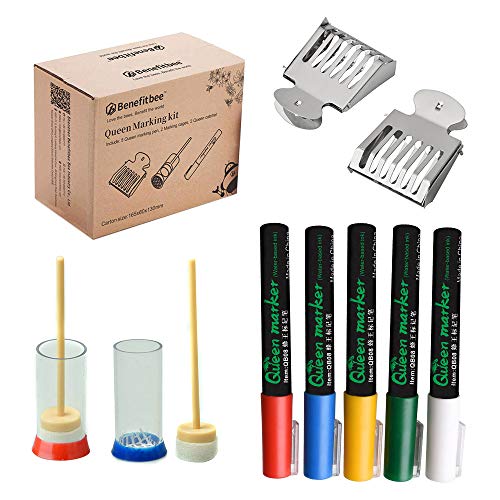
benefitbee Queen Bee Marking Kit
benefitbee · Queen marking kit (listed) · markers and marking cage · color-code ready
Our verdict: The benefitbee marking kit pairs the two things safe queen marking requires: paint pens and a marking cage that immobilizes the queen gently against soft mesh while you dot her thorax. Marked queens transform inspections, seconds to find instead of minutes, and instantly expose supersedure when an unmarked queen appears on the comb. For queens worth $30 to $50 each, or worth a whole grafting round of your effort, a $22 marking setup is trivially justified.
An unmarked queen is a rumor; a marked queen is a fact. Every inspection question that matters, is she alive, is she this year's, did the colony replace her without asking, resolves in one glance at a paint dot. The benefitbee marking kit handles the part that intimidates beginners: the listed marking cage traps the queen against a soft surface, immobilizing her for the two seconds a clean thorax dot requires, with no freehand grabbing and no risk of a dropped queen vanishing into the grass. Dot the thorax only, never the head or wing roots, let the paint dry a few breaths before release, and she walks back onto the comb a managed asset.
Marking pairs naturally with the catching tools below: clip or catcher to lift her from the comb, cage to hold her, pen to mark, done inside a minute. Do it on a warm calm day mid-inspection, ideally when she is on a frame of capped brood with fewer bees to manage. Newly emerged virgins should wait until after mating to be marked; a mated, laying queen handles the process with zero drama. Every queen this guide's grafting kits produce should leave her mating nuc wearing the year's color, and our inspection walkthrough shows how much faster a marked yard runs.
Who should buy it
Buy the benefitbee kit if you want the controlled, cage-assisted marking method from your first queen onward. It is the right marking setup for anyone who finds freehand queen handling nerve-wracking, which is nearly everyone at first.
What we don't like
Confirm the listed marker colors cover the code years you need; multi-color coverage varies by bundle. Paint pens dry out if uncapped carelessly, and any marking session carries nonzero handling risk, which is why the cage method this kit enables is the method we teach.
- Role
- Queen marking
- Listed contents
- Markers and marking cage
- Method
- Cage-immobilized thorax dot
- Color code
- White in 2026 (years ending 1/6)
- Approx. price
- ~$22
Pros
- Marking cage removes the scariest handling step
- Marked queens make every inspection faster
- Exposes supersedure the moment it happens
- Cheap insurance on queens worth $30-50
Cons
- Verify listed colors against code years you need
- Pens demand capping discipline
- All marking carries slight handling risk
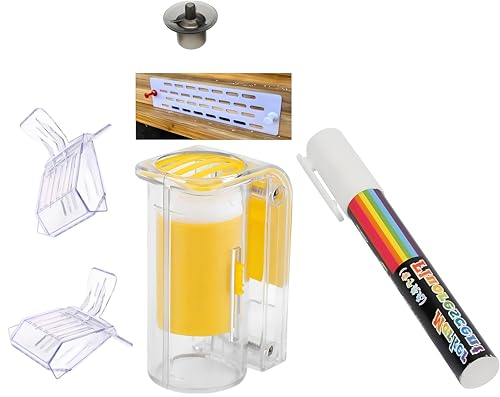
YOFAN Queen Bee Catcher Set, 6-Piece
YOFAN · 6-piece queen catcher set (listed) · clip and cage capture tools · ~$10
Our verdict: The YOFAN set covers queen capture, the step upstream of marking, caging, and every requeen, for about the price of lunch. The listed six pieces center on clip-style catchers that scoop a queen off the comb without fingers ever touching her, plus cage components for holding and transport. It is the cheap kit that should live in every bee toolbox, because queen emergencies never schedule themselves.
The day you need a queen catcher, you need it within arm's reach. A supersedure cell inspection that turns up two queens, a swarm settling on a fence post with the old queen in its heart, a marking session, a planned requeen: all of them start with safely lifting one irreplaceable insect off a comb of thousands. The YOFAN 6-piece set makes that a tool operation instead of a nerve operation: clip catchers close gently around the queen with space she cannot be crushed in, and the listed cage pieces hold her calmly for marking, transport, or introduction.
At about $10 this is also the natural companion purchase to either marking kit above, and the honest overlap note: the Qualirey kit below bundles its own clips, so buyers going that route may not need this set separately. Where the YOFAN earns a standalone slot is the toolbox multiple: one set in the bee bag, one at the bench, spares for the neighbor kid learning on your yard. Queen handling is also the gateway skill for the whole rearing pipeline this guide covers, and for the requeening decisions in our requeening guide: catch calmly, and everything downstream gets easier.
Who should buy it
Buy the YOFAN set as the default capture hardware for any beekeeper who does not yet own queen clips, and as cheap spares for those who do. It belongs in the toolbox before the day it is suddenly indispensable.
What we don't like
Budget plastic hinges want a gentleness the tool itself is teaching you; clips live longer when never forced. The listed piece count spans capture and cage components rather than six distinct tools of equal value. And buyers of bundled marking kits like the Qualirey may find some overlap.
- Role
- Queen capture and holding
- Listed contents
- 6-piece clip and cage set
- Method
- Clip capture, no direct handling
- Cost class
- Toolbox staple
- Approx. price
- ~$10
Pros
- Fingers never touch the queen
- Cheap enough for spares everywhere
- Covers capture, holding, and transport
- The prerequisite tool for marking and requeening
Cons
- Budget hinges reward gentle use
- Piece count includes minor components
- Overlaps with clips bundled in marking kits

Qualirey 15-Piece Queen Marking Kit
Qualirey · 15-piece kit (listed): 8 marking pens, 5 catcher clips, 2 bottles · multi-year color coverage
Our verdict: The Qualirey kit is the volume answer to queen marking: a listed eight pens across colors, five catcher clips, and accessory bottles, which covers the full five-color international rotation with spares for the colors that dry out first. For about $17 it equips marking and capture in one order, making it the value bundle for beekeepers who intend to mark every queen for years, which is all of them, once they start.
Marking is a habit, and habits need supplies that do not run out. The five-year color rotation means a marking pen bought for 2026's white queens will not mark 2027's yellow ones, and single-color kits quietly expire. The Qualirey 15-piece kit solves the whole rotation at once: eight listed pens spanning multiple colors, five clip catchers so capture hardware is never the bottleneck, and two bottles rounding out the accessories. One purchase, and both this season's grafted queens and the next several years of requeens get their correct color on schedule.
Against the benefitbee kit above, the trade is the marking cage versus color depth: benefitbee's cage gives the most controlled single marking experience, Qualirey gives more pens and more clips for less money. Confident hands take the Qualirey; nervous hands take the cage. Either way, mark on warm days, thorax only, and let paint dry before release. The clips here also stand in for a separate catcher set, consolidating the toolbox. Marked queens then make the rest of your management legible, from the inspection rhythm in our inspection guide to the swarm-season queen checks the first-year calendar schedules for spring.
Who should buy it
Buy the Qualirey kit if you want the full color rotation and spare capture clips in one value order, and you are comfortable marking with clip control rather than a dedicated cage. It is the multi-year supply for committed markers.
What we don't like
No marking cage, so the steadiness comes from you and the clips. Eight pens across colors means fewer spares of any single color than a dedicated one-color buy. Budget pens reward a test scribble before touching a queen, every session.
- Role
- Queen marking and capture bundle
- Listed contents
- 8 pens, 5 clips, 2 bottles
- Coverage
- Multi-year color rotation
- Method
- Clip-controlled marking
- Approx. price
- ~$17
Pros
- Covers the five-color code in one purchase
- Five clips consolidate the catcher toolbox
- Best per-piece value in the marking category
- Years of requeens supplied at once
Cons
- No marking cage included
- Fewer spares per individual color
- Test pens before each session

Apimaye Insulated 7 Frame Nucleus Hive
Apimaye · Insulated 7-frame Langstroth nucleus hive · assembled (listed) · overwinter-capable housing
Our verdict: The Apimaye 7-frame insulated nuc is where the queens you raise go to become colonies. Its insulated walls hold brood-nest temperatures stable in the small clusters that mating nucs and new splits run, its assembled plastic construction shrugs off weather that rots budget nuc boxes, and it is genuinely capable of overwintering a queen-right nucleus, which turns spare queens from a summer luxury into spring inventory. Expensive, and worth it for the operation queen rearing builds.
Queen rearing's dirty secret is that the queens are the easy part; housing them well is the investment. A mating nuc holds a small, thermally fragile population that must keep brood warm with a fraction of a full colony's workforce, and every degree the box loses is honey burned and brood chilled. The Apimaye 7-frame insulated nuc attacks exactly that: listed insulated double walls that damp both summer spikes and cold snaps, an assembled weatherproof build with the brand's signature integrated feeders and ventilation control, and seven-frame capacity that gives a mated queen room to prove her laying pattern before promotion to a full hive.
The honest scale question: at about $224 this is not the box for banking a dozen mating nucs; budget wooden nucs from our nuc box guide serve high-count mating yards at a fraction of the cost. The Apimaye is the premium tier for the queens that matter: your breeder queen's home, the overwintering nucs in your spring plan, the split you intend to grow. It is also the rare nuc that needs no assembly, painting, or maintenance beyond a rinse, which sideliners with more grafts than weekends will feel immediately. Buy budget cups by the hundred and housing that lasts a decade; that allocation is the whole economics of this guide in one sentence.
Who should buy it
Buy the Apimaye 7-frame nuc for the queens your operation depends on: breeder stock, overwintering nucleus colonies, and premium splits. It is the housing investment for beekeepers whose queen rearing has become a real pipeline.
What we don't like
It costs ten times a budget wooden nuc, which caps how many mating slots it can economically provide. Plastic-and-insulation construction is a look and a philosophy not every traditionalist wants in the yard. And frames are your responsibility; the listed price is the hive body system.
- Role
- Premium mating, increase, and overwintering nuc
- Capacity
- 7 Langstroth frames (listed)
- Construction
- Insulated, assembled plastic (listed)
- Season
- Year-round, overwinter-capable
- Approx. price
- ~$224
Pros
- Insulation stabilizes small, fragile clusters
- Genuinely overwinter-capable nucleus housing
- Assembled, weatherproof, zero maintenance painting
- Integrated feeder and ventilation ecosystem
Cons
- Premium price limits mating-yard scale
- Plastic construction is a deliberate aesthetic trade
- Frames not included at the listed price
More gear worth comparing
Beyond this guide: the highest-rated gear across every category and budget, with a live price check on each.



As an Amazon Associate we may earn from qualifying purchases, at no cost to you.
Quick shop: every pick
Skip the scroll: the whole lineup, with a live price check on each.
- APlayfulBee Queen Rearing Kit, Complete SystemBest OverallAPlayfulBee · ~$20Check Price
- HunterBee JZBZ Queen Rearing KitBest Standard SystemHunterBee · ~$19Check Price
- Walfront Queen Rearing Kit, 110 Cell Cups with Cell BarBest Bulk CupsWalfront · ~$20Check Price
- benefitbee Queen Bee Marking KitBest Marking Kitbenefitbee · ~$22Check Price
- YOFAN Queen Bee Catcher Set, 6-PieceBest Budget CatcherYOFAN · ~$10Check Price
- Qualirey 15-Piece Queen Marking KitBest Marking ValueQualirey · ~$17Check Price
- Apimaye Insulated 7 Frame Nucleus HiveBest Premium Mating NucApimaye · ~$224Check Price
How we chose
We judge queen gear on the queen's terms: does the cup geometry take a graft cleanly, do bees accept and draw the cells, and does the cage hardware protect a virgin without stressing her. Acceptance rate is the metric everything serves.
Beginner-viability weighs heavily: queen rearing has a learning curve, so kits that include the whole pipeline and forgive a shaky first graft rank above bare components.
Marking tools are judged on control and safety: a marking cage or catcher that lets you immobilize a queen gently beats freehand daring, and paint pens must dry fast and stay put.
Listed counts, materials, and contents are treated as listed, not verified: we do not count 110 cups, and neither should your purchase decision hinge on cup 108.
Prices come from our verified offer table; no brand bought a placement, and the $30-50 cost of purchased queens is the benchmark every kit here is measured against.
Key terms
- Grafting
- Transferring day-old larvae from worker cells into artificial queen cups so a colony raises them as queens. The core skill of queen rearing: modest tooling, real technique, and larvae age as the deciding variable.
- Cell cup
- The artificial queen-cell-shaped cup a grafted larva is placed into, mounted on bars in a cell-builder colony. JZBZ-pattern cups are the industry standard with the widest ecosystem of protectors and cages.
- Starter colony
- A queenless, nurse-bee-packed colony used to accept fresh grafts, its broodlessness and crowding driving maximum royal jelly feeding for the first 24 to 48 hours.
- Finisher colony
- A strong queen-right colony that carries accepted queen cells from the starter through capping, feeding them on a boomer's surplus, with the cells kept above an excluder away from the resident queen.
- Mating nuc
- A small hive housing one ripe queen cell or virgin queen while she completes mating flights and starts laying. Insulated versions like the Apimaye hold brood temperature with the small clusters mating nucs run.
- Queen marking color code
- The international five-color rotation for marking queens by year: white (years ending 1/6), yellow (2/7), red (3/8), green (4/9), blue (5/0). 2026 is a white year.
- Supersedure
- A colony replacing its own queen without swarming. In a marked yard it announces itself as an unmarked or wrong-color queen on the comb, which is half the argument for marking.
- Virgin queen
- An emerged, unmated queen. She hardens, orients, and takes mating flights over roughly her first two weeks, then begins laying; she is the fragile stage the mating nuc exists to protect.
Questions, answered
Is it hard to raise your own queen bees?
The mechanics are learnable in a season: graft day-old larvae into cups, let a queenless starter accept them, finish the cells in a strong colony, and give each ripe cell a mating nuc. The genuinely hard parts are timing and colony strength, not tooling. Expect a humbling first round and steady improvement after; the $20 kits make the experiment nearly free.
How much does a queen bee cost in 2026?
Mated queens from breeders generally run $30 to $50 each before shipping, more for instrumentally inseminated or breeder-grade stock, and availability gets tight in mid-summer panic season. That price is the benchmark that makes a $20 grafting kit and homegrown queens such lopsided economics for anyone with two strong colonies.
What is the queen marking color for 2026?
White. The international code rotates five colors by the year's final digit: white for 1 and 6, yellow for 2 and 7, red for 3 and 8, green for 4 and 9, blue for 5 and 0. Since 2026 ends in 6, every queen raised or bought this season gets a white thorax dot.
What age larvae do you graft for queens?
As close to 24 hours after hatching as possible, and under 36: tiny comma-shaped larvae floating on visible royal jelly. Older larvae have already begun worker development and make smaller, poorer queens. If a larva looks comfortably big enough to graft easily, it is probably too old.
What is a cell starter and finisher?
The two-colony system that raises grafted cells: a starter is queenless and packed with nurse bees, which makes it accept grafts ravenously for the first day or two; a finisher is a strong queen-right colony that feeds the accepted cells through capping above a queen excluder. Small operations can combine both roles in one colony with simplified methods.
How long from grafting to a laying queen?
About a month: cells are capped within days, ripe around day 10 after grafting, and queens emerge around day 11 to 12 post-graft. The virgin then spends roughly two weeks hardening, orienting, and mating before she starts laying. Weather during the mating window is the step you cannot control, which is why grafters run extra cells.
Do I need a mating nuc for each queen?
Each virgin needs her own queenless unit to emerge into, fly from, and return to, so yes, one mating slot per queen you finish. Budget wooden nucs and divided mating boxes serve volume cheaply; an insulated unit like the Apimaye 7-frame is the premium slot for breeder queens and any nucleus you intend to overwinter.
How do you mark a queen bee safely?
Catch her with a clip so fingers never touch her, immobilize her gently, ideally in a marking cage against soft mesh, and place one small paint dot on the thorax only, never the head or wings. Let it dry a few moments before release. Mark mated, laying queens on warm calm days; leave virgins unmarked until after mating.
Why did my colony replace the queen I raised?
Supersedure usually means the colony judged her failing or poorly mated: sparse laying, patchy brood, or injury. Some replacement rate is normal even for professionals, which is why grafting rounds overproduce. Marked queens expose supersedure instantly, an unmarked queen where your white-dotted one lived, and your notes tell you whether a line supersedes too often to graft from.
When is the best time of year to raise queens?
From spring buildup through late summer, whenever drones are abundant and flying, because queens mate in the air with the local drone pool. Peak conditions are usually late spring on a light flow. Stop when fall drone eviction begins; a queen who cannot mate well is worse than no queen at all.
Keep reading
How to Requeen a Hive
The installation half of queen rearing: introducing, protecting, and confirming the queens you raise.
The Best Nuc Boxes and Swarm Traps (2026)
The affordable mating-nuc and increase housing that scales the queen pipeline.
Apimaye Ergo Beehive Review
The full-size flagship behind the insulated nuc: our long-look at the Apimaye system.
First-Year Beekeeping Calendar
When drones fly, when grafting windows open, and when queen season ends, month by month.
How to Do a Hive Inspection
Finding queens, reading brood patterns, and the inspection rhythm marked queens accelerate.
The Best Varroa Mite Treatments (2026)
Requeening with hygienic stock is a mite strategy: the treatment program it complements.