Our Pick: Apimaye
Check PriceThe Best Premium Insulated Beehives (2026)
Our pick is the Apimaye Ergo Insulated Bee Hive Set with Plastic PRO Frames at $320: a complete, double-walled, insulated 10-frame system with an integrated top feeder, a pollen trap, and a screened bottom board built in, ready for bees the day it arrives. It is the most expensive way to start a colony in our entire catalog, and it is also the one purchase in beekeeping where the premium most clearly buys something bees measurably use: retained heat in January and dry air in March.
By The BeehiveKits Hive Desk2026-08-2816 min read Fact-checked against verified Amazon listingsHow we research
Here is the blunt math behind this page. The Bee Informed Partnership's national surveys have put annual US colony losses around 40 to 50 percent in recent years, and winter is where a huge share of those deaths happen (Bee Informed Partnership). A colony in a thin-walled wooden box spends the cold months eating honey to generate heat, and much of that heat leaks straight out through three-quarters of an inch of pine. Worse, the warm moist air the cluster exhales condenses on a cold inner cover and drips back down as ice water. Cold bees survive; wet bees die. Insulated hives attack both problems at once, which is why university extension winter-prep guidance keeps circling back to insulation and moisture management as the levers a beekeeper actually controls (Penn State Extension).
Apimaye is the brand that built its whole identity on this argument. The Ergo hives are double-walled food-grade plastic with insulation in the cavity, and the listed feature set reads like a winter checklist: integrated top feeder so you never crack the hive in the cold, entrance reducers, a screened bottom with a removable tray for mite monitoring, and latches that hold the stack together in wind. Everything below is standard 10-frame Langstroth footprint, so your existing frames, excluders, and extractors still fit. We ranked the full sets first, then the expansion boxes and components that grow the system.
The usual disclosure, plainly: no brand paid for a placement here, and Apimaye did not see this page before publication. Links go to Amazon; if you buy through one we may earn a commission at no cost to you. Prices were verified against live listings on August 28, 2026, and specs we could not verify ourselves are marked as listed. If you are still deciding whether bees are for you at all, start with our guide to how to start beekeeping before spending premium money.
What to know
- Our pick is the Apimaye Ergo set with plastic PRO frames ($320): the complete insulated system, frames included, nothing left to buy but bees.
- Already own frames? The Apimaye Ergo 10 Frame set ($295) is the same hive without frames, and the smarter buy for sideliners with drawn comb.
- Insulation earns its money twice: warmer clusters burn fewer honey stores in winter, and warm inner surfaces stop the condensation drip that kills wet colonies.
- The whole system is standard 10-frame Langstroth footprint (listed), so frames, queen excluders, and extractors from your wooden hives carry over.
- Expansion path: add the $130 insulated deep or $230 insulated medium super as the colony grows, and run splits in the $224 insulated 7-frame nuc.
- On a budget, the $72 Apimaye screened bottom board brings mite monitoring and ventilation control to an ordinary wooden 10-frame hive.
At a glance
| Product | Best for | Format | Standout | Price | Check price |
|---|---|---|---|---|---|
| Apimaye Ergo set with PRO frames | Our Pick | 10-frame set, frames included (listed) | Complete insulated system, bee-ready | $320 | Check Price |
| Apimaye Ergo 10 Frame set | Best with your own frames | 10-frame set, no frames (listed) | Same hive, $25 less, your comb | $295 | Check Price |
| Apimaye Insulated Deep Super | Best brood expansion | 10-frame deep body (listed) | Grows the brood nest, stays insulated | $130 | Check Price |
| Apimaye Insulated Medium Super | Best honey super | 10-frame medium (listed) | Insulated honey storage, lighter lifts | $230 | Check Price |
| Apimaye Insulated 7 Frame Nuc | Best for splits and queens | 7-frame nucleus hive (listed) | Overwinter nucs like a pro outfit | $224 | Check Price |
| Apimaye Screened Bottom Board | Best wooden-hive upgrade | 10-frame Langstroth bottom (listed) | Mite tray + ventilation for $72 | $72 | Check Price |
The Apimaye insulated lineup at a glance. Configurations are the manufacturer's listed contents; prices verified against live Amazon listings on August 28, 2026.

Apimaye Ergo Insulated Bee Hive Set with Plastic PRO Frames
Apimaye · 10-frame Langstroth footprint · double-walled insulated plastic · PRO frames included · all listed
Our verdict: This is the whole Apimaye argument in one box: insulated double-walled bodies, integrated top feeder, pollen trap, screened bottom with mite tray, and the plastic PRO frames already included. At $320 it costs double a good wooden kit, and in exchange your colony enters winter in the best-protected housing on this site. If you are buying one premium hive, buy this one.
The set with frames is the version we hand people, because it removes the last excuse. The standard Apimaye pitch has always had one asterisk: the hives ship without frames, and a new keeper discovers that on unboxing day. The Apimaye Ergo set with plastic PRO frames closes that gap. The listed package is the full Ergo system: double-walled insulated plastic brood chamber and super, an integrated hive-top feeder you can refill without opening the brood nest, a pollen trap built into the entrance, a screened bottom board with a removable inspection tray, entrance reducers, division boards, and the PRO frames to fill it. You add bees and a stand, and you are keeping.
The overwintering case is the reason this page exists. A cluster in an insulated cavity spends less energy holding temperature, which means it consumes stores more slowly and comes out of winter stronger, and warm interior wall surfaces mean the moisture the bees exhale is far less likely to condense and rain back onto the cluster. Extension winter-prep guidance consistently names moisture, not cold alone, as the killer in wooden equipment (Penn State Extension). Apimaye's design attacks that directly, and the screened bottom with tray doubles as your varroa monitoring station: pull the tray, count the mite drop, decide.
The honest caveats: it is plastic, and some keepers simply want wood; the PRO frames are plastic too, and bees can be slow to draw plastic foundation until it is well waxed. And $320 is real money, though the pieces it bundles (feeder, pollen trap, screened bottom) are all things wooden-hive keepers end up buying separately anyway. Priced as a system rather than a box, the premium shrinks fast.
Who should buy it
Buy the PRO-frames set if you are starting fresh or adding a hive and want the full insulated system with zero missing pieces: first-year keepers who would rather not discover the no-frames asterisk in April, cold-climate keepers anywhere winter is a real event, and anyone who wants feeding and mite monitoring built into the architecture instead of bolted on.
What we don't like
The price, obviously: $320 buys two complete wooden kits. The included frames are plastic, and colonies draw plastic foundation reluctantly until it carries a good wax coat, so budget patience or extra wax. And a plastic hive never smells like a cedar one; some of what you give up is romance, and we will not pretend romance is worthless.
- Format
- 10-frame Langstroth footprint (listed)
- Construction
- Double-walled insulated food-grade plastic (listed)
- Frames
- Plastic PRO frames included (listed)
- Feeder
- Integrated hive-top feeder (listed)
- Mite control
- Screened bottom board with removable tray (listed)
- Extras
- Pollen trap, entrance reducers, division boards (listed)
- Price
- $320
Pros
- Complete insulated system: nothing left to buy but bees
- Integrated top feeder means feeding without opening the hive
- Screened bottom with tray makes mite monitoring routine
- Double-walled insulation for winter warmth and summer shade
- Standard 10-frame footprint keeps your Langstroth gear compatible
Cons
- $320 is the most expensive starter path on this site
- Plastic frames draw slowly until well waxed
- All-plastic construction is a dealbreaker for wood purists
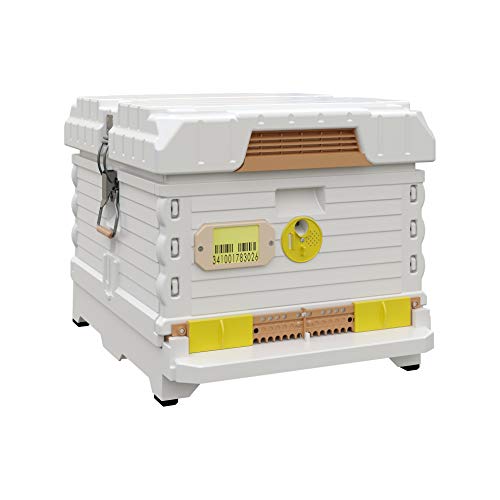
Apimaye Ergo Insulated 10 Frame Bee Hive Set (No Frames)
Apimaye · 10-frame Langstroth footprint · double-walled insulated plastic · frames NOT included · all listed
Our verdict: Identical Ergo architecture, $25 less, no frames in the box. For a beekeeper with existing equipment this is the better buy, because your drawn comb is worth more to a colony than any new foundation. For a true beginner it is a trap unless you remember to order frames the same day.
Drawn comb is the most valuable asset in your apiary, and this is the hive that lets you keep using it. The Apimaye Ergo Insulated 10 Frame set is the same double-walled insulated system as our top pick: integrated top feeder, pollen trap, screened bottom with tray, latches, entrance management, all listed. The only difference is the empty frame rests. Because the body is standard 10-frame Langstroth (listed), your existing deep frames drop straight in, and a colony transferred onto its own warm drawn comb barely notices the move. That makes this the natural Apimaye entry point for the sideliner upgrading a yard one hive at a time.
Why the frameless version at all? Frame preference is one of beekeeping's real religions. Plenty of keepers want wooden frames with wax foundation in every box they run, or foundationless frames, or drone frames for mite trapping, and Apimaye selling the hive bare respects that. You get the insulation story where it matters, the walls and covers, and you populate the interior your way. The $25 saved nearly covers a ten-pack of wooden deeps. Just run one frame standard per hive: mixing plastic PRO and wooden frames in a single brood box works, but comb management gets messier.
Who should buy it
Buy the no-frames Ergo if you already keep bees and own frames or drawn comb, if you have strong opinions about foundation, or if you are converting a wooden-hive yard to insulated equipment box by box. It is the sideliner's version of the flagship.
What we don't like
It quietly punishes the unwary beginner: $295 and no way to house a bee until frames arrive. The savings over the PRO set is only $25, so if there is any chance you will just use the included plastic frames anyway, the bundle is the better value. Same plastic-or-nothing construction question as the whole line.
- Format
- 10-frame Langstroth footprint (listed)
- Construction
- Double-walled insulated food-grade plastic (listed)
- Frames
- Not included
- Feeder
- Integrated hive-top feeder (listed)
- Mite control
- Screened bottom board with removable tray (listed)
- Price
- $295
Pros
- Full Ergo insulated feature set, listed identical to our top pick
- Takes standard deep frames, so drawn comb transfers straight in
- Respects your frame and foundation preferences
- Slightly cheaper entry into the Apimaye system
Cons
- No frames: beginners can get caught flat-footed
- Only $25 cheaper than the frames-included set
- Plastic construction, same as the whole line

Apimaye Insulated Deep Super, 10 Frame
Apimaye · 10-frame Langstroth deep body · insulated walls · frames not included · all listed
Our verdict: A booming Apimaye colony needs room, and stacking a thin wooden deep on an insulated hive undoes half the point. The insulated deep super keeps the whole column warm, matches the Ergo latches and footprint (listed), and at $130 is the cheapest full-size box in the system. Buy it in year one; you will need it by the flow.
An insulated hive is only as warm as its coldest box. When your colony fills its first chamber, the tempting move is to stack whatever spare wooden deep is in the shed. It works, bees are adaptable, but you have now bolted a single-wall radiator onto a double-wall hive, and the cluster's heat finds it immediately. The Apimaye Insulated Deep Super is the system-native answer: a 10-frame Langstroth deep (listed) with the same insulated wall construction, designed to latch into the Ergo stack and keep the thermal envelope intact from floor to lid.
The deep is the box we recommend for brood expansion, and expansion comes faster than new keepers expect: a healthy spring colony can want a second chamber within weeks of a strong start. Remember the weight math before you commit to deeps for honey, though: a full 10-frame deep runs about 80 to 90 pounds by common listed estimates, which is why we steer harvest storage toward the medium below. Frames are not included here either, so pair it with a ten-pack from our frames and foundation guide, and set the growing stack on something rated for the load from our stands and winter wraps roundup.
Who should buy it
Buy the insulated deep if you run an Ergo hive and the colony is filling its brood chamber: it is the box that doubles the nest without breaking the insulation story. Also the right spare to have on hand for catching a spring boom or hiving a big swarm.
What we don't like
$130 for a single bare box stings when a wooden deep costs a third of that, and frames are extra. A deep full of honey is a back-punishing lift, so plan it as brood space, not harvest space. And it only makes thermal sense on an Apimaye stack; on a wooden hive it is an expensive mismatch.
- Format
- 10-frame Langstroth deep (listed)
- Construction
- Insulated plastic walls (listed)
- Frames
- Not included
- Full weight
- About 80 to 90 lbs full of honey (listed estimates)
- Price
- $130
Pros
- Keeps the whole stack insulated as the colony grows
- Standard deep dimensions take ordinary Langstroth frames
- Latches into the Ergo system (listed)
- Cheapest full-size box in the Apimaye line
Cons
- Several times the price of a wooden deep
- Frames sold separately
- Deeps full of honey are brutally heavy to lift

Apimaye Insulated Medium Super, 10 Frame
Apimaye · Standard 10-frame Langstroth medium · insulated construction · all listed
Our verdict: The medium super is where your honey crop lives, and Apimaye's insulated version keeps summer heat from cooking it and shoulder-season chill from chasing the bees out of it. A full medium runs around 50 pounds by common estimates, a lift most keepers can manage. At $230 it is priced like the premium component it is; we wish it were cheaper, and we would still buy it.
Harvest happens in mediums for a reason your back already knows. A full deep of honey is an 80-pound-plus deadlift off the top of a chest-high stack; a full medium is roughly 50 pounds by common listed estimates, which is the difference between a chore and an injury. The Apimaye Insulated Medium Super brings the system's wall construction to the harvest box, in the standard 10-frame Langstroth medium format (listed), so ordinary medium frames and your extractor tooling all fit. Insulation earns its keep up here too: it moderates summer heat over the broodnest and keeps bees working and capping in the super later into the cool shoulder seasons.
The awkward fact on this listing is the price: at $230 the medium costs $100 more than the deep, which inverts every wooden-equipment instinct you have. Our advice is to buy it for what it is, the harvest box of a premium system, and to count the honey math before flinching: established colonies commonly average 30 to 60 pounds of surplus in most US regions, and how much of that you actually pull is the subject of our honey-per-hive explainer. One good season fills this box. When it is capped and ready, our honey extractor guide covers what happens next.
Who should buy it
Buy the insulated medium if you run Apimaye brood boxes and want the harvest story to match the winter story: one system, one footprint, one set of latches. Especially right for keepers who have already learned, the hard way, what a full deep weighs.
What we don't like
The price is genuinely hard to love: $230 for a medium is more than many complete wooden kits, and $100 more than Apimaye's own deep. Frames are extra. If your budget only stretches to one insulated expansion box, buy the deep for the brood nest and run wooden mediums for harvest; the bees winter in the brood boxes, not the supers.
- Format
- Standard 10-frame Langstroth medium (listed)
- Construction
- Insulated plastic (listed)
- Frames
- Not included
- Full weight
- About 50 lbs full (listed estimates)
- Price
- $230
Pros
- Manageable harvest-box weight when full
- Standard medium format fits ordinary frames and extractors
- Keeps the insulated envelope intact through the supers
- Moderates super temperature in heat waves and cold snaps
Cons
- $230 is steep, and more than the larger deep
- Frames not included
- Overkill if you only super during warm months

Apimaye Insulated 7 Frame Langstroth Nucleus Hive
Apimaye · 7-frame Langstroth nucleus · insulated, assembled (listed) · standard deep frame compatible
Our verdict: Nucs are how beekeepers stop buying bees, and winter is where backyard nucs die. Apimaye's insulated 7-frame nuc gives a small cluster the thermal help it needs most, takes standard deep frames (listed), and arrives assembled. At $224 it costs like three wooden nuc boxes; an overwintered nuc is worth more than that every spring.
The cheapest bees you will ever own are the ones you raise yourself. A nucleus colony, a queen and a few frames of brood and bees, is how established keepers make increase, back up their yards against losses, and stop writing a check for packages every April. The catch is that small clusters have the worst surface-to-volume ratio in the apiary: they lose heat fastest and die in winter most often. The Apimaye Insulated 7 Frame Nuc aims squarely at that weakness, wrapping a seven-frame Langstroth nucleus (listed) in the same insulated construction as the full hives, with feeding and ventilation management built in (listed).
Seven frames is a genuinely useful size, roomier than the five-frame wooden standard, which buys a growing split more runway before it must be moved. Because it takes standard deep frames, resources shuttle freely between this box and your production hives: a frame of brood in, a drawn comb out. We would use it three ways: overwintering fall splits, housing a caught swarm through establishment (see our nuc box and swarm trap roundup for the trapping half), and banking a backup queen. Against national loss rates of 40 to 50 percent (Bee Informed Partnership), a live nuc in April is the difference between rebuilding and restocking, and your seasonal calendar should have a slot for making one.
Who should buy it
Buy the insulated nuc once you have at least one production colony to split from: second-year keepers making increase, anyone tired of buying replacement bees, and queen-minded keepers who want a warm bank box. It is the piece of the Apimaye system that pays for itself most directly.
What we don't like
At $224 it costs roughly three times a decent wooden nuc box, which stings if you only nuc casually. A thriving seven-frame colony outgrows it and must be transferred on schedule. And true beginners do not need it in year one; it is a tool for keepers with resources to split.
- Format
- 7-frame Langstroth nucleus (listed)
- Construction
- Insulated, assembled (listed)
- Frames
- Takes standard deep frames
- Use
- Splits, swarm catches, queen banking, overwintering nucs
- Price
- $224
Pros
- Insulation where small clusters need it most
- Seven frames buys more runway than five-frame nucs
- Standard deep frames interchange with production hives
- Arrives assembled (listed)
Cons
- Triple the price of wooden nuc boxes
- Strong splits outgrow it on a deadline
- A year-two tool, not a year-one need

Apimaye Premium Screened Bottom Board, 10 Frame
Apimaye · Fits standard 10-frame Langstroth (listed) · screened floor with removable tray
Our verdict: Not ready for a $320 hive? This is the Apimaye component that upgrades the wooden equipment you already own: a screened bottom board sized for standard 10-frame Langstroth (listed), with a removable tray for mite counts and seasonal airflow control. At $72 it is the cheapest meaningful move on this page.
The floor is the most underrated part of a beehive. A solid wooden bottom board traps debris, blocks airflow, and tells you nothing. A screened floor does three jobs at once: fallen varroa mites drop through the mesh and cannot climb back to the cluster; a sticky-board count on the removable tray turns mite monitoring into a two-minute chore instead of an alcohol wash; and sliding the tray in or out tunes ventilation from open summer airflow to a closed winter floor. Extension mite-management guidance treats regular monitoring as non-negotiable, with treatment commonly advised around thresholds of 2 to 3 mites per 100 bees (Bee Health extension community), and a monitoring tool built into the hive is the one you will actually use.
The Apimaye Premium Screened Bottom Board brings the system's plastic-precision build to that job, and because it is dimensioned for standard 10-frame Langstroth (listed), it slides under the wooden hive you already run. That makes it the honest entry point to this whole page: try Apimaye's engineering for $72, use the tray data to run your mite treatment decisions, and if the build quality sells you, the full Ergo system is waiting. It also pairs naturally with an oxalic acid vaporizer: the tray gives you the before-and-after drop counts that tell you whether a treatment worked.
Who should buy it
Buy the screened bottom board if you keep wooden 10-frame hives and want built-in mite monitoring and ventilation control, or if you want to audition Apimaye quality before committing to a full set. It is also the natural replacement when a wooden floor finally rots.
What we don't like
At $72 it costs two to three times a basic wooden screened floor, and the premium is in build quality rather than new capability. It fits 10-frame equipment (listed); 8-frame keepers are out of luck. And a screened floor is a monitoring tool, not a mite treatment: the tray tells you when to act, it does not act for you.
- Fit
- Standard 10-frame Langstroth (listed)
- Floor
- Screened, with removable inspection tray (listed)
- Function
- Mite drop monitoring, adjustable ventilation
- Price
- $72
Pros
- Makes mite-drop monitoring a routine two-minute check
- Tray tunes ventilation season by season
- Upgrades existing wooden 10-frame hives
- Cheapest entry into Apimaye build quality
Cons
- Pricey next to basic wooden screened boards
- 10-frame only (listed)
- Monitors mites; does not treat them
More gear worth comparing
Beyond this guide: the highest-rated gear across every category and budget, with a live price check on each.



As an Amazon Associate we may earn from qualifying purchases, at no cost to you.
Quick shop: every pick
Skip the scroll: the whole lineup, with a live price check on each.
- Apimaye Ergo Insulated Bee Hive Set with Plastic PRO FramesBest OverallApimaye · $320Check Price
- Apimaye Ergo Insulated 10 Frame Bee Hive Set (No Frames)Best If You Already Own FramesApimaye · $295Check Price
- Apimaye Insulated Deep Super, 10 FrameBest Expansion DeepApimaye · $130Check Price
- Apimaye Insulated Medium Super, 10 FrameBest Honey SuperApimaye · $230Check Price
- Apimaye Insulated 7 Frame Langstroth Nucleus HiveBest Insulated NucApimaye · $224Check Price
- Apimaye Premium Screened Bottom Board, 10 FrameBest Wooden-Hive UpgradeApimaye · $72Check Price
How we chose
Our lens on every product is the same: would we put a colony in it? For insulated hives that means judging the winter story first: wall construction, whether the lid and floor are insulated too (heat leaves upward), and whether moisture has a managed way out.
We weight bee safety and food-grade materials. A poly hive lives in the sun for a decade; coatings, UV resistance, and plastic quality are the difference between an investment and a brittle regret.
We check Langstroth compatibility obsessively. A premium hive that strands you outside the standard 10-frame ecosystem of frames, excluders, and extractors fails our test no matter how warm it is. Every Apimaye piece here is listed as standard 10-frame compatible.
We judge beginner-readiness: can a first-year keeper assemble it, feed through it, and inspect it without prying propolized wood apart in the cold? Integrated feeders and latches score points here.
Prices come from our verified offer table, checked August 28, 2026. Specs we have not measured ourselves are the manufacturer's listed figures and are labeled that way.
No placement is paid. Apimaye earns every slot on this page by being, in our judgment, the insulated system with the deepest expansion path an American beekeeper can actually buy today.
Key terms
- Condensation kill
- The classic winter death in thin-walled hives: warm moist air from the cluster condenses on a cold inner cover and drips ice water back onto the bees. Insulated covers and walls keep interior surfaces warm enough that moisture condenses elsewhere or vents away.
- Winter cluster
- The tight ball a colony forms in cold weather, shivering flight muscles to hold the core warm while consuming honey stores. Smaller clusters lose heat faster, which is why nucleus colonies benefit most from insulation.
- Poly hive
- Shorthand for hives built from insulating plastic or expanded polymer instead of solid wood. Double-walled insulated plastic designs like the Apimaye Ergo belong to the same family: the wall itself slows heat transfer.
- Screened bottom board
- A hive floor of mesh instead of solid wood. Fallen varroa mites drop through and cannot return, a removable tray beneath allows mite-drop counts, and sliding the tray in or out adjusts ventilation by season.
- Pollen trap
- An entrance fitting that brushes some pollen loads off returning foragers into a collection drawer. Integrated in the Ergo design (listed); used sparingly, it harvests pollen without starving the brood nest of protein.
- Hive-top feeder
- A syrup reservoir built into or set atop the hive so bees feed from inside while the keeper refills from outside. It matters most in cold and robbing season, when opening a hive to swap jars costs the colony dearly.
- Langstroth footprint
- The standard American hive dimensions descending from L. L. Langstroth's 1852 movable-frame patent and the 3/8 inch bee space discovery behind it (Wikipedia). Equipment on the standard footprint interchanges: frames, excluders, extractors.
Questions, answered
Are insulated beehives worth the money?
In cold-winter climates, the case is strong: an insulated hive burns fewer honey stores, sidesteps the condensation drip that kills wet clusters, and starts spring stronger. In the Deep South and mild-winter West the winter argument shrinks, though insulation still moderates brutal summer heat. The honest framing: insulation shifts the odds meaningfully, but good stores, low mite loads, and a young queen still matter more than the box.
What is the best insulated beehive for 2026?
Our pick is the Apimaye Ergo Insulated Bee Hive Set with Plastic PRO Frames at $320: double-walled insulated construction, integrated top feeder, pollen trap, and screened bottom board with a mite tray, with frames included so it is bee-ready on arrival. Keepers who already own frames should buy the $295 no-frames version of the same set instead.
Do Apimaye hives fit standard Langstroth frames?
Yes, per the listings: the Ergo bodies, deep super, and medium super are standard 10-frame Langstroth format, and the 7-frame nuc takes standard deep frames. That compatibility is a big part of why we rank the system: your existing frames, queen excluders, and extractor tooling carry over from wooden equipment.
Do bees overwinter better in insulated hives?
The physics favors it: a cluster in an insulated cavity loses heat more slowly, consumes stores more slowly, and faces less condensation over the cluster, and extension winter guidance emphasizes exactly those factors, insulation and moisture control. National surveys from the Bee Informed Partnership have shown annual losses around 40 to 50 percent in recent years, so any controllable edge matters. It is an edge, though, not immunity: mites and starvation kill insulated colonies too.
Why do Apimaye hives come without frames?
Frame choice is personal: wooden with wax foundation, plastic, foundationless, drone comb for mite trapping. The base $295 Ergo set leaves that choice to you, which suits experienced keepers with drawn comb. Beginners should buy the $320 PRO-frames version, or order frames the same day, because the hive cannot house bees without them.
Are plastic frames bad for bees?
Not bad, just slower: colonies often draw wax on plastic foundation reluctantly until it carries a good beeswax coating, and a strong nectar flow or feeding helps. Once drawn, plastic frames are durable, extractor-safe, and immune to wax moth destruction of the midrib. Many commercial outfits run plastic exclusively. If your bees ignore the PRO frames early on, extra wax coating is the standard fix.
Can I put an Apimaye super on a wooden hive?
Dimensionally it should sit on any standard 10-frame Langstroth stack, since the boxes are listed as standard footprint. Thermally it is backwards: one insulated box on a single-wall hive does little, and the latching system is designed to mate with Apimaye components. The component that genuinely upgrades a wooden hive is the $72 screened bottom board, which is built for standard 10-frame equipment.
How do I winterize a wooden hive if I skip the insulated system?
Chase the same physics from outside: reduce the entrance, ensure heavy stores, add top insulation so the inner cover stays warm (stopping the condensation drip), consider a wrap in cold climates, and go into winter with mites controlled. Our stands and winter wraps guide covers the equipment half; the Bee Informed Partnership surveys are a sobering reminder of why the effort is worth it.
Filed under Buyer's Guide
Part of Hive Kits
Keep reading
Best Auto-Flow Beehives
The other premium path: tap-the-hive auto-frame systems, ranked with the honesty the category rarely gets.
Flow Hive vs Langstroth
The total-cost-of-ownership math between the auto-frame route and the classic box plus extractor.
Best 10-Frame Beehives
The wooden 10-frame kits that share this footprint at a third of the price.
Best Beehive Stands & Winter Wraps
The winterizing gear that chases the same warm-and-dry physics for wooden hives.
Best Observation Hives
Window hives that let you check the colony without cracking the boxes open.
8-Frame vs 10-Frame Beehives
The size decision that determines which equipment ecosystem you live in.