Our Pick: Honey Lake
Check PriceThe Beekeeping Cost Index: What Bees Really Cost
Here is the answer before the itemization: a sensible two-hive first year of beekeeping costs roughly $1,000 to $1,300 all-in, a determined single-hive shoestring build can be done for about $340 plus bees, and a premium insulated two-hive apiary lands around $1,900. The single most under-budgeted line is the bees themselves: a nucleus colony runs $150 to $250 as a current market range, a package roughly $100 to $180, and neither is ever included with a hive kit. If you read nothing else on this page, read that sentence twice, because "wait, the bees cost WHAT?" is the most common message we get.
By The BeehiveKits Hive Desk2026-08-2821 min read Fact-checked against verified Amazon listingsHow we research
This page is the budget reference for the whole site. Every price attached to a named product below was verified against live listings on our publication date, and every market-range figure (bees, sugar, jars) is stated as a range because it genuinely varies by region and year. We build three complete shopping lists in tables you can copy, then cover the recurring costs nobody mentions at the point of sale: year-two treatments and feed, replacement woodenware, and the harvest gear that suddenly matters when there is honey.
Standard disclosure, plainly: no brand paid for placement, and some links go to Amazon, where purchases may earn us a small commission at no extra cost to you. Our lens on every product is the same one we use in the full reviews, would we put a colony in it, and the builds below only include gear that clears that bar. Where a cheaper item exists that we would not trust with bees, it is not in the table, and where cheap is genuinely fine, we say so and mean it.
What to know
- Budget the bees first: $150 to $250 per nuc or $100 to $180 per package as market ranges, ordered December through February, never included with any kit.
- Three honest builds: a $340-plus-bees single-hive shoestring, a $1,000 to $1,300 two-hive standard year (our recommendation), and a $1,900-class premium insulated apiary.
- Year two is not free: plan on roughly $150 to $300 per year for treatments, feed, and replacement gear, plus harvest equipment when the honey arrives.
- Your first jar is expensive and it is fine: amortized over early seasons, hobby honey commonly works out to $10 to $30 per pound before the setup pays itself down.
- Never cheap out on woodenware joints, the veil, or varroa treatment; save cheerfully on hive tools, brushes, and anything that does not touch bee safety.

Honey Lake 8-Frame Beehive Starter Kit
Honey Lake · 8-frame Langstroth deep · beeswax coated · frames and foundation included (listed)
Our verdict: The anchor of our shoestring build: a real beeswax-coated 8-frame deep with frames and foundation in the box at a price that leaves room for bees. Lighter lifts than 10-frame gear, standard dimensions, and none of the corner-cutting that disqualifies most sub-$90 kits.
Under $90, most hive kits fail our colony test on missing frames, green lumber, or toy-grade covers. The Honey Lake 8-frame starter ($79.79) is the exception we keep recommending: frames and foundation included, a factory beeswax coating, and 8-frame width that makes every future lift about a fifth lighter.
Plan to add a second deep as the colony grows, and see the 8-frame roundup for the class above it.
Who should buy it
Shoestring builders and anyone starting 8-frame on purpose for the lighter lifting; it is the best sub-$100 first box on the market.
What we don't like
One deep is a starting point, not a home; budget the expansion box up front. Assembly instructions are minimal.
- Configuration
- 8-frame Langstroth deep (listed)
- Material
- Beeswax-coated pine (listed)
- Frames/foundation
- Included (listed)
- Price
- $79.79
Pros
- Cheapest kit that clears our bee-safety bar
- Frames and foundation actually included
- 8-frame width saves your back for years
Cons
- Needs a second deep sooner than buyers expect
- Thin documentation

Apimaye Ergo Insulated Hive Set with PRO Frames
Apimaye · Insulated 10-frame system · integrated top feeder and screened bottom with mite tray (listed) · PRO plastic frames included
Our verdict: The reference premium hive in the US market: insulation that moderates winter and summer alike, an integrated feeder and pollen trap, a mite-count tray built into the floor, and latching parts that survive weather and transport. At $320 with frames it is the top of our budget tables and earns the position.
The Apimaye Ergo with PRO frames ($320.00) collapses several budget lines into one purchase: hive, feeder, screened bottom with monitoring tray, and winter protection, since the double walls do the wrap's job. In hard-winter and brutal-summer climates that is a functional edge, not a luxury.
The trade-offs are plastic-hive trade-offs: nonstandard aesthetics, proprietary parts, and a price that buys four budget kits. The full case for and against lives in the premium insulated hive guide.
Who should buy it
Cold-winter and hot-summer keepers, buy-once-cry-once temperaments, and anyone who wants feeder and mite tray integrated instead of accumulated.
What we don't like
The price, the plastic look, and the ecosystem lock-in: expansions come from Apimaye at Apimaye prices, like the $130 insulated deep super.
- Configuration
- 10-frame insulated system (listed)
- Insulation
- Double-walled body (listed)
- Feeder
- Integrated top feeder (listed)
- Mite tray
- Screened bottom with tray (listed)
- Frames
- Plastic PRO frames included (listed)
- Price
- $320.00
Pros
- Insulation works both seasons, wrap not needed
- Feeder, mite tray, and pollen trap integrated
- Weatherproof latched construction
- Frames included, ready faster than wood kits
Cons
- $320 per hive before bees
- Proprietary parts and plastic aesthetics
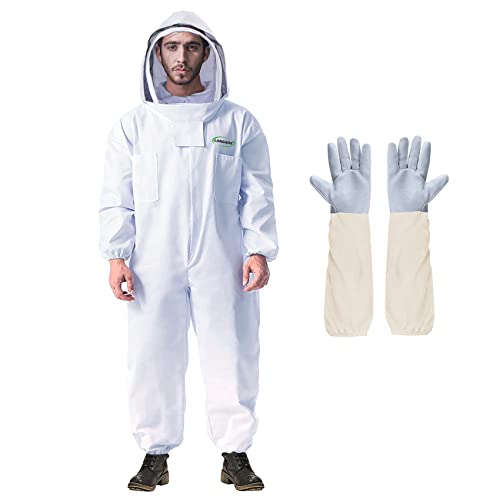
LONGADS Full Beekeeper Suit with Gloves
LONGADS · Full-body suit with veil and gloves included (listed)
Our verdict: The budget suit that covers everything the shoestring build needs: full-body coverage, an included veil and gloves, and construction honest enough for calm inspections. It gives up ventilation, not protection, and that is the right corner to cut at $45.99.
Protection budgets have a floor, and the LONGADS full suit ($45.99) sits right on it: suit, veil, and gloves in one box for less than half the price of ventilated 3-layer gear. For morning inspections and moderate climates it simply does the job.
What the missing $84 buys elsewhere is airflow; August in a single-layer suit is a workout. If your summers are brutal, read the full suit guide before deciding which tier you are.
Who should buy it
Shoestring builders, cool-climate keepers, and anyone buying a spare suit for visitors and helpers.
What we don't like
Single-layer fabric runs hot and sits closer to the skin than ventilated mesh, so work slowly and time inspections for cool hours. Included gloves are basic; many keepers upgrade them first.
- Type
- Full suit with veil
- Gloves
- Included (listed)
- Construction
- Single-layer fabric (listed)
- Price
- $45.99
Pros
- Complete protection, gloves included, under $50
- Full-body coverage builds beginner confidence
- Perfect spare or helper suit later on
Cons
- No ventilation: hot in high summer
- Basic included gloves
How to read this index
Three rules keep this page honest. First, named products carry the exact price we verified on publication day, like the Honey Lake 8-frame starter kit at $79.79; prices drift, so treat them as accurate-at-press and check the live listing. Second, anything bought from a local supplier or grocery store, bees, sugar, lumber for stands, jars, appears as a range, because a nuc in Georgia and a nuc in Massachusetts are different purchases. Third, every build is complete: it includes protection, smoke, tools, feeding, mite management, and winter prep, because a "$100 beekeeping setup" that omits the suit and the treatment is not a budget, it is a countdown.
One framing note: we build around two hives in the standard and premium tiers because two is the correct beginner number, a comparison baseline plus a rescue bank, as we argue at length in how to start beekeeping. The shoestring build is one hive, eyes open, for readers whose budget makes it that or nothing. Beekeeping with one hive beats not beekeeping.
The summary: three builds at a glance
Here is the whole page in one table. Each build is detailed line by line below, and each assumes you still need everything, no inherited gear, no club loaners.
| Build | Hives | Equipment total | Bees (market range) | All-in first year |
|---|---|---|---|---|
| Shoestring | 1 | about $340 | $100 to $180 (package) | about $440 to $520 |
| Standard (our pick) | 2 | about $700 to $800 | $300 to $500 (2 nucs) | about $1,000 to $1,300 |
| Premium insulated | 2 | about $1,350 to $1,450 | $300 to $500 (2 nucs) | about $1,650 to $1,950 |
Where does the money concentrate? In every build, roughly a third to half is woodenware, a quarter to a third is bees, and the remainder splits across protection, tools, feeding, and mite management. That distribution is worth noticing because it tells you where shopping effort pays: a $20 saving on a hive tool is noise, while kit selection and bee sourcing move the whole budget.
The line nobody budgets: the bees themselves
Bees are sold separately, always. The two mainstream formats: a nucleus colony (five frames of bees, brood, stores, and a laying queen) at $150 to $250 as a market range, and a package (about three pounds of loose bees plus a caged queen) at roughly $100 to $180. Nucs cost more because they are further along, typically three to four weeks ahead in buildup, with a proven queen and locally wintered genetics when you buy from a nearby producer. For beginners we consider the nuc premium the best-spent money in the entire budget, and we make the full case in the starting guide.
Two timing facts with budget consequences. Bees are ordered December through February for April-May delivery, so the money leaves your account months before anything buzzes. And prices climb with demand in tight years; national colony losses in the 40 to 50 percent range reported in recent Bee Informed Partnership surveys keep replacement-bee demand, and therefore prices, firm. Budget the top of the range and be pleasantly surprised.
Build one: the shoestring (one hive, about $340 plus bees)
The floor, built honestly: one hive, one keeper, nothing missing that bees need, everything missing that pride wants. This is the build for a tight budget or a try-it year, and every item cleared our would-we-put-a-colony-in-it bar.
| Item | Pick | Price |
|---|---|---|
| Hive kit (8-frame, frames included) | Honey Lake 8-frame starter | $79.79 |
| Full suit with veil and gloves | LONGADS bee suit | $45.99 |
| Smoker | Blisstime stainless smoker | $17.99 |
| Hive tools (2) | ThxBees J-hook tool set | $6.95 |
| Entrance feeders (4-pack) | Aukbeefun entrance feeders | $13.99 |
| Varroa treatment (one round) | Formic Pro 2-dose | $30.00 |
| Second deep box (colony will need it) | ThxBees deep brood box + BEEINN foundation sheets | $39.99 + $15.19 |
| Feeding sugar, season | grocery store | $40 to $60 (range) |
| Stand, wrap, misc | concrete blocks + lumber, DIY | $25 to $45 (range) |
| Equipment total | about $340 | |
| Plus bees (package) | local supplier | $100 to $180 (range) |
What the shoestring gives up, knowingly: the second colony (no rescue bank, no comparison), ventilated protection (the LONGADS is a real suit, but a sweaty one in August), and margin everywhere. It is a tightrope you can absolutely walk; just know it is a tightrope, and read the buying mistakes guide so the savings do not come out of bee safety.
Build two: the standard two-hive year (our recommendation)
This is the build we would hand a friend: two hives, real protection, a full season of feeding and mite management, and winter prep, at roughly $1,000 to $1,300 all-in depending on bee prices in your region.
| Item | Pick | Price |
|---|---|---|
| Hive kits x2 (10-frame, frames included) | Honey Lake 10-frame starter x2 | $231.98 |
| Ventilated suit | USKEEPERS 3-layer suit | $129.99 |
| Goatskin gloves | Forest goatskin gloves | $24.95 |
| Smoker | VIVO large smoker | $29.99 |
| Tool kit | BeeCastle 9-piece tool kit | $25.64 |
| Top feeders x2 | KAGZ 1.5-gallon top feeder x2 | $75.98 |
| Varroa treatment, two rounds | Formic Pro 2-dose + Varroxsan oxalic strips | $72.49 |
| Hive stands x2 | MayBee adjustable stand x2 | $77.88 |
| Winter wraps x2 | MayBee winter wrap x2 | $53.98 |
| Feeding sugar, season | grocery store | $60 to $100 (range) |
| Equipment total | about $780 to $820 | |
| Plus bees (2 nucs) | local producer via your club | $300 to $500 (range) |
Notes on the choices: the 10-frame Honey Lake is our benchmark starter (full field in the starter kit guide); the ventilated suit is the line where we stop economizing, for reasons covered in the suit guide; and two varroa chemistries are budgeted on purpose, because rotation is best practice per the Honey Bee Health Coalition. Each hive will also want a second deep or a couple of medium supers as it grows; that is in the year-two table below, though strong colonies may demand it in year one, so keep roughly $90 per hive of flex.
Protection: the $46-to-$130 decision
The protection budget runs from the $45.99 LONGADS full suit to ventilated 3-layer suits around $130, with jackets like the $79.99 USKEEPERS ventilated jacket splitting the difference for quick checks. What the extra money buys is not more sting-proofing on paper, it is ventilation, and ventilation is what determines whether you actually wear the thing properly zipped in an August inspection. A suit that stays in the shed protects nothing.
Our honest guidance by build: shoestring keepers take the LONGADS and inspect in the cool of morning; standard-build keepers buy ventilated once and thank themselves for a decade. Gloves are cheap either way, $7.49 to $24.95 covers the field. The complete rankings are in suits and jackets and gloves.
The varroa line: the $30 to $75 you must not delete
Every build above carries a mite-management line, and it is the one line we will argue about if you try to cut it. Varroa mites and the viruses they vector are the leading killer of managed colonies in the US, and the treatments are not expensive: a two-dose round of Formic Pro is $30.00, Apiguard thymol trays run $42.99 for ten, and oxalic options like Varroxsan strips are $42.49. Monitoring costs a jar, alcohol, and ten minutes a month. Against a $150 to $250 nuc, treatment is the cheapest insurance in the hobby.
Budget two rounds per year (late summer mandatory, spring or broodless-winter as counts dictate) and rotate chemistries, per extension guidance summarized by the Honey Bee Health Coalition. Product-by-product comparisons, including temperature windows, are in the varroa treatment guide, and vaporizer hardware from the $39.95 Varomorus up is in the vaporizer roundup.
Feeding: sugar is a real line item
New colonies eat money in the nicest way. Figure a first-year colony drinks 25 to 50 pounds of sugar as 1:1 spring syrup while drawing comb, plus another 15 to 30 pounds as 2:1 fall syrup if the season runs lean, which at grocery prices means $30 to $50 per hive per year as a range. The hardware is a one-time cost: a top feeder like the $37.99 KAGZ 1.5-gallon per hive pays for itself in reduced disturbance and reduced robbing versus open or entrance feeding, and the field is compared in the feeder guide.
Do not economize by underfeeding a new colony to "toughen it up." Comb is infrastructure; a colony that stalls at five drawn frames in June is a colony that enters fall small, and fall is not the time to discover that the $40 you saved on sugar cost you a $200 nuc.
Year two: the budget nobody publishes
Good news first: year two is much cheaper than year one, because the capital gear exists. The recurring budget for a two-hive apiary looks like this.
| Year-two item | Typical cost | Notes |
|---|---|---|
| Varroa treatments (2 rounds x2 hives) | $60 to $110 | Rotate chemistries |
| Feed sugar | $40 to $80 | Less than year one; established comb |
| Honey supers + frames (x2 hives) | about $180 | e.g. MayBee medium super $44.99 each plus frames |
| Queen excluders x2 | about $34 | Ambrose plastic excluder $16.88 each |
| Harvest: crush-and-strain kit | $70 to $100 | Buckets, gate, strainer; extractor borrowed from club |
| Jars and lids | $30 to $60 | Scales with harvest |
| Replacement frames/foundation | $30 to $60 | Rotate old comb out |
| Typical year-two total | about $450 to $620 | Drops to $150 to $300 in year three once harvest gear exists |
The wildcard is extraction. Borrow the club extractor in year two, and only buy your own when hive count or impatience demands it: manual machines like the $110.42 VEVOR 2/4-frame manual extractor start the ladder, and the field through the $449.99 VIVO 8-frame electric is ranked in the extractor guide, with the supporting cast in harvesting equipment.
The cost per pound of honey, computed without flinching
Time for the math your family will do out loud at Thanksgiving. Take the standard build: call it $1,150 all-in for year one, plus $530 in year two. First-year harvest is typically little or nothing, since new colonies spend the season drawing comb; established hives in most US regions average roughly 30 to 60 pounds of surplus in a decent year (we unpack the ranges in how much honey per hive). Suppose your two hives yield a combined 70 pounds in year two. Your first 70 pounds cost about $1,680, or roughly $24 per pound.
| Horizon | Total spent | Cumulative honey (illustrative) | Cost per lb |
|---|---|---|---|
| End of year 1 | about $1,150 | 0 to 15 lbs | ouch |
| End of year 2 | about $1,680 | about 70 lbs | about $24 |
| End of year 3 | about $1,930 | about 160 lbs | about $12 |
| End of year 5 | about $2,450 | about 350 lbs | about $7 |
Three notes on that table. The yields are illustrative mid-range figures, not promises; a dearth year or a dead-out moves them. The curve only bends down if colonies survive, which loops back to the varroa line above. And nobody keeps bees to beat the grocery store; the honest accounting is that a few hundred dollars a year buys a working apiary, superior honey, pollination, and the best excuse ever invented to stand in a yard on a Saturday. By hobby standards, that is cheap. Ask a golfer.
Where NOT to cheap out
Five lines where the cheap option costs more, in rough order of regret. One: woodenware squareness. A kit with warped boxes and sloppy rabbets never stops costing you: violated bee space, burr comb on every frame, covers that leak. Buy from the vetted list in the starter kit guide, not the cheapest search result. Two: the veil. Face and neck protection is the difference between a calm keeper and an abandoned hobby; no-name veils with failing zippers are how people quit. Three: varroa management. Covered above; skipping a $30 treatment to protect a $200 nuc is the worst trade in beekeeping. Four: the bees. Craigslist mystery bees and bargain nucs from unknown yards import problems, and used equipment can carry American foulbrood spores that persist for decades (Wikipedia: American foulbrood); buy bees from producers your club vouches for, and be very careful with secondhand comb. Five: the feeder-shaped hole. No feeder means starving spring colonies in a cold snap; it is a $14 to $38 problem, solve it before install day.
Where to save cheerfully
Everything that does not touch bee safety or your face is fair game. Hive tools: the $6.95 ThxBees J-hook pair pries exactly as well as tools costing five times more, and all of them vanish into tall grass at the same rate. Smokers: $17.99 to $29.99 buys everything a smoker needs to do (see the smoker guide). Stands: concrete blocks and two rails are functionally equal to bought stands. Sugar: store brand, always. Paint: leftover exterior latex is tradition. Jars: reused with new lids, fine for gifts.
The other big save is patience. Winter sales are real, clubs run group buys with meaningful discounts, and every experienced beekeeper's garage contains surplus they will happily sell to a mentee, minus anything that ever held comb (see foulbrood, above). Buying over four months instead of one weekend routinely trims 15 to 20 percent off the standard build.
The bottom line, and where to go next
Beekeeping costs about $1,000 to $1,300 to start properly with two hives, roughly $500 the second year as harvest gear arrives, and a few hundred a year after that. It can be done for half that with open eyes, and double that with insulated hardware that earns its keep in harsh climates. The bees are $150 to $250 a colony, ordered in winter, and they are the line to budget first, not last.
From here, the path branches by what you are deciding. Choosing the hive: starter kits, 8 vs 10 frame, or premium insulated. Building the plan: how to start beekeeping and the first-year calendar. Avoiding the classic wallet injuries: beehive kit buying mistakes, which is this page's cranky sibling. Spend where the bees live, save where they do not, and the budget takes care of itself.
More gear worth comparing
Beyond this guide: the highest-rated gear across every category and budget, with a live price check on each.



As an Amazon Associate we may earn from qualifying purchases, at no cost to you.
Quick shop: every pick
Skip the scroll: the whole lineup, with a live price check on each.
- Honey Lake 8-Frame Beehive Starter KitBest Budget HiveHoney Lake · $79.79Check Price
- Apimaye Ergo Insulated Hive Set with PRO FramesBest Premium HiveApimaye · $320.00Check Price
- LONGADS Full Beekeeper Suit with GlovesBest Budget ProtectionLONGADS · $45.99Check Price
Key terms
- Nuc price
- The market cost of a five-frame nucleus colony with a laying queen, currently about $150 to $250 in most of the US depending on region, genetics, and year. Ordered in winter, delivered in spring, and never included with hive kits.
- Woodenware
- The wooden components of a hive: boxes, frames, bottom board, and covers. The largest equipment line in every startup budget and the worst place to buy cheap, since warped boxes violate bee space for their whole service life.
- Crush and strain
- Harvesting honey by crushing comb and filtering through a strainer, no extractor required. The budget path to a first harvest: about $70 to $100 in buckets, gates, and strainers, at the cost of the drawn comb an extractor would preserve.
- Chemistry rotation
- Alternating varroa treatment active ingredients (formic, oxalic, thymol, amitraz) across rounds so mites do not develop resistance. The reason our budgets carry two different treatments per year.
- Group buy
- Club-organized bulk equipment orders at discounted prices, typically run in winter. One of the two big legal discounts in beekeeping; the other is patience and the winter sales.
Questions, answered
How much does it cost to start beekeeping in 2026?
About $1,000 to $1,300 all-in for a properly equipped two-hive first year: roughly $780 to $820 in equipment plus $300 to $500 for two nucs of bees. A single-hive shoestring build can be done for about $440 to $520 including package bees, and a premium insulated two-hive apiary runs about $1,650 to $1,950. This page itemizes all three builds line by line.
How much do bees cost?
A nucleus colony (five frames with a laying queen, brood, and stores) runs about $150 to $250 as a current market range, and a three-pound package with a caged queen about $100 to $180. Prices vary by region, genetics, and year. Bees are ordered December through February for spring delivery and are never included with any hive kit.
What is the cheapest way to start beekeeping?
One hive, bought honestly: our shoestring build totals about $340 in equipment, an 8-frame starter kit with frames included, a $46 full suit with gloves, a basic smoker, tools, entrance feeders, one varroa treatment, and a DIY stand, plus $100 to $180 for package bees. Cheaper than that means deleting protection, feeding, or mite treatment, and those deletions cost more than they save.
How much does beekeeping cost per year after the first year?
Plan on about $450 to $620 in year two, which includes one-time harvest purchases like supers, excluders, and crush-and-strain gear, and then roughly $150 to $300 per year from year three: varroa treatments, feed sugar, replacement frames, and jars. Borrowing the club extractor instead of buying keeps year two at the bottom of that range.
Is beekeeping an expensive hobby?
Mid-tier by hobby standards. The startup year is the expensive one at roughly $1,000 to $1,300 done right, then costs drop to a few hundred a year, partially offset by honey from year two onward. The real financial risk is not the price list, it is buying twice: cheap woodenware that gets replaced, colonies lost to skipped mite treatment, and gadget bundles that never touch a hive.
How much is a beehive kit?
Trustworthy starter kits run from $79.79 for our budget benchmark 8-frame Honey Lake to about $170 for full-supply bundles, with the standard 10-frame sweet spot around $115 to $140. Premium insulated systems like the Apimaye Ergo with frames are $295 to $320 per hive. Below about $80, kits start failing on missing frames, green lumber, and warped boxes.
What does honey cost per pound from your own hive?
Amortized honestly: roughly $24 per pound by the end of year two on a standard build, falling to around $12 by year three and about $7 by year five as the setup pays itself down, assuming mid-range yields of 30 to 60 pounds per established hive. Nobody beats the grocery store in the first few seasons; the honey is the dividend, not the business case.
Where should I not cheap out when starting beekeeping?
Five places: woodenware squareness (warped boxes cost you forever), the veil (face protection failures end hobbies), varroa treatment (a $30 treatment protects a $200 colony), bee sourcing (buy from club-vouched producers, and treat used comb as a foulbrood risk), and having a feeder before install day. Save cheerfully on hive tools, smokers, stands, sugar brand, and jars instead.
Filed under Explainer
Part of Beekeeping 101
Keep reading
How to Start Beekeeping
The complete first-year plan this budget funds: classes, ordering windows, install, inspections, varroa, and winter.
The Best Beehive Starter Kits
The ranked field behind our woodenware lines: every kit judged by whether we would put a colony in it.
Your First-Year Beekeeping Calendar
When each line of this budget actually gets spent, month by month from winter ordering to spring two.
12 Beehive Kit Buying Mistakes
The wallet injuries this index exists to prevent, cataloged one expensive lesson at a time.
The Best Premium Insulated Beehives
The full case for the top of our budget tables: when insulation is a functional edge, not a luxury.
How Much Honey Does One Hive Make?
The yield side of the cost-per-pound math: honest ranges by region, season, and colony age.