Our Pick: Apimaye
Check PriceApimaye Ergo Insulated Beehive Review (2026)
Verdict up front: the Apimaye Ergo Insulated Bee Hive Set with Plastic PRO Frames is the best turnkey insulated hive you can order on Amazon, and at $320 it is the version of the Ergo we would buy. You get the double-walled 10-frame system, the integrated top feeder, the screened bottom board with a sliding mite tray, division boards, and, crucially, frames in the box, which the $295 frameless Ergo set does not include. If your winters are hard, your summers are brutal, or you are simply tired of losing colonies to weather you cannot control, this is the strongest single purchase in the premium tier.
By The BeehiveKits Hive Desk2026-08-2815 min read Fact-checked against verified Amazon listingsHow we research
 Best Overall
Apimaye Ergo Insulated Bee Hive Set with Plastic PRO Frames
Apimaye · 4.8
$320.00
 Best Value
BeeCastle 10 Frame Langstroth Bee Hive, 100% Beeswax Coated
BeeCastle · 4.7
$179.21
The case for it starts with physics. Bees do not heat the hive, they heat the cluster, and a colony wintering in 3/4 inch pine sheds that heat through the walls all season while condensation forms on the cold ceiling above them. Cold bees survive; cold, wet bees die. The Ergo's double-walled construction, listed, moderates both problems the way a cooler moderates ice: less heat lost in January, less heat gained in a Texas July, and interior surfaces that stay closer to cluster temperature, which is what keeps water vapor from raining back down on the bees.
It is not a romantic object. It is plastic, it locks you into Apimaye's own expansion parts, and its molded PRO frames will start arguments in any bee club. We spent this review on the honest questions: what assembly is actually like, how the feeder and mite tray change your season, whether bees accept plastic frames, and what a decade of ownership costs against the beeswax-coated wooden hive we recommend to everyone else. No brand paid for placement and none saw this review before publication; links go to Amazon and may earn us a commission at no cost to you, and prices were verified in late August 2026.
What to know
- Buy the $320 PRO-frame set, not the $295 frameless set: the $25 difference is far less than ten frames cost separately, and the frameless Ergo ships with NO frames included, listed.
- The insulation case is real: double-walled construction, listed, moderates winter heat loss and summer heat gain, and warmer interior surfaces mean less condensation dripping on the cluster.
- The integrated top feeder and sliding mite tray change your routine: syrup without opening the hive, varroa monitoring without pulling frames.
- Bees accept the plastic PRO frames in wide field use, but acceptance is smoother with a strong colony and a nectar flow; some beekeepers still prefer wax-coated wooden frames inside it, which standard sizing allows.
- Expansion is Apimaye-only: the insulated deep super runs $130 and the insulated medium $230, so price the full stack you intend to own before committing.
- If the thermal argument does not move you, the wooden counterargument is the BeeCastle 10 Frame Langstroth at $179.21: fully beeswax-coated, standard everything, and $140 cheaper.
At a glance
| Hive | Construction | Frames included | Feeder | Price | Check price |
|---|---|---|---|---|---|
| Apimaye Ergo with PRO Frames | Double-walled insulated plastic, listed | Yes, plastic PRO | Integrated top feeder | $320.00 | Check Price |
| Apimaye Ergo 10 (frameless) | Double-walled insulated plastic, listed | NO frames included | Integrated top feeder | $295.00 | Check Price |
| BeeCastle 10 Frame Langstroth | Beeswax-coated pine, listed | Yes, wood with foundation | None, add your own | $179.21 | Check Price |
The reviewed Apimaye Ergo PRO-frame set against its frameless sibling and the wooden alternative. Specs as listed by manufacturers; prices verified August 2026.
Apimaye Ergo Insulated Bee Hive Set with Plastic PRO Frames
Apimaye · Insulated 10-frame system · integrated top feeder and mite tray · plastic PRO frames included, listed
Our verdict: The Apimaye Ergo with PRO Frames is the most complete answer to colony survivability sold at this price: double-walled insulation, an integrated feeder, a screened bottom with a mite-count tray, and ten plastic frames included, all listed, for $320. It asks you to accept plastic and an Apimaye-only ecosystem. In hard climates, we would make that trade.
Assembly is where this hive first pays for itself. The Apimaye Ergo Insulated Bee Hive Set with Plastic PRO Frames arrives as molded components that snap and latch together in well under an hour with no glue, no nails, no paint, and no wax dip. If you have ever spent a weekend squaring up a wooden kit with a mallet and a bottle of Titebond, the difference is startling: every part indexes into its neighbor, the latches pull boxes tight enough to lift the whole hive as one unit, and there is nothing to seal or weatherproof, ever. First-hive beginners get a working apiary the same afternoon the box lands; sideliners get a hive they can strap and move without a ratchet-strap ritual.
The first season with it runs differently than a wooden hive. The integrated top feeder, listed, takes syrup from above without cracking the hive open, so early-spring and fall feeding stops being a bees-in-the-air event; our feeder guide exists mostly for hives that lack this. The screened bottom board carries a sliding tray that does double duty: pull it to check natural mite drop against the roughly 2 to 3 mites per 100 bees action thresholds that extension programs publish, and use it as a bottom trap surface for debris reads in general. An entrance-mounted pollen trap position is part of the design, listed, and division boards let you shrink the cavity for a nuc-sized start or a two-queen experiment. None of these are exotic add-ons; the point of the Ergo is that they are all one object.
The plastic PRO frames are the honest controversy. Wide field use says bees draw them readily when the colony is strong and nectar is coming in, but plastic foundation anywhere is slower to be accepted than fresh wax, and a package installed onto bare plastic during a dearth will sulk. Feed them through the buildup (the built-in feeder makes this trivial) and acceptance stops being a story. If you remain a wooden-frame loyalist, standard Langstroth internal sizing, listed, means ten wooden deep frames from our frames and foundation guide drop straight in, and the hive loses nothing.
Long-term ownership is where the math turns decisively. There is no paint cycle, no rot, no wax re-dip, and no winter wrap; the hive you buy is the hive you own in year ten, and our winterizing guide gets much shorter when the insulation is molded in. What you do sign up for is Apimaye's ecosystem: growing the stack means the Apimaye Insulated Deep Super at $130 for brood expansion or the Apimaye Insulated Medium Super at $230 for honey, because wooden boxes do not stack onto the latching system. Price a mature two-deep-plus-super configuration before you commit. Against the roughly 40 to 50 percent annual colony losses US beekeepers have reported in recent Bee Informed Partnership surveys, we think one saved colony pays for the whole premium; that is the bet this hive asks you to make, and it is a reasonable one.
Who should buy it
Buy the PRO-frame Ergo if you keep bees where weather kills colonies: northern winters, desert summers, wind-raked yards, or anywhere your losses have outrun your patience. It is also the right first hive for a well-funded beginner who wants feeding, mite monitoring, and weatherproofing designed in rather than bolted on. Buy this set over the frameless one unless you already own frames.
What we don't like
It is plastic, and no amount of engineering makes that traditional. Expansion parts are Apimaye-only and expensive, with the insulated medium super at $230 costing more than some complete wooden hives. The PRO frames need a strong colony or steady feeding for clean acceptance, resale is thinner than wooden gear, and at $320 before expansion this is a real investment in a single colony.
- Hive type
- Insulated 10-frame Langstroth-compatible system (listed)
- Construction
- Double-walled insulated plastic (listed)
- Frames
- 10 plastic PRO frames included (listed)
- Feeder
- Integrated top feeder (listed)
- Bottom board
- Screened, with sliding mite/debris tray (listed)
- Extras
- Division boards, entrance/pollen-trap system (listed)
- Maintenance
- No paint, wax, or wrap required
- Price
- $320.00
Pros
- Complete system: insulation, feeder, mite tray, and frames in one order
- Double-walled construction moderates cold, heat, and condensation
- Tool-free assembly and latching, movable as one unit
- Zero exterior maintenance for the life of the hive
- Standard internal sizing accepts wooden frames if you prefer them
Cons
- Apimaye-only expansion parts at premium prices
- Plastic frames divide opinion and want a flow or feeding for acceptance
- High upfront cost and thin resale market
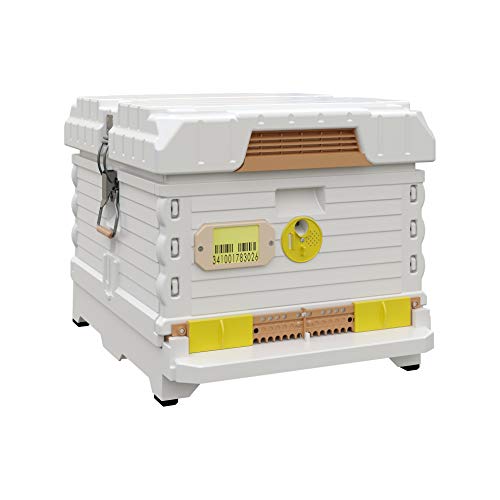
Apimaye Ergo Insulated 10 Frame Bee Hive Set (No Frames)
Apimaye · Insulated 10-frame system · integrated feeder · NO frames included, listed
Our verdict: The frameless Ergo 10 is the same hive as our reviewed set with one line removed from the manifest: NO frames included, listed, for $295. Ten deep frames cost more than the $25 you save, so this version only makes sense for beekeepers with frames on hand or a firm wooden-frame preference. For everyone else it is a $25 trap.
This is not a lesser hive; it is a lesser deal. The Apimaye Ergo Insulated 10 Frame Set is the identical double-walled system, the same integrated feeder, the same screened bottom and tray, and the listing says in capital letters what it lacks: NO frames included. At $295 it sits $25 below the PRO-frame set while ten new deep frames run roughly $30 to $60 from any maker, so the arithmetic only closes if the frames you intend to use already exist.
Everything we wrote about the reviewed set applies here: the assembly, the condensation physics, the feeder-driven season, the Apimaye-only expansion path. The decision between the two siblings is purely a frames decision, and we walk through the broader insulated field in our premium insulated hive guide if you want the Ergo line in full context.
Who should buy it
Buy the frameless Ergo 10 only if you own frames already, ideally drawn comb from an existing colony, or if you are certain you want wooden frames and foundation inside it. Beekeepers starting from zero should spend the extra $25 on the PRO-frame set and be done in one order.
What we don't like
The value math is upside down for new beekeepers: saving $25 to then spend $30 to $60 on frames is a loss, and more than a few buyers discover the missing frames only when the box arrives. All the reviewed set's ecosystem caveats apply unchanged.
- Hive type
- Insulated 10-frame Langstroth-compatible system (listed)
- Construction
- Double-walled insulated plastic (listed)
- Frames
- NOT included (listed)
- Feeder
- Integrated top feeder (listed)
- Bottom board
- Screened, with sliding tray (listed)
- Price
- $295.00
Pros
- Identical insulated system to the reviewed set
- The right receiving hive for existing drawn comb
- Free choice of frame type inside standard sizing
Cons
- NO frames at $295 makes it worse value for most buyers
- Easy listing to misread when ordering quickly
- Same premium ecosystem lock-in
BeeCastle 10 Frame Langstroth Bee Hive, 100% Beeswax Coated
BeeCastle · 10-frame Langstroth · 100% beeswax coated, listed · complete hive with frames
Our verdict: The BeeCastle 10 Frame Langstroth is the strongest reason not to buy an Apimaye: a listed 100 percent beeswax-coated wooden hive, complete with frames, at $179.21, that fits every standard part ever made. In moderate climates with a winter wrap, it closes most of the survivability gap for $140 less, and its expansion boxes cost a third of Apimaye's.
The wooden case is compatibility and cost, and it is a good case. The BeeCastle 10 Frame Langstroth Bee Hive is our top wooden pick across the site: full-coverage beeswax coating, listed, tight milling, and a complete manifest from bottom board to telescoping cover. Because it holds the standard dimensions descended from Langstroth's 1852 movable-frame design, every frame, feeder, excluder, and super in American beekeeping fits it, used gear is everywhere, and a replacement deep costs $40 to $55 instead of $130.
Thermally, coated pine plus a good winter wrap is a workable answer in most of the continental US; the insulated hive's edge shows most at the climate extremes and in condensation-prone shoulder seasons. If you run wood, monitor mites with a dedicated tool from our mite monitoring guide, since there is no built-in tray to pull.
Who should buy it
Buy the BeeCastle if your winters are moderate, your budget has a ceiling, or you value the standard ecosystem: cheap expansion, universal parts, easy resale, and every mentor's advice mapping directly onto your equipment. It is the rational default; the Ergo is the climate-driven upgrade.
What we don't like
It needs seasonal winterizing and eventual refinishing, ships with no feeder or monitoring hardware, and a full deep still weighs 80 to 90 lbs by listed estimates. The premium wooden finish also puts it near the top of the wooden price range.
- Hive type
- 10-frame Langstroth (listed)
- Coating
- 100% beeswax coated (listed)
- Material
- Pine (listed)
- Frames and foundation
- Included (listed)
- Compatibility
- Standard Langstroth, universal parts
- Price
- $179.21
Pros
- Best-in-class wooden build with full-coverage wax coating, listed
- Universal compatibility and cheap standard expansion
- Complete with wooden frames and foundation
- $140 cheaper than the reviewed Apimaye set
Cons
- Needs wraps, maintenance, and add-on feeders over its life
- No insulation: the condensation problem is yours to manage
- Heavy full boxes, like every wooden 10-frame
More gear worth comparing
Beyond this guide: the highest-rated gear across every category and budget, with a live price check on each.



As an Amazon Associate we may earn from qualifying purchases, at no cost to you.
Quick shop: every pick
Skip the scroll: the whole lineup, with a live price check on each.
- Apimaye Ergo Insulated Bee Hive Set with Plastic PRO FramesThe Reviewed HiveApimaye · $320.00Check Price
- Apimaye Ergo Insulated 10 Frame Bee Hive Set (No Frames)Alternative: The Frameless SiblingApimaye · $295.00Check Price
- BeeCastle 10 Frame Langstroth Bee Hive, 100% Beeswax CoatedAlternative: The Wooden CounterargumentBeeCastle · $179.21Check Price
How we chose
We review hives on long-term ownership, not unboxing: assembly, the first season's routine, durability through weather, and what the stack costs to grow over five to ten years.
Our lens is the same everywhere on this site: would we put a colony in it? Bee safety, ventilation, fit, and whether a beginner can actually run the equipment.
Every spec we could not independently verify is written as listed. Prices come from live Amazon listings checked on the byline date.
Alternatives get full cards, not footnotes: the point of a review is to tell you when NOT to buy the hero product, and we take that half seriously.
No placements were sold, and no manufacturer saw this review before publication.
Key terms
- Double-walled hive
- A hive built as two shells with an insulating layer between, moderating heat loss in winter and heat gain in summer. The Apimaye Ergo's defining feature, listed.
- Condensation
- Water vapor from the cluster condensing on cold interior surfaces and dripping back onto bees. Warmer interior walls, via insulation, are the main structural defense.
- PRO frames
- Apimaye's molded plastic frames with integrated foundation, included in the $320 set. Bees accept them best with a strong colony and active feeding or flow.
- Screened bottom board
- A mesh floor that lets debris and fallen mites drop through to a sliding tray, enabling mite-drop monitoring without opening the hive.
- Division board
- A vertical partition that shrinks the usable cavity, letting a large hive host a small colony or two separated units. Part of the Ergo system, listed.
- Top feeder
- A syrup reservoir bees access from inside the hive's top, refillable without exposing frames. Integrated into the Ergo; an add-on purchase for wooden hives.
Questions, answered
Is the Apimaye Ergo beehive worth the money?
For beekeepers in hard climates, we think yes: the $320 PRO-frame set bundles insulation, a top feeder, a mite-monitoring tray, and frames into one maintenance-free unit, and one colony saved from winter loss roughly pays the premium over a wooden hive. In mild climates the value case weakens, and a $179.21 beeswax-coated wooden hive with a winter wrap is the rational alternative.
Should I buy the Apimaye set with PRO frames or the frameless set?
Buy the $320 set with PRO frames unless you already own frames. The frameless set costs $295 and includes no frames at all, listed, while ten deep frames cost roughly $30 to $60 separately, so the $25 saving is an illusion for anyone starting fresh. The frameless set exists for beekeepers moving drawn comb from an existing hive or committed to wooden frames.
Do bees accept Apimaye's plastic PRO frames?
Generally yes, with the usual plastic-foundation caveat: bees draw plastic readily when the colony is strong and nectar or syrup is coming in, and reluctantly during a dearth. Feed a new colony through its buildup, which the Ergo's integrated feeder makes easy, and acceptance is rarely a problem. If you prefer wooden frames, the hive's standard internal sizing accepts them.
Does the Apimaye Ergo really prevent condensation?
It attacks the mechanism directly. Condensation kills wintering colonies when vapor hits cold interior surfaces, condenses, and drips onto the cluster. Double-walled construction keeps those surfaces closer to cluster temperature, so moisture is more likely to leave as vapor through the ventilation system. No hive abolishes physics, but insulated walls plus controllable ventilation is the strongest structural defense sold at this price.
Can I put wooden boxes on an Apimaye hive?
No. The Ergo's boxes latch into Apimaye's own system, so growing the stack means Apimaye's insulated deep super at $130 or insulated medium super at $230. Standard frames fit inside the boxes, but the boxes themselves do not interstack with wooden equipment. Price the full future stack before buying; ecosystem lock-in is the hive's biggest genuine cost.
Does the Apimaye Ergo need winterizing?
Not in the wrap-and-insulate sense: the insulation is molded in, there is nothing to paint or seal, and the listed ventilation controls handle moisture management. You still do winter beekeeping, ensuring food stores, reducing entrances, and treating varroa in the fall, because insulation does not feed bees or kill mites. Our winterizing guide covers the full checklist.
Is the Apimaye Ergo good for beginners?
Mechanically it is one of the friendliest hives a beginner can run: tool-free assembly, feeding without opening the hive, and mite monitoring from a slide-out tray. The tradeoffs are cost and community: at $320 plus expansion parts it is an expensive first bet, and a mentor teaching on wooden equipment will find some of its parts unfamiliar. Well-funded beginners in harsh climates are its best first-hive case.
What does it cost to expand an Apimaye hive?
The insulated deep super lists at $130 and the insulated medium super at $230, against roughly $40 to $55 for standard wooden equivalents. A mature two-deep configuration with one honey super therefore runs several hundred dollars beyond the original set. That is the honest lifetime price of the insulated ecosystem, and it belongs in your decision on day one.
Keep reading
The Best Premium Insulated Beehives
The whole insulated tier ranked, including the Apimaye supers, nuc, and screened bottom board.
The Best 10-Frame Beehives (2026)
The wooden field the Ergo competes against, from $124.99 budget completes to the BeeCastle flagship.
How to Winterize a Beehive
Wraps, moisture control, and food stores: the seasonal work insulation replaces, and the work it does not.
The Best Mite Monitoring Tools
Alcohol wash and sticky-board options for hives without a built-in tray, and how to read counts.
Honey Lake Starter Kit Review
Our review of the budget wooden alternative: what $159.99 buys and what it leaves out.
Beekeeping Cost Index
Full first-year and five-year cost math for wooden and premium setups, one to five hives.