Our Pick: USKEEPERS
Check PriceBee Sting Safety: Reactions, First Aid Basics, and Real Prevention
Here is the answer-first version: almost all bee stings cause a normal local reaction, sharp pain for a few minutes, then redness, a small welt, and itching that resolves over hours to a few days, and the correct response is to scrape the stinger out immediately, wash the site, and get on with your day. The genuinely dangerous outcome, a systemic allergic reaction called anaphylaxis, is rare, tends to start within minutes, and announces itself with symptoms far from the sting site: hives across the body, swelling of lips or throat, trouble breathing, dizziness. That is a 911 call, immediately, every time. And the best sting strategy in beekeeping is not toughness or remedies; it is not getting stung, which is why our first recommendation on this page is a real ventilated suit like the USKEEPERS 3-layer suit ($129.99), not a first-aid kit.
By The BeehiveKits Hive Desk2026-08-2818 min read Fact-checked against verified Amazon listingsHow we research
We are writing this page because the internet's sting content splits into two useless halves: folksy reassurance that ignores the one scenario that matters, and alarmism that makes new beekeepers afraid of a hobby with a genuinely manageable risk profile. Beekeepers do get stung, a few times a season with good gear and habits, dozens if they get casual, and the overwhelming majority of those stings are a non-event. The skill is knowing which reactions are normal, which deserve a doctor conversation, and which mean emergency services, before the situation is in front of you.
One thing this page is not: medical advice. We are a beekeeping equipment desk, and everything below is general information from mainstream sources, cited where it counts, to help you have better conversations with actual clinicians. If you have any reason to think you or a family member is allergic to stings, the move is an allergist appointment before the bees arrive, not a comment thread. Standard disclosure, plainly: no brand paid to appear here, and some links go to Amazon, where a purchase may earn us a small commission at no extra cost to you.
What to know
- Normal local reactions (pain, redness, a welt, itching at the sting site) are by far the most common outcome and resolve on their own over hours to days.
- A large local reaction, swelling that grows over a day or two around the sting, is alarming to look at but still a local reaction; mention it to your doctor at the next visit.
- Systemic symptoms away from the sting site, body-wide hives, throat or tongue swelling, wheezing, trouble breathing, dizziness or collapse, mean call 911 immediately. Anaphylaxis moves fast.
- Remove stingers by scraping sideways with a fingernail or hive tool edge immediately; speed matters far more than technique, so do not hunt for tweezers while the venom sac keeps pumping.
- Beekeeper sting immunity folklore is half true at best: tolerance to local swelling often grows with exposure, but true allergy is a different mechanism, can appear at any point, and is a doctor question, not a toughness question.
- The real mitigation stack is gear and technique: a ventilated suit, gloves, a lit smoker, and calm inspection habits prevent the stings that no remedy would have to treat.
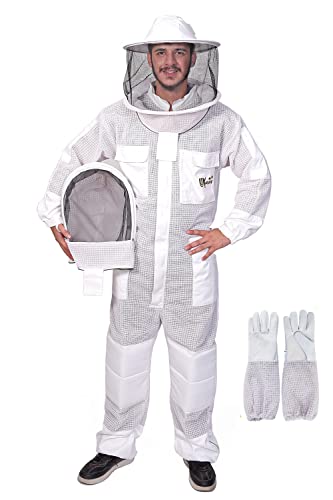
USKEEPERS 3-Layer Ventilated Bee Suit
USKEEPERS · 3-layer ventilated mesh construction · full suit with veil · listed sting-proof design
Our verdict: The single most effective sting-safety purchase in beekeeping: spacer mesh too deep for most stingers to bridge, with airflow that makes wearing it in July realistic, because the suit you actually wear is the one that protects you.
Sting safety gear fails two ways: it lets stingers through, or it is so hot it stays in the shed. The USKEEPERS 3-layer ventilated suit ($129.99) addresses both, three layers of ventilated fabric that hold stingers short of skin, with airflow a cotton suit cannot approach.
Fit is the spec that matters: suits protect by standoff distance, so size loose per the chart. The full field, from budget polycotton to premium, is ranked in our bee suit guide.
Who should buy it
Every new beekeeper, anyone whose confidence is the bottleneck, and every keeper in a hot-summer state where an unventilated suit goes unworn.
What we don't like
Bulkier to store than a jacket and warmer than one in spring; taut fabric at pressure points can still transmit a sting, so honor the loose sizing.
- Type
- Full suit with hood/veil
- Construction
- 3-layer ventilated mesh (listed)
- Best for
- Full inspections, hot climates
- Price
- $129.99
Pros
- Mesh depth stops most stings before skin
- Ventilation makes summer wear realistic
- Full coverage builds calm, and calm prevents stings
Cons
- Costs more than jacket setups
- Protection depends on loose fit; size carefully
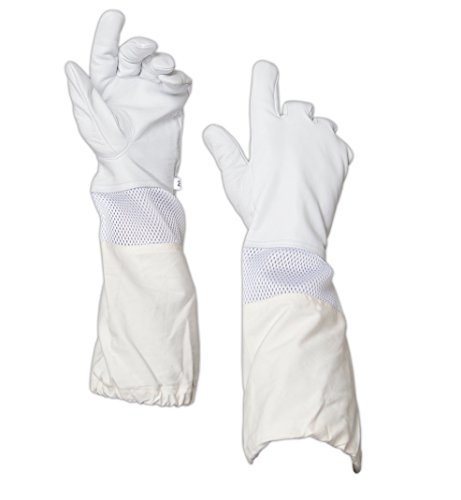
Forest Beekeeping Goatskin Gloves
Forest Beekeeping · Goatskin leather · vented mesh cuff · long gauntlet (listed)
Our verdict: Hands take more stings than everything else combined, and goatskin is the material that stops them without the clumsy-bear feel that crushes bees and escalates inspections. The long vented cuff closes the wrist leak point.
The hand-protection tradeoff is real: thick gloves stop stings but crush bees, and crushed bees release the alarm pheromone that invites more stings. Goatskin like the Forest Beekeeping goatskin gloves ($24.95) sits at the working optimum, sting-resistant with enough feel to lift frames without casualties.
The vented gauntlet handles the classic wrist gap, and at this price a spare pair belongs in the kit. Alternatives, including nitrile for delicate work, are in jackets and gloves.
Who should buy it
All beginners and anyone whose sting log is mostly hands and wrists, which is nearly everyone's.
What we don't like
Fine work like queen handling is clumsy in any leather glove; experienced keepers keep nitrile or bare hands for those minutes and goatskin for the rest.
- Material
- Goatskin leather (listed)
- Cuff
- Long vented gauntlet (listed)
- Best for
- Routine inspections, new keepers
- Price
- $24.95
Pros
- Stops nearly all hand and wrist stings
- Enough dexterity to avoid crushing bees
- Cheap enough to keep a backup pair
Cons
- Too clumsy for queen-level fine work
- Leather absorbs alarm pheromone over time; wash or replace

VIVO Large Stainless Steel Bee Smoker
VIVO · Stainless steel · large fuel chamber · heat shield (listed)
Our verdict: Smoke is the behavioral half of sting prevention: it masks the alarm signal that coordinates defense. The VIVO's large chamber is the point, because the smoker that dies mid-inspection leaves you smokeless at exactly the moment you need it.
Most defensive incidents in a backyard apiary trace to the same script: no smoke or dead smoker, a jarred box, alarm pheromone, escalation. The VIVO large stainless smoker ($29.99) breaks the script with fuel capacity, packed right, it smolders through a full two-hive session, and the heat shield and hanging hook are the touches you use every time.
A puff on a sting site also masks the pheromone marker that draws follow-up stings, a trick worth knowing. Technique and the full field are in the smoker roundup.
Who should buy it
Every beekeeper without exception; buy the large chamber even for a single hive, because fuel capacity is patience.
What we don't like
Serviceable rather than premium bellows, and every smoker takes a dozen lightings to learn. That is the craft, not the hardware.
- Material
- Stainless steel (listed)
- Size
- Large fuel chamber
- Heat shield
- Yes (listed)
- Price
- $29.99
Pros
- Large chamber stays lit through long sessions
- Masks alarm pheromone, including on sting sites
- Heat shield and hook are genuinely useful
Cons
- Basic bellows
- Keeping any smoker lit is a learned skill
What actually happens when a honey bee stings
A honey bee sting is a one-shot weapon with a cruel mechanism: the stinger is barbed, so when the bee stings mammal skin it anchors, and the bee tears away leaving the stinger, venom sac, and pumping musculature behind (Wikipedia: bee sting). The bee dies; the detached apparatus keeps injecting venom for a minute or more if left in place. That mechanism drives the two facts that matter most on this page: honey bees sting defensively and reluctantly, because it costs them their lives, and stinger removal speed is the one first-response variable you control.
The venom itself, apitoxin, is a cocktail of peptides and enzymes, principally melittin, that produces immediate burning pain, local inflammation, and, in a small minority of people, an allergic cascade. Worth knowing: a honey bee sting also deposits alarm pheromone at the site, which smells faintly of banana and marks you for nestmates. This is why one sting near a hive sometimes becomes three, why smoke helps (it masks the marker), and why the standard advice after a sting during an inspection is a puff of smoke on the sting site, calm movements, and finishing or closing up rather than flailing.
Wasps, hornets, and yellowjackets are different animals with smooth stingers, multiple stings per insect, and different venom; people allergic to one are not automatically allergic to the others. Most backyard sting drama in late summer is yellowjackets, not honey bees, a distinction your neighbors will appreciate you making on their behalf.
Normal local reactions: the overwhelming majority
The standard sting sequence: sharp burning pain that peaks in the first minute or two, a red welt with a small white center where the stinger entered, some swelling around the site, and itching as it resolves. Pain typically fades within an hour; the welt and itch settle over a few hours to a few days. This is not an allergic emergency; it is the venom doing exactly what venom does to everyone, and it describes the overwhelming majority of all stings.
Sensible, mainstream self-care is unglamorous: get the stinger out fast, wash the site with soap and water, and use a cold compress for the swelling. Over-the-counter options exist for itch and discomfort, and the pharmacist's aisle handles that conversation better than we can; the folk remedies (baking soda paste, toothpaste, tobacco, meat tenderizer) have tradition on their side and not much else. Location modifies the experience: stings on loose tissue like the face and especially near the eye swell impressively, and stings inside the mouth or throat deserve prompt medical attention regardless of allergy status because swelling there can affect breathing mechanics.
What surprises new beekeepers most is how fast a routine sting becomes background noise. The first sting of the season gets your attention; by August, a sting through the sock is a muttered word and a scrape with the hive tool. That normalization is fine, healthy even, as long as the next two sections stay filed in memory.
Large local reactions: ugly, scary looking, still local
A minority of people respond to stings with a large local reaction: swelling that keeps growing for 24 to 48 hours and can span several inches, a forearm sting swelling to the elbow, a hand becoming a baseball mitt. It looks dramatic, photographs terribly, and sends a lot of people to urgent care, but it is still a local reaction, contiguous with the sting site, and it typically resolves over five to ten days (Wikipedia: bee sting).
Two practical notes. First, large local reactions merit a conversation with your doctor, ideally an allergist if they recur, because managing them well makes the hobby far more comfortable, and because you want a professional, not a forum, to characterize your personal risk. Second, the swelling of a large local reaction is sometimes confused with infection. Sting-site infections exist but are uncommon and arrive on a different schedule, typically worsening after the first couple of days rather than improving; when in doubt, that is a clinician call, not a Facebook group call.
Anaphylaxis: the one scenario you must know cold
Anaphylaxis is a rapid, body-wide allergic reaction that can be fatal, and insect stings are one of its classic triggers (Wikipedia: anaphylaxis). It usually begins within minutes of the sting. The signs to burn into memory are symptoms remote from the sting site: hives or flushing across the body, itching of palms, soles, or scalp, swelling of the lips, tongue, or throat, hoarseness or trouble swallowing, wheezing or difficulty breathing, stomach cramping and vomiting, and lightheadedness or collapse from falling blood pressure. Any of those after a sting means call 911 immediately. Not a wait-and-see, not a drive-yourself, not an antihistamine-and-a-nap. Emergency treatment for anaphylaxis is epinephrine and professional care, and minutes matter.
Some perspective, because the point of this section is preparedness, not fear: severe systemic reactions to stings occur in a low single-digit percentage of the population, and fatal outcomes are rare, on the order of dozens of deaths per year in the US across all stinging insects. The risk is real enough to respect and rare enough that it should not keep a non-allergic person out of beekeeping. The preparedness moves are simple: know the symptom list above, keep your phone in the apiary, never do your first several inspections alone if you have never been stung as an adult, and tell household members where the hives are and what the plan is.
One more scenario worth naming: mass envenomation. Dozens to hundreds of stings at once, from a dropped brood box or a wrecked colony, can cause serious illness from venom load alone, no allergy required. It is very rare in backyard beekeeping and almost always a gear-and-technique failure story, which is exactly why the prevention half of this page is the longer half.
Stinger removal: scrape, don't pinch, and hurry
The classic advice is to scrape the stinger out sideways with a fingernail, credit card edge, or hive tool rather than pinching it with fingers or tweezers, the logic being that squeezing the attached venom sac could inject more venom. The refined, evidence-flavored version: speed beats method. The venom sac delivers most of its payload in the first seconds, so the worst response is spending half a minute hunting for the perfect tool while the pump runs. Get it out now, with whatever is at hand; scraping is simply the technique least likely to squeeze the sac on the way (Wikipedia: bee sting).
In-apiary practice looks like this: sting lands, scrape it out with the hive tool in your hand or a gloved thumbnail, puff smoke on the site to mask the alarm pheromone, and keep your movements slow. Through a suit or jacket, stingers often catch in the fabric and never reach skin, one more argument for the gear section below; run the hive tool over the fabric to clear stingers so the pheromone flag does not ride around with you.
Afterward: wash when you get inside, cold pack if it is swelling, and note the sting in your inspection log. A colony that stings through normal, calm handling repeatedly is data, temperament worth tracking and eventually requeening away, which we cover in how to requeen a hive.
Sting counts, immunity folklore, and what allergy actually is
Beekeeping culture is thick with sting mythology: old-timers who claim immunity, advice to take stings on purpose, arthritis theories, the works. Here is the sortable version. It is true that many regular beekeepers develop reduced local reactions over years of exposure, first-of-season stings often swell more than August ones, and this tolerance is a real immunological phenomenon. It is also true that medical desensitization exists: venom immunotherapy, in which an allergist administers escalating controlled doses over years, is a genuine, well-established treatment for sting allergy with high success rates.
What the folklore gets dangerously wrong is collapsing those facts into stings toughen you up, so allergy is for the soft. Allergy is not weakness, and tolerance is not a ratchet: sting allergy can develop at any point in life, including in long-time beekeepers after years of uneventful stings, and a history of fine reactions is not a guarantee about the next one. The immune system writes its own rules. That is why the honest guidance runs through a clinician: anyone with a history of systemic reactions, or with escalating reactions, belongs in an allergist's office discussing testing and venom immunotherapy, the controlled medical version of what folklore imagines backyard stings do.
The family question: allergies, kids, and neighbors
Before bees arrive, run the household inventory: does anyone at home have a known sting allergy or a history of dramatic reactions? That answer belongs in a doctor's office conversation before hive placement, not after the first backyard sting. Plenty of families with an allergic member keep bees successfully with sensible layers: hives sited away from play areas with entrances facing away from traffic, flyway barriers pushing flight paths overhead, the allergic member staying out of the apiary and keeping their prescribed medications current, and everyone knowing the symptom list and the plan.
For kids in a beekeeping family, the practical curriculum is short: bees at flowers are working and harmless to the ignoring passerby, the area near hive entrances is bee traffic and not play space, and any sting gets reported to an adult immediately, every time, so an adult can watch for the systemic signs listed above. A child-sized veil and jacket turns hive visits from a fear into the best show-and-tell in the county.
Siting is the quiet half of family and neighbor safety, and it overlaps completely with good beekeeping: entrances pointed away from sidewalks and patios, a six-foot barrier lifting flight paths, water provided on-site so bees skip the neighbor's pool, and gentle stock requeened at the first sign of chronic bad temper. The full checklist is in our beehive placement guide, and the ordinance homework is in how to start beekeeping.
The epinephrine conversation to have with your doctor
Epinephrine auto-injectors (EpiPen and its generics and competitors) are the first-line emergency treatment for anaphylaxis, prescription devices that inject a measured dose into the outer thigh while emergency services are on the way (Wikipedia: anaphylaxis). Whether you or anyone in your household should carry one is squarely a doctor question, driven by history and testing, and we are not going to play clinician from a gear desk. What we will say is: have the conversation. It costs one appointment, and for allergic individuals an auto-injector plus a plan is the difference between a scary story and a tragedy.
If a prescriber does put an auto-injector in your life, the beekeeping-specific habits are about logistics: it lives where the beekeeping happens, not in a bathroom cabinet indoors; it has a temperature-sane home, not a truck dashboard in July; expiration dates go on the same calendar as mite treatments; and anyone who might be nearby during apiary work knows where it is and how it works. Using one is always paired with calling 911, epinephrine buys time for professional care, it does not replace it.
For the non-allergic majority, the honest version of this section is shorter: know the anaphylaxis symptom list, keep a phone within reach in the apiary, and get stinger removal fast. Preparedness for the rare scenario is a checklist, not a lifestyle.
The real mitigation: gear that keeps venom out of your skin
Every section above manages stings after they happen. The better program is fewer stings, and that is a purchasing and technique decision, not a courage decision. Start with the suit: a modern three-layer ventilated suit like the USKEEPERS 3-layer ventilated suit ($129.99) uses spacer mesh deep enough that stingers run out of reach before skin, with airflow that makes July inspections humane. The mechanism matters: most suit failures are fit failures, fabric pulled taut against skin at knees, shoulders, or elbows gives a stinger a bridge, so suits are sized loose on purpose. Full rankings, including budget routes, are in best beekeeping suits and jackets and gloves.
Hands take more stings than any other body part for the obvious reason: they are the part in the hive. Goatskin gloves like the Forest Beekeeping goatskin gloves ($24.95) stop nearly all of them while keeping enough feel to avoid crushing bees, which itself prevents stings, crushed bees release alarm pheromone and escalate the whole inspection. Veil integrity is the non-negotiable: face and neck stings are the ones that swell dangerously and the ones that panic people into dropping frames. Zip fully, check the zipper meeting points, and retire any veil with a hole the day you find it.
Ankles and wrists are the classic leak points. Bees walk upward, so an untucked pant leg is an invitation; tuck pants into socks or boots, snug the elastic, and the problem disappears. None of this gear is expensive against what it prevents: the entire protection stack, suit, gloves, and the smoker below, costs less than $200 and converts stings from a weekly event into a rare one.
Smoke and technique: the behavioral half of prevention
A lit smoker is sting prevention disguised as tradition. Cool white smoke masks the alarm pheromone that coordinates colony defense and triggers bees to preload honey, and a colony that cannot broadcast alarm mostly declines to escalate. The practical spec is a chamber big enough to stay lit through a full session, which is why we run the VIVO large stainless smoker ($29.99): a smoker that dies mid-inspection converts you into a smokeless beekeeper at exactly the wrong moment. Technique is a few puffs at the entrance, a patient pause, a puff under the lid, and a puff on any sting site; the full method and the field of alternatives live in best bee smokers.
The rest is body discipline, and it is learnable in a season. Work from beside or behind the hive, never blocking the entrance flight path. Move like you are underwater: bees target fast movement and vibration, and swatting is the single most sting-productive act in beekeeping. Pick weather on purpose, mid-morning to mid-afternoon on warm, calm days when foragers are out, and expect grumpier colonies in dearth, before storms, and in early spring and late fall. Skip the perfume, and skip the banana-scented anything (alarm pheromone smells like banana; do not show up smelling like the attack signal).
Finally, keep score. A colony that punishes calm, well-smoked handling week after week is not your failure, it is genetics, and requeening from gentler stock fixes it permanently. The inspection rhythm that makes all of this routine is laid out in how to do a hive inspection, and the glossary for any term on this page is here.
The bottom line
Bee sting risk management is a short list executed consistently. Know the three reaction tiers: normal local (common, self-resolving), large local (ugly, still local, worth a doctor mention), systemic (rare, fast, call 911). Scrape stingers immediately, speed over technique. Treat the immunity folklore as folklore and route real allergy questions, testing, auto-injectors, venom immunotherapy, through an allergist. And spend your actual effort on the preventable side: a ventilated suit, decent gloves, a smoker that stays lit, calm hands, and smart siting will do more for your sting count than everything else on this page combined.
Beekeeping's sting problem is, in the end, one of its smaller problems, well behind varroa, weather, and beginner overconfidence. Gear up sensibly, learn the symptom list once, and get back to the actual work of keeping colonies alive, which starts at how to start beekeeping.
More gear worth comparing
Beyond this guide: the highest-rated gear across every category and budget, with a live price check on each.


As an Amazon Associate we may earn from qualifying purchases, at no cost to you.
Quick shop: every pick
Skip the scroll: the whole lineup, with a live price check on each.
- USKEEPERS 3-Layer Ventilated Bee SuitBest Sting PreventionUSKEEPERS · $129.99Check Price
- Forest Beekeeping Goatskin GlovesBest Hand ProtectionForest Beekeeping · $24.95Check Price
- VIVO Large Stainless Steel Bee SmokerBest Defensiveness ReducerVIVO · $29.99Check Price
Key terms
- Local reaction
- The normal sting outcome: pain, redness, a welt, and itching confined to the sting site, resolving over hours to a few days without intervention.
- Large local reaction
- Exaggerated swelling contiguous with the sting site that grows over 24 to 48 hours and can span several inches, resolving over about five to ten days. Alarming to see, still a local reaction, and worth mentioning to a doctor.
- Anaphylaxis
- A rapid, potentially fatal body-wide allergic reaction marked by symptoms away from the sting site: widespread hives, throat or tongue swelling, breathing difficulty, dizziness, or collapse. The response is calling 911 immediately; emergency treatment is epinephrine.
- Apitoxin
- Honey bee venom, a peptide and enzyme cocktail dominated by melittin, responsible for the immediate pain and inflammation of a sting.
- Alarm pheromone
- The banana-scented chemical signal released at a sting site and by crushed bees that recruits nestmates to defend. Smoke works largely by masking it.
- Venom immunotherapy
- Medically supervised desensitization for sting allergy: an allergist administers escalating controlled venom doses over years. The legitimate, high-success version of what sting-immunity folklore imagines.
- Epinephrine auto-injector
- A prescription device that delivers a measured emergency epinephrine dose for anaphylaxis while emergency services respond. Whether to carry one is a decision made with a doctor, and its use is always paired with calling 911.
Questions, answered
What is a normal reaction to a bee sting?
Sharp pain for a few minutes, then a red welt, mild swelling, and itching at the sting site that fades over hours to a few days. This is the outcome for the large majority of stings and does not indicate allergy. Scrape the stinger out promptly, wash the site, and use a cold compress for comfort.
When should you call 911 for a bee sting?
Immediately, at the first sign of symptoms away from the sting site: hives spreading across the body, swelling of the lips, tongue, or throat, trouble breathing or swallowing, wheezing, severe dizziness, or collapse. These are signs of anaphylaxis, which progresses in minutes. Stings inside the mouth or throat also warrant prompt medical attention regardless of allergy history.
How do you remove a bee stinger correctly?
Scrape it out sideways with a fingernail, card edge, or hive tool rather than pinching it, and above all do it immediately. The detached venom sac keeps pumping for a minute or more, so speed matters more than technique. Afterward, wash the site and, in the apiary, puff smoke on it to mask the alarm pheromone that can draw more stings.
Do beekeepers become immune to bee stings?
Many develop milder local reactions over years of exposure, which is a real phenomenon, but it is not immunity and it is not guaranteed to last. True allergy is a different mechanism that can develop at any point, even in veteran beekeepers. Genuine desensitization exists as venom immunotherapy administered by an allergist; deliberately taking stings to toughen up is folklore with real tail risk.
Can you develop a bee sting allergy later in life?
Yes. A lifetime of normal reactions does not lock in your future response, and systemic reactions sometimes appear after years of uneventful stings. That is why escalating or unusual reactions belong in an allergist's office, and why every beekeeper should know the anaphylaxis symptom list even with a clean history.
How many bee stings is dangerous?
For a person with sting allergy, one sting can be a medical emergency. For non-allergic adults, serious illness from venom load alone generally requires a large number of stings at once, the kind of mass-sting event that is rare in backyard beekeeping and usually traces to a dropped box or destroyed colony. Any sting count that comes with systemic symptoms is a 911 call regardless of the number.
Does a bee die after it stings you?
A honey bee usually does: its barbed stinger anchors in mammal skin and tears away with the venom sac as the bee pulls free. This is why honey bees sting reluctantly and only in defense. Wasps, hornets, and yellowjackets have smooth stingers, sting repeatedly, and account for much of the sting trouble blamed on bees.
What gear prevents bee stings while beekeeping?
A ventilated full suit or jacket with an intact veil, long-cuff goatskin gloves, pants tucked into boots, and a smoker large enough to stay lit through the inspection. Fit matters: suits protect by holding fabric off the skin, so they are sized loose. With that stack plus calm technique, most hobbyists take only a handful of stings a season.
Should beekeepers carry an EpiPen?
That is a decision to make with a doctor, based on personal and family history and, where appropriate, allergy testing. Auto-injectors are prescription devices, and anyone prescribed one should keep it accessible wherever apiary work happens and pair its use with an immediate 911 call. Non-allergic keepers should at minimum know the anaphylaxis symptoms and keep a phone in the apiary.
Why do bees sting some people more than others?
Mostly behavior and circumstances rather than personal chemistry: fast movements, blocked flight paths, no smoke, dark fuzzy clothing, strong scents, and bad-weather inspections all raise sting odds. Colony genetics matter too, and a hive that stays defensive under calm handling is a candidate for requeening. The alarm pheromone from one sting or crushed bee also marks a target for more.
Filed under Explainer
Part of Beekeeping 101 · Protective Gear & Tools
Keep reading
The Best Beekeeping Suits
The protection rankings: ventilated three-layer suits to budget polycotton, judged on the fit details that actually stop stings.
Best Beekeeping Jackets and Gloves
The lighter half of the protection stack: jackets for quick checks and the glove field from goatskin to nitrile.
The Best Bee Smokers
The defensiveness tool ranked by the spec that matters: staying lit through a full inspection.
How to Do a Hive Inspection
The calm, methodical routine that prevents more stings than any gear purchase.
Beehive Placement Guide
Siting for safety: flight paths, flyway barriers, setbacks, and the neighbor-proof apiary.
How to Start Beekeeping
The complete first-year plan, with the safety homework built in where it belongs.