Our Pick: Apimaye
Check PriceBeekeeping in Hot Climates: The Southern Playbook
In a hot climate the season that kills colonies is summer, and the four things that get you through it are afternoon shade, real ventilation, uninterrupted water, and honest small hive beetle management. That reorders the shopping list: a screened bottom board like the Apimaye premium screened bottom ($72.00) and a ventilating inner cover like the DoubleFill 2-pack ($27.99) do more for a Gulf Coast colony than any wrap ever will, and a set of watering stations like the Retyion 4-pack ($17.83) stops being a nicety at 100 degrees and starts being life support.
By The BeehiveKits Hive Desk2026-08-2920 min read Fact-checked against verified Amazon listingsHow we research
The second hot-climate reality is biological rather than mechanical. Where brood rearing continues nearly year-round, varroa mites reproduce nearly year-round too, so there is no natural broodless window handed to you in December the way northern keepers get one. That means more monitoring, a longer treatment calendar, and careful attention to temperature ceilings on the labels: formic acid products carry an upper limit around 85F, which in July in Phoenix or Houston simply removes them from the menu for weeks at a time. Thymol gels like Apiguard ($42.99) and amitraz strips become the practical summer options, always per label.
The third reality is the summer dearth. In much of the South and Southwest the nectar shuts off in June or July and does not return until fall, which means the hot-climate calendar has two lean seasons rather than one: a real dearth in midsummer and a mild, short winter. Colonies get defensive, robbing pressure spikes, and feeding sometimes resumes in the hottest month of the year. Northern-tier keepers can read the mirror image of all this in beekeeping in cold climates.
Standard disclosure, plainly: no brand paid for a placement here, and some links go to Amazon, where a purchase may earn us a small commission at no extra cost to you. Prices were verified at publication. Treatment guidance here is general; the product label is the law, and your state apiarist and local club outrank this page on anything local.
What to know
- Afternoon shade beats full sun south of roughly the 32nd parallel. Morning sun plus afternoon shade is the hot-climate ideal.
- Ventilation is the core hardware change: screened bottom boards, an upper entrance or ventilated inner cover, and a shim or propped cover in the worst weeks.
- Water is survival equipment, not a courtesy. A colony in a heat wave can go through a startling volume, and a dry station in August is a real emergency.
- Small hive beetles are a hot-climate constant. Strong colonies, sunny hive placement, and trapping keep them from taking over; weak colonies get slimed.
- Near year-round brood means near year-round varroa reproduction. Monitor more often and plan a treatment calendar rather than a single August event.
- Formic acid labels cap out around 85F, so build the summer plan around thymol, amitraz, or oxalic instead, always following the label.
- The midsummer dearth is the South's second winter: feeding, robbing precautions, and reduced entrances all come back in July and August.
- In the Southwest, Africanized genetics are a real management factor. Requeen defensive colonies from known stock and do not let feral swarms populate your yard.
At a glance
| Task | Temperate baseline | Hot climate (South, Gulf, Southwest) | Why |
|---|---|---|---|
| Sun exposure | Full sun preferred | Morning sun, afternoon shade | Comb softens and colonies burn energy cooling |
| Ventilation | Solid bottom, closed in winter | Screened bottom plus upper vent year-round | Heat and humidity must have an exit |
| The lean season | Winter | Midsummer dearth plus a short mild winter | Nectar shuts off in the heat, not the cold |
| Varroa treatment | One decisive August treatment | A calendar of treatments, temperature-gated | Brood is present most or all of the year |
| Formic acid | Usable in August | Often blocked by the 85F label ceiling | Label window is a hard limit, not a suggestion |
| Beetle pressure | Occasional nuisance | Permanent management task | Beetles thrive in warm, humid, sandy soils |
Hot-climate management versus the temperate baseline

Apimaye Premium Screened Bottom Board, 10-Frame
Apimaye · 10-frame Langstroth · screened with tray (listed) · stays open year-round in hot regions
Our verdict: The single most useful hardware change for a hot-climate hive. A screened bottom gives the colony a permanent low-side air intake for its cooling system and gives you a tray for mite drop counts, which matters double where brood and mites run nearly year-round.
Bees cool the hive by moving air, and air needs an intake. The Apimaye premium screened bottom board ($72.00) is the well-built version of that part: 10-frame Langstroth fit, integrated tray, and a build quality that survives a Gulf Coast summer better than the thin plywood screened bottoms that warp within a season.
The second job is diagnostic. Slide a sticky board into the tray and you get a mite drop count without opening the hive, which is a genuine convenience when the alternative is a full inspection at 100F. Pair it with an upper vent so the airflow actually has an exit; intake alone accomplishes very little.
Who should buy it
Anyone keeping bees where summer afternoons regularly exceed 95F, plus anyone in a humid region fighting small hive beetles or mite pressure who wants easier monitoring.
What we don't like
It is the priciest bottom board most beginners will consider, it is 10-frame specific, and in cool-spring regions an open screen slows early buildup, so it is not the right part everywhere.
- Fit
- 10-frame Langstroth (listed)
- Type
- Screened bottom board with tray (listed)
- Primary job
- Ventilation intake
- Secondary job
- Sticky board mite drop counts
- Price
- $72.00
Pros
- Permanent airflow intake for the colony's cooling system
- Tray enables mite drop monitoring without an inspection
- Built heavier than budget screened bottoms
- Useful year-round in hot regions
Cons
- Expensive relative to basic screened bottoms
- 10-frame only
- Slows spring buildup in cool climates

DoubleFill Beehive Inner Cover, 2-Pack
DoubleFill · 10-frame inner covers · 2-pack · notched for upper entrance and venting
Our verdict: A screened bottom without a top vent is a chimney with a lid on it. An inner cover with a notch turned upward gives hot, humid air somewhere to go, adds a small upper entrance that reduces traffic congestion, and gives you a working surface during inspections.
The DoubleFill beehive inner cover 2-pack ($27.99) is the cheapest meaningful ventilation upgrade in a hot-climate apiary, and the two-pack covers the standard two-hive start. Turn the notch up in summer for a top vent and upper entrance, and you have completed the airflow path that the screened bottom starts.
The same part earns its keep in winter for a different reason, as the moisture-management layer under a quilt box or insulation, which is the northern story told in beekeeping in cold climates. Few beekeeping parts are genuinely useful at both temperature extremes; this is one.
Who should buy it
Every hot-climate keeper running wooden equipment, and anyone who has added a screened bottom board without adding a top exit.
What we don't like
An upper entrance is another opening to defend during the dearth, so pair it with a reduced main entrance, and fit tolerances on budget inner covers vary enough that you may need to plane an edge.
- Count
- 2 covers
- Fit
- 10-frame Langstroth (listed)
- Summer use
- Notch up for top venting and upper entrance
- Winter use
- Moisture management layer
- Price
- $27.99
Pros
- Completes the airflow path from a screened bottom
- Adds an upper entrance that eases traffic
- Two-pack covers the standard two-hive start
- Useful in both hot and cold seasons
Cons
- Another opening to defend in a dearth
- Budget fit tolerances vary between brands
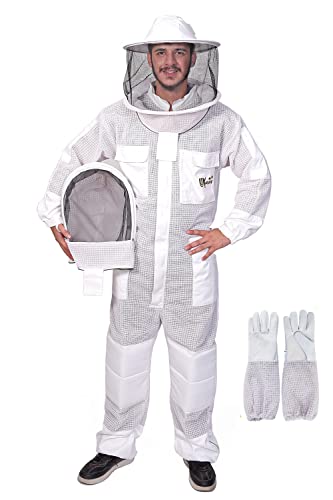
USKEEPERS 3-Layer Ultra Ventilated Bee Suit
USKEEPERS · 3-layer ventilated mesh construction (listed) · full suit with veil · sting standoff by design
Our verdict: In the South a ventilated mesh suit is safety equipment for the beekeeper, not a comfort upgrade. Three-layer construction moves air while holding stingers off skin, which is exactly what you want in a 100-degree inspection and doubly what you want in Africanized-genetics country.
Heat illness is the underrated hazard of southern beekeeping, and a heavy cotton suit at 100F cuts inspections short or makes them dangerous. The USKEEPERS 3-layer ultra ventilated bee suit ($129.99) solves it the right way: the layered mesh construction lets air move through the fabric while the standoff distance keeps stingers from reaching skin.
That standoff is also why we recommend a full suit rather than a jacket in the Southwest, where feral Africanized genetics are established and defensive events are more intense. Full-field comparisons across price points, including the polycotton and budget options, are in our bee suit guide.
Who should buy it
Anyone inspecting hives in genuine summer heat, and everyone keeping bees in regions where Africanized genetics are established.
What we don't like
Ventilated mesh is bulkier than cotton, it snags on brush, and the price is roughly double the entry-level polycotton suits, which is real money for a first-year keeper.
- Construction
- 3-layer ventilated mesh (listed)
- Coverage
- Full suit with veil (listed)
- Best for
- High heat, high defensiveness
- Sting protection
- Standoff by layered construction
- Price
- $129.99
Pros
- Air moves through the suit in real heat
- Layered standoff keeps stingers off skin
- Makes long summer inspections survivable
- Full-body coverage for defensive colonies
Cons
- Bulkier than cotton and snags on brush
- Roughly double the price of entry-level suits

Apiguard Varroa Mite Treatment, 10 x 50g
Vita BeeHealth · Thymol gel, 10 x 50g trays (listed) · use strictly per label · organic-acid rotation partner
Our verdict: When the thermometer takes formic acid off the table for two months, thymol becomes the practical warm-season tool. Apiguard is the widely available version, it fits a rotation plan, and the ten-tray pack covers a multi-treatment southern calendar rather than a single event.
The hot-climate varroa problem is not a lack of products, it is a lack of products you can legally and safely use in July. Formic labels cap out around 85F. Apiguard ($42.99) is a thymol gel that fits the warm end of the calendar better, applied as trays on the top bars and used strictly per the label, which controls temperature range, dosing, and honey-super restrictions.
Two honest caveats. Thymol can prompt bearding, brood interruption, and temporary queen laying pauses in real heat, and it has its own upper and lower temperature considerations, so read the label as carefully as you would a formic one. And rotate: southern keepers treat more often, which raises resistance pressure. The whole field by chemistry sits in the varroa treatment guide, with the calendar logic in when to treat for varroa.
Who should buy it
Hot-climate keepers building a multi-treatment annual plan who need a warm-season option and a rotation partner for amitraz and oxalic.
What we don't like
Thymol can cause bearding, brood pauses, and occasional queen issues in high heat, it has honey-super restrictions per label, and the smell lingers in wax.
- Active ingredient
- Thymol (listed)
- Format
- 10 x 50g gel trays (listed)
- Application
- Trays on top bars, per label
- Best window
- Warm season, per label temperature range
- Price
- $42.99
Pros
- Fits the warm calendar when formic is blocked
- Naturally derived chemistry suits rotation plans
- Ten trays supports a multi-treatment southern year
- Simple top-bar application
Cons
- Bearding and brood interruption in high heat
- Honey-super restrictions per label
- Thymol odor persists in wax

Retyion Bee Watering Station, 4-Pack
Retyion · 4-pack · shallow landing surfaces · garden, deck, or apiary placement
Our verdict: In a hot climate, water is not a courtesy for the neighbors, it is the input to the colony's entire cooling system. Four stations gives you the redundancy that matters when shade moves, wind tips a dish, and a 105-degree afternoon evaporates the rest.
Foragers redirect en masse from nectar to water in extreme heat, and a colony that has to fly a quarter mile for it pays for that trip in honey. Placing the Retyion bee watering stations ($17.83) close to the hives, in partial shade, and keeping them full daily is the cheapest productivity upgrade in a southern apiary.
Use these as your distributed small sources and back them with one larger shaded reservoir so a missed day is never a zero-water day. The full category, including floating and ceramic designs, is compared in the bee water station guide.
Who should buy it
Every keeper in a hot region, and urgently anyone whose apiary is within flight range of a pool, a livestock trough, or a neighbor's water feature.
What we don't like
The small reservoirs evaporate fast in genuine heat, so these are a daily chore in July rather than a set-and-forget solution.
- Count
- 4 stations
- Design
- Shallow with landing surfaces (listed)
- Placement
- Partial shade, near the hives
- Summer maintenance
- Check and fill daily
- Price
- $17.83
Pros
- Redundancy across four placements
- Shallow design reduces drowning
- Close water means more nectar foraging
- Cheap enough to place generously
Cons
- Evaporates quickly in extreme heat
- Needs a larger backup reservoir in a heat wave
The hot-climate year: two lean seasons, not one
The temperate beekeeping calendar most books teach has one hard season, winter, and everything else builds toward surviving it. In the Gulf South, Florida, south Texas, the desert Southwest, and much of southern California, that shape breaks. The real hardship is a midsummer dearth: a stretch from roughly June or July into September when the nectar has stopped, temperatures are punishing, and colonies contract, get defensive, and start eyeing each other's stores. Winter, by contrast, is short, mild, and in some areas barely interrupts brood rearing at all.
Two consequences follow. The first is that "fall feeding to survive winter" becomes "summer feeding to survive the dearth, and light fall feeding if the fall flow disappoints." The second is that colony management gets busier in July than in January, which is the exact inversion of how most beekeeping content is written. Read the standard first-year beekeeping calendar for the structure, then shift the pressure points: your August is somebody else's February.
The upside is real. Longer seasons mean more brood cycles, faster buildup, earlier splits, and in good years a spring flow that starts in February. Southern beekeepers routinely make increase on a schedule that would be fantasy in Vermont. The cost is that the pests and parasites get the same long season you do.
Shade versus full sun: where the standard advice flips
Almost every beekeeping book says full sun, and in Ohio it is correct: sun keeps hives dry, discourages small hive beetles, and warms the cluster on marginal spring days. South of roughly the 32nd parallel, and in any location where summer afternoons routinely clear 95F, the calculus changes. Colonies in full afternoon sun spend an enormous share of their labor on evaporative cooling, hauling water and fanning instead of foraging, and in extreme heat comb can soften enough to sag or blow out in a poorly ventilated stack.
The hot-climate ideal is morning sun with afternoon shade: east-facing entrances that catch first light and get foragers out early, with dappled or full shade from roughly 1 pm onward. High deciduous shade is best, since it thins out in winter exactly when you would like the sun back. Where no tree exists, shade cloth on a simple frame works, mounted high enough that air still moves under it, and a raised stand still matters for airflow and for keeping the bottom board off hot ground.
Do not overcorrect into deep, all-day shade. Permanently shaded hives stay damp, and dampness plus warmth is precisely the environment small hive beetles prefer. The target is a hive that is bright in the morning and shaded in the afternoon, not a hive in a dark corner. The rest of the siting logic, drainage, wind, entrance orientation, and access, is in our hive placement guide.
Ventilation: the hardware that actually matters down here
Bees cool a hive by fanning air across water they have spread on comb surfaces, which only works if the humid air has somewhere to go. Ventilation is therefore not a comfort feature in a hot climate, it is the mechanism the colony uses to survive. Three changes make the difference.
A screened bottom board. Replacing a solid bottom with a screened one gives you a permanent low-side air intake and, as a bonus, a place to slide a sticky board for mite counts. The Apimaye premium screened bottom board ($72.00) is the premium version of this part, built for 10-frame Langstroth boxes with an integrated tray, and in hot regions it stays open essentially year-round rather than being closed for winter.
An upper exit. Hot air rises, and a hive with intake at the bottom and no exit at the top is a chimney with a lid on it. A ventilated inner cover such as the DoubleFill beehive inner cover 2-pack ($27.99) gives you a proper top vent and doubles as a stable working surface. A notched inner cover turned notch-up, or a simple shim under the telescoping cover, accomplishes something similar.
Propping and shimming in extremes. In a genuine heat dome, many southern keepers prop the telescoping cover on shims for a week, or stagger boxes a few millimeters. Do this deliberately and reverse it when the heat breaks, because every extra opening is an extra entrance to defend during a dearth, which is the tension the next section covers.
Water is life: the hot-climate version of feeding
A colony in extreme heat consumes a genuinely surprising amount of water, and it uses it for evaporative cooling rather than drinking. In a heat wave, foragers redirect from nectar to water almost entirely, which is why a hot-climate apiary with a distant water source produces less honey and runs hotter than one with water 20 feet away. It is also why urban and suburban keepers in hot regions get pool complaints more than anyone else, a dynamic covered in our urban beekeeping guide.
Practical requirements: multiple sources, shallow, with landing surfaces, in partial shade so they do not become hot tubs or evaporate by noon, and checked daily in summer rather than weekly. A four-pack like the Retyion bee watering stations ($17.83) covers redundancy at the small end; pair them with a larger reservoir, a shaded bucket with floats or a slow-drip on gravel, so that a missed day is not a crisis. Options across the category are compared in the bee water station guide.
Two details southern keepers learn the hard way. Bees prefer water with some scent or mineral content over sterile water, so a bit of algae or a pinch of sea salt makes a station more attractive, and a station that dries out for even a day can push foragers to relearn a new source you do not control. Consistency beats capacity.
Small hive beetles: the hot-climate resident pest
Small hive beetles are a warm-climate problem in a way northern keepers rarely appreciate. They thrive in warm, humid conditions and in sandy soils where their larvae pupate easily, which describes most of the Southeast and Gulf Coast precisely. In a strong colony they are a nuisance the bees corral and harass; in a weakened, queenless, or over-supered colony they can reduce frames of honey to a fermented slime in a matter of days, and that is not a metaphor, the smell is unmistakable and the frames are usually a loss.
The management set is mostly about colony strength and space discipline. Keep colonies matched to their boxes rather than giving a small colony four boxes of empty comb to police. Site hives in that morning-sun position rather than deep shade. Never leave supers or comb sitting around in a hot yard, because unprotected stored comb is a beetle nursery. Inspect with the frames going back promptly rather than laid out on a hot day. And use traps, in-hive oil traps between frames or beetle blasters in the top box, as a supplement rather than a strategy.
The full identification, life cycle, and trapping comparison is in our small hive beetle guide. If you find a collapsed hive full of slimed frames, work through the autopsy properly rather than guessing, because beetles are often the finisher rather than the original cause: how to diagnose a deadout walks the diagnostic order.
Varroa on a long season: why one August treatment is not a plan
Varroa mites reproduce inside sealed brood cells. In a northern colony, brood rearing pauses in late fall and winter, which gives the keeper a natural broodless window when a single oxalic acid treatment can reach essentially every mite in the hive. In much of the Deep South, Florida, and the low desert, brood rearing barely pauses, or pauses only briefly and unpredictably. The mites therefore never get switched off, and neither does your obligation.
What that means in practice: monitor with an alcohol wash or sugar roll more often, roughly monthly through the whole active season rather than three times a year, and think in terms of a treatment calendar rather than a single decisive event. Threshold guidance from extension programs generally lands around 2 to 3 mites per 100 bees, per the Honey Bee Health Coalition, and southern keepers frequently cross it more than once a year. The monitoring hardware is compared in mite monitoring tools, and the timing logic is in when to treat for varroa.
Rotation matters more here too. Because you are treating more often, resistance pressure is higher, so alternating chemistries across the year is not an optional refinement. Build a plan with your local club and your state apiarist that alternates classes rather than leaning on one product all season.
Treatment temperature windows: the 85F problem
Every miticide has a label, and the label controls. The one that bites hot-climate keepers hardest is formic acid: formic products carry an upper temperature limit in the neighborhood of 85F, because above it the vapor release accelerates in ways that can harm brood and queens. In practice this means that in July and August across most of Texas, Florida, Arizona, and the Gulf, formic is simply off the table, and trying to sneak it in on a "cooler" week is how people lose queens. Pesticide labels are enforceable documents, as the EPA framework makes clear, and reading them is part of the job.
The practical hot-season alternatives, all per label. Thymol gels such as Apiguard ($42.99) have their own temperature considerations at the low end and can prompt bearding and brood interruption at the high end, but they fit a warm calendar better than formic does. Amitraz strips are widely used in southern commercial operations for exactly this reason. Oxalic acid, by vaporization or extended-release strips, works best when brood is minimal, which in a hot climate means you may need to create the window through a split or a caging rather than waiting for winter to hand it to you.
Two scheduling tricks that southern keepers use. First, treat in the shoulder seasons, late spring and early fall, when temperatures cooperate with more products. Second, plan treatments around your honey supers, since several products cannot be used with supers on. The full chemistry-by-chemistry comparison lives in the varroa treatment guide.
The midsummer dearth and the robbing that comes with it
When the flow stops in the heat, the yard's mood changes within a week. Flight looks aimless, guard bees get serious, and any exposed drop of syrup or honey starts a robbing frenzy that can kill a weak colony in an afternoon. In hot climates this happens in the middle of the year rather than at the end of it, and it lasts longer.
The management set: entrances reduced, especially on smaller colonies; inspections short, purposeful, and ideally late in the day; no syrup spilled and no comb left out; feeding done inside the hive at dusk, never in open containers; and robbing screens on anything vulnerable. Our comparison of that hardware is in robbing screens and entrance reducers.
Feeding during a hot dearth is a judgment call. Light colonies need it, and a colony that has burned through its stores in a 100-degree July can starve in a month with green grass all around it. Heavy colonies do not, and feeding a strong colony during a dearth mostly funds robbing. Heft the hives, feed the light ones, leave the heavy ones alone. Syrup ferments quickly in heat, so mix small and refresh often.
Africanized bees: the Southwest management reality
Across the desert Southwest, south Texas, and parts of southern California and Florida, Africanized honey bee genetics are established in the feral population. These are the same species as European honey bees, and they make honey and pollinate like any other colony; what differs is defensive behavior, which can be dramatically more intense and more sustained (Wikipedia: Africanized bee). For a keeper in these regions this is a management factor, not a reason to avoid the hobby, and the practices are straightforward.
Buy queens and nucs from known, reputable producers rather than starting from feral swarms, which in Africanized-established areas is how unwanted genetics enter a yard. Requeen any colony whose temperament changes for the worse, promptly, and do not "wait and see," because a colony can supersede quietly and shift temperament without your permission. Keep colonies where a defensive event does not endanger neighbors or livestock, and be far more conservative about hive placement near sidewalks, pools, and pens than a keeper in Michigan needs to be. Wear more protective gear than you think you need, which is the argument for the suit in the shelf below.
Also worth knowing: stock temperament is genetic and manageable, and the differences among commonly sold lines are real. Types of honey bees covers what Italian, Carniolan, Russian, and Buckfast stock actually mean for temperament, buildup, and mite tolerance. Your state apiarist is the authority on regional Africanized status and any requirements that come with it.
Working bees in the heat: you, not just them
A full inspection in a ventilated suit at 100F with 70 percent humidity is genuinely hazardous to the beekeeper, and heat illness is a real risk that southern keepers underplay. Work early, ideally within a couple of hours of sunrise, when it is coolest and the field force is out. Hydrate before you suit up rather than after. Keep inspections targeted: know the two questions you are answering before you crack the lid, and close up when you have the answers.
Gear matters here. A three-layer ventilated mesh suit like the USKEEPERS 3-layer ultra ventilated bee suit ($129.99) is not a luxury in the South, it is the difference between a 40-minute inspection and a 12-minute one. The mesh construction lets air move through the suit while keeping stingers off skin, and in Africanized-genetics regions the extra standoff distance is a safety feature, not a comfort one. Alternatives across price points are ranked in our bee suit guide.
Smoke sparingly in the heat. Overheated colonies are already stressed, and heavy smoke on a 100-degree afternoon is unkind and unhelpful. A light puff at the entrance and under the lid is usually enough on an early-morning visit.
Hot-weather harvest handling
Heat changes harvest logistics in three ways. First, honey flows more freely when warm, which makes extraction easier and uncapping cleaner, so a warm extraction room is actually an advantage as long as you are working with it deliberately rather than fighting a 105-degree garage.
Second, comb is fragile. Warm comb, especially new comb, sags and blows out in an extractor at speeds that would be safe in October. Start slow, build up, and turn frames rather than pushing rpm. Third, and most important in humid regions: honey picks up moisture from humid air, so uncapped frames left sitting in a Gulf Coast garage overnight can gain enough water to push a marginal batch over the line. Honey is generally considered ripe below roughly 18.6 percent moisture, and a refractometer is the only way to know rather than guess (Wikipedia: honey).
Practical rules: pull only what you will extract within a day or two, keep supers covered and in a dehumidified or air-conditioned space if you have one, extract promptly, and bottle promptly. Robbing risk during harvest is also higher in a hot dearth, so move supers in a closed vehicle or covered totes and never leave wet frames out for the bees to clean in the open. The full workflow is in how to harvest honey, and the equipment field is in honey harvesting equipment.
A hot-climate season plan
Late winter (January to February): the year starts early. Maples, willows, and in the Gulf the first big flows can begin in February. Check stores, do a mite count, and treat in this cooperative-temperature window if counts warrant. Order queens now; southern queen producers ship early and sell out.
Spring (March to May): the main flow and the buildup. Add space aggressively, split to control swarming, and get supers on ahead of the flow. This is the honey season in most hot regions, not July.
Early summer (June): harvest, then reconfigure for heat. Screened bottoms open, top ventilation on, shade cloth up, water stations doubled, entrances reduced as the flow tapers.
Midsummer dearth (July to August): the hard season. Short inspections, robbing discipline, beetle traps refreshed, feed only the light colonies, and a mite count you actually act on with a temperature-appropriate product.
Fall (September to November): the fall flow in many regions, then the real winter prep, which in the South means adequate stores and a healthy low-mite population rather than insulation. If you overwinter nucs as insurance, the approach is in how to overwinter nucs.
Winter (December): short, mild, and often not broodless. Keep an eye on stores, because a warm winter colony keeps eating and keeps raising brood, and a mild December that looks harmless can empty a hive that a cold one would have preserved.
More gear worth comparing
Beyond this guide: the highest-rated gear across every category and budget, with a live price check on each.


As an Amazon Associate we may earn from qualifying purchases, at no cost to you.
Quick shop: every pick
Skip the scroll: the whole lineup, with a live price check on each.
- Apimaye Premium Screened Bottom Board, 10-FrameBest Ventilation UpgradeApimaye · $72.00Check Price
- DoubleFill Beehive Inner Cover, 2-PackBest Upper VentilationDoubleFill · $27.99Check Price
- USKEEPERS 3-Layer Ultra Ventilated Bee SuitBest Suit for Working in HeatUSKEEPERS · $129.99Check Price
- Apiguard Varroa Mite Treatment, 10 x 50gBest Warm-Season Varroa OptionVita BeeHealth · $42.99Check Price
- Retyion Bee Watering Station, 4-PackBest Water Setup for Extreme HeatRetyion · $17.83Check Price
How we chose
We built this guide around the management differences that repeat across southern extension guidance: ventilation, shade, water, beetle pressure, and temperature-gated treatment.
Treatment guidance is deliberately general. Every miticide is used according to its own label, and the label controls temperature, timing, and honey-super restrictions.
Product picks are limited to gear whose job is specifically hot-climate: ventilation, water, beetle-tolerant management, and a suit you can survive an August inspection in.
Prices come from our verified offer table and were checked at publication.
We do not tell you what your state requires for Africanized-area management. That is a state apiarist question and it changes.
Key terms
- Summer dearth
- A midsummer stretch when nectar sources shut down in the heat, typically June or July into September in the South and Southwest. Colonies contract, get defensive, and rob. Functionally the hot-climate equivalent of a northern winter.
- Bearding
- Bees massed on the outside of the hive on hot evenings. Usually normal thermoregulation rather than a problem, but persistent heavy bearding on a well-populated hive is a signal to improve ventilation and shade.
- Screened bottom board
- A bottom board with mesh instead of solid wood, providing permanent airflow intake and, with a tray, a surface for counting natural mite drop. Standard equipment in hot regions, more situational in cold ones.
- Small hive beetle
- A warm-climate hive pest whose larvae tunnel through comb and ferment stored honey into a foul slime. Controlled primarily by keeping colonies strong and correctly spaced, with traps as a supplement rather than a strategy.
- Label window
- The temperature range, timing, and use restrictions printed on a miticide label, which are legally binding rather than advisory. Formic acid products commonly cap around 85F, which removes them from the hot-climate summer menu.
- Broodless window
- A period when the colony has no sealed brood, making oxalic acid treatment far more effective because no mites are hiding under cappings. Northern keepers get one for free in winter; hot-climate keepers often have to create one.
- Africanized honey bee
- Honey bees carrying genetics from African subspecies, established in feral populations across parts of the Southwest, south Texas, southern California, and Florida. Same species, markedly more defensive behavior; managed by sourcing known stock and requeening promptly.
- Honey moisture
- The water content of honey, generally considered ripe below roughly 18.6 percent. Humid-climate keepers must watch it closely because uncapped frames absorb moisture from humid air, and a refractometer is the only way to know.
Questions, answered
should beehives be in sun or shade in hot climates
Morning sun with afternoon shade is the hot-climate ideal. Full sun is the right advice in temperate regions but costs a southern colony enormous labor in evaporative cooling once afternoons regularly exceed 95F. Avoid deep all-day shade, which keeps hives damp and favors small hive beetles.
how do I keep my beehive cool in summer
Build an airflow path and a shade plan. Use a screened bottom board for intake, a notched or ventilated inner cover for exhaust, raise the hive off hot ground on a stand, provide afternoon shade or shade cloth mounted high enough for airflow, and keep multiple water sources full within sight of the hives.
can you use formic acid in hot weather
No, not above the label ceiling, which for formic products sits around 85F. Exceeding it can harm brood and queens because vapor release accelerates. In most of the South and Southwest that removes formic from the menu for much of the summer, so plan around thymol, amitraz, or oxalic instead, always according to the product label.
how do I get rid of small hive beetles in my hive
Strength and space discipline first: keep colonies matched to the number of boxes they can patrol, requeen weak or queenless hives, keep hives in morning sun rather than deep shade, and never store unprotected comb in a warm yard. Add in-hive oil traps as a supplement. Severe infestations in a collapsing colony are usually a symptom of another problem.
do bees need water in hot weather
Constantly. Bees use water for evaporative cooling, and in a heat wave foragers redirect from nectar to water almost entirely. Multiple shallow shaded sources near the hives, checked daily in summer, keep the colony productive and keep your bees off the neighbor's pool.
when should I treat for varroa in the south
Think calendar, not event. Monitor roughly monthly through the active season, because near year-round brood means near year-round mite reproduction, and treat whenever counts approach the widely cited 2 to 3 mites per 100 bees threshold. Choose the product by the temperature the label allows on that week, and rotate chemistries across the year.
why are my bees hanging outside the hive at night
That is bearding, and on a hot evening with a strong colony it is normal thermoregulation rather than a problem. It becomes a signal when it is heavy, persistent, and paired with a hive in full afternoon sun or with no upper ventilation. In that case add shade, add a top vent, and check that the colony has water close by.
is there a summer dearth in texas and florida
Yes, in most of both. Nectar commonly shuts down from roughly June or July into September, and it behaves like a northern winter: colonies contract, robbing risk spikes, and light hives may need feeding in the hottest month of the year. Reduce entrances, keep inspections short, and heft your hives rather than assuming green landscaping means nectar.
are africanized bees a problem for backyard beekeepers
In the desert Southwest, south Texas, parts of southern California, and Florida they are a real management factor. Buy queens and nucs from reputable producers rather than starting from feral swarms, requeen any colony whose temperament worsens, site hives away from neighbors and livestock, and wear full protective gear. Your state apiarist is the authority on regional status.
how do you store honey supers in humid weather
Extract quickly and keep them covered. Honey absorbs moisture from humid air, and uncapped frames sitting overnight in a humid garage can gain enough water to push a batch above the roughly 18.6 percent ripeness line. Pull only what you can extract within a day or two, use a conditioned space if you have one, and check with a refractometer instead of guessing.
Filed under Explainer
Part of Beekeeping 101
Keep reading
Beekeeping in Cold Climates
The mirror image of this playbook: stores targets, condensation control, wrapping, and the short build-up window.
The Small Hive Beetle Guide
Identification, life cycle, and the trapping and management set for the hot climate's resident pest.
When to Treat for Varroa
The timing logic behind a treatment calendar, including what changes when brood never stops.
The Best Varroa Mite Treatments
Every mainstream chemistry compared by temperature window, super restrictions, and rotation fit.
The Best Beekeeping Suits
Ventilated versus cotton across price points, for anyone inspecting hives in genuine heat.
The Urban Beekeeping Guide
Flyway barriers, water politics, and rooftop heat load: the city layer on top of the hot-climate layer.