Our Pick: Retyion
Check PriceThe Best Bee Water Stations: 4 Picks That Bees Can Land On
The station we would put out first is the Retyion 4-Pack Bee Watering Station ($17.83): four shallow vessels for under eighteen dollars, which lets you place water near the hive or the bee house, near the forage, and near wherever bees are already going, instead of betting everything on one location. Multiple stations is the actual trick in this category, and a four-pack is the cheapest way to run the experiment.
By The BeehiveKits Hive Desk2026-08-2915 min read Fact-checked against verified Amazon listingsHow we research
Here is why any of this matters. A bee that lands on a smooth wet surface gets her wings stuck to the water film and cannot take off. Surface tension is a serious force at that scale, and open water is genuinely lethal: birdbaths, buckets, pet bowls, rain barrels, and swimming pools all kill bees routinely. What a bee needs is a landing surface, something she can stand on while the water reaches her tongue. Pebbles, marbles, corks, floating wood, sloped ceramic. That is the entire product category, and everything else is styling.
Volume matters more than most gardeners expect. Honey bees do not just drink water, they use it for evaporative cooling: foragers spread it on comb surfaces and fan, air-conditioning the brood nest through a heat wave. Commonly cited estimates put a strong colony's summer water demand around a quart a day, more in extreme heat, which is a lot of quarter-teaspoon trips. If you keep hives and provide nothing, your bees will find water elsewhere, and elsewhere is usually a neighbor's pool.
This guide covers both audiences. Beekeepers need real volume and a station that will not go dry in a heat wave; gardeners hosting mason bees or just feeding pollinators need something shallow, safe, and low maintenance. Standard disclosure: no brand paid for placement, prices were verified at publication, and some links go to Amazon, where a purchase may earn us a small commission at no extra cost to you.
What to know
- Bees drown in open water. Every station needs pebbles, marbles, corks, or a sloped surface so a bee can stand on something dry while she drinks.
- A strong honey bee colony's water use in summer is commonly estimated around a quart a day, because water is used for evaporative cooling of the brood nest, not just for drinking.
- Multiple small stations beat one big one: bees are loyal to a source once they learn it, so placing several raises the odds one gets adopted.
- Put water out before your bees find a worse source. Once foragers commit to a neighbor's pool, moving them off it is genuinely difficult.
- Dump and refill every few days in warm weather. Standing water in a shallow dish is exactly where mosquitoes lay, and a neglected bee bath becomes a nursery.
- Place stations in morning sun, out of strong wind, near the hive or house but not directly in the flight path, and keep them full without fail from May through September.
At a glance
| Station | Price | Format | Landing surface | Best for | Check price |
|---|---|---|---|---|---|
| Retyion Bee Watering Station, 4 Pack | $17.83 | Four shallow garden baths | Add pebbles or marbles | Covering several placements at once | Check Price |
| Mellbree Metal Flower Bee Bath, 4 Pack | $14.99 | Metal flower stakes | Shallow petal dish | Cheapest multi-station set | Check Price |
| FOWUIKOH Ceramic Bee Watering Station, 6 pcs | $22.99 | Mini ceramic dishes | Textured ceramic plus pebbles | Looks in a visible garden bed | Check Price |
| Elempony Floating Bee Watering Station, 2 pcs | $4.96 | Floating insert | Floats on existing water | Ponds, buckets, birdbaths, pools | Check Price |
Bee watering stations at a glance

Retyion Bee Watering Station, 4 Pack
Retyion · 4-pack garden bee baths (listed) · shallow vessel format · pebble or marble fill recommended
Our verdict: The right pick because it solves the real problem in this category, which is not vessel design but placement. Four stations let you cover the hive, the bee house, the flower bed, and the fence line at once, and then double down on whichever gets adopted.
Every guide to watering bees eventually admits that the hardware barely matters and the location does. The Retyion 4-Pack Bee Watering Stations ($17.83) take that seriously by giving you four shots at once for the price of a single decorative bath.
Set them up correctly and they work: fill with pebbles, marbles, or small stones so there is dry footing standing proud of the water line, top up daily in heat, and dump and refill completely every three or four days to stay ahead of mosquitoes. Place one near the hive or bee house, one in the flower bed, one near where you already see bees, and one wherever you suspect they are going instead.
After two weeks you will know which locations bees adopted, and the answer is frequently not the one you expected. Keep those filled without a gap for the rest of the season, and move the others.
Who should buy it
Beekeepers establishing a water source before their bees find a pool, mason bee hosts, and any gardener who wants to solve placement by testing rather than guessing.
What we don't like
Small shallow vessels evaporate quickly in real heat, so they need topping up daily in summer, and none of them holds enough on their own for a strong colony's cooling demand without frequent refills.
- Count
- 4 stations (listed)
- Format
- Shallow garden bee bath
- Landing surface
- Add pebbles or marbles
- Capacity
- Small; top up daily in heat
- Maintenance
- Dump and refill every 3 to 4 days
- Price
- $17.83
Pros
- Four stations means four placement attempts at once
- Cheap enough to treat placement as an experiment
- Shallow format is safe once filled with pebbles
- Small vessels are easy to dump and refill completely
- Works equally for honey bees and native bees
Cons
- Evaporates fast in summer heat
- Needs pebbles or marbles added, not included as a landing surface

Mellbree Metal Flower Bee Bath, 4 Pack
Mellbree · 4-pack metal flower bee baths (listed) · stake format · shallow petal dish
Our verdict: The cheapest way to get four stations into a garden bed, and the stake format puts water at flower height rather than on the ground, which suits a planting bed better than a saucer does.
Ground-level dishes disappear under foliage by June. The Mellbree 4-pack metal flower bee baths ($14.99) stake into the soil and hold their shallow dish up among the plants, which keeps them visible to bees working the bed and visible to you when it is time to refill.
Small dishes mean small volume, so treat these as garden accents rather than an apiary water supply, and add a few pebbles so there is footing. Metal in full sun also heats up fast, so morning sun with some afternoon shade is the better placement.
Who should buy it
Gardeners scattering water through flower beds, mason bee hosts, and anyone who wants the cheapest possible multi-station set.
What we don't like
Very small capacity that evaporates fast, metal heats in full sun, and stake stability depends on soil, so a windy site or loose bed may need them pressed in firmly.
- Count
- 4 baths (listed)
- Format
- Metal flower stake with shallow dish
- Landing surface
- Shallow petal dish, add pebbles
- Capacity
- Very small; refill daily
- Placement
- In beds, at plant height
- Price
- $14.99
Pros
- Lowest cost per station on this page
- Stake format keeps water visible among plants
- Puts water where bees are already foraging
- Easy to dump and refill completely
Cons
- Tiny capacity, evaporates very quickly
- Metal heats up in direct afternoon sun
- Not a solution for a colony's cooling demand

FOWUIKOH Ceramic Bee Watering Station, 6 Pieces
FOWUIKOH · 6 ceramic mini watering dishes (listed) · glazed ceramic · garden decor format
Our verdict: Ceramic is the material we would choose for a station that lives in a visible garden bed: it will not rust, does not overheat like metal, and holds up outdoors for years. Six pieces also means enough stations to cover a whole yard.
The FOWUIKOH 6-piece ceramic bee watering stations ($22.99) win on materials and count. Glazed ceramic outlasts metal and plastic in the garden, does not heat as aggressively in sun, and reads as a deliberate garden object rather than a saucer someone forgot to put away.
Fill them with small pebbles until stone breaks the surface, which is essential in a smooth glazed dish since glazing gives a bee nothing to grip. Bring them in before a hard freeze; ceramic left full of water through a freeze-thaw cycle cracks.
Who should buy it
Front-yard and shared-space gardens, anyone who wants water stations that read as decor, and gardeners covering several beds at once.
What we don't like
Glazed surfaces are slick, so pebbles are mandatory rather than optional, and ceramic cracks if left full through a hard freeze, so it is a seasonal item in cold regions.
- Count
- 6 dishes (listed)
- Material
- Glazed ceramic (listed)
- Landing surface
- Pebbles required, glaze is slick
- Capacity
- Small; refill daily in heat
- Winter
- Empty and store before hard freezes
- Price
- $22.99
Pros
- Ceramic outlasts metal and plastic outdoors
- Does not overheat the way metal dishes do
- Six stations covers an entire yard
- Looks deliberate in a visible bed
Cons
- Slick glaze makes pebbles mandatory
- Cracks if left full through a freeze
- Highest price on this page
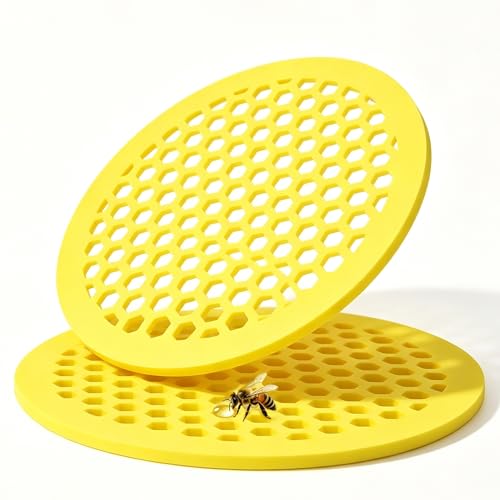
Elempony Floating Bee Watering Station, 2 Pieces
Elempony · 2 floating bee watering stations (listed) · floats on existing water · landing platform format
Our verdict: The cheapest useful thing on this page, and the only one that addresses water you already have. A floating platform converts a birdbath, a pond edge, a rain barrel, or even a pool into a place a bee can drink and leave alive.
Most bee drownings happen in water nobody put out for bees. The Elempony 2-piece floating bee watering stations ($4.96) address that directly: drop one into a birdbath, a pond, a stock tank, a rain barrel, or a pool, and there is suddenly dry footing where there was only surface tension.
Two specific uses. In a birdbath, a floater turns a known bee killer into a station both birds and bees can use. In a swimming pool, it is a partial mitigation when bees have already adopted the pool: give them somewhere safe to stand while you work on establishing an attractive station nearby and drawing them off, as described above.
At under five dollars there is no reason not to have a couple around, and they pair naturally with any of the dedicated stations above.
Who should buy it
Anyone with a birdbath, pond, rain barrel, stock tank, or pool, and beekeepers doing damage control after bees have found a water source you would rather they had not.
What we don't like
It is a mitigation, not a water source: it holds no water of its own, and a floater in a pool does not solve the underlying problem of bees choosing the pool over your yard.
- Count
- 2 floaters (listed)
- Format
- Floating platform for existing water
- Landing surface
- Built in, floats at surface level
- Best for
- Birdbaths, ponds, rain barrels, pools
- Capacity
- None; uses existing water
- Price
- $4.96
Pros
- Cheapest item here by a wide margin
- Fixes water you already have rather than adding more
- Turns a birdbath from a hazard into a station
- Useful damage control for a pool problem
Cons
- Provides no water of its own
- Does not draw bees away from a bad source on its own
Why bees drown, and what a landing surface actually does
At bee scale, water is not a liquid you dip into. Surface tension makes it a sticky film, and wings that touch it stay touched. A bee that lands on open water in a birdbath or a bucket usually cannot break free, and even a bee that lands on a wet vertical wall can get pinned. This is why beekeepers who have never provided water often find dead bees floating in the dog bowl.
A landing surface fixes it by giving the bee somewhere dry to stand while only her tongue reaches the water. The mechanics are boring and the results are immediate: pebbles proud of the water line, glass marbles in a shallow dish, wine corks floating in a bucket, a sloped ceramic edge, or gravel in a plant saucer. Bees will crowd onto whatever dry footing exists, and a well-set station has a visible line of bees along the wet edge on a hot afternoon.
The other rule is consistency. Bees are loyal to a learned source: once foragers have recruited to a water location, they return to it and keep returning, which is great when the location is your station and bad when it is the neighbor's pool. Set the station out early in the season, keep it wet without gaps, and you own the loyalty rather than fighting it.
How much water a colony really uses
Honey bees use water for three jobs: drinking, diluting stored honey for feeding brood, and evaporative cooling. That third one is the volume driver. In hot weather, foragers bring water into the hive, spread it in thin films on comb and cell walls, and fan across it, holding the brood nest near its target temperature. It is air conditioning that runs on water and wing muscles, and it is why a hive on a July afternoon sounds like a small engine.
Commonly cited estimates put a strong colony's summer demand around a quart a day, and considerably more in extreme heat or in dry regions. Each forager carries a droplet measured in fractions of a teaspoon, so that quart represents an enormous number of trips, and it explains why an unwatered apiary produces such intense pressure on whatever water source exists nearby. Colony water collection and thermoregulation are standard topics in extension beekeeping programs, and Bee Health at eXtension is a solid starting point for the underlying biology.
Native bees need far less. A mason bee host is providing drinking water rather than a cooling supply, and a few small stations are plenty. What both audiences share is the drowning problem and the need for consistency, which is why the same hardware serves both. Mason bees also need something water cannot substitute for: wet clay-rich mud for building nest partitions, covered in how to raise mason bees.
The mosquito problem, and how to run a station that is not a nursery
Any shallow standing water is potential mosquito habitat, and a bee bath is a nearly ideal one: warm, still, and undisturbed. Ignoring this is how a well-meant pollinator project turns into a neighborhood complaint.
The control is simple and it costs nothing. Dump and refill completely every three to four days in warm weather. Mosquito larvae need a stretch of undisturbed water to develop, and a station that gets emptied and refilled twice a week never gets there. Emptying also flushes out algae, bird droppings, and the film that makes a station unattractive to bees.
Other things that help. Keep stations small, because small vessels get changed more often and evaporate faster anyway. Keep them in some sun and some air movement rather than deep still shade. Skip anything decorative that traps water in crevices you cannot dump. And if you also have a rain barrel, a pond, or a neglected wheelbarrow on the property, deal with those first, since they hold far more water than any bee bath.
What not to do: never add oil, soap, or an insecticide to a bee watering station. Anything that kills mosquito larvae in a dish of water is going straight into the bees you are trying to help.
Placement: where bees will actually find it
Near, but not in the flight path. Ten to thirty feet from a hive entrance or bee house, off to the side rather than directly in front. Bees leaving the entrance are moving fast and on a mission; a station just off the runway gets noticed on the way back.
Morning sun. Warm water gets found and used earlier in the day, and a station in deep shade stays cold and ignored. In hot southern summers, morning sun with afternoon shade is the sweet spot, since it slows evaporation without making the water unattractively cold.
Out of strong wind. Wind ripples the surface, blows small bees off their footing, and speeds evaporation. Against a wall, a fence, or a shrub is better than an open lawn.
Near forage. Bees working a flower bed will take water where they already are. Placing a station in the middle of the planting from our forage guide gets more visits than one on the far side of the yard.
Multiple locations. This is the highest-value trick in the category and the reason we recommend multi-packs. Put three or four out, watch which ones get adopted after a week or two, and then keep those filled religiously. Guessing correctly on the first try is unlikely; running four guesses at once costs eighteen dollars.
The neighbor's swimming pool problem
This is the single most common water complaint in backyard beekeeping, and it is entirely preventable if you act early. Pools are close to a perfect bee water source: warm, wide, endlessly available, with textured coping and shallow steps to land on, and often the only reliable open water for a block in either direction. Once a colony's foragers commit to it, dozens of bees at the pool edge become a daily fact, and your neighbor is not going to enjoy it.
The prevention is timing. Put your water out first, before your bees have learned another source, ideally in early spring as soon as flight begins, and never let it run dry. Establishing loyalty to your station is easy; breaking loyalty to a pool is hard.
If the pool has already been adopted, the standard playbook, none of it guaranteed: set up an attractive station very close to the pool, keep it wet, and then gradually move it back toward your property over days; try adding something that makes your water more findable by scent, such as a small amount of salt or a bit of algae growth, since bees do favor water that smells like something; and be pleasant about it. Talk to the neighbor, offer honey, offer to cover the pool cost of a cover, and take the problem seriously. Neighbor relations decide whether backyard beekeeping stays legal in a lot of towns, which is exactly why our beehive placement guide spends as much time on people as on sun and wind.
More gear worth comparing
Beyond this guide: the highest-rated gear across every category and budget, with a live price check on each.



As an Amazon Associate we may earn from qualifying purchases, at no cost to you.
Quick shop: every pick
Skip the scroll: the whole lineup, with a live price check on each.
- Retyion Bee Watering Station, 4 PackBest OverallRetyion · $17.83Check Price
- Mellbree Metal Flower Bee Bath, 4 PackBest Budget Multi-PackMellbree · $14.99Check Price
- FOWUIKOH Ceramic Bee Watering Station, 6 PiecesBest LookingFOWUIKOH · $22.99Check Price
- Elempony Floating Bee Watering Station, 2 PiecesBest for Ponds and PoolsElempony · $4.96Check Price
How we chose
Landing surface first: a station scores on whether a bee has somewhere dry to stand, either built in or easily added with pebbles and marbles.
Depth honesty: shallow is safer, but shallow also evaporates fast, so we weigh drowning risk against how often you will realistically refill.
Mosquito manageability: we favor stations that are easy to dump and refill completely, since standing water in a bee bath is standing water in a mosquito habitat.
Placement flexibility: multiple small vessels usually outperform one large one, because bees commit to a learned source and you want several chances at adoption.
Volume for beekeepers: where a colony may need around a quart a day in heat, we say plainly which picks need daily attention and which can be scaled with a larger reservoir.
Same desk, same standard: no brand paid for placement, and we note in print that a pie plate of gravel does most of this job for free.
Key terms
- Landing surface
- Anything a bee can stand on while drinking: pebbles, marbles, corks, gravel, or a sloped edge. Without one, surface tension traps bees and open water becomes lethal.
- Evaporative cooling
- The honey bee method of air-conditioning a hive: foragers bring water in, spread it on comb, and fan across it. It is the reason colony water demand spikes in hot weather.
- Water forager
- A worker bee specialized on collecting water rather than nectar or pollen. Water foragers commit to a learned source and keep returning, which is why establishing your station early matters.
- Mosquito larval window
- The stretch of undisturbed standing water mosquito larvae need to develop. Dumping and refilling a station every three to four days prevents it without any chemical treatment.
- Mud source
- A patch of damp clay-rich soil within about 50 feet of a mason bee house, used for building nest cell partitions. Distinct from a water station and equally necessary.
Questions, answered
do bees need a water source in the garden
Yes. Bees drink, and honey bee colonies also use water for evaporative cooling of the brood nest in hot weather, with commonly cited summer demand around a quart a day for a strong colony. Without a provided source, bees will find water elsewhere, which is often a neighbor's pool, a pet bowl, or a birdbath where they drown.
why do bees drown in water
At bee scale, surface tension makes water a sticky film that grabs wings. A bee landing on open water usually cannot break free and take off. That is why every bee watering station needs pebbles, marbles, corks, or a sloped surface, so she can stand on something dry while only her tongue reaches the water.
what do you put in a bee water station
Small stones, pebbles, glass marbles, gravel, or wine corks, filled deep enough that dry surfaces stand proud of the water line. Never add soap, oil, sugar, or insecticide. Plain water with solid footing is exactly what bees want, and additives either harm them or attract robbing and wasps.
how do i keep my bee bath from breeding mosquitoes
Dump it and refill it completely every three to four days in warm weather. Mosquito larvae need a stretch of undisturbed standing water to develop, and a twice-weekly change never allows it. Keep stations small so changing them is easy, and never use oil or larvicide in water bees drink from.
where should i put a bee watering station
Ten to thirty feet from the hive or bee house, off to the side rather than directly in the flight path, in morning sun and out of strong wind, and ideally near flowers the bees already work. Put out several locations at once and then keep the ones that get adopted filled without gaps.
how do i keep bees out of my neighbors pool
Establish your own water source first, before your bees learn the pool, and never let it run dry. If they have already adopted it, set an attractive station right next to the pool, keep it wet, then move it back toward your property over several days. Bees favor water that smells like something, so slightly algal water competes better than clean tap water.
how much water does a beehive need per day
Commonly cited estimates put a strong colony around a quart a day in summer, and more in extreme heat or arid regions, because water is used for evaporative cooling as well as drinking. That volume is why small decorative dishes need daily refilling and why beekeepers usually add a bucket or tub with floating corks.
can i just use a birdbath for bees
Only if you modify it. A standard birdbath is a drowning hazard because the water is open and the sides are smooth. Add a layer of pebbles or stones that break the surface, or drop in a floating platform, and it becomes a genuinely good station that serves birds and bees at once.
do mason bees need water too
They drink, but their more critical need is wet clay-rich mud within about 50 feet of the nest, which they use to build cell partitions and seal tunnels. A water station covers drinking; a deliberate damp clay patch covers construction. Missing mud is the most common reason a well-sited mason bee house stays empty.
when should i put out water for bees
Early spring, as soon as bees are flying, and keep it filled continuously through fall. Timing matters because bees commit to a learned water source and keep returning to it. Establishing your station before they discover a pool or a pond is far easier than trying to move them off one later.
Filed under Buyer's Guide
Part of Bees & Pollinators
Keep reading
Beehive Placement Guide
Sun, wind, flight paths, and the neighbor diplomacy that decides whether backyard hives work.
How to Raise Mason Bees
The other wet thing native bees need: a clay-rich mud source, plus the full annual routine.
Best Mason Bee Houses
Eight houses ranked on cleanability, hole size, mounting, and rain protection.
Mason Bees vs Honey Bees
Cost, time, stings, honey, and pollination compared, for anyone still choosing a path.
The Native Bees Guide
The 4,000 species drinking from your station, and what else they need from your yard.
Best Plants for Honey Bees
Where to put the water: right in the middle of the forage, with bloom from spring to frost.