Our Pick: POLLIBEE
Check PriceHow to Raise Mason Bees: The Complete Year, Start to Finish
Answer first: raising mason bees means mounting a house on an east-facing wall in late winter, releasing cocoons when daytime temperatures hold near 55F and the first blossoms open, keeping a patch of damp clay-rich mud within about 50 feet, then harvesting the filled tubes in October and refrigerating the cleaned cocoons until spring. A complete starter setup runs about $47: a $28.90 POLLIBEE Wax Coated Mason Bee House and a $17.99 pack of Rivajam nesting tubes. Total labor for the year is roughly four hours.
By The BeehiveKits Hive Desk2026-08-2922 min read Fact-checked against verified Amazon listingsHow we research
Set expectations correctly and you will love this hobby. Mason bees make no honey and no wax. They do not live in colonies, do not swarm, do not need feeding, do not get varroa mites, and are not regulated in the way managed honey bee colonies are in many towns. Each female is her own queen and her own worker: she emerges in spring, mates, spends four to six weeks filling nesting tunnels with pollen and eggs, and dies. The next generation sits in your house all summer, all fall, and all winter, and flies the following spring.
What you get in exchange is pollination that punches far above its weight. Mason bees fly in cooler, wetter weather than honey bees, they belly-flop through blossoms carrying dry pollen loose on the underside of the abdomen rather than packed neatly on the legs, and they visit far more flowers per trip because they are sloppy. On fruit trees a single female is worth many honey bee foragers. If you own apples, cherries, plums, pears, or almonds, this is the highest return per dollar in pollinator gardening.
This guide runs the year in order, with the specific numbers that matter and the specific mistakes that cause empty houses. It pairs with our hardware roundups on mason bee houses and tubes and cocoons, and with the honest comparison in mason bees vs honey bees if you are still deciding. No brand paid for placement, prices were verified at publication, and some links go to Amazon, where a purchase may earn us a small commission at no extra cost to you.
What to know
- The whole year is four steps: mount the house in late winter, release cocoons at about 55F when bloom opens, leave it alone all summer, harvest and refrigerate cocoons in the fall.
- Mud within about 50 feet is the number one reason houses succeed or sit empty. Mason bees build cell walls from wet clay-rich soil and will not travel far for it.
- They do not make honey, do not live in colonies, and almost never sting. Males cannot sting at all, and females have no colony or stores to defend.
- Per individual on fruit trees they out-pollinate honey bees substantially, because they carry pollen loosely on the abdomen and fly in cooler, wetter weather.
- Replace nesting material every single year. Reused tubes accumulate chalkbrood and pollen mites, which is how well-meaning bee houses become disease traps.
- Total annual cost after year one is about the price of a tube refill, roughly fifteen to twenty five dollars, and total annual labor is around four hours.
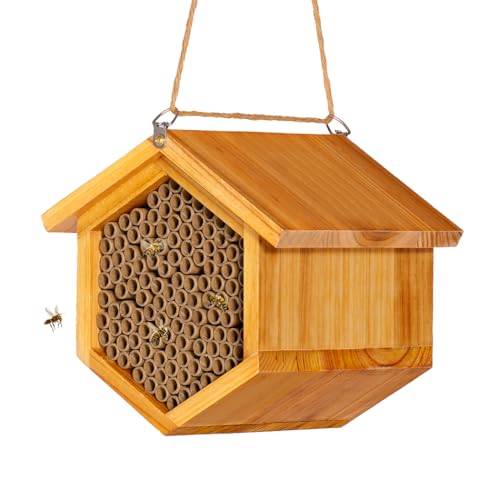
POLLIBEE Wax Coated Mason Bee House
POLLIBEE · Wax-coated wooden shell · loose nesting tubes (listed) · overhanging roof
Our verdict: The house we recommend when someone wants one link and no research. It gets the three things right that decide success: weather protection over the openings, rigid mounting, and nesting material you can pull out and replace every fall.
Everything in this guide assumes a house you can service, and the POLLIBEE Wax Coated Mason Bee House ($28.90) is the cheapest one we trust to do that. Wax-treated wood handles weather without sealing anything into the tunnels, the roof overhangs the face so rain runs past the openings, and the nesting tubes are loose rather than bored permanently into the back.
Mount it in February or early March facing east or southeast, at chest height, screwed to something that does not move. Then leave it there for a decade, replacing only what is inside it.
Who should buy it
Anyone starting mason bees this year who wants the correct hardware without comparing eight products first.
What we don't like
Tube counts and dimensions are listed rather than verified, and wooden houses want a genuinely sheltered mount in wet climates.
- Material
- Wood with wax coating (listed)
- Nesting
- Removable tubes (listed)
- Cleanable
- Yes, replace tubes annually
- Mounting
- Rigid, 3 to 6 feet
- Best facing
- East or southeast
- Price
- $28.90
Pros
- Removable tubes make the annual reset simple
- Roof overhang keeps rain off the openings
- Wax coating without interior treatments
- Right capacity for a normal yard
Cons
- Specs are manufacturer-listed
- Wants a sheltered mounting spot in wet regions

Rivajam 150 Mason Bee House Tubes Refill Pack
Rivajam · 150 tubes (listed) · cardboard with paper inserts (listed) · annual consumable
Our verdict: The consumable that makes the whole practice work. Inserts unroll at harvest, cocoons come out clean, and last year's material goes in the trash where it belongs.
Fresh nesting material every year is the single hygiene rule of this hobby, and the Rivajam 150-tube refill pack ($17.99) is the version that makes people actually follow it. The paper insert inside each cardboard tube unrolls like a scroll in October, and the cocoons come away without prying or cutting.
One pack reloads a typical garden house for a season or two, so the running cost of doing this correctly is roughly the price of two coffees per year.
Who should buy it
Every host, every year. If you own a bee house and have not bought tubes this season, this is the purchase.
What we don't like
Cardboard needs a house with real rain protection, and bore mixes are listed rather than verified, so check the size distribution against your target species.
- Count
- 150 tubes (listed)
- Construction
- Cardboard with paper insert (listed)
- Harvest
- Unroll the insert
- Replacement
- Annual, no reuse
- Price
- $17.99
Pros
- Harvest is genuinely easy
- Enough tubes to reload more than once
- Consistent factory bore
- Cheap enough to replace without hesitation
Cons
- Softens if rain reaches the openings
- Counts and diameters are listed

Retyion Bee Watering Station, 4 Pack
Retyion · 4-pack bee watering stations (listed) · shallow garden bee bath format
Our verdict: Mud is for building and water is for drinking, and a bee yard needs both. Four shallow stations let you put water near the house, near the forage, and near wherever the bees are already congregating.
Open water kills bees, because a bee that lands on a smooth wet surface gets its wings stuck and cannot take off. Shallow stations with landing surfaces solve that, and the Retyion 4-pack bee watering stations ($17.83) let you place several rather than fighting over one location.
Add pebbles, marbles, or corks so there is always dry standing room, and refill often enough that nothing stagnates. Placement and mosquito control are covered in our water station roundup.
Who should buy it
Any bee house host, and any gardener who wants pollinators to stay in the yard rather than commuting to a neighbor's pool.
What we don't like
Small shallow vessels evaporate fast in summer heat, so they need topping up every day or two, and they must be dumped and refilled regularly to stay mosquito free.
- Count
- 4 stations (listed)
- Format
- Shallow garden bee bath
- Needs
- Pebbles or marbles as landing surfaces
- Placement
- Near the house and near forage
- Price
- $17.83
Pros
- Four stations cover several placements
- Shallow design prevents drowning when filled correctly
- Cheap addition to any bee house setup
- Works for native bees, honey bees, and butterflies alike
Cons
- Evaporates quickly in summer heat
- Requires regular dumping to avoid mosquitoes
What a mason bee actually is
Mason bees are solitary bees in the genus Osmia, and the one most people host is the blue orchard mason bee, Osmia lignaria, a metallic blue-black native across much of North America. The name comes from the masonry: females build partition walls between egg cells out of wet mud, and seal the tunnel entrance with a final mud plug.
There is no colony. Every female is her own queen, forager, builder, and defender, working alone in a tunnel she did not dig, usually a beetle hole, a hollow stem, or a crack in weathered wood. She provisions each cell with a loaf of pollen and nectar, lays one egg on it, walls it off, and starts the next. A productive female fills several tunnels over a working life of about four to six weeks, then dies, having never met her offspring.
Those offspring hatch, eat the provision, spin a cocoon, transform into adults by late summer, and then sit still inside the sealed cell through fall and winter. That waiting adult is what you harvest in October and what you refrigerate until spring. Understanding that single fact, that the bee is already fully formed and simply dormant, makes every storage and release decision in this guide obvious.
Why gardeners raise them: the pollination case
Honey bees are generalists and hoarders. They pack pollen into tidy dampened pellets on their hind legs, which is efficient for the colony and inefficient for the flower, because packed pollen is largely unavailable for pollination. Mason bees carry pollen dry and loose in a brush of hairs under the abdomen called a scopa, and it falls off constantly as they scramble through blossoms.
Add three more advantages. They fly at lower temperatures and in light rain, which is the difference between pollination happening and not happening during a cool, damp fruit bloom. They forage very close to home, so their entire effort lands on your trees rather than a neighborhood two miles away. And they visit far more blossoms per unit time, because they are not being careful.
The commonly cited comparisons put one female mason bee on par with a large number of honey bee foragers for fruit tree pollination, which is why commercial orchards manage them and why the USDA Agricultural Research Service runs long-standing research programs on managed native pollinators. For a backyard with a few fruit trees, a well-run bee house is a genuinely meaningful upgrade to fruit set.
The mason bee year at a glance
| Window | What you do | What the bees do |
|---|---|---|
| February to early March | Mount house, load fresh tubes, prepare mud | Dormant adults in cocoons |
| March to April | Release cocoons at about 55F with bloom open | Males emerge, then females; mating |
| April to May | Keep mud damp, watch, stay out of the way | Females provision and seal tunnels |
| June to September | Nothing. Leave the house alone | Larvae feed, spin cocoons, become adults |
| October to November | Harvest tubes, sort, wash cocoons | Dormant adults inside cocoons |
| November to February | Cold storage at roughly 34F to 39F | Overwintering |
That is the whole hobby. Compare it with the twelve-month management load of a honey bee colony in our first-year beekeeping calendar and the difference in commitment becomes obvious immediately.
Step one: the house, and why cleanability is the spec
Buy a house whose nesting material comes out. That single criterion outranks capacity, material, roof style, and appearance, because it determines whether you can run the annual hygiene routine that keeps a concentrated nest site healthy. Our top pick for most gardens is the POLLIBEE Wax Coated Mason Bee House ($28.90), which pairs a weather-coated shell and a real roof overhang with loose tubes you can pull.
Mount it in February or early March, before emergence, on an east or southeast face so morning sun warms the entrance and the bees fly early. Fix it rigidly to a wall, fence, or post at roughly 3 to 6 feet. Do not hang it from a hook or a branch: motion during nesting disturbs the female mid-build. Put it under an eave if you have one, and make sure nothing shades it all morning.
Skip the drilled block and skip the sealed bamboo bundle. Neither can be opened, which means neither can be cleaned or harvested, and both concentrate chalkbrood and pollen mites season over season. The full argument, with eight houses ranked on that basis, is in the mason bee house roundup.
Step two: fresh tubes, correct bore, correct depth
Load new nesting material every year. A pack of Rivajam 150 mason bee tubes ($17.99) reloads a typical house for a season or two and uses paper inserts, which makes the fall harvest a ten minute job at the kitchen table instead of a knife-and-patience exercise.
Two dimensions decide who nests. Bore: about 5/16 inch, roughly 8mm, is what blue orchard mason bees choose. Around 6mm shifts you toward leafcutter bees and smaller Osmia species, which nest later and extend your season. Depth: 6 inches or more, because a female lays fertilized eggs that become females at the back of the tunnel and unfertilized eggs that become males near the front, where predators strike first. Shallow tubes produce a male-heavy generation, and males do not build nests.
Tunnels must be closed at the far end. Anything open at both ends reads as a draft, not a nest.
Step three: mud, the failure that explains most empty houses
If you read one section twice, make it this one. Mason bees need wet, clay-rich soil to build cell partitions and the entrance plug, and unlike honey bees fetching water, they will not commute for it. Guidance consistently puts the useful radius at roughly 50 feet from the nest.
Most modern yards fail this test without anyone noticing. Full mulch coverage, thick turf, gravel, and sandy soil all mean zero accessible mud. The result is a beautifully sited house that stays empty while the host concludes mason bees do not live around here.
Fixes, in order of effort. Easiest: dig a bare patch a foot or two across near the house, in a spot that stays damp, and simply do not plant or mulch it. Better: sink a shallow tray or a plant saucer, fill it with clay-heavy soil, and keep it wet as you would a potted plant. Best in sandy regions: buy a small bag of clay or pond soil, mix it into your mud patch, and keep a drip or a weekly watering on it through the nesting season.
Step four: releasing cocoons at the right moment
Two conditions must both be true: daytime temperatures holding around 55F, and bloom actually open within a few hundred feet. Temperature alone triggers emergence; bloom alone feeds them. Miss either and you get bees with nothing to eat or blossoms with no bees.
Timing by region, approximately: early to mid March in the South, late March into April across the middle of the country, and mid to late April in the North and at elevation. Local fruit bloom is a far better signal than the calendar, so watch the trees rather than the date.
Mechanically: put the cocoons in a small ventilated container or the release chamber built into many houses, tuck it under the roof out of rain, and keep ants off it. Males emerge over the first several days and hang around the house waiting; females follow, mate within a day or two, and start scouting tunnels almost immediately. If your spring throws hard freezes, release half the cocoons at the first sustained warm spell and hold the rest in the refrigerator for another two weeks.
Step five: the nesting season, and what you will see
This is the good part, and it lasts four to six weeks. A female works a tunnel from the back forward: fly out, gather pollen and nectar, return, unload, repeat until the loaf is big enough, lay one egg on it, then fly for mud and wall the cell off. Watch for a few minutes and you can tell pollen trips from mud trips by what she is carrying and how she backs in.
Capped tunnels get a flush mud plug, and a house fills from the outside tubes inward or in whatever pattern the females prefer that year. Expect a slow start and an accelerating middle. By late May in most regions the mason bee season is done, and if the house has 6mm tubes and summer bloom, leafcutter bees may take over and cap their tunnels with tidy circles of cut leaf.
Your job during all of this is minimal: keep the mud damp, keep the water station full, do not move the house, and do not open anything. Stand a foot away and watch as much as you like. Mason bees are so unbothered by people that gardeners routinely work directly under an active house without protection, which is the subject of the next section.
Stings, safety, and kids
Male mason bees have no sting at all. Females have one and effectively never use it, because there is no colony, no honey, and no stored wealth to defend; a solitary bee that dies defending a nest loses everything, so evolution selected for fleeing rather than fighting. Reports of stings almost always involve a bee trapped against skin, and the sting itself is generally described as far milder than a honey bee's.
Practically, that means a mason bee house is appropriate on a patio, next to a play area, or at a school, in places where a honey bee hive would be a bad idea. It is a large part of why we recommend mason bees to families and to anyone in a dense neighborhood, and the tradeoffs against a real hive are laid out in mason bees vs honey bees.
The usual caveat still applies: anyone with a diagnosed bee venom allergy should treat all bees with the same caution and carry whatever their clinician prescribed. Our bee sting safety guide covers reactions and when they warrant medical attention.
Forage: plant close, plant early
Because mason bees forage short distances, proximity beats abundance. A single early-flowering tree fifty feet from the house does more for them than an acre of wildflowers at the back of the property. Prioritize in this order: fruit trees (apple, cherry, plum, pear), early natives and willows, maples, dandelions and other early lawn bloom, and spring bulbs planted in mass rather than in ones and twos.
Two habits help more than any purchase. First, stop deadheading the lawn in March: dandelions and other early weeds are the bridge between emergence and real bloom. Second, plant natives where you have the choice, because native bees have deeper relationships with native plants than honey bees do, a point we develop in the native bees guide. Seed mixes and bloom succession planning carry over from our forage planting guide, with the caveat that the mason bee window is early spring, not high summer.
And keep insecticides away from bloom. Systemic products move into pollen and nectar, and the EPA pollinator protection program is the reference worth bookmarking before you spray anything near a nesting house.
Fall harvest: opening the tubes
Wait until October or November, once the adults inside have fully formed. Bring the filled tubes indoors to a cool room and work over a table with a bowl of cool water and a colander.
Unroll paper inserts, or split reeds lengthwise with a thumbnail or knife tip. Inside you will find a row of cocoons separated by mud walls. Sort as you go: keep the firm, uniform, rice-grain-shaped cocoons, and discard chalky white mummies, cells full of fine dust with visible mites, and cells containing wasp larvae rather than a cocoon. Discards go in the trash, not the compost pile next to the house.
Then wash. Rinse the keepers in cool water, agitating gently to float away mud and mites, and rinse clean. Some hosts add a brief dilute bleach step, a practice commonly recommended in extension and commercial guidance for chalkbrood and mite control; keep it short, rinse thoroughly afterward, and never soak. Spread the cocoons on a towel until they are surface dry. The detailed material-by-material harvest walkthrough lives in the tubes and cocoons guide.
Winter storage and the reset
Dried cocoons go into a ventilated container, a small box with air holes or a mesh pouch, with a slightly damp element such as a dampened paper towel in a separate corner for humidity. Commonly listed storage temperatures are roughly 34F to 39F, which is standard refrigerator territory, and the goal is a normal winter without desiccation.
Check monthly. You are looking for mold, which means too much moisture, or shriveled cocoons, which means too little. Adjust the humidity source accordingly. A crisper drawer with produce in it can be too humid and too full of ethylene, so a separate shelf is safer.
Meanwhile, in late winter, clean the empty house: brush out debris, discard every scrap of last year's nesting material, and load fresh tubes. In February or early March the house goes back up, and in March or April the cocoons come out of the refrigerator. That is the reset, and each year you should be harvesting more cocoons than you released, which is the whole scoreboard.
Troubleshooting: empty houses, parasites, and predators
Nothing nested at all. Check mud first, every time. Then orientation (east or southeast), rigidity of the mount, rain protection, and whether early bloom exists within a few hundred feet. If all four are right for two seasons, your area likely has no established population, and buying cocoons once is the fix.
Chalky white cocoons at harvest. That is chalkbrood, a fungal disease of the larvae. Discard the affected cells, wash the survivors, and never reuse the nesting material. Persistent problems usually trace to reused tubes or a chronically damp house.
Cells full of dust and tiny crawling mites. Pollen mites, which eat the provision and starve the larva. The harvest-and-wash routine is the control, and annual tube replacement is the prevention.
Tiny wasps around the house. Parasitic wasps lay through tube walls. Some presence is normal; heavy pressure argues for harvesting and storing cocoons rather than leaving tubes on the wall through fall, and for spreading nests across two smaller houses rather than one large one.
Woodpeckers or birds tearing at tubes. Hardware cloth stretched a couple of inches in front of the house face solves it without blocking bee access.
Ants. They raid provisions. A smear of petroleum jelly on the mounting post or bracket stops the trail without pesticides anywhere near the nest.
How to Raise Mason Bees Through a Full Year
- 1
Pick and site the house (February to early March)
Choose a house with removable nesting tubes, then mount it rigidly on an east or southeast facing wall, fence, or post at roughly 3 to 6 feet. Put it under an eave or use a house with a real roof overhang so rain never runs into the tube openings. A house that swings in the wind will be rejected.
- 2
Load fresh nesting tubes
Fill the house with new tubes every year, sized near 5/16 inch (about 8mm) and at least 6 inches deep for blue orchard mason bees. Add some 6mm tubes if you also want leafcutter bees in summer. Never reuse last year's material.
- 3
Build a mud source within 50 feet
Expose a bare patch of clay-rich soil about a foot across, or fill a shallow tray with clay soil, and keep it damp through spring. Sandy or heavily mulched yards need clay added. Without accessible mud, females cannot partition their cells and will nest somewhere else.
- 4
Confirm there is spring bloom within about 300 feet
Mason bees forage short distances. Fruit trees, willows, maples, dandelions, and early perennials near the house matter far more than a meadow across the property. If your only bloom is distant, add early flowering plants near the house before you release bees.
- 5
Release cocoons when it hits about 55F with bloom open
Set purchased or overwintered cocoons out in a ventilated release container tucked under the house roof, protected from rain and ants, once daytime temperatures hold near 55F and blossoms are opening. Stagger the release across two weeks if late freezes are likely.
- 6
Watch the nesting season and stay out of the way
Males emerge first, then females, who mate and begin provisioning within days. Expect four to six weeks of activity. Watch as much as you want from a foot away, but do not open tubes, move the house, or handle capped nests.
- 7
Leave the house alone through summer
Once tubes are capped with mud, the season is over for mason bees and the larvae inside are eating and spinning cocoons. Do not bring tubes indoors in July. If leafcutter bees show up and cap tubes with leaf discs, that is a bonus second tenant.
- 8
Harvest filled tubes in the fall (October to November)
Unroll paper inserts or split reeds over a table. Sort out chalky mummies, mite-packed cells, and parasitized cells, and discard them in the trash. Keep the firm, uniform cocoons.
- 9
Wash and dry the cocoons
Rinse the harvested cocoons in cool water, agitating gently to float away mud, frass, and mites, then rinse clean and spread them on a towel until surface dry. Discard anything that stays floating or crumbles.
- 10
Refrigerate over winter, then repeat
Store the dried cocoons in a ventilated container with a little humidity at commonly listed temperatures of roughly 34F to 39F, checking monthly for mold. In late winter, load fresh tubes into the cleaned house and start the cycle again.
More gear worth comparing
Beyond this guide: the highest-rated gear across every category and budget, with a live price check on each.




As an Amazon Associate we may earn from qualifying purchases, at no cost to you.
Quick shop: every pick
Skip the scroll: the whole lineup, with a live price check on each.
- POLLIBEE Wax Coated Mason Bee HouseThe HousePOLLIBEE · $28.90Check Price
- Rivajam 150 Mason Bee House Tubes Refill PackThe Annual RefillRivajam · $17.99Check Price
- Retyion Bee Watering Station, 4 PackThe Water SourceRetyion · $17.83Check Price
Key terms
- Osmia lignaria
- The blue orchard mason bee, a metallic blue-black solitary bee native across much of North America and the species most commonly hosted in bee houses.
- Solitary bee
- A bee with no colony, no queen caste, and no workers. Each female builds and provisions her own nest alone, which is why solitary bees are gentle and require no hive management.
- Scopa
- The brush of hairs, in mason bees located under the abdomen, that carries dry pollen loosely. Loose dry pollen falls off readily, which makes mason bees unusually effective pollinators.
- Cell partition
- The mud wall a female builds between egg chambers inside a nesting tunnel. Building it requires wet clay-rich mud within about 50 feet of the nest.
- Cocoon
- The sealed case a larva spins in late summer, inside which it becomes an adult and waits out fall and winter. This is what you harvest in October and refrigerate until spring.
- Release
- Setting overwintered cocoons out in spring, timed to daytime temperatures holding near 55F with bloom open nearby, so emerging adults have food immediately.
- Pollen mite
- A mite, commonly Chaetodactylus, that consumes the pollen provision meant for a bee larva. Controlled by annual tube replacement and fall cocoon washing.
Questions, answered
how do you raise mason bees for beginners
Mount a house with removable tubes on an east-facing wall in late winter, load fresh nesting tubes, keep a patch of damp clay-rich mud within about 50 feet, and release cocoons when daytime temperatures hold near 55F with bloom open. Leave the house alone all summer, then harvest, wash, and refrigerate the cocoons in October. That is the entire year.
do mason bees make honey
No. Mason bees are solitary and store only enough pollen and nectar to feed individual larvae, so there is no surplus and no comb. If honey is your goal you need managed honey bee colonies, which is a much larger commitment in equipment, cost, and time.
do mason bees sting
Almost never. Males have no sting at all, and females have one they effectively do not use because there is no colony or honey store to defend. Stings generally happen only when a bee is trapped against skin and are described as milder than a honey bee sting. People with known bee venom allergies should still take normal precautions.
when should i put out my mason bee house
Late winter, roughly February to early March in most of the US, so the house is mounted and weathered before the first bees emerge. Load fresh tubes at the same time. Cocoons go out a few weeks later, once daytime temperatures hold near 55F and early bloom is open.
why are mason bees not using my house
Check mud first, because it is the most common cause. Mason bees need damp clay-rich soil within about 50 feet and will not travel far for it. Then confirm the house faces east or southeast, is rigidly mounted at 3 to 6 feet, is protected from rain, and has early bloom within a few hundred feet. If all of that is right for two seasons, your area may lack an established population.
are mason bees better pollinators than honey bees
Per individual on fruit trees, yes, substantially. They carry pollen dry and loose under the abdomen rather than packed on the legs, so it transfers readily, and they fly in cooler and wetter conditions and forage close to home. Honey bees still win on colony scale and on producing honey, which mason bees do not do at all.
what do you feed mason bees
Nothing. You never feed mason bees. They gather all the pollen and nectar they need from flowers within a few hundred feet, so your job is to provide bloom nearby rather than syrup or patties. Water and mud are the two things worth supplying directly.
how do you store mason bee cocoons over winter
Harvest in October or November, sort out diseased and parasitized cells, wash the healthy cocoons in cool water, and dry them. Then store in a ventilated container with a small humidity source at commonly listed temperatures of roughly 34F to 39F, which is normal refrigerator range, checking monthly for mold or shriveling.
how many mason bees do i need to start
A few dozen cocoons is a normal starter batch for a garden house. Each female fills several tunnels over four to six weeks, so a small release seeds a house quickly when mud and bloom are present. After the first successful year you should be harvesting more cocoons than you released and never need to buy again.
do mason bees come back every year
The individuals do not, since adults live only a few weeks in spring, but the population does. Their offspring overwinter as adults inside sealed cocoons in your nesting tubes and fly the following spring. Whether that population grows depends almost entirely on whether you replace the nesting material annually and harvest cocoons rather than letting parasites accumulate.
Filed under Explainer
Part of How-To Guides · Bees & Pollinators
Keep reading
Best Mason Bee Houses
Eight houses ranked on cleanability, hole size, and rain protection, from $18.99 to $83.96.
Best Mason Bee Tubes and Cocoons
The annual consumable: cardboard versus reed, harvest technique, and ethical cocoon sourcing.
Mason Bees vs Honey Bees
Cost, hours, stings, honey, and pollination compared, with honest routing on which one you should keep.
The Native Bees Guide
Roughly 4,000 native species, the major groups, and why bare ground helps more than bee houses.
Best Bee Water Stations
Shallow drinking stations, landing surfaces, and how to keep them from breeding mosquitoes.
Beekeeping Cost Index
What the honey bee alternative actually costs in year one, for anyone weighing the two paths.