Our Pick: BBB Seed
Check PriceThe Best Plants for Honey Bees: Seed Mixes and a Real Forage Plan
If you want one packet to throw at the question, buy the BBB Seed Honey Bee Wildflower Mix ($16.29): a mix assembled specifically for honey bee forage rather than generic prettiness, with the bloom spread that matters more than any single flower in it. But the honest answer to what should I plant for my bees is bigger than a packet, and this guide covers all of it: which seed mixes are worth the money, how nectar plants differ from pollen plants, how to stack blooms so something is always flowering from March to frost, and why the biggest forage upgrades on most properties are a tree and a lazier lawn, not a flower bed.
By The BeehiveKits Hive Desk2026-08-2821 min read Fact-checked against verified Amazon listingsHow we research
First, the scale disclaimer every honest planting guide owes you: your colonies forage a two-mile radius, roughly 8,000 acres, and no backyard planting meaningfully changes the total nectar economy of that circle. What your plantings do accomplish is real and threefold: they patch the specific hungry gaps in your local calendar (early spring buildup and the late-summer dearth), they feed the native pollinators that share your yard, and they put forage where you can see it, which makes you a sharper observer of what your bees actually work. Plant for the gaps and the joy, and let the two-mile circle grow the honey crop.
Our lens here is the same one we bring to hive hardware: does it actually serve the bees, and will a normal person succeed with it? That means mixes with real bloom succession instead of one flashy month, plants with documented nectar or pollen value, honest words about invasive species and pesticide-treated nursery stock, and zero pretense that a $16 packet replaces good beekeeping. Standard disclosure, plainly: no brand paid to appear here, and some links go to Amazon, where a purchase may earn us a small commission at no extra cost to you.
What to know
- Plant for the gaps, not the peak: most regions have plenty of bloom in May and June and go hungry in early spring and the late-summer dearth. Your plantings matter most at the edges of the season.
- Nectar plants and pollen plants are different jobs: nectar becomes honey and winter stores, pollen becomes brood protein. A good forage plan supplies both, and the best mixes and trees do too.
- Trees beat flower beds on volume: a mature basswood or black locust in bloom offers more nectar than most entire yards of flowers. If you own dirt, plant a tree this year and flowers while you wait.
- The classic bee plants earn their reputations: white clover, borage, goldenrod, asters, sunflowers, anise hyssop, and flowering herbs are reliable performers across most of the US.
- Skip invasive showpieces and pesticide-treated nursery stock; systemic insecticides travel into nectar and pollen, so seeds and untreated plants are the safer route, per EPA pollinator guidance.
- A seed mix is the cheapest experiment in beekeeping: $10 to $20 covers hundreds of square feet, and our four picks below cover honey-bee-specific, bulk-budget, coverage-per-dollar, and native-diversity strategies.
At a glance
| Mix | Price | Strategy | Coverage | Best for | Check price |
|---|---|---|---|---|---|
| BBB Seed Honey Bee Mix | $16.29 | Honey-bee-targeted blend | Small plots, refreshed yearly | Beekeepers planting for their own hives | Check Price |
| Burpee Wildflower Bulk | $9.99 | 18-variety general wildflower (listed) | 25,000 seeds (listed) | Big coverage on a small budget | Check Price |
| Mountain Valley Wildflower | $10.46 | High seed count per dollar | 80,000+ seeds, 2 oz (listed) | Overseeding margins and strips | Check Price |
| Tactiko Save the Bees Mix | $19.48 | Pollinator diversity blend | 26 varieties (listed) | Mixed native and honey bee forage | Check Price |
Bee forage seed mixes at a glance

BBB Seed Honey Bee Wildflower Seed Mix
BBB Seed · Honey-bee-targeted wildflower blend · annuals and perennials (listed) · untreated seed (listed)
Our verdict: Most pollinator mixes are butterfly bouquets with a bee on the label. This one is blended around what honey bees demonstrably work, with a bloom spread that reaches into the dearth months where a backyard planting actually matters.
The difference between a pollinator mix and a honey bee mix is which insect the blend was built around, and the BBB Seed Honey Bee Wildflower Mix ($16.29) is the rare packet designed from the honey bee side: heavy on the open-faced, nectar-and-pollen workhorses bees mob, blended across seasons rather than dumped into one photogenic month.
Treat it as your gap-patcher: sow it on prepared bare soil in a sunny patch, water it to establishment, and let the annuals carry year one while perennials build toward year two. It will not change your honey crop, nothing packet-sized does, but it will change what your bees find in August, which is the month that counts.
Who should buy it
Beekeepers planting specifically for their own colonies, and anyone who wants the mix choice made by forage value rather than catalog photography.
What we don't like
Costs more per square foot than the bulk options below, and like every mix it rewards real ground prep; scattered into standing grass, no mix on this page performs.
- Strategy
- Honey-bee-targeted blend
- Composition
- Annual and perennial wildflowers (listed)
- Seed
- Untreated (listed)
- Best sowing
- Fall or early spring, bare soil
- Price
- $16.29
Pros
- Blended around honey bee forage value specifically
- Bloom succession reaches the dearth months
- Untreated seed sidesteps the systemic-pesticide question
- Annual-perennial mix pays in year one and builds in year two
Cons
- Pricier per square foot than bulk mixes
- Needs genuine ground prep to establish

Burpee Wildflower 25,000 Seeds Bulk Mix
Burpee · 25,000 seeds (listed) · 18 wildflower varieties (listed) · non-GMO (listed)
Our verdict: The volume play from the most familiar name in home seed: 18 varieties and a listed 25,000 seeds for under ten dollars. Less honey-bee-specific than our top pick, but for sheer flowering square footage per dollar it is the easy call.
When the project is turn this bare quarter of the yard into something blooming, seed count is the spec, and the Burpee Wildflower 25,000-seed bulk mix ($9.99) delivers it with a listed 18 varieties of general wildflower cover. Bees will work a solid share of the blend, and the diversity feeds the rest of the yard's pollinators too.
It is a generalist by design: expect a peak-season show more than a dearth-targeted one, and pair it with borage, anise hyssop, or our top pick if August coverage is the goal. As with all mixes, bare soil and seed-to-soil contact decide the outcome.
Who should buy it
Big-area planters on small budgets, first-time meadow experimenters, and anyone seeding the back forty of the yard where cost per square foot rules.
What we don't like
General wildflower rather than honey-bee-targeted, so a chunk of the blend is scenery; bloom concentrates in the already-rich months more than the hungry ones.
- Strategy
- General wildflower volume
- Seed count
- 25,000 (listed)
- Varieties
- 18 (listed)
- Seed
- Non-GMO (listed)
- Price
- $9.99
Pros
- Best raw coverage per dollar on this page
- 18-variety diversity feeds the whole pollinator yard
- Familiar brand, widely reviewed
- Cheap enough to experiment without stakes
Cons
- Not honey-bee-specific
- Peak-season heavy; dearth coverage is incidental

Mountain Valley Seed Co Wildflower Mix, 2 oz
Mountain Valley Seed Co · 2 oz bulk pack · 80,000+ seeds (listed) · mixed annuals and perennials (listed)
Our verdict: The density champion: a listed 80,000-plus seeds for around ten dollars makes this the mix for edges, strips, and overseeding thin spots, everywhere you want bloom pressure without precision.
Some plantings are designed; others are opportunistic, the fence line, the ditch bank, the strip behind the shed. For those, buy density, and the Mountain Valley Seed Co 2 oz wildflower mix ($10.46) lists over 80,000 seeds, enough to oversow every margin on a suburban lot and re-hit the thin patches in fall.
Density does not repeal the ground-prep rules, but it does buy forgiveness: on roughed-up, imperfectly cleared edges, more seeds per square foot means something establishes. Use the designed mixes for the showcase patch and this one everywhere else.
Who should buy it
Margin and strip planters, overseeders, and anyone treating wildflowers as ground-cover pressure rather than a composed bed.
What we don't like
A generalist blend like the Burpee, with the same peak-season skew, and tiny-seeded mixes sown thick want thinning or acceptance that the vigorous varieties will win.
- Strategy
- Maximum seed density
- Seed count
- 80,000+ (listed)
- Weight
- 2 oz
- Composition
- Annuals and perennials (listed)
- Price
- $10.46
Pros
- Standout listed seed count per dollar
- Ideal for margins, strips, and overseeding
- Density forgives imperfect ground prep
- Two-season composition (listed)
Cons
- Not honey-bee-targeted
- Thick sowings self-thin toward the aggressive varieties
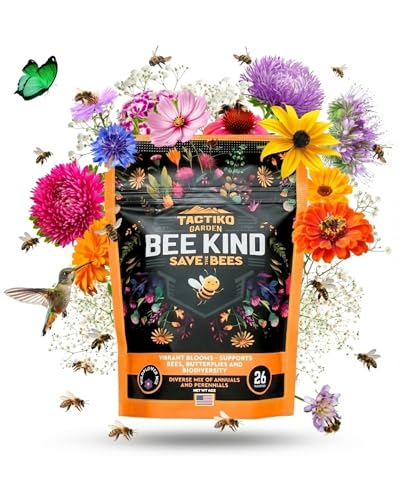
Tactiko Save the Bees Wildflower Seed Mix
Tactiko · Pollinator-focused blend · 26 varieties (listed) · annuals and perennials (listed)
Our verdict: The biodiversity pick: a listed 26 varieties aimed at the whole pollinator guild, bumblebees, solitary bees, butterflies, with plenty your honey bees will work. The right mix when the goal is an ecosystem, not just an apiary amenity.
Honey bees are one species among the hundreds of bees in a healthy yard, and the Tactiko Save the Bees mix ($19.48) plants for the guild: a listed 26 varieties spanning bloom shapes and seasons, which in practice means broader succession and more August options than narrow blends deliver.
For a beekeeper it is the both-and choice: your colonies work the clovers, cosmos, and composites while the natives get the flowers honey bees skip. Variety-rich mixes also hedge your site conditions; with 26 entries, something will love your soil.
Who should buy it
Ecosystem planters, native-pollinator sympathizers with hives, and anyone whose site conditions are uncertain enough that variety is the best hedge.
What we don't like
The priciest packet here, and guild-focused breadth means a share of the blend is planted for insects other than your honey bees, a feature or a cost depending on your goal.
- Strategy
- Pollinator guild diversity
- Varieties
- 26 (listed)
- Composition
- Annuals and perennials (listed)
- Best sowing
- Fall or early spring, bare soil
- Price
- $19.48
Pros
- Widest listed variety count on this page
- Diversity extends bloom succession naturally
- Feeds native pollinators alongside honey bees
- Hedges unknown soil and site conditions
Cons
- Most expensive packet in the roundup
- Guild focus dilutes the honey-bee-specific share
Nectar plants vs pollen plants: two different groceries
Bees shop for two staples, and most planting advice blurs them. Nectar is carbohydrate, the sugar solution that becomes flight fuel, winter stores, and, concentrated and cured, honey itself; the full conversion is its own story in how bees make honey. Pollen is protein and fat, the grocery that becomes brood food; a colony can sit on fifty pounds of honey and still starve its brood-rearing without pollen income. The two arrive from different flowers on different schedules, and colonies balance their foraging force across both according to need.
Some plants are nectar machines: basswood, clovers, borage, black locust, vitex. Some are primarily pollen sources: early willows and maples, corn (wind-pollinated but heavily worked for pollen), many asters. The best forage plants and mixes deliver both, sunflowers, goldenrod, and anise hyssop among them. For the beekeeper the practical rule is seasonal: pollen matters most in late winter and early spring, when it throttles brood buildup, and again in fall when colonies rear the winter bees that carry them to March. Nectar matters most whenever you want the scale to move, and when it stops, you are in a dearth and the feeders come out.
This is also why supplement products exist: pollen patties and substitutes patch protein gaps the landscape leaves. But patties are a patch, and forage is the fabric; a yard planned around the next section's bloom calendar shrinks the gaps you would otherwise buy your way through.
Bloom succession: the March-to-frost relay
A forage plan is a relay race: something must hand off to something else from first flight to frost. Here is the general-knowledge succession that works across most of the temperate US, adjusted locally by your club's veterans, who can name your county's version of each leg.
Early season (roughly March to April): the buildup months, when pollen is the bottleneck. Willows and maples (see the tree section next), dandelions, crocus, henbit, and fruit bloom, apples, cherries, plums, carry this leg. The beekeeper's contribution: stop murdering dandelions, plant spring bulbs in mass, and add fruit trees that pay you twice.
Main flow (roughly May to June): the abundance leg, when most US regions make their honey: clovers, black locust, basswood, brambles, tulip poplar in the East, and the great mixed bloom of early summer. Your plantings matter least here; the landscape is already rich. This is the flow the honey math depends on.
The dearth (roughly July to August): the hungry leg, when plantings earn their keep. Borage (a legendary rebloomer), anise hyssop, mountain mint, cosmos, zinnias, sunflowers, catmint, oregano and thyme let to flower, buttonbush, and vitex bridge the gap. A yard that blooms in August is doing more for your bees than the same yard in May.
Fall (September to frost): the winter-stores leg: goldenrod and asters dominate it across most of the country, with sedum and late sunflowers assisting. Goldenrod honey is strong-flavored and famously ripe-gym-socks fragrant in the hive; the bees are unbothered, and it winters colonies beautifully. This leg feeds the winter-bee rearing that decides survival, the story continued in winter bee feed and how to winterize a beehive.
Trees beat flowers: the acre in the air
The least intuitive fact in bee forage: the serious nectar in most landscapes hangs overhead. A mature flowering tree presents tens of thousands of blossoms in a canopy, an acre of forage on a fifty-foot footprint, and honey bees, efficiency obsessives, will abandon your flower bed wholesale when a good tree turns on. If you own dirt and think in years, tree planting is the highest-leverage forage act available to you.
The east-of-the-Rockies honor roll: basswood (American linden, Tilia americana), whose June bloom is among the great honey plants of the temperate world and yields a prized pale varietal (Wikipedia: Tilia americana); black locust (Robinia pseudoacacia), a May bloomer whose nectar makes the water-white acacia honey of European fame (Wikipedia: Robinia pseudoacacia), though its bloom is gloriously undependable year to year; maples, especially red maple, whose February-to-March flowers are the first serious pollen and nectar of the year and quietly fuel spring buildup; and willows, the other early-pollen pillar. Add tulip poplar in the Southeast, sourwood in Appalachia, and the catalpas, hollies, and fruit trees almost everywhere.
Two practical notes. Plant for the gaps here too: a red maple and a basswood cover early spring and the June flow; a vitex (chaste tree) or buttonbush covers the summer dearth in much of the country. And mind the bloom-year math: trees take five to ten years to contribute seriously, which is exactly why the seed mixes below exist, they are the forage you get this summer while the real infrastructure grows.
What NOT to plant (and what not to bother with)
First, the invasives. Some famous honey plants earned their fame while wrecking ecosystems, and planting them today is a bad trade: purple loosestrife (banned in many states), Japanese knotweed (a legendary fall nectar plant and a property-value catastrophe), and in much of the country autumn olive and non-native bush honeysuckles. Check your state's noxious weed list before adding any vigorous unfamiliar plant; your extension office maintains it. In the same spirit, confine the thugs: mints, including the excellent mountain mint, spread hard, and borage self-seeds enthusiastically, wonderful traits in a managed patch, less so in a perennial border.
Second, the useless-to-bees. Modern ornamental breeding optimizes for petals, and double-flowered cultivars, those pom-pom roses, mums, dahlias, and cherry blossoms, often have nectaries bred away or buried past reach. Wind-pollinated turf grasses offer nothing from flowers. And the showy annuals in big-box hanging baskets, petunias, impatiens, most begonias, are close to forage-neutral. A yard can be gorgeous and a food desert; single-flowered, old-fashioned varieties are the fix.
Third, the overblamed: no, planting flowers near hives does not flavor your honey to match, colonies blend the whole two-mile circle, and single-source varietal honey requires acreage-scale monoculture, as we cover in the honey explainer. Plant the yard for succession and diversity and let the honey be what your region makes.
The pesticide fine print: seeds, transplants, and your own shed
The quiet way bee gardens go wrong is chemistry. Systemic insecticides, neonicotinoids most famously, move through plant tissue and can appear in the nectar and pollen of treated plants, meaning a flower can be simultaneously beautiful, marketed as pollinator-friendly, and delivering dosed groceries. The EPA maintains an active pollinator protection program covering these risks, label restrictions, and the state managed-pollinator plans that grew out of them (EPA: pollinator protection); it is worth a beekeeper's bookmark.
Practical defenses are simple. Growing from seed, like the mixes below, sidesteps most of the transplant problem outright. When you do buy nursery plants, ask whether stock was treated with systemics; the big chains have shifted policies in recent years, but ask anyway. And audit your own shed, because the most likely applicator within two miles of your hives is you: read labels for bee hazard statements, skip spraying anything in bloom, apply unavoidable treatments at dusk after flight ends, and treat lawn grub products, many of them systemic, with particular suspicion. If a neighbor farms or sprays, being registered with your state apiary program gets you on notification lists, one more argument for the paperwork covered in how to start beekeeping.
Lawn conversion: the biggest small upgrade in suburbia
The American lawn is the largest irrigated crop in the country and, kept in golf-course condition, a forage desert. You do not have to abandon it to fix it; you have to negotiate with it. The gateway move is overseeding white clover into existing turf: a couple dollars of seed per thousand square feet, frost-seeded in late winter or raked in after a fall aeration, and by year two your lawn hums from May onward. White clover is the single most dependable honey plant in America, fixes its own nitrogen, and stays green through droughts that brown the fescue around it. Mow higher, 3.5 to 4 inches, and less often, and the clover blooms between cuts.
The intermediate moves: tolerate the dandelions (early forage, free), let a back strip go to a managed meadow with one of the mixes below, and convert the hell strip or the septic field, the places turf never thrived anyway, to a sown wildflower patch. Seed-mix ground prep is the difference between a meadow and a disappointment: strip or smother the existing vegetation, seed onto bare soil at the listed rate in fall or early spring, press it in, and accept that year one is sparse, year two is the show.
Does planting actually add honey? The honest math
Time to close the loop with the question every beekeeper is quietly asking: will this show up in the supers? Directly, barely, a quarter-acre of excellent forage is a rounding error against the 8,000-acre circle your bees actually work, and anyone selling a plant your way to bigger harvests packet is selling a story. Indirectly, meaningfully: forage quality drives colony strength, early pollen means bigger spring populations in time for the main flow, and dearth-gap bloom keeps colonies from burning stored honey (and your sugar) through late summer. Strong, well-fed colonies are the ones that make surplus, and the full yield model, region, weather, colony strength, and flow, is laid out in how much honey per hive.
So plant with honest expectations: the seed mixes below are for gap coverage, native pollinators, better bee-watching, and the long game of a forage-rich neighborhood, especially if you evangelize a packet or two to the neighbors, whose yards are also inside your circle. The honey comes from the landscape; your job is to keep colonies strong enough to catch it.
More gear worth comparing
Beyond this guide: the highest-rated gear across every category and budget, with a live price check on each.



As an Amazon Associate we may earn from qualifying purchases, at no cost to you.
Quick shop: every pick
Skip the scroll: the whole lineup, with a live price check on each.
- BBB Seed Honey Bee Wildflower Seed MixBest for Honey BeesBBB Seed · $16.29Check Price
- Burpee Wildflower 25,000 Seeds Bulk MixBest Budget CoverageBurpee · $9.99Check Price
- Mountain Valley Seed Co Wildflower Mix, 2 ozBest Seed Count per DollarMountain Valley Seed Co · $10.46Check Price
- Tactiko Save the Bees Wildflower Seed MixBest Diversity BlendTactiko · $19.48Check Price
How we chose
We judge mixes on bloom succession first: a blend that flowers across three seasons beats a prettier one that dumps everything into June, because the hungry months are the point.
Honey bee value is not pollinator value in general: we favored mixes heavy in the flowers honey bees demonstrably work (clovers, borage, cosmos, sunflowers, coreopsis) while crediting native diversity that feeds the broader yard.
Seed math over marketing: we compare price against listed seed counts and coverage claims, hedge every unverifiable spec as listed, and assume real-world germination is never the packet's best case.
No invasive passengers: mixes built on aggressive spreaders lose points, and we tell you which common bee plants to confine rather than broadcast.
Chemical honesty: we favor untreated seed and flag the systemic-pesticide issue on nursery transplants, following EPA pollinator protection guidance rather than vibes.
Same desk, same standard: no brand paid for placement, and a mix that underperforms a $2 bag of white clover for your goal gets told so in print.
Key terms
- Nectar plant
- A plant whose flowers yield significant nectar, the carbohydrate bees convert into honey and winter stores. Basswood, clovers, borage, and black locust are classic examples.
- Pollen plant
- A plant bees work primarily for pollen, the protein and fat source that feeds brood. Early willows and maples, and many fall asters, carry the colony's protein budget.
- Bloom succession
- Planting so overlapping bloom periods run from early spring to frost, patching the hungry gaps (early buildup and late-summer dearth) rather than piling more flowers into the already-rich peak.
- Dearth
- A period, typically mid-to-late summer, when little nectar is available. The season when planted forage matters most and robbing and feeding pressures peak.
- Systemic insecticide
- An insecticide, neonicotinoids most prominently, absorbed and transported through plant tissue, which can reach nectar and pollen. The reason untreated seed and pesticide-free nursery stock matter to bee gardeners.
- Monofloral honey
- Honey dominated by a single nectar source, like basswood or black locust, requiring landscape-scale bloom of that plant. Backyard plantings produce wildflower blend honey, not varietals.
Questions, answered
What are the best plants for honey bees?
For most US yards: white clover, borage, anise hyssop, goldenrod, asters, sunflowers, and flowering herbs like oregano and thyme, backed by nectar trees, basswood, black locust, maples, and willows, which out-produce flower beds by orders of magnitude. The best plan stacks bloom from March to frost rather than maximizing any single month.
Do wildflower seed mixes actually help honey bees?
Yes, with honest expectations. A packet-scale planting will not change your honey harvest, since colonies forage a two-mile radius, but it meaningfully patches local gaps, especially the late-summer dearth, feeds native pollinators, and strengthens the forage picture bees rely on for brood rearing. Choose mixes with multi-season succession and untreated seed.
What should I plant for bees in late summer?
The dearth is where plantings earn their keep: borage, anise hyssop, mountain mint, cosmos, zinnias, sunflowers, catmint, and herbs allowed to flower, plus buttonbush and vitex on the shrub side. In fall, goldenrod and asters take over and fuel winter-store buildup. A yard blooming in August helps bees more than the same yard blooming in May.
Are trees better than flowers for honey bees?
By volume, overwhelmingly. A mature basswood or black locust in bloom presents tens of thousands of flowers, more forage than most entire yards, and early maples and willows supply the first pollen of spring. Trees take five to ten years to contribute, so the standard plan is trees for the long game and seed mixes for coverage while they grow.
What plants should I avoid planting for bees?
Skip invasive nectar plants like purple loosestrife and Japanese knotweed, check unfamiliar vigorous species against your state noxious weed list, and confine spreaders like mints and self-seeding borage to managed patches. Also skip double-flowered ornamental cultivars, whose nectaries are often bred away, and be cautious with nursery transplants treated with systemic insecticides.
Will planting flowers near my hives change my honey's flavor?
No. Colonies blend nectar from their whole two-mile foraging circle, so a backyard patch is a rounding error in the flavor. Varietal honeys like basswood or black locust come from landscape-scale bloom of a single source. Your yard's real influence is on colony strength through the hungry months, which indirectly supports the harvest.
How do I convert part of my lawn for bees?
Start by overseeding white clover into existing turf and mowing higher and less often; that alone makes a lawn hum from May on. For a meadow patch, strip or smother the turf, sow a mix on bare soil in fall or early spring, press it in, and give it two seasons. Keep mowed edges crisp so the patch reads as intentional to neighbors and HOAs.
Are pesticide-treated plants really a problem for bees?
They can be. Systemic insecticides such as neonicotinoids move through plant tissue and can appear in nectar and pollen, so a treated plant can dose the bees it attracts. Growing from untreated seed avoids most of the risk, and the EPA's pollinator protection program covers label rules and best practices. Audit your own shed too: homeowner grub and ornamental products are a common exposure route.
How much does forage affect honey production?
Forage is the ceiling on everything: regional bloom, weather, and colony strength set the crop, which is why identical hives in different counties produce wildly different harvests. Your plantings move the needle indirectly, by strengthening colonies through the early-spring and dearth gaps so they are at full force when the main flow arrives. The full yield model is in our how-much-honey-per-hive guide.
Filed under Buyer's Guide
Part of Beekeeping 101 · Bees & Pollinators
Keep reading
How Much Honey Does One Hive Really Make?
The yield math this whole page feeds into: forage, region, weather, and colony strength, honestly modeled.
How Bees Make Honey
What happens to the nectar your plants provide: enzymes, evaporation, capping, and why honey keeps.
The Best Bee Feeders
For the gaps no planting covers: the syrup delivery hardware, ranked by refill disturbance and robbing risk.
Best Pollen Patties and Substitutes
The protein patch for landscapes that come up short in early spring and fall.
How to Winterize a Beehive
Where the fall goldenrod and aster flow ends up: the winter-stores program, step by step.
Beehive Placement Guide
Siting the hives inside the forage picture: sun, water, flight paths, and neighbor diplomacy.