Our Pick: POLLIBEE
Check PriceThe Best Mason Bee Houses: 8 Tested Picks for Real Native Bees
The house we would hang in our own garden is the POLLIBEE Wax Coated Mason Bee House ($28.90): a wax-dipped wooden shell with a deep roof overhang and loose nesting tubes you can pull out, inspect, and replace every fall. That last part is the whole review. A mason bee house is not a birdhouse you hang and forget; it is a nesting substrate that collects pathogens season over season, and the only houses worth owning are the ones you can take apart.
By The BeehiveKits Hive Desk2026-08-2919 min read Fact-checked against verified Amazon listingsHow we research
Here is the part most listings will never tell you. Solitary bees nesting in a tube leave behind pollen crumbs, frass, and, over time, chalkbrood spores and pollen mites that build to levels no wild scattered nest ever reaches. Concentrate two hundred nesting females into one box, never change the tubes, and you have built a disease amplifier with a cute gabled roof. The fix is trivially simple: use tubes or trays you can remove and replace annually, at a cost of roughly fifteen to twenty five dollars a year. The houses that make that possible are the ones we ranked at the top.
The rest is siting, and siting is where most first-year houses fail. Mason bees want morning sun on the entrance, which means an east or southeast face; they want the house rigidly mounted so it does not swing; they want a roof overhang or an eave keeping rain off the tube openings; and they want mud. Wet, clay-rich mud within about fifty feet, because mud is the mortar in mason bee, and a house with no mud source nearby stays empty no matter what you paid for it. We cover all of it below, and the full annual routine lives in our companion guide on how to raise mason bees.
Standard disclosure, plainly: no brand paid to appear on this page, prices were verified at publication, and some links go to Amazon, where a purchase may earn us a small commission at no extra cost to you.
What to know
- Buy for cleanability, not looks. If the nesting material cannot be removed and replaced, the house becomes a chalkbrood and pollen-mite trap within two or three seasons.
- Hole diameter decides your tenants: 5/16 inch (about 8mm) is the blue orchard mason bee standard, while 6mm holes suit leafcutter bees and the smaller Osmia species.
- Depth matters more than most buyers realize: nesting tunnels should run at least 6 inches deep, because females lay female eggs at the back and males at the front, and shallow tubes produce mostly males.
- Mount it facing east or southeast at roughly 3 to 6 feet, rigidly attached to a wall, post, or fence so it never swings, with an eave or a real roof overhang shedding rain off the tube mouths.
- No mud, no mason bees. A patch of bare, clay-rich, damp soil within about 50 feet is the single most common reason a good house sits empty.
- The cheap sealed bamboo bundle is the one type to skip outright: the canes split, they cannot be opened, cane diameters are random, and the cut nodes trap moisture.
At a glance
| House | Price | Nesting material | Cleanable? | Best for | Check price |
|---|---|---|---|---|---|
| POLLIBEE Wax Coated Mason Bee House | $28.90 | Loose tubes in a wax-coated shell | Yes, replace tubes | The default first house | Check Price |
| POLLIBEE Mason Bee House, Large | $31.40 | Loose tubes, larger capacity | Yes, replace tubes | Bigger gardens and orchards | Check Price |
| Pollen Patch Redwood Bee House | $22.99 | Redwood shell with nesting tubes | Yes, replace tubes | Rot resistance on a budget | Check Price |
| Rivajam Native Bee Observatory | $41.99 | Viewable nesting chambers (listed) | Yes, by design | Watching nesting up close | Check Price |
| UUMENHA Insect Hotel & Bee House | $18.99 | Mixed chambers, multi-species | Partly | Cheapest broad habitat box | Check Price |
| JCs Wildlife Poly Lumber Mason House | $83.96 | Recycled poly shell, replaceable tubes | Yes, replace tubes | Buy once, outlive the garden | Check Price |
| WildYard Bee House with Tubes | $29.99 | Nesting tubes included | Yes, replace tubes | A house that reads as decor | Check Price |
| bambeco Log Cabin Bee House | $22.28 | Cabin-style nesting block | Limited | Gift and garden-charm buyers | Check Price |
Mason bee houses at a glance
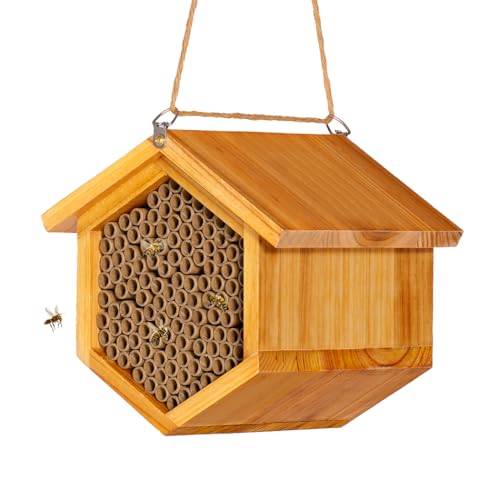
POLLIBEE Wax Coated Mason Bee House
POLLIBEE · Wax-coated wooden shell · loose nesting tubes (listed) · roof overhang over tube mouths
Our verdict: The house that gets the important things right and skips the gimmicks: a weather-coated wooden shell, a roof that actually shades the openings, and nesting tubes that lift out so the house can be cleaned and reloaded annually. That last feature is what separates a bee house from a bee trap.
Most sub-thirty-dollar bee houses are decorative objects with holes. The POLLIBEE Wax Coated Mason Bee House ($28.90) is built the way the entomology says it should be: a wax-treated wooden body that sheds weather without sealing chemicals into the tunnels, a roof that overhangs the face so rain runs past the openings rather than into them, and loose nesting tubes rather than tunnels bored permanently into the back panel.
In use, that design pays off twice. In spring you can see exactly which tubes are being provisioned, because they are individual pieces rather than an anonymous drilled face. In fall you tip the filled tubes out, store or harvest them, and drop in a fresh bundle of Rivajam mason bee tube refills ($17.99) for next season. The whole hygiene program takes about ten minutes a year, which is the entire reason we put this at the top.
Size is sensible rather than heroic: enough capacity for a normal suburban lot without creating the parasite density that oversized hotels invite. If you are hosting bees in a yard rather than an orchard, this is the correct scale to start at, and adding a second house twenty feet away later beats buying one enormous one.
Who should buy it
First-time hosts and anyone who wants a house they can maintain properly without a project. It is the one we recommend when someone asks for a single link and no homework.
What we don't like
Included tube counts and materials are listed rather than verified, and like every wooden house it wants a genuinely sheltered mounting spot; hung on an exposed post in a wet climate, the wax coating is doing more work than it should have to.
- Material
- Wood with wax coating (listed)
- Nesting
- Removable tubes (listed)
- Cleanable
- Yes, replace tubes annually
- Roof
- Overhanging, sheds rain off openings
- Mounting
- Wall, fence, or post at 3 to 6 feet
- Best facing
- East or southeast
- Price
- $28.90
Pros
- Removable tubes make annual replacement trivial
- Wax coating weatherproofs without sealing the tunnels
- Roof overhang genuinely shades the tube mouths
- Right-sized for a normal yard rather than parasite-farm large
- Refill tubes are cheap and widely available
Cons
- Tube count and dimensions are manufacturer-listed
- Wood still wants a sheltered mounting location in wet regions
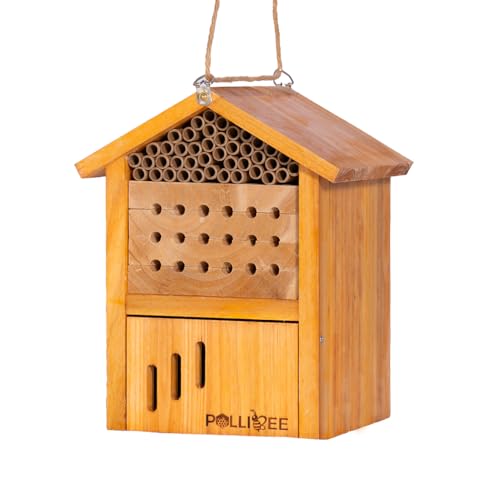
POLLIBEE Mason Bee House, Large
POLLIBEE · Wax-coated wooden shell · larger nesting capacity (listed) · removable tubes
Our verdict: The bigger sibling, and worth the extra couple of dollars only if you have the forage and the mud to fill it. A larger house in a small yard is not a bigger success, it is more empty tubes and a higher parasite load in the tubes that do fill.
If your first house filled completely in year one, the POLLIBEE large mason bee house ($31.40) is the logical step up: same wax-coated construction and removable tube approach, more nesting real estate. Fruit trees, a berry patch, and a reliable mud source are the conditions that justify it.
Our standing advice, though, is to grow by adding houses rather than by buying one big one. Two medium houses on different walls spread the parasite risk, give you a hedge against one bad microclimate, and let you retire and clean them on alternating schedules. Concentration is the enemy in solitary bee hosting, and it is worth spending a few extra dollars to avoid it.
Who should buy it
Hosts whose first house filled out completely, small orchard owners, and anyone with fruit bloom and a wet clay patch who wants the capacity to match.
What we don't like
Bigger houses concentrate more nests in one spot, which raises disease and parasite pressure, and they make the annual tube replacement a slightly larger chore and expense.
- Material
- Wood with wax coating (listed)
- Nesting
- Removable tubes, larger capacity (listed)
- Cleanable
- Yes, replace tubes annually
- Roof
- Overhanging
- Best for
- Orchards, established bee yards
- Price
- $31.40
Pros
- More capacity for properties with real forage
- Keeps the removable-tube design that makes cleaning possible
- Wax-coated shell handles weather
- Small price step over the standard size
Cons
- Higher nest density raises parasite and disease pressure
- More tubes to replace every fall

Pollen Patch Redwood Mason Bee House
Pollen Patch · Redwood construction (listed) · nesting tubes included (listed) · solitary bee hotel format
Our verdict: Redwood is a genuinely good choice for something that lives outdoors year round, and this is the cheapest way to get it. A sensible starter house for anyone unsure whether native bee hosting will stick.
Wood choice matters more on a bee house than on most garden objects, because the thing sits outside through every rain and freeze for years. The Pollen Patch Redwood Bee House ($22.99) uses naturally rot-resistant redwood, which ages to gray and keeps its structure without any treatment that could off-gas into the nesting tunnels.
It is a simple product and priced like one. Treat it as a first house: hang it correctly, keep the tubes replaceable, and see whether bees find you. If they do, you can move up in capacity next year without feeling you overspent on the experiment.
Who should buy it
Budget buyers, first-year hosts, and anyone in a wet climate who wants the rot resistance of redwood without paying for recycled poly.
What we don't like
The simplest build here, so the roof overhang and tube depth are worth checking against the listing before you mount it in an exposed spot, and included tube counts are listed rather than verified.
- Material
- Redwood (listed)
- Nesting
- Tubes included (listed)
- Cleanable
- Yes, replace tubes
- Weathering
- Naturally rot resistant, ages gray
- Mounting
- Wall or post
- Price
- $22.99
Pros
- Redwood resists rot without chemical treatment
- Lowest-cost credible wooden house here
- Tube-based nesting keeps it cleanable
- Simple enough that nothing on it can fail
Cons
- Basic construction with a modest roof
- Capacity and tube specs are manufacturer-listed

Rivajam Native Bee Observatory
Rivajam · Observation-style native bee house · viewable nesting chambers (listed) · openable for inspection
Our verdict: The premium pick, and the only house here whose extra cost buys something other than capacity: you can actually see cell partitions, pollen provisions, and developing brood. For families and classrooms it is the difference between a box on a wall and a season-long science project.
The Rivajam Native Bee Observatory ($41.99) applies the same idea our beekeeping side loves in observation hives: make the inside visible and the whole thing becomes educational rather than decorative. Here that means nesting chambers you can open and view, so you can watch a female wall off one completed cell and start the next.
Being openable is also the hygiene feature. Instead of guessing whether last year's tunnels are clean, you look. Chalkbrood mummies, pollen mite infestations, and parasitized cells become obvious rather than invisible, and cocoon harvesting in the fall is straightforward.
The discipline it demands: look, then close it and leave it alone. Repeatedly opening chambers during active nesting disturbs the female, and an abandoned partial nest helps nobody. Check once every week or two at most during the season, and save the real inspection for fall.
Who should buy it
Families with curious kids, teachers, and anyone who plans to harvest cocoons and wants to see the nest contents rather than infer them.
What we don't like
The most expensive way to house a modest number of bees, and the temptation to peek constantly is real; over-inspection during nesting is the main way owners hurt their own results.
- Format
- Observation-style native bee house
- Nesting
- Viewable, openable chambers (listed)
- Cleanable
- Yes, opens for inspection and cleaning
- Best for
- Education, cocoon harvesting
- Mounting
- Wall or post, east facing
- Price
- $41.99
Pros
- You can actually see nest cells and brood development
- Opening for inspection makes disease obvious early
- Simplifies fall cocoon harvest
- Outstanding with kids and in classrooms
Cons
- Priciest house on the page for the capacity offered
- Rewards restraint; frequent peeking disturbs nesting females

UUMENHA Insect Hotel & Mason Bee House
UUMENHA · Multi-chamber insect hotel · mason bee section plus butterfly and ladybug chambers (listed)
Our verdict: A general beneficial-insect box rather than a serious mason bee house, and priced accordingly. Buy it as garden habitat and a gift, not as the nesting substrate you intend to manage and clean.
Multi-chamber insect hotels like the UUMENHA insect hotel and mason bee house ($18.99) do a real job: they add structural habitat and shelter to a tidy yard, and at under twenty dollars they are an easy gift for a gardener. The bee section will get used if the mud and forage are there.
Where we are honest: the butterfly and ladybug chambers in every hotel of this type are more decorative than functional, and the bee chambers are usually harder to strip and replace than dedicated tube houses. If native bee production is the goal, spend the extra ten dollars on a tube-based house. If garden habitat and charm are the goal, this is a fine buy.
Who should buy it
Gift buyers, gardeners who want visible habitat features, and anyone adding a secondary box alongside a proper tube house.
What we don't like
The non-bee chambers are mostly ornamental, and the mixed-chamber format makes annual cleaning fiddlier than a dedicated tube house, which is the one thing that matters most.
- Format
- Multi-chamber insect hotel
- Nesting
- Bee tubes plus butterfly and ladybug chambers (listed)
- Cleanable
- Partly; mixed chambers complicate replacement
- Best for
- Garden habitat, gifting
- Price
- $18.99
Pros
- Cheapest entry point on this page
- Adds real structural habitat to a tidy yard
- Attractive gift for gardeners
- Bee chambers work when mud and forage are present
Cons
- Butterfly and ladybug sections are largely decorative
- Harder to strip and reload than dedicated tube houses
- Not the pick if cocoon harvesting is your goal

JCs Wildlife Small Poly Lumber Mason Bee House
JCs Wildlife · Recycled poly lumber construction (listed) · designed for replaceable nesting tubes
Our verdict: The buy-it-once option. Poly lumber does not rot, does not need sealing, and does not absorb the moisture that turns cheap wooden houses into mold farms, which is exactly what you want on a structure that lives outdoors for ten years.
At $83.96 the JCs Wildlife poly lumber mason bee house costs as much as three budget wooden houses, and the argument for it is durability. Recycled poly lumber ignores freeze-thaw cycles, will not check or split, and cannot rot, so the shell outlasts several generations of nesting tubes rather than degrading alongside them.
The design intent is right too: the house exists to hold replaceable tubes, not to be the nesting surface itself. That is the correct division of labor. The shell is permanent infrastructure and the tunnels are consumables, which is exactly how the hygiene problem gets solved.
Worth noting for hot climates: dark poly surfaces absorb heat, so an east-facing mount with afternoon shade matters more here than on a light wooden house. Morning sun is what you want anyway.
Who should buy it
Long-term hosts, wet or freeze-thaw climates, and anyone tired of replacing weathered wooden garden fixtures every few years.
What we don't like
The price is a real jump for a small house, and poly surfaces run hot in full afternoon sun, so siting discipline matters more than with wood.
- Material
- Recycled poly lumber (listed)
- Nesting
- Replaceable tubes
- Cleanable
- Yes, shell is permanent, tubes are consumable
- Weathering
- Will not rot, warp, or need sealing
- Best facing
- East, with afternoon shade
- Price
- $83.96
Pros
- Effectively weatherproof for the long haul
- Shell outlives many seasons of nesting tubes
- No sealing, painting, or maintenance of the house itself
- Made from recycled material
Cons
- Costs three to four times the budget wooden houses
- Dark poly heats up in full afternoon sun

WildYard Bee House for Garden
WildYard · Painted yellow garden house · nesting tubes included (listed) · wall or post mount
Our verdict: For gardens where the hardware has to look intentional, this is the one that will not get vetoed. It keeps the tube-based nesting that makes annual replacement possible, which is more than most decorative houses manage.
Plenty of good bee houses look like shop-class projects. The WildYard Bee House ($29.99) is the one you can hang on a visible fence without an argument, and unlike most decor-first houses it still ships with proper nesting tubes rather than a permanently drilled face.
One caution that applies to every painted house: paint belongs on the outside only. Keep coatings out of the tunnels, and if you ever refresh the finish, pull the tubes first and let the house air out for a week before reloading it.
Who should buy it
Front-yard and shared-space installs, gift buyers who still want function, and anyone whose household vetoes utilitarian garden gear.
What we don't like
Style adds cost without adding capacity, and painted exteriors mean you need to be deliberate about keeping finish out of the nesting tunnels.
- Material
- Painted wood (listed)
- Nesting
- Nesting tubes included (listed)
- Cleanable
- Yes, replace tubes
- Mounting
- Wall, fence, or post
- Best for
- Visible garden placement
- Price
- $29.99
Pros
- Looks deliberate in a visible garden spot
- Keeps replaceable tubes rather than drilled bores
- Easy wall or fence mounting
- Good gift that is also functional
Cons
- Style premium rather than capacity premium
- Painted finish requires care to keep out of tunnels
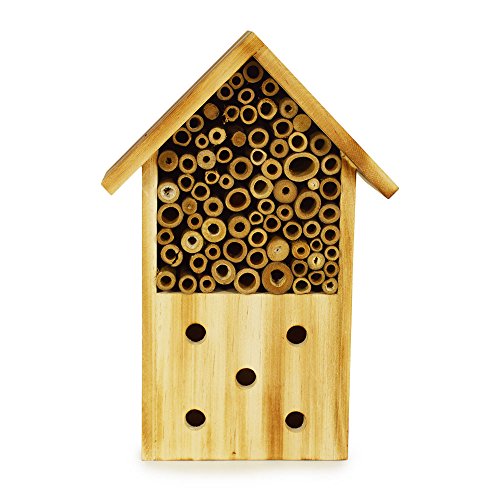
bambeco Log Cabin Bee House
bambeco · Log cabin styling · 7 W x 4 D x 10 H (listed) · nesting block format
Our verdict: Bought as a gift it is delightful; bought as a management tool it is limited, because cabin-style nesting blocks are harder to strip and reload than loose tubes. Pair it with a tube house if you want both charm and results.
The bambeco Log Cabin Bee House ($22.28) is a gift-shelf product at a listed 7 by 4 by 10 inches, and it does what gift-shelf products do: it gets a non-gardener interested in native bees. That has real value, and we would rather someone start here than not start.
Be clear-eyed about the limits. Fixed nesting blocks cannot be replaced the way loose tubes can, so plan on either retiring the house after a few seasons or fitting it with paper inserts you can pull. Our tubes and cocoons guide covers the insert trick, which rescues a lot of decorative houses.
Who should buy it
Gift buyers, cabin-and-cottage aesthetics, and anyone introducing a friend or a kid to native bees for the first time.
What we don't like
Fixed nesting material is the exact flaw this whole guide warns about, so it needs paper inserts or a retirement date to stay a healthy nest site.
- Style
- Log cabin
- Dimensions
- 7 W x 4 D x 10 H inches (listed)
- Nesting
- Cabin-style nesting block
- Cleanable
- Limited; use paper inserts
- Best for
- Gifting
- Price
- $22.28
Pros
- Genuinely charming gift under $25
- Compact footprint for small gardens
- Gets non-gardeners interested in native bees
Cons
- Fixed nesting material is hard to replace annually
- Needs paper inserts to stay hygienic
- Modest capacity
The problem nobody puts on the box: bee hotels can hurt bees
Solitary bees evolved nesting alone and scattered: a beetle hole here, a hollow stem there, spread across a hedgerow. A bee house reverses that. It gathers dozens or hundreds of nests into one square foot of wood, which is exactly the density that lets parasites and pathogens find every nest with no effort at all. The usual suspects are chalkbrood, a fungal disease that mummifies developing larvae, along with pollen mites in the genus Chaetodactylus that eat the pollen provision out from under the larva, and small parasitic wasps that lay through the tube wall.
None of that is an argument against bee houses. It is an argument against permanent bee houses. A wild nest site gets used once and then weathers away over a season or two; your house does not, unless you make it. Replacing the nesting material every year is the entire hygiene program, and it is why the shopping question is not which house is prettiest but which house lets you pull the tubes out.
This is also the honest case against the classic bamboo bundle, the twenty dollar cylinder of cut canes sold in every garden center. The canes cannot be opened, so cocoons cannot be harvested or washed; the internal nodes trap moisture and produce mold; the cut ends are often ragged enough to shred wings; and cane diameters are whatever the plant grew, which means most of the holes are the wrong size for anything. If you already own one, use it as a trellis marker and buy tubes you can replace. Our roundup of mason bee tubes and cocoons covers the refill side in detail.
Hole diameter and depth: the two numbers that decide who moves in
Cavity-nesting bees are picky about bore size, and the size determines the species. The blue orchard mason bee, Osmia lignaria, is the North American headliner and wants tunnels around 5/16 inch, roughly 8mm. Drop to 6mm, about 1/4 inch, and you shift toward leafcutter bees and the smaller Osmia species that nest later in the summer. Go bigger than 3/8 inch and you mostly attract wasps.
| Tunnel diameter | Typical tenants | Season |
|---|---|---|
| 6mm (about 1/4 in) | Leafcutter bees, small Osmia | Early to mid summer |
| 8mm (5/16 in) | Blue orchard mason bees | Early spring through late spring |
| 10mm (3/8 in) | Larger Osmia, some wasps | Varies |
Depth is the number almost nobody markets. A nesting female provisions cells from the back of the tunnel forward, and she places fertilized eggs that become females at the back and unfertilized eggs that become males at the front, because the front cells are the ones parasites and birds reach first. A tunnel only three or four inches deep therefore produces a male-heavy generation, which is a bad trade since females do all the nesting and nearly all the pollination. Aim for tunnels of 6 inches or deeper, and treat any house whose listed tunnels are shorter as a supplemental box rather than the main house.
One more geometry note: tunnels must be closed at the back. A tube open at both ends reads as a drafty tunnel rather than a nest, and females will pass it over. Cardboard tubes come with a closed end or get paired with a paper insert; drilled blocks are drilled to depth, not through.
Where to hang it: sun, height, rain, and the mud rule
Face it east or southeast. Mason bees are cold-morning fliers, and a sun-warmed entrance gets them airborne earlier than the honey bees down the street, which is precisely why orchardists value them. A north-facing house stays cold and stays empty.
Mount it rigidly at roughly 3 to 6 feet. Screw it to a wall, fence post, or shed side. A house dangling from a string swings in wind, and swinging disturbs the mud partitions a female is building. Chest height also means you can actually see the nesting activity, which is most of the fun.
Keep rain off the openings. Under an eave is ideal. Otherwise you want a roof that overhangs the tube mouths by a couple of inches. Wet tubes go moldy, and moldy tubes kill the brood inside them.
Provide mud within about 50 feet. This is the failure mode we see most. Mason bees build cell partitions and a final plug from wet, clay-rich soil, and unlike honey bees they will not travel far for it. If your yard is mulched wall to wall, dig a bare patch a foot across, mix in clay soil if yours is sandy, and keep it damp through spring. A shallow tray of clay soil kept wet works too. Pair that with a shallow drinking source from our bee water station roundup, and you have covered both liquids a bee yard needs.
Have bloom within about 300 feet. Mason bees forage short distances compared with honey bees, so early fruit bloom, willows, maples, and spring flowers near the house matter more than a big meadow across the property. Our forage planting guide works for natives too, with the caveat that native bees want native plants more than honey bees do.
What a filled house looks like, month by month
Spring: tubes fill from the back forward, and you watch a female disappear inside, back out, fly off for mud, and return. Capped tubes get a plug of dried mud flush with the opening. By early summer the mason bee season is over, and if leafcutters find you, a second wave caps their tubes with neat green leaf discs instead.
Summer and early fall: the house does nothing visible while larvae eat their pollen provisions and spin cocoons. Leave it alone. Do not bring capped tubes indoors in July, and do not open them out of curiosity.
Fall: this is your maintenance window. Filled tubes get moved to an unheated, protected spot, or the cocoons get harvested and washed, and next year's tubes get loaded into the empty house. The full calendar, including winter refrigeration temperatures and spring release timing, is laid out in how to raise mason bees. If you would rather not do any of that, the honest alternative is to run a house with cheap replaceable tubes and simply swap all the material every year, which is a real strategy and the reason the top picks below matter.
More gear worth comparing
Beyond this guide: the highest-rated gear across every category and budget, with a live price check on each.




As an Amazon Associate we may earn from qualifying purchases, at no cost to you.
Quick shop: every pick
Skip the scroll: the whole lineup, with a live price check on each.
- POLLIBEE Wax Coated Mason Bee HouseBest OverallPOLLIBEE · $28.90Check Price
- POLLIBEE Mason Bee House, LargeBest for Bigger GardensPOLLIBEE · $31.40Check Price
- Pollen Patch Redwood Mason Bee HouseBest Budget Wooden HousePollen Patch · $22.99Check Price
- Rivajam Native Bee ObservatoryBest for WatchingRivajam · $41.99Check Price
- UUMENHA Insect Hotel & Mason Bee HouseBest Multi-Species HabitatUUMENHA · $18.99Check Price
- JCs Wildlife Small Poly Lumber Mason Bee HouseBest Long-Term BuildJCs Wildlife · $83.96Check Price
- WildYard Bee House for GardenBest LookingWildYard · $29.99Check Price
- bambeco Log Cabin Bee HouseBest Gift Under $25bambeco · $22.28Check Price
How we chose
Cleanability first, always: we ranked on whether nesting material comes out and gets replaced. Any house that permanently seals its tunnels lost points no matter how good it looked.
Tunnel geometry second: we favored houses whose listed tunnels reach 6 inches or deeper at roughly 5/16 inch, the dimensions blue orchard mason bees actually select.
Weather protection third: a roof overhang that shades the tube mouths from rain is the difference between capped cells and moldy ones, so shallow-roof designs were downgraded.
Finish safety: we prefer bare wood, wax coatings, or inert recycled poly over painted or heavily varnished interiors, and we treat every manufacturer material claim as listed rather than verified.
Honest capacity: a house with 100 tunnels is not a win if you have 20 nesting females and no plan to clean it. We weighed capacity against how much annual work the design creates.
Same desk, same standard: no brand paid for placement, and where a $23 house does the same job as an $84 one we say so in print.
Key terms
- Mason bee
- A solitary bee in the genus Osmia that builds cell partitions from mud. The blue orchard mason bee, Osmia lignaria, is the common North American species hosted in bee houses.
- Cavity nester
- A bee that nests in existing holes, hollow stems, or tunnels rather than digging in soil. Only cavity nesters use bee houses; roughly 70 percent of native bees nest in the ground instead.
- Nesting tube
- The replaceable cardboard, paper, or reed tunnel a female provisions and seals. Replacing tubes annually is the core hygiene practice of responsible bee house hosting.
- Chalkbrood
- A fungal disease that mummifies bee larvae. It accumulates in nesting material that is never replaced, which is why permanently drilled or sealed houses become disease traps.
- Pollen mite
- A tiny mite, commonly in the genus Chaetodactylus, that consumes the pollen provision a female left for her larva, starving it. A leading cause of failed cells in unmanaged bee houses.
- Cocoon
- The sealed case a mason bee larva spins in late summer and overwinters inside as an adult. Cocoons can be harvested from tubes in fall, cleaned, and stored cold until spring release.
- Mud source
- A patch of bare, damp, clay-rich soil within about 50 feet of the house. Mason bees use it for cell partitions and the entrance plug, and its absence is the top cause of empty houses.
Questions, answered
do mason bee houses actually work
Yes, when they are sited correctly and maintained. A house facing east or southeast, mounted rigidly at 3 to 6 feet with rain kept off the openings, and with damp clay-rich mud within about 50 feet, will usually attract nesting females within a season or two if mason bees are present locally. Houses that are never cleaned do work at first and then decline as pathogens accumulate.
what size holes do mason bees need
Blue orchard mason bees prefer tunnels around 5/16 inch, roughly 8mm, in diameter. Tunnels near 6mm attract leafcutter bees and smaller Osmia species instead. Depth matters as much as diameter: aim for 6 inches or more, because females place female eggs at the back of the tunnel and shallow tubes produce mostly males.
which direction should a bee house face
East or southeast, so the morning sun warms the entrance and gets the bees flying early. Mount it at roughly 3 to 6 feet on a wall, fence, or post so it cannot swing, and put it under an eave or use a house with a real roof overhang so rain does not run into the tube openings.
are bamboo bee hotels bad for bees
The cheap sealed bamboo bundles are a poor choice. The canes split as they weather, internal nodes trap moisture and grow mold, cane diameters are random so most holes fit no target species, and nothing can be opened for inspection or replacement. Purpose-cut reed tubes are a different product and work well because they split open for harvest.
how do you clean a mason bee house
You do not scrub the house so much as replace what is inside it. In fall, remove the filled tubes for storage or cocoon harvest, discard the used nesting material, brush out the empty shell, and load fresh tubes for spring. Houses whose tunnels are drilled permanently into the wood cannot be cleaned properly, which is why we rank cleanability first.
do mason bees sting
Very rarely. Females have a sting but are famously reluctant to use it, and males cannot sting at all. There is no colony and no honey stores to defend, which removes the main reason social bees become defensive. Most hosts work around an active house in a t-shirt without incident, though anyone with a known bee-venom allergy should still keep their distance.
why is my mason bee house empty
The three usual causes, in order: no mud source nearby, wrong siting, or no local mason bee population. Fix mud first by keeping a bare patch of damp clay-rich soil within about 50 feet. Then confirm the house faces east or southeast, is rigidly mounted, and is sheltered from rain. If your area has no established population, buying cocoons is the reset.
when should i put out a mason bee house
Mount it in late winter or very early spring, roughly February to March in most of the US, so it is weathered and in place before the first females emerge. Emergence generally begins when daytime temperatures hold around 55F and early fruit and willow bloom opens, which is also when purchased cocoons should be set out.
how many mason bee houses should i put up
Start with one modest house, then add a second in a different location if it fills, rather than buying one very large house. Dense nest aggregations attract parasitic wasps and pollen mites, so spreading nests across two or three sites lowers per-nest failure and hedges against a bad microclimate.
do mason bees make honey
No. Mason bees are solitary, store only enough pollen and nectar to provision individual larval cells, and produce no surplus honey and no wax comb. If honey is the goal you want managed honey bee colonies instead, which is a far bigger commitment in cost, time, and equipment.
Filed under Buyer's Guide
Part of Bees & Pollinators
Keep reading
How to Raise Mason Bees
The full annual cycle: mounting, release timing, mud, fall harvest, cocoon washing, and winter storage.
Best Mason Bee Tubes and Cocoons
The consumable side: cardboard versus reed versus trays, and how to source cocoons responsibly.
Mason Bees vs Honey Bees
Cost, time, stings, honey, and pollination efficiency compared, with honest routing on which to keep.
The Native Bees Guide
The 4,000 species most people never notice, what they need, and why bare ground matters more than houses.
Best Bee Water Stations
The other liquid a bee yard needs: shallow drinking surfaces bees can land on without drowning.
Best Plants for Honey Bees
Bloom succession, nectar trees, and what to skip, useful for native bees with a native-plant tilt.