Our Pick: POLLIBEE
Check PriceMason Bees vs Honey Bees: Which One Belongs in Your Yard
Answer first: if your goal is pollination, a gentle backyard, and a small time commitment, keep mason bees. A complete setup is about $65, starting with a $28.90 POLLIBEE Wax Coated Mason Bee House, and the annual labor is roughly four hours. If your goal is honey, wax, and the craft of managing a living colony through a full year, keep honey bees, starting around $159.99 for a Honey Lake 10-frame Langstroth kit plus bees, a suit, and tools, at several hundred dollars all in and dozens of hours a season.
By The BeehiveKits Hive Desk2026-08-2918 min read Fact-checked against verified Amazon listingsHow we research
That framing matters because the two are not competing versions of the same hobby. A honey bee colony is livestock: a superorganism of tens of thousands of individuals that you feed, inspect, treat for parasites, and prepare for winter, and that can die on you. A mason bee house is habitat: you provide a nest site, mud, and flowers, and native insects that already live nearby use it. One is animal husbandry. The other is gardening.
There is also a species fact worth stating plainly up front, because it reframes the whole comparison. The honey bee, Apis mellifera, is not native to North America; it was brought over by European colonists in the 1600s. Mason bees in the genus Osmia are native here, and so are roughly four thousand other US bee species. Keeping honey bees is a farming choice, not a conservation act, a distinction we work through in the native bees guide.
This page is written by a desk that sells hive kits and still tells people to buy a $29 bee house when that is the right answer. No brand paid for placement, prices were verified at publication, and some links go to Amazon, where a purchase may earn us a small commission at no extra cost to you.
What to know
- Cost: about $65 for a complete first-year mason bee setup versus several hundred dollars for a first honey bee colony with hive, bees, suit, and tools.
- Time: roughly four hours a year for mason bees versus dozens of hours across a season for a hive that needs inspections, mite management, feeding, and winter prep.
- Stings: male mason bees cannot sting and females effectively do not. Honey bees defend a colony and stored honey, which is why a suit is standard equipment.
- Honey: only honey bees make it. Mason bees produce no honey and no wax, which is the single biggest reason people choose the harder path.
- Pollination: per individual on fruit trees mason bees win clearly, because they carry dry loose pollen and fly in cooler, wetter weather. Per colony, honey bees win on sheer numbers and range.
- Regulation and neighbors: many jurisdictions register or restrict honey bee hives, while a bee house is a garden ornament nobody licenses. Check our state-by-state guide before buying a hive.
At a glance
| Factor | Mason bees | Honey bees |
|---|---|---|
| Year one cost | About $65 all in | Several hundred dollars with bees, suit, and tools |
| Ongoing annual cost | About $18 for fresh tubes | Treatments, feed, replacement bees, more boxes |
| Time per year | Roughly 4 hours | Dozens of hours across the season |
| Honey | None | Often 30 to 60 lbs surplus from an established hive |
| Stings | Males cannot, females effectively do not | Real risk; a suit is standard equipment |
| Pollination per individual | Higher on fruit bloom | Lower per bee, enormous per colony |
| Equipment | House, tubes, mud, water | Hive boxes, frames, suit, smoker, tools, extractor |
| Pests and disease | Chalkbrood and pollen mites, managed by cleaning | Varroa, foulbrood, hive beetles, wax moths, viruses |
| Regulation | Generally none | Registration or restriction in many states and towns |
| Winter work | Cocoons in a refrigerator | Feeding, wrapping, ventilation, mite prep, and worry |
| Native to North America | Yes | No, introduced from Europe in the 1600s |
| Can it die on you | Individual nests fail; the practice does not | Yes, and colony loss is common |
Mason bees vs honey bees, head to head
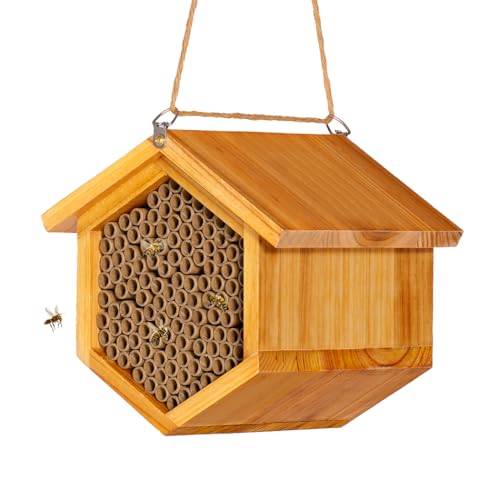
POLLIBEE Wax Coated Mason Bee House
POLLIBEE · Wax-coated wooden shell · removable nesting tubes (listed) · roof overhang
Our verdict: Twenty nine dollars buys the whole hobby: no suit, no smoker, no treatments, no registration, and no colony that can die on you. For most backyards asking this question, this is the correct answer.
The POLLIBEE Wax Coated Mason Bee House ($28.90) is the piece of hardware that makes the mason bee side of this comparison real. Wax-coated shell, a roof that keeps rain off the tube mouths, and nesting tubes that pull out so the house can be reset every fall.
Add a bag of tubes, a damp clay patch, and a shallow water dish, and your total commitment is about $65 and four hours a year. Full setup instructions are in how to raise mason bees, and seven alternatives are ranked in the house roundup.
Who should buy it
Gardeners with fruit trees, families with kids, renters, small lots, and anyone who wants pollinators without livestock.
What we don't like
It will never make honey, and if honey is what you actually want, no amount of native bee virtue substitutes for it.
- Material
- Wood with wax coating (listed)
- Nesting
- Removable tubes (listed)
- Annual work
- About 4 hours
- Year one cost
- About $65 with tubes and water
- Stings
- Males cannot, females effectively do not
- Price
- $28.90
Pros
- Cheapest real pollinator setup available
- No protective gear, treatments, or registration
- Excellent fruit tree pollination per bee
- Safe next to patios, play areas, and property lines
Cons
- No honey, no wax, nothing to harvest
- Active season is only four to six weeks in spring

Honey Lake 10-Frame Langstroth Beehive Starter Kit
Honey Lake · 10-frame Langstroth kit · beeswax-coated (listed) · complete hive configuration
Our verdict: If honey is the goal, this is where the road starts: a full 10-frame Langstroth at a fair price. Just price the rest of the project honestly before you buy it, because the hive is the smaller half of year one.
The Honey Lake 10-Frame Langstroth Beehive Starter Kit ($159.99) is a sensible first hive: the standard American configuration, beeswax coated, with the boxes and frames a first colony needs. Ten-frame equipment is the most common format in the US, which matters for parts availability and for borrowing from a mentor.
What it does not include is bees, protection, tools, feed, or treatments. That is the part new beekeepers underestimate, and it is why we send everyone to the cost index and the starter kit roundup before they order. If eight-frame equipment suits your back better, the tradeoffs are in 8-frame vs 10-frame.
Who should buy it
Anyone who wants honey and wax, has the space and legal clearance, and can commit real hours from March through October.
What we don't like
It is the beginning of a much larger purchase, and a first-year colony usually produces little to no surplus honey while you are still paying for everything.
- Format
- 10-frame Langstroth
- Coating
- Beeswax coated (listed)
- Includes
- Complete hive kit, no bees
- Also needed
- Bees, suit, smoker, hive tool, feeder, treatments
- Annual work
- Dozens of hours across the season
- Price
- $159.99
Pros
- Standard 10-frame format with wide parts availability
- Beeswax coated rather than raw pine
- Fair price for a complete hive kit
- The path to honey, wax, and real colony management
Cons
- Hive alone is a fraction of true first-year cost
- Requires ongoing mite management and inspections
- Regulated or restricted in some towns and HOAs

USKEEPERS 3-Layer Ultra Ventilated Bee Suit
USKEEPERS · 3-layer ventilated construction (listed) · full body suit with veil · sting-resistant design
Our verdict: A good three-layer ventilated suit is the difference between confident inspections and rushed ones, and it is also the clearest illustration of the gap between these two hobbies: nobody has ever needed one to host mason bees.
If you go the honey bee route, do not cheap out here. The USKEEPERS 3-Layer Ultra Ventilated Bee Suit ($129.99) is the class of protection that lets a beginner work slowly and calmly instead of hurrying through an inspection, and three-layer mesh is dramatically more bearable in July heat than the cheap polycotton coveralls.
We include it here mostly to make the comparison concrete. This single item costs more than four times the mason bee house, and it is one of six or seven things a first-year beekeeper buys before the bees arrive. Alternatives and jacket options are in our bee suit roundup.
Who should buy it
Every new honey bee keeper. Confidence during inspections is a safety feature, and heat exhaustion in a cheap suit is a real hazard.
What we don't like
It is a substantial cost on top of the hive, and it represents an entire category of expense and hassle that the native bee path simply does not have.
- Construction
- 3-layer ventilated mesh (listed)
- Coverage
- Full body with veil
- Needed for mason bees
- No
- Needed for honey bees
- Yes
- Price
- $129.99
Pros
- Three-layer mesh is far cooler than polycotton in summer
- Full coverage builds beginner confidence
- Slower, calmer inspections mean gentler colonies
Cons
- Costs more than four mason bee houses
- One of many pre-bee purchases on the honey bee path
Two completely different animals
The honey bee is a social insect living in a perennial colony of tens of thousands, with one reproductive queen, a workforce of sterile females, and seasonal males. The colony survives winter as a unit by clustering and eating stored honey, which is precisely why it makes so much of it. It is livestock, and it behaves like livestock: it needs monitoring, feeding in shortfalls, treatment for parasites, and space management, and it dies if you neglect it badly enough.
A mason bee is a solitary insect with a life cycle that fits in one sentence: emerge in spring, mate, provision a few tunnels with pollen loaves and eggs over four to six weeks, die. There is no colony, no queen, no workers, no stores, no wax, and nothing to defend. The next generation waits out the year as dormant adults inside sealed cocoons. Nothing about it resembles animal husbandry, which is why the entire practice fits in the ten-step routine in how to raise mason bees.
That structural difference drives every row of the comparison table. Colonies are expensive because they need housing and equipment at scale. They sting because they have wealth to defend. They make honey because they must survive winter as a group. And they get varroa because a dense perennial colony is exactly the habitat a parasitic mite evolved to exploit.
Cost: about $65 against several hundred
The mason bee side is easy to price completely. A POLLIBEE Wax Coated Mason Bee House at $28.90, a pack of nesting tubes at about $18, and a shallow water station at about $18 is roughly $65 for everything, and year two costs only the tubes. Cocoons, if your area needs seeding, are a one-time purchase of a few dozen.
The honey bee side does not stop at the hive. A Honey Lake 10-Frame Langstroth Beehive Starter Kit is $159.99, which is a genuinely good price for a complete beeswax-coated hive, and then you add bees, a suit like the USKEEPERS 3-Layer Ventilated Bee Suit at $129.99, a smoker, a hive tool, feeders, mite treatments, and eventually extraction gear. Our beekeeping cost index runs the real arithmetic line by line, and the honest total for a first year is several hundred dollars before a drop of honey exists.
| Line item | Mason bees | Honey bees |
|---|---|---|
| Housing | $28.90 house | $159.99 complete 10-frame kit |
| Bees | Free if local, or a one-time cocoon purchase | Nuc or package, purchased most first years |
| Protective gear | None needed | $129.99 ventilated suit |
| Tools | None | Smoker, hive tool, brush, feeder |
| Annual consumables | About $18 of tubes | Mite treatments, sugar, foundation, replacement gear |
| Harvest equipment | None | Extractor or crush and strain setup |
The point is not that honey bees are overpriced. It is that they are a real capital project, and people routinely start one without pricing past the hive.
Time: four hours against a season
Mason bee labor, honestly counted: mount the house once, load tubes once a year, keep a mud patch damp through spring, put cocoons out in March, take tubes down in October, spend an evening harvesting and washing cocoons, put them in the refrigerator, check them monthly. That is about four hours annually, most of it enjoyable, none of it urgent.
Honey bee labor is a calendar, not a chore list. Inspections every one to two weeks through the active season, each running twenty to forty minutes per hive. Mite monitoring and treatment windows that cannot be missed. Feeding during dearth. Swarm prevention in spring. Adding and removing boxes. Harvest and extraction. Winter preparation. Our first-year beekeeping calendar lays out the whole thing month by month, and it is a genuinely rewarding commitment, but it is a commitment.
The deciding question is not whether you can find the hours in April. It is whether you can find them in the third week of July when it is 95 degrees, you are wearing a full suit, and the colony needs a mite treatment that has a temperature window.
Stings: the honest safety comparison
Male mason bees have no sting. Females have one and effectively never use it, because there is no colony and no honey store worth dying for; solitary bees flee rather than fight. Stings essentially only happen when a bee is pressed against skin, and the sting is generally described as much milder than a honey bee's. Gardeners routinely work directly under an active mason bee house in a t-shirt.
Honey bees are a different proposition. A colony has tens of thousands of individuals, brood, and stored honey to defend, and defensiveness varies with genetics, weather, season, and how clumsy you are with the hive tool. It is entirely manageable with a suit, a smoker, and calm technique, which is why those are standard equipment rather than optional. But it is a real factor in a small yard, near a pool, or next to a neighbor's patio, and our beehive placement guide exists largely because of it.
For families with small kids, shared fence lines, or anyone with a bee venom allergy in the household, this row of the table often ends the debate on its own. Reaction severity and when to seek care are covered in our bee sting safety guide.
Honey: the one thing only honey bees do
Mason bees produce no honey. None. They store only enough pollen and nectar to feed each individual larva, sealed in its own cell, and there is no surplus, no comb, and nothing to harvest. Anyone telling you otherwise is confused about what a solitary bee is.
An established honey bee colony in most US regions produces something like 30 to 60 pounds of surplus honey in a normal year, with wide regional variation, and typically little to nothing in its first season while it builds comb and population. It also produces beeswax, propolis, and the raw material for candles, wraps, and mead. The full yield model is in how much honey per hive.
If honey is the actual goal, then this comparison is already over and you want honey bees. Everything else on this page is an argument about the best way to get pollination and bee-watching, and honey is simply not on the mason bee menu at any price.
Pollination: per bee versus per colony
Both claims you have heard are true, and they measure different things.
Per individual, mason bees win on fruit bloom, clearly. They carry pollen dry and loose in a brush under the abdomen rather than packed and dampened on the hind legs, so it transfers to the next blossom instead of going home to the nest. They fly at lower temperatures and in light rain, which is often the difference between pollination happening at all during a cool spring bloom. And they forage a very short radius, so their entire effort lands on your trees.
Per colony, honey bees win on scale. One hive fields tens of thousands of foragers over a two-mile radius across the entire growing season, not four to six weeks in spring. That is why commercial agriculture rents hives by the truckload, and why honey bees pollinate crops that bloom long after mason bees are done for the year.
For a backyard with fruit trees, the mason bee is the better tool, full stop. For a diversified garden that blooms from March to frost, honey bees cover a longer season. For actual conservation value, the native bees that already live in your yard matter more than either managed option, which is the argument in the native bees guide.
Equipment, pests, and the maintenance you are signing up for
Mason bee equipment is a house, tubes, a mud patch, and a water station. Mason bee pests are chalkbrood, pollen mites, and parasitic wasps, and the entire control program is replacing nesting material every year and washing cocoons in the fall.
Honey bee equipment is boxes, frames, foundation, bottom boards, covers, a suit, gloves, a smoker, a hive tool, feeders, an entrance reducer, and eventually a queen excluder and extraction gear. Honey bee pests start with varroa mites, which are the central management problem of modern beekeeping and require monitoring and treating on a real schedule, and continue through small hive beetles, wax moths, foulbrood, nosema, and the virus complex varroa carries. Our varroa treatment roundup and treatment timing guide exist because that one parasite decides whether colonies live.
None of this is meant to scare anyone off. Millions of people manage colonies successfully and love it. But the difference in maintenance surface between the two options is roughly the difference between owning a bicycle and owning a horse.
Rules, neighbors, and where you actually live
A mason bee house on a fence is a garden ornament. Nobody registers it, nobody zones it, no HOA has a clause about it, and no neighbor has ever called the city about one.
Honey bee hives are regulated in many places. Some states require apiary registration, some cities cap hive counts or set setback distances from property lines, and some HOAs prohibit them outright. Our state-by-state beekeeping laws guide is the starting point, and your county extension office is the authority. Beyond the legal question there is the practical one: hives need a flight path that does not cross a patio, a water source that is not the neighbor's pool, and a screening fence to lift bee traffic above head height.
If you rent, live on a small urban lot, share a fence with someone nervous about insects, or simply do not want a conversation with your HOA, the native bee route sidesteps all of it while still giving you pollinators and something to watch.
Winter: a refrigerator drawer versus a season of worry
Mason bee winter is a container of clean cocoons on a refrigerator shelf at roughly 34F to 39F, checked monthly for mold. That is the whole overwintering program.
Honey bee winter is the part of the hobby that keeps people up at night. Colonies must go into cold weather with adequate stores, a low mite load, a healthy population of winter bees, moisture control, and often supplemental feed. National loss surveys from Bee Informed Partnership have run in the range of 40 to 50 percent of colonies annually in recent years, which is a sobering number for a first-year beekeeper who has spent several hundred dollars and a summer of attention. Our winterizing guide covers what actually moves those odds.
Mason bees fail differently and more gently: a bad year means fewer cocoons, not a dead colony and an empty box in March.
The verdict: who should keep which, and who should keep both
Keep mason bees if you want fruit tree pollination, you have kids or a small yard, you are allergic or someone in the household is, you rent, your HOA is strict, your budget is under a hundred dollars, or you simply do not have twenty free hours in a summer. This is most people asking the question, and there is nothing second-best about it.
Keep honey bees if you want honey and wax, you are drawn to the craft of colony management, you have the space and the legal clearance, and you can commit real time from March through October every year. It is a deeper, more absorbing hobby, and the reason this site exists. Start with how to start beekeeping and price it honestly with the cost index before ordering anything.
Keep both if you already run hives and own fruit trees. This is the underrated answer. Mason bees cover the cool early spring bloom weeks when your colonies are still small and reluctant to fly, honey bees cover the long summer season, and the mason bee house costs less than a single mite treatment. Adding a house to an existing apiary is close to a free upgrade to your orchard's fruit set, and it takes four hours a year.
More gear worth comparing
Beyond this guide: the highest-rated gear across every category and budget, with a live price check on each.


As an Amazon Associate we may earn from qualifying purchases, at no cost to you.
Quick shop: every pick
Skip the scroll: the whole lineup, with a live price check on each.
- POLLIBEE Wax Coated Mason Bee HouseBest Mason Bee StartPOLLIBEE · $28.90Check Price
- Honey Lake 10-Frame Langstroth Beehive Starter KitBest Honey Bee StartHoney Lake · $159.99Check Price
- USKEEPERS 3-Layer Ultra Ventilated Bee SuitThe Gear Mason Bees Do Not NeedUSKEEPERS · $129.99Check Price
How we chose
We priced both paths from the same offer table used across this site, with mason bee hardware at published prices and honey bee startup built from a real hive kit, suit, and tools rather than a wish list.
Time estimates come from the actual task lists in our own guides: the four-step mason bee year against the inspection, treatment, feeding, and winterizing calendar a colony demands.
We separated pollination per individual from pollination per colony, because conflating them is how both sides of this argument get overstated.
We treated honey as the decisive variable it really is, since it is the one thing the cheaper, easier option cannot deliver at any price.
We flag regulation and neighbor risk explicitly, because those decide feasibility in dense neighborhoods more often than budget does.
Same desk, same standard: we sell hive kit clicks and still route most backyard readers toward the twenty nine dollar bee house when that is the honest answer.
Key terms
- Solitary bee
- A bee with no colony, queen, or workers. Each female builds and provisions her own nest, which is why solitary bees are gentle and need no management.
- Superorganism
- The way a honey bee colony behaves: tens of thousands of individuals functioning as one unit that overwinters together, defends stores, and can die as a whole.
- Apis mellifera
- The western honey bee, native to Europe, Africa, and western Asia and introduced to North America by colonists in the 1600s. Every managed honey bee in the US descends from imported stock.
- Varroa destructor
- The parasitic mite that is the central management problem in modern beekeeping. It has no equivalent in mason bee hosting, where pollen mites and chalkbrood are handled by annual cleaning.
- Surplus honey
- Honey beyond what a colony needs for its own winter survival, and the only honey a beekeeper should harvest. Mason bees produce none, since they store only per-cell larval provisions.
- Scopa
- The abdominal pollen brush of a mason bee, which carries dry loose pollen that transfers readily to the next flower. It is the mechanical reason mason bees out-pollinate honey bees per individual.
Questions, answered
are mason bees better than honey bees
For backyard fruit pollination, cost, safety, and time, yes. Mason bees cost about $65 to set up, take roughly four hours a year, almost never sting, and pollinate fruit bloom more effectively per individual. Honey bees win decisively on honey, wax, colony-scale pollination, and season length. The right answer depends entirely on whether you want honey.
do mason bees make honey like honey bees
No. Mason bees are solitary and store only enough pollen and nectar to feed each larva in its sealed cell, so there is no surplus and no comb to harvest. Honey is exclusive to honey bees, which is the single biggest reason people take on the far more expensive and time-consuming path.
which is cheaper mason bees or honey bees
Mason bees, by a wide margin. A complete first-year mason bee setup runs about $65 and drops to roughly $18 a year afterward. A first honey bee colony runs several hundred dollars once you add bees, a suit, tools, feed, and mite treatments to the hive itself, with recurring costs every season.
do mason bees sting more than honey bees
Far less. Male mason bees cannot sting at all and females effectively do not, because they have no colony or stores to defend. Honey bees defend a hive containing tens of thousands of bees and stored honey, which is why suits and smokers are standard equipment for working a colony.
can you keep mason bees and honey bees together
Yes, and it is an underrated combination. Mason bees cover cool early spring fruit bloom when honey bee colonies are small and reluctant to fly, while honey bees cover the long summer season. A bee house costs less than a single mite treatment and takes about four hours a year, so it adds almost nothing to an existing apiary's workload.
are honey bees native to north america
No. The western honey bee, Apis mellifera, is native to Europe, Africa, and western Asia, and was brought to North America by colonists in the 1600s. Mason bees in the genus Osmia are native, along with roughly 4,000 other US bee species, which is why keeping hives is best understood as agriculture rather than conservation.
do mason bees pollinate better than honey bees
Per individual on fruit trees, clearly yes. They carry dry loose pollen under the abdomen instead of packed on the legs, fly in cooler and wetter weather, and forage very close to the nest. Per colony, honey bees win overwhelmingly, since one hive fields tens of thousands of foragers across the entire growing season.
how much time do honey bees take compared to mason bees
Mason bees take about four hours a year: mount, load tubes, release cocoons, harvest and refrigerate. Honey bees take dozens of hours across a season, with inspections every one to two weeks, mite monitoring and treatment windows, feeding during dearth, swarm management, harvest, and winter preparation.
do you need a permit for mason bees
Generally no. A mason bee house is treated as a garden feature and is not registered or zoned anywhere we are aware of. Honey bee hives are a different matter: many states require apiary registration and many cities and HOAs limit hive numbers or set setbacks, so check our state-by-state guide and your local ordinances before buying a hive.
should a beginner start with mason bees or honey bees
Start with mason bees unless honey is the specific goal. A season of hosting native bees costs under $70, teaches you the pollination calendar and how bees actually behave, and carries no risk of losing a several-hundred-dollar colony. If you finish that year wanting more bees rather than fewer, buy the hive the following spring with real experience behind the decision.
Filed under Comparison
Part of Bees & Pollinators
Keep reading
How to Raise Mason Bees
The full four-hour year: mounting, release timing, mud, harvest, and winter refrigeration.
Best Mason Bee Houses
Eight houses ranked on cleanability, hole size, and rain protection, from $18.99 up.
How to Start Beekeeping
The honest version of the other path: what a first colony really requires from you.
Beekeeping Cost Index
Line by line pricing for a first year of honey bees, before a drop of honey exists.
The Native Bees Guide
The 4,000 species neither option covers, and what actually helps them in a normal yard.
Best Bee Water Stations
The one accessory both paths need: shallow water bees can land on without drowning.