Our Pick: POLLIBEE
Check PriceThe Native Bees Guide: 4,000 Species Most People Never Notice
Answer first: the United States is home to roughly 4,000 native bee species, and the honey bee is not one of them. Apis mellifera is native to Europe, Africa, and western Asia and was carried to North America by colonists in the 1600s, which means every honey bee you have ever seen here descends from imported livestock. The bees that co-evolved with American plants are almost all solitary, mostly ground-nesting, largely stingless in practice, and nearly invisible to people who have never been told to look.
By The BeehiveKits Hive Desk2026-08-2921 min read Fact-checked against verified Amazon listingsHow we research
The most useful fact in this entire guide is that roughly 70 percent of native bee species nest in the ground. Not in hives, not in houses, not in bundles of tubes, but in small tunnels dug into bare, undisturbed, sunlit soil. Which means the highest-value pollinator action available to a normal homeowner is to stop doing something: stop mulching every square inch, stop tilling the same strip, and leave a patch of bare dirt alone. That is free, and it outperforms every product on this page.
The cavity-nesting minority, roughly 30 percent, is the group bee houses actually serve: mason bees, leafcutter bees, and a handful of others that use hollow stems and old beetle holes. Hosting them is genuinely worthwhile, especially around fruit trees, and it is the most engaging way to get a household paying attention to insects. It is just not the whole picture, and guides that pretend a bee hotel is native bee conservation are selling hardware, not ecology.
This is a field guide and an action list: the major groups you will actually see, how to tell them apart, where each one nests, what it pollinates, and what helps. No brand paid for placement, prices were verified at publication, and some links go to Amazon, where a purchase may earn us a small commission at no extra cost to you.
What to know
- About 4,000 native bee species live in the US. The honey bee, Apis mellifera, is an introduced species brought from Europe in the 1600s and managed as livestock.
- Roughly 70 percent of native bees nest in the ground, in bare sunlit soil. Leaving unmulched, undisturbed patches helps more species than any bee house can.
- Most native bees are solitary: no colony, no honey, no defensive behavior. Many are physically incapable of stinging through human skin or simply never try.
- Bumble bees are the main native social exception, and their buzz pollination unlocks tomatoes, blueberries, and peppers that honey bees handle poorly or not at all.
- Specialists matter: squash bees, for example, are tied to cucurbits and are often in your squash blossoms at dawn before honey bees are awake.
- The action list is mostly free: bare ground, native plants, no spraying, standing stems over winter, and a shallow water source. Hardware is optional and comes last.
At a glance
| Group | Nests | Social? | What to look for | Signature job |
|---|---|---|---|---|
| Bumble bees (Bombus) | Ground cavities, tussocks | Social, annual colonies | Large, furry, loud | Buzz pollination of tomatoes and blueberries |
| Mason bees (Osmia) | Existing cavities, mud walls | Solitary | Metallic blue-black, spring only | Early fruit tree pollination |
| Leafcutter bees (Megachile) | Existing cavities, leaf discs | Solitary | Neat circles cut from leaves | Summer garden and alfalfa pollination |
| Mining bees (Andrena) | Ground tunnels | Solitary, often aggregated | Small volcano-like soil mounds | Early spring bloom, orchards |
| Sweat bees (Halictidae) | Ground, some in wood | Varies, some semi-social | Tiny, often metallic green | Broad generalist pollination |
| Squash bees (Peponapis) | Ground, under the vines | Solitary | In squash blossoms at dawn | Cucurbit specialists |
| Carpenter bees (Xylocopa) | Tunnels bored in wood | Solitary, often social-ish | Large, shiny black abdomen | Powerful buzz pollinators, and deck damage |
The major native bee groups at a glance
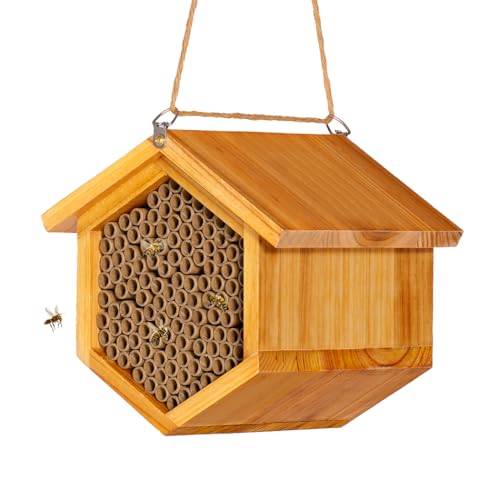
POLLIBEE Wax Coated Mason Bee House
POLLIBEE · Wax-coated wooden shell · removable nesting tubes (listed) · roof overhang
Our verdict: A bee house serves the cavity-nesting minority, not native bees as a whole, and that is still worth doing. This one gets the essential feature right: nesting tubes you can pull out and replace every year, which is what keeps a concentrated nest site from becoming a disease trap.
If you want to host cavity nesters deliberately, the POLLIBEE Wax Coated Mason Bee House ($28.90) is the version we recommend: weather-coated shell, a roof that shades the tube mouths from rain, and loose tubes rather than tunnels bored permanently into the wood.
Set expectations honestly. This helps mason bees and, with smaller tubes, leafcutter bees. It does nothing for mining bees, sweat bees, squash bees, or bumble bees, which together are the large majority of the species in your yard. Pair it with bare ground and native plants and you are covering both halves.
Full setup is in how to raise mason bees, and seven alternatives are compared in the house roundup.
Who should buy it
Gardeners with fruit trees, families who want something to watch, and anyone adding cavity nesting sites to a yard that already has bare ground and native bloom.
What we don't like
It serves a minority of native bee species, and an unmaintained bee house is actively worse than no bee house, because concentrated nests amplify chalkbrood and pollen mites.
- Serves
- Cavity nesters: mason and leafcutter bees
- Does not serve
- Ground nesters, roughly 70 percent of species
- Nesting
- Removable tubes (listed)
- Maintenance
- Replace tubes annually
- Best facing
- East or southeast
- Price
- $28.90
Pros
- Removable tubes make annual cleaning possible
- Excellent for fruit tree pollination
- The best engagement tool in pollinator gardening
- Roof overhang protects the tube openings
Cons
- Helps only the cavity-nesting minority
- Requires annual maintenance to stay healthy

BBB Seed Honey Bee Wildflower Seed Mix
BBB Seed · Wildflower blend for bee forage · annuals and perennials (listed) · untreated seed (listed)
Our verdict: Flowers beat hardware. A seeded patch feeds ground nesters, cavity nesters, bumble bees, and specialists alike, and it costs less than a bag of mulch. Buy this before you buy a bee house.
The most cost-effective purchase in this guide is seed. The BBB Seed Honey Bee Wildflower Mix ($16.29) is blended for bee forage across multiple seasons rather than for one photogenic month, and while the name points at honey bees, an open-flowered succession planting feeds the whole native guild too.
Two notes for a native-bee reader. First, favor native species where you can find them, because specialists are tied to particular hosts and generalist wildflower mixes are broad rather than targeted. Second, sow on prepared bare soil and then leave part of that bare soil bare, because for the ground nesters the dirt itself is the habitat. Bloom succession planning carries over from the forage guide.
Who should buy it
Everyone, honestly. It is the cheapest meaningful habitat upgrade in the guide and it helps every group described above.
What we don't like
General wildflower mixes are not native plant communities, so a share of the blend does nothing for specialist bees, and mixes reward genuine ground prep rather than scattering.
- Type
- Wildflower seed mix for bee forage
- Composition
- Annuals and perennials (listed)
- Seed
- Untreated (listed)
- Helps
- Every native bee group, plus honey bees
- Best sowing
- Fall or early spring, bare soil
- Price
- $16.29
Pros
- Cheapest meaningful habitat improvement here
- Feeds ground nesters and cavity nesters equally
- Untreated seed avoids the systemic pesticide problem
- Multi-season bloom rather than one peak month
Cons
- Not a native plant community, so specialists are underserved
- Needs real ground preparation to establish

My Home Park 64 Live Native Plants for Full Sun
My Home Park · 64 live native plants (listed) · full sun selection · pollinator-supporting natives
Our verdict: The expensive answer and the best one for actual conservation value. Live native plants establish faster than seed, are chosen for a region, and support the specialist bees that generic wildflower mixes miss entirely.
Seed is cheap and slow. Live plants are expensive and fast, and for native bees the species identity matters more than it does for honey bees. The My Home Park 64-plant native collection ($329.00) is the serious commitment: enough plugs to convert a real bed or a lawn strip into an established native planting in a single season.
What that buys ecologically is specialist support. A meaningful share of native bees collect pollen from a narrow set of plant genera, and those bees are absent from yards planted entirely in ornamental exotics no matter how many flowers are present. Natives also tend to bloom on the schedule local bees evolved around, which matters most at the shoulders of the season.
The honest caveat: this is a landscaping-scale purchase, and if the budget only stretches to one thing, seed plus bare ground is the higher-value move. Buy this when you are ready to convert an area rather than decorate one.
Who should buy it
Homeowners converting a lawn strip or a full bed, gardeners who want specialist bees rather than generalists, and anyone treating this as a landscaping project with a budget.
What we don't like
It is by far the most expensive item in this guide, plug collections need watering through establishment, and regional fit varies, so check the species list against your area before committing.
- Count
- 64 live plants (listed)
- Exposure
- Full sun selection (listed)
- Establishment
- Faster than seed, needs watering year one
- Supports
- Specialist native bees generic mixes miss
- Price
- $329.00
Pros
- Live plants establish far faster than seed
- Native species support specialist bees
- Enough plugs to convert a real area at once
- Blooms on the schedule local bees evolved with
Cons
- Expensive relative to everything else here
- Requires watering through the establishment year
- Regional suitability must be checked before buying
One imported bee, four thousand natives
Start with the framing, because it changes how you read every bee you see. The western honey bee is native to Europe, Africa, and western Asia, and was introduced to North America in the 1600s. It is a domesticated animal maintained at population densities its wild relatives never reach, and it is the only bee most Americans can name.
Behind it stand roughly 4,000 native bee species in the United States, in families ranging from bees smaller than a grain of rice to bumble bees you can hear coming. Almost none of them make honey. Almost none of them live in colonies. Almost none of them sting in any way that matters to a person. And collectively they do an enormous share of the pollination that happens in American gardens, orchards, and wild landscapes, much of it while the neighborhood credits the honey bees.
This is not an argument against keeping honey bees; our whole site is built around helping people do that well. It is an argument for accuracy. Keeping hives is agriculture. Helping native bees is habitat work, and the two overlap less than the marketing suggests. The practical comparison for a homeowner deciding where to spend is in mason bees vs honey bees.
Ground nesters vs cavity nesters: the split that decides what helps
Every action recommendation in native bee conservation flows from one division. Roughly 70 percent of native bee species are ground nesters: a female digs a narrow tunnel in soil, lines it, provisions cells with pollen, and seals it. The remaining 30 percent are mostly cavity nesters, using hollow stems, old beetle borings, and other pre-existing tunnels, which is the group bee houses serve.
| Nesting type | Share of species | Examples | What actually helps |
|---|---|---|---|
| Ground nesting | About 70 percent | Mining bees, sweat bees, squash bees, most bumble bees | Bare, undisturbed, sunlit soil; no mulch, no tilling, no landscape fabric |
| Cavity nesting | About 30 percent | Mason bees, leafcutter bees | Bee houses with replaceable tubes, standing hollow stems, dead wood |
| Wood boring | Small subset | Carpenter bees | Unpainted dead wood away from structures |
Read that table twice, because it explains why so much well-intentioned pollinator gardening underdelivers. A yard with a bee hotel on the fence, wall-to-wall mulch, and landscape fabric under the beds has provided housing for less than a third of local bee species and evicted the rest. The single highest-value change available to most homeowners is a sunny, undisturbed, unmulched patch of bare dirt, ideally on a slight slope, that nobody digs or covers.
Mason bees: the spring cavity nesters
Mason bees in the genus Osmia are small, often metallic blue-black, and easy to miss because their entire season is over by the time most people start gardening. The famous one, Osmia lignaria, the blue orchard mason bee, emerges with early fruit bloom, works for four to six weeks, and disappears.
They are cavity nesters, which makes them the primary tenants of bee houses, and they build partition walls between cells out of wet mud, which is where the name comes from. Per individual they are outstanding fruit tree pollinators: they carry dry loose pollen under the abdomen instead of packed on the legs, they fly in cool damp weather, and they forage very close to home.
They are also the easiest native bee to host deliberately. A house with replaceable tubes, a mud patch, and early bloom is the entire requirement, and the whole annual routine is in how to raise mason bees. If you want the hardware comparison first, our bee house roundup ranks eight of them on the criterion that matters, which is whether the nesting material comes out for annual replacement.
Leafcutter bees: the ones cutting circles in your roses
If something has been removing neat semicircles from the edges of your rose, redbud, or lilac leaves, you have leafcutter bees, genus Megachile, and the correct response is delight rather than pest control. The damage is cosmetic and the bee is a first-rate pollinator.
Females cut those discs and use them to line and cap nest cells inside cavities, which makes them the summer counterpart to spring mason bees: same nesting strategy, different season, different construction material. They favor slightly smaller tunnels, around 6mm, which is why mixed-bore tube packs are worth buying if you want both tenants across a longer season. The alfalfa leafcutter bee is managed commercially at scale for seed production, so this is a group with real agricultural weight.
Do not spray for leaf damage, and do not deadhead your bee house in July because the tubes look different. Leaf-capped tubes are a success, not a problem, and the tube-format tradeoffs are covered in the tubes and cocoons guide.
Mining bees: the spring soil specialists
Andrena mining bees are among the first bees flying in spring, often before the last frost, working willows, maples, fruit bloom, and early natives. They are modest in size, often furry, and easy to overlook individually. What is not easy to overlook is an aggregation: dozens or hundreds of females nesting in the same sunny bank, each with her own tunnel, producing a field of small soil mounds that looks alarming and is entirely harmless.
Aggregations are not colonies. Every female is independent, they are not defending anything communal, and they will not chase you. They are also gone in a few weeks. Every year, extension offices field calls about bee infestations in lawns that are simply Andrena doing their brief spring work.
Helping them is exactly the bare-ground rule: sunny, well-drained, sparsely vegetated soil that does not get tilled, covered in fabric, or buried in three inches of bark. If you find an aggregation, the correct action is to mow around it for a month and brag about it.
Sweat bees: the tiny metallic ones
The family Halictidae holds the small bees you have been seeing your whole life and reading as flies: often under a centimeter, frequently metallic green or bronze, and everywhere. The common name comes from a genuine habit of landing on skin to drink perspiration, which is where the vast majority of native bee stings originate, and those stings are extremely mild.
Socially they are the most varied group in the guide: some species are strictly solitary, some are communal with several females sharing one entrance, and some are genuinely eusocial with a queen and workers, sometimes varying within a single species by climate. For a gardener the takeaway is simpler: they are generalist pollinators active across the whole season, most of them nest in the ground, and they show up in enormous numbers on open flowers like asters, coreopsis, and anything in the carrot family.
Nothing you buy helps sweat bees. Bare soil, unsprayed flowers, and a shallow water source do.
Squash bees: the dawn specialists in your zucchini
Some native bees are specialists tied to a single plant group, and the one home gardeners meet most often is the squash bee, Peponapis pruinosa, which forages almost exclusively on squash, pumpkins, and gourds. They are up and working before sunrise, when cucurbit flowers open and before honey bees are flying, and males frequently sleep inside closed squash blossoms.
Look for them at first light: pull back a squash flower at dawn and there is a decent chance a bee is already inside. In many home gardens they are doing the majority of the cucurbit pollination while the credit goes to whatever shows up at ten in the morning.
They are ground nesters, and here is the practical implication: they typically nest directly beneath the squash vines. Which means that heavy tilling of the vegetable garden, especially in spring and fall, destroys the nests of the very bees pollinating the crop. Reduce tillage in and around cucurbit beds, and leave the soil under vines undisturbed.
Carpenter bees: powerful pollinators, real property damage
Carpenter bees in the genus Xylocopa are the large bees that look like bumble bees with a shiny hairless black abdomen, and they are the one native group with a genuine conflict with homeowners. Females bore perfectly round half-inch tunnels into unpainted wood, and generations reuse and extend the same galleries, which over years does real structural damage to fascia, deck rails, and eaves.
They are also excellent pollinators, including buzz pollinators on some crops, and the hovering male that dive-bombs your head in April cannot sting at all. Distinguishing an ecological asset from a structural liability is a matter of location, not species: a carpenter bee in a dead snag at the back of the property is a good thing, and one in your porch beam is a maintenance problem.
The management answer is mostly carpentry: paint or varnish exposed softwood, since they prefer bare weathered wood, fill and plug old galleries in the fall after emergence, and offer unpainted dead wood elsewhere on the property. Traps are the common retail answer, and we cover when they work in our guides on carpenter bee traps and how to get rid of carpenter bees without a broad insecticide program that harms everything else in the yard.
Do honey bees compete with native bees?
Sometimes, and the honest answer depends on density and landscape. A honey bee colony fields tens of thousands of foragers over a two-mile radius, which is a scale no native bee approaches, and in forage-limited landscapes research has documented competition for floral resources. High densities of managed hives in wildland areas are the case that draws the most scrutiny; a couple of backyard hives in a suburb full of gardens is a much smaller concern.
There is also a pathogen dimension worth knowing about: some viruses circulate between managed honey bees and wild bees through shared flowers. It is an active research area, and the USDA Agricultural Research Service maintains ongoing pollinator health programs covering it.
The practical conclusion for a homeowner is not to feel guilty about a hive. It is to plant more forage than your bees consume, keep your colonies healthy so they are not a disease reservoir, and spend at least as much effort on habitat as on hardware. If you keep hives, adding bare ground and native plants is the way to be a good neighbor to the other four thousand species.
The action list, ranked by what actually works
1. Leave bare ground. A sunny, undisturbed, unmulched patch of soil, ideally sloped and sparsely vegetated. Free, and it serves the 70 percent that no bee house touches.
2. Stop spraying. Especially systemic insecticides, which move into pollen and nectar, and especially anything applied to plants in bloom. The EPA pollinator protection program is the reference for label rules and best practices.
3. Plant natives, in bloom succession. Native bees have deeper relationships with native plants than honey bees do, and specialists like squash bees are tied to specific hosts. Aim for something flowering from earliest spring through frost.
4. Leave stems and leaves standing over winter. Hollow and pithy stems are nesting cavities, and leaf litter shelters overwintering queens. Cut back in late spring instead of fall, and leave stem stubs of a foot or so.
5. Reduce tillage. Especially around cucurbits, where squash bees nest directly under the vines you are trying to pollinate.
6. Provide water. A shallow source with landing surfaces, covered in our water station roundup, so bees can drink without drowning.
7. Then, optionally, add a bee house. It helps the cavity-nesting minority, it is excellent for fruit trees, and it is by far the best way to get a household actually watching bees. Just do it with replaceable tubes and an annual cleaning routine, or it becomes a disease trap.
How to identify what is in your yard
A quick field triage that gets you to the right group most of the time. Big, furry, loud, active in cool weather? Bumble bee. Big, shiny black abdomen, hovering near wood? Carpenter bee. Small, metallic blue-black, only in spring, near fruit bloom? Mason bee. Cutting neat circles out of leaves in summer? Leafcutter. Tiny and metallic green, landing on your arm? Sweat bee. In squash blossoms at dawn? Squash bee. Small mounds of soil in a sunny bank in March? Mining bee aggregation. Golden brown, in a colony, in a box? Honey bee, and someone owns it.
Two things that are not bees and get blamed as bees: hoverflies, which have one pair of wings, huge eyes, and hover with sudden darting movements, and yellowjackets and other wasps, which are smooth, narrow-waisted, and much more likely to be interested in your lunch. Our bee versus wasp versus hornet guide sorts out the ones that matter for stings.
None of this requires equipment. A phone camera and the willingness to stand still near a flowering plant for five minutes will show you more bee diversity in one afternoon than most people notice in a lifetime.
More gear worth comparing
Beyond this guide: the highest-rated gear across every category and budget, with a live price check on each.



As an Amazon Associate we may earn from qualifying purchases, at no cost to you.
Quick shop: every pick
Skip the scroll: the whole lineup, with a live price check on each.
- POLLIBEE Wax Coated Mason Bee HouseBest for Cavity NestersPOLLIBEE · $28.90Check Price
- BBB Seed Honey Bee Wildflower Seed MixBest Cheap Habitat UpgradeBBB Seed · $16.29Check Price
- My Home Park 64 Live Native Plants for Full SunBest Native Plant InvestmentMy Home Park · $329.00Check Price
How we chose
This is a field-and-garden guide, not a taxonomic key: we cover the groups a US gardener will actually encounter and skip the ones only a specialist can identify.
Every biological claim here is either mainstream general knowledge or cited to an approved reference, and we hedge estimates like species counts as approximate because they are.
We rank actions by real-world impact, which is why bare ground and native plants come before any purchase on this page.
We say plainly where honey bees compete with native bees, because pretending otherwise does readers no favors.
Products appear only where they genuinely help, and we note which parts of the native bee community they do nothing for.
Same desk, same standard: no brand paid for placement, and the highest-value recommendation in this guide costs nothing.
Key terms
- Native bee
- A bee species indigenous to a region. The US has roughly 4,000, nearly all solitary and most nesting in the ground. The honey bee is not among them.
- Ground nesting bee
- A bee that digs a nest tunnel in soil. About 70 percent of native bee species nest this way, which is why bare, undisturbed, sunlit soil is the highest-value habitat feature in a yard.
- Cavity nesting bee
- A bee that nests in pre-existing holes, hollow stems, or beetle borings rather than digging. Mason and leafcutter bees are the common examples, and they are the tenants bee houses serve.
- Buzz pollination
- Sonication: a bee vibrating her flight muscles to shake pollen from anthers that will not release it otherwise. Bumble bees do it, honey bees cannot, and tomatoes and blueberries depend on it.
- Specialist bee
- A bee that collects pollen from a narrow set of plant genera, such as the squash bee on cucurbits. Specialists disappear from landscapes planted entirely in exotic ornamentals.
- Aggregation
- Many solitary bees nesting close together in a favorable patch of soil. It looks like a colony and is not: each female is independent, and the group is harmless and short-lived.
- Apis mellifera
- The western honey bee, native to Europe, Africa, and western Asia and introduced to North America in the 1600s. It is managed livestock rather than a native pollinator.
Questions, answered
how many native bee species are in the united states
Roughly 4,000, across a wide range of families and sizes. Nearly all are solitary, most nest in the ground, and almost none produce honey. The western honey bee is not among them: it was introduced from Europe in the 1600s and is managed as livestock.
are honey bees native to north america
No. Apis mellifera is native to Europe, Africa, and western Asia and was brought to North America by colonists in the 1600s. Every honey bee in the US descends from imported stock, which is why keeping hives is best understood as agriculture rather than pollinator conservation.
what is the best way to help native bees
Leave bare, undisturbed, sunny soil, because roughly 70 percent of native bee species nest in the ground and cannot use bee houses. After that: stop spraying, plant natives that bloom across the whole season, leave stems and leaf litter standing over winter, reduce tillage, and provide shallow water. Hardware comes last.
do native bees sting
Rarely and mildly. Most native bees are solitary, with no colony or honey stores to defend, so defensive behavior barely exists. Many are too small to sting through human skin, and male bees of every species cannot sting at all. Sweat bees account for many of the few native bee stings people experience, and those are very mild.
what are the small bees making holes in my lawn
Almost certainly mining bees in the genus Andrena or ground-nesting sweat bees. Look for small volcano-like mounds of fine soil with a pencil-width hole. They are solitary, harmless, do not damage turf, and are usually gone within a few weeks in spring. Mow around them and leave the soil undisturbed.
do bee hotels actually help native bees
They help the roughly 30 percent that nest in cavities, mainly mason and leafcutter bees, and they are excellent for fruit tree pollination and for getting people to notice bees. They do nothing for the ground-nesting majority. They also require annual replacement of nesting material, since concentrated nests accumulate chalkbrood and pollen mites.
which bees pollinate tomatoes
Bumble bees, primarily, along with some other native bees capable of buzz pollination. Tomato anthers release pollen only when vibrated at the right frequency, and honey bees cannot do it. This is why greenhouse tomato growers buy bumble bee colonies and why a yard with bumble bees sets fruit better.
do honey bees compete with native bees
In forage-limited landscapes they can, since a single colony fields tens of thousands of foragers across a two-mile radius. Concerns are largest around high densities of managed hives in wild areas and smallest around a couple of backyard hives in a flower-rich suburb. Planting more forage than your colonies consume is the practical response.
what bee cuts circles out of my leaves
A leafcutter bee, genus Megachile. She cuts neat semicircular discs to line and cap nest cells in a cavity. The leaf damage is cosmetic and the bee is a valuable summer pollinator, so no treatment is warranted. Consider it a sign your yard is hosting native bees successfully.
should i get rid of carpenter bees
Only where they are damaging structures. Carpenter bees are strong pollinators and the hovering males cannot sting, but females bore half-inch tunnels in unpainted wood and generations extend the same galleries over years. Paint or seal exposed softwood, plug old galleries after emergence, and leave dead wood elsewhere on the property as an alternative.
Filed under Explainer
Part of Bees & Pollinators
Keep reading
How to Raise Mason Bees
The one native bee you can host deliberately, from February mounting through winter storage.
Best Mason Bee Houses
Housing for the cavity-nesting minority, ranked on whether the tubes come out for cleaning.
Mason Bees vs Honey Bees
Cost, time, stings, honey, and pollination compared, including the conservation question.
Best Bee Water Stations
Shallow drinking surfaces for the whole guild, and how to keep them mosquito free.
Best Plants for Honey Bees
Bloom succession, nectar trees, and pesticide cautions, useful for natives with a native-plant tilt.
Best Mason Bee Tubes and Cocoons
Cardboard versus reed versus trays, plus ethical cocoon sourcing and fall harvest technique.