Our Pick: Rivajam
Check PriceBest Mason Bee Tubes and Cocoons: What to Buy Every Year
If you want one annual refill and no decisions, buy the Rivajam 150-tube mason bee refill pack ($17.99): a mixed pack of cardboard tubes and paper inserts, enough to reload a normal garden house for a season or two, at a price that makes throwing last year's tubes away feel painless. That painless part is the point. Nesting tubes are the cheapest insurance in native bee hosting, and the whole practice depends on replacing them every single year.
By The BeehiveKits Hive Desk2026-08-2917 min read Fact-checked against verified Amazon listingsHow we research
Here is the arithmetic that should govern this category. A bee house costs twenty to eighty dollars once. Tubes cost roughly fifteen to twenty five dollars a year. Skipping the annual refill saves you the price of two coffees and costs you a nest site that quietly accumulates chalkbrood spores, pollen mites, and parasitic wasp larvae until the failure rate climbs past what a wild population can absorb. The tubes are not the accessory; they are the management.
Cocoons are the other half of this page, and they deserve more caution than the tube market gets. Buying cocoons is a legitimate way to seed a house in an area with no established population, and it is also a way to move bees, and everything living on them, into a region they did not come from. We cover how to buy responsibly: source as locally as you can, favor sellers who ship regionally appropriate stock, and understand that the goal is a self-sustaining local population, not an annual subscription.
Standard disclosure: no brand paid for placement here, prices were verified at publication, and some links go to Amazon, where a purchase may earn us a small commission at no extra cost to you. The house side of this decision lives in our mason bee house roundup, and the full season is in how to raise mason bees.
What to know
- Tubes are annual. Replace every piece of nesting material each year, and treat the house shell as the only permanent part of the system.
- Cardboard tubes with paper inserts are the easiest to harvest: the insert unrolls, the cocoons come out clean, and nothing needs to be split with a knife.
- Reed tubes are the best natural option: they split open cleanly for harvest, breathe well, and are what most experienced hosts move to after a season or two.
- Drilled wooden blocks are the format to avoid unless the tunnels take paper inserts, because you cannot open them to harvest or clean.
- Buy cocoons locally where you can. Shipping bees across regions moves their parasites and pathogens too, and regional stock is better matched to your bloom calendar.
- Harvest in fall, wash gently in cool water, store cold at commonly listed refrigerator temperatures of roughly 34F to 39F with humidity, and release when daytime temperatures hold near 55F and bloom opens.
At a glance
| Product | Price | Type | Harvest method | Best for | Check price |
|---|---|---|---|---|---|
| Rivajam 150 Tube Refill Pack | $17.99 | Cardboard tubes plus inserts (listed) | Unroll the paper insert | The default annual refill | Check Price |
| Rivajam 125 Phragmite Reed Tubes | $24.99 | Natural reed | Split the reed open | Hosts who harvest cocoons | Check Price |
| Veemoon 100 Reed Tubes | $13.57 | Natural reed | Split the reed open | Cheapest reed per tube | Check Price |
| Made Easy Kit Bee House | $24.99 | House plus nesting tubes | Replace tubes | Starting from zero | Check Price |
| JCs Wildlife Poly Lumber House | $83.96 | Permanent shell for tubes | Swap tubes annually | A shell that outlives the tubes | Check Price |
Nesting tubes and refill options at a glance

Rivajam 150 Mason Bee House Tubes Refill Pack
Rivajam · 150 tubes (listed) · cardboard tubes plus paper inserts (listed) · refill format
Our verdict: The right default: enough tubes to reload a typical house for a season or two, cheap enough that discarding used material is painless, and built around paper inserts so the fall harvest takes minutes instead of a knife and patience.
The single best thing about the Rivajam 150 mason bee tube refill pack ($17.99) is the insert. A cardboard outer tube gives the nest structural protection and weather resistance; the paper liner inside is what the bee actually nests in, and in October you slide it out and unroll it like a scroll. The cocoons come off clean, the used liner goes in the trash, and there is nothing to pry, split, or saw.
That matters because harvest is the step new hosts skip, and they skip it when it looks like work. Make it a ten minute kitchen-table job and people actually do it, which is how a bee house stops being a disease trap and starts being a bee nursery.
Pair it with a house built for loose tubes, our POLLIBEE Wax Coated Mason Bee House ($28.90) being the obvious partner, and the annual cost of running a properly managed bee house lands under twenty dollars.
Who should buy it
Every first-time host, and anyone who wants the fall harvest to be genuinely easy rather than a project they will put off until the cocoons are ruined.
What we don't like
Cardboard needs a house with a real roof overhang; in sustained rain on an exposed mount the tubes soften. Tube counts and diameters are listed rather than verified, so check the bore mix against the species you are targeting.
- Count
- 150 tubes (listed)
- Construction
- Cardboard tube with paper insert (listed)
- Harvest
- Slide out and unroll the insert
- Reuse
- None, replace annually
- Pairs with
- Any loose-tube bee house
- Price
- $17.99
Pros
- Paper inserts make cocoon harvest genuinely easy
- Enough tubes to reload a typical house more than once
- Cheap enough that annual replacement is painless
- Consistent factory bore rather than random cane diameters
- Fits standard loose-tube houses
Cons
- Cardboard softens if the house lets rain reach the openings
- Counts and diameters are manufacturer-listed

Rivajam 125 Phragmite Reed Mason Bee Tubes
Rivajam · 125 phragmite reed tubes (listed) · natural material · splits for cocoon harvest
Our verdict: What most experienced hosts move to. Reed handles humidity better than paper, has the hollow-stem structure solitary bees evolved to use, and splits along its length with a thumbnail so harvest stays practical.
Reed is the material native bees have actually been nesting in for as long as there have been reeds. The Rivajam 125 phragmite reed tube pack ($24.99) delivers it cut and sorted for the job, which is the crucial difference between purpose-cut reed and the sealed bamboo bundles we tell people to skip in the house roundup.
Two practical advantages over cardboard. Reed breathes, so condensation is less of an issue in humid climates and cool springs. And the natural taper and texture seem to read as a real nesting cavity to prospecting females, which is anecdotal but consistent across hosts we trust.
The tradeoff is variability: a natural material means a range of bore diameters in one bundle. That widens the species you might attract and narrows how many tubes are exactly right for blue orchard mason bees, which is the honest tradeoff of buying nature instead of a factory.
Who should buy it
Second-year hosts, humid climates, anyone who intends to harvest cocoons every fall, and gardeners who want the most natural nesting substrate available at a sane price.
What we don't like
Bore diameters vary within a bundle, so tube-for-tube it is less targeted than factory cardboard, and it costs about seven dollars more than the cardboard pack for fewer tubes.
- Count
- 125 reeds (listed)
- Material
- Phragmite reed (listed)
- Harvest
- Split lengthwise
- Breathability
- Better than cardboard in humid climates
- Reuse
- None, replace annually
- Price
- $24.99
Pros
- Natural hollow stems, the substrate solitary bees evolved with
- Breathes well, less condensation risk than paper
- Splits cleanly for fall cocoon harvest
- Purpose-cut and sorted, unlike garden-center bamboo
Cons
- Natural diameter variation within the bundle
- Higher cost per tube than cardboard refills

Veemoon 100 Natural Reed Pollinator Tubes
Veemoon · 100 natural reed tubes (listed) · pollinator nesting refill · splits for harvest
Our verdict: The budget reed option, and it makes annual replacement almost free. When the enemy is hosts who reuse tubes because refills feel expensive, a fourteen dollar pack is a genuinely useful product.
At $13.57 the Veemoon 100-count reed tube pack is the price point that removes every excuse for reusing last year's nesting material. It is the same basic proposition as the pricier reed bundle: natural hollow stems that split open for harvest, in a count that reloads a small or medium house.
Expect more variability in sorting and diameter than the premium reed packs, which is what the price reflects. For a small garden house that is a fine trade, and it is a much better nesting material than any drilled block at the same money.
Who should buy it
Budget-minded hosts, anyone running two or three small houses who needs volume, and gardeners who want to try reed before committing to a premium bundle.
What we don't like
Sorting and diameter consistency are the compromise here, and lower counts mean a bigger house will need two packs to reload properly.
- Count
- 100 tubes (listed)
- Material
- Natural reed (listed)
- Harvest
- Split lengthwise
- Reuse
- None, replace annually
- Cost per season
- Under $15 for a small house
- Price
- $13.57
Pros
- Cheapest credible reed refill here
- Makes annual replacement effectively painless
- Splits open for cocoon harvest
- Good volume for running multiple small houses
Cons
- Less consistent sorting and diameter
- Count may not fully reload a large house
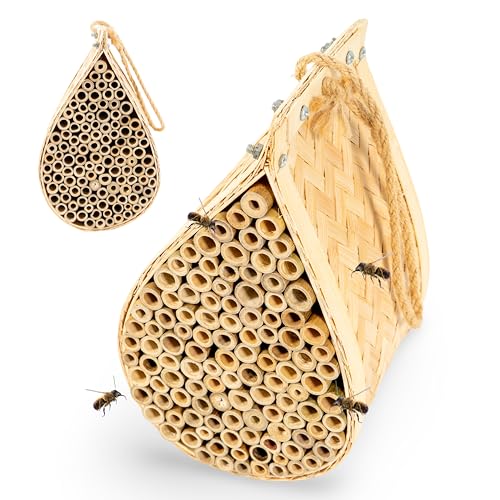
Made Easy Kit Bee House with Nesting Tubes
Made Easy Kit · Bee house with nesting tubes included (listed) · targets mason and leafcutter bees (listed)
Our verdict: The one-box start. You get a shell and a first load of tubes for the price of a good refill pack, and you can move to dedicated tube refills in year two once you know the site works.
Not everyone reading this owns a house yet. The Made Easy Kit Bee House ($24.99) solves that in one purchase: a mounted shell with nesting tubes already in it, listed as targeting both mason and leafcutter bees, which is the sensible two-species approach since leafcutters extend the nesting season into summer.
Treat the included tubes as year one only. In fall, harvest or store them, then reload with a dedicated refill pack. The bundle is a starting point, not a permanent system, and every kit of this type should be read that way.
Who should buy it
Anyone starting from zero who would rather buy one thing than two, and gift-givers who want the recipient to have everything needed in a single box.
What we don't like
Bundled tube counts are modest and listed rather than verified, so plan on a proper refill pack for year two, and confirm the roof overhang before mounting it anywhere exposed.
- Format
- House with nesting tubes included
- Targets
- Mason and leafcutter bees (listed)
- Cleanable
- Yes, replace tubes annually
- Year two
- Reload with a dedicated refill pack
- Mounting
- Wall or post, east facing
- Price
- $24.99
Pros
- Everything needed to start in one box
- Targets leafcutters as well as mason bees
- Priced like a refill pack alone
- Keeps replaceable tubes rather than drilled bores
Cons
- Included tube supply is a starter quantity
- Shell specs are manufacturer-listed

JCs Wildlife Small Poly Lumber Mason Bee House
JCs Wildlife · Recycled poly lumber (listed) · permanent shell designed around replaceable tubes
Our verdict: If the tubes are the consumable, the shell should be permanent, and poly lumber is the most permanent material in this category. Expensive once, then nothing but refills for years.
The correct mental model for this hobby is a durable shell plus annual consumables, and the JCs Wildlife poly lumber mason bee house ($83.96) is the shell half taken seriously. Recycled poly does not rot, warp, split, or need sealing, so it survives the freeze-thaw cycles that turn budget wooden houses into projects.
Amortized over a decade of eighteen-dollar refills, the premium is small. Site it east-facing with afternoon shade, since dark poly absorbs heat, and reload it every spring with whichever tube format you prefer.
Who should buy it
Committed hosts thinking in decades, wet or freeze-thaw climates, and anyone who wants to buy the structure once and only ever shop for tubes afterward.
What we don't like
A steep single purchase relative to the rest of this page, and poly runs hot in direct afternoon sun, so siting is less forgiving than with light-colored wood.
- Material
- Recycled poly lumber (listed)
- Role
- Permanent shell for replaceable tubes
- Weathering
- No rot, warp, or sealing needed
- Best facing
- East, with afternoon shade
- Refills
- Any standard tube format
- Price
- $83.96
Pros
- Outlasts many seasons of nesting tubes
- Zero maintenance on the structure itself
- Built around the replaceable-tube model
- Recycled material
Cons
- Expensive next to the consumables it holds
- Dark poly heats in full afternoon sun
Cardboard vs reed vs wood trays vs drilled blocks
Four nesting formats dominate the market, and they differ mainly in how you get the cocoons back out in the fall. That is the axis that matters, because harvest is what lets you wash off pollen mites, discard chalkbrood-infected cells, and give next spring's bees a clean start.
| Format | Harvest | Strengths | Weaknesses |
|---|---|---|---|
| Cardboard tube with paper insert | Slide out the insert and unroll it | Cheapest, easiest harvest, consistent bore | Softens in sustained wet, must be sheltered |
| Natural reed | Split the reed lengthwise | Breathes well, natural, splits cleanly, reusable-looking but still annual | Diameters vary within a bundle |
| Wooden tray stack | Unstack the grooved trays | Reusable shell, excellent inspection, tidy | Highest upfront cost, needs real cleaning between seasons |
| Drilled wooden block | None, unless it takes paper inserts | Durable, cheap to make | Cannot be opened, accumulates disease, the format to avoid |
Our practical recommendation for most gardens: start on cardboard tubes with inserts because the harvest is idiot-proof, then move to reed once you have done a fall harvest and want a material that handles humidity better. Trays are excellent and worth it if you get serious. Drilled blocks are only acceptable when the tunnels are sized to accept paper inserts, which converts them into a tube house wearing a wooden costume.
Why you replace tubes every single year
The case is simple and it is the reason this article exists. A tunnel that raised bees last year is coated in pollen residue, frass, and the shed skins of whatever also lived in there. Two organisms take advantage. Chalkbrood spores survive in old nesting material and infect the next generation of larvae. Pollen mites in the genus Chaetodactylus overwinter in used tubes and swarm onto the provision of the next larva, eating the food out from under it until it starves.
Neither problem is dramatic in a wild landscape, where nest sites are scattered and short-lived. Both compound fast in a box on your fence that gets reused indefinitely. Annual replacement resets the clock, and it costs less than a bag of potting soil.
The corollary is that you should also not reuse the paper inserts, should discard reeds after one nesting season, and should scrub or replace wooden trays between years. The house shell is permanent infrastructure. Everything a bee touched is a consumable. Our house roundup ranks houses on exactly this axis, and it is why a cleanable twenty three dollar house beats a beautiful sealed one at any price.
Buying cocoons without moving problems around
Cocoons are sold by the dozen or the hundred every winter, and there are two good reasons to buy them: your area has no established mason bee population, or your house has sat empty for two seasons despite correct siting and mud. There is one bad reason, which is treating cocoons as an annual subscription so you never have to learn the harvest routine.
The ethics here are the same ones that govern any live animal shipment. Bees carry their parasites, pathogens, and genetics with them, and moving them between regions moves all three. So: source as locally as you can, prefer sellers who ship stock appropriate to your region rather than one national population, and ask what species you are actually buying, since Osmia lignaria is native across much of North America while some marketed Osmia are not native everywhere they are sold. State agriculture departments regulate some interstate movement of bees, and the USDA Agricultural Research Service maintains active research programs on native pollinators worth reading before you order.
The goal, stated plainly, is a local population that sustains itself in your yard. Buy once to seed it, then harvest and overwinter your own cocoons every year afterward. That is both cheaper and better practice than importing bees every spring, and it is the same instinct that makes us recommend local nucs over long-distance packages on the honey bee side in where to buy bees.
Fall harvest and washing, step by step
Harvest happens in fall, generally October to November in most of the US, once the larvae inside have spun cocoons and become adults waiting out the winter. Work indoors at a table, in a cool room, with a bowl of cool water and a colander.
Open the material. Unroll paper inserts, split reeds lengthwise with a thumbnail or a knife tip, or unstack trays. You are looking for a row of cocoons separated by mud partitions, with a mud plug at the outer end.
Sort as you go. Healthy cocoons are firm, uniform, and roughly the size of a plump grain of rice. Discard anything chalky and white, anything that crumbles, cells full of fine dust with mites crawling in it, and any cell holding small wasp larvae instead of a cocoon. Discarded material goes in the trash, not the compost.
Wash gently. Rinse the cocoons in cool water, agitating lightly to float off mud, frass, and mites. Some hosts follow with a brief dilute bleach rinse, a practice commonly recommended in extension and commercial guidance for mite and chalkbrood control; if you do it, keep it brief, rinse thoroughly in clean water afterward, and never soak. Cocoons that float persistently after washing are usually dead and can be discarded.
Dry and store. Spread them on a towel until surface dry, then into a ventilated container with a slightly damp element for humidity, and into cold storage. The commonly listed target range is a refrigerator at roughly 34F to 39F, which mimics a normal winter without letting them dry out or wake up early. Check monthly for mold.
Spring release: the timing that decides everything
Release cocoons when two things are true at once: daytime temperatures are holding around 55F and there is bloom open within a few hundred feet. Release too early and the bees emerge into a foodless landscape; release too late and they miss the fruit bloom they exist to pollinate. In much of the US that lands somewhere between early March in the South and late April in the North.
Mechanically it is easy: put the cocoons in a small ventilated release box or a shallow container tucked under the house roof, out of direct rain and away from ants, with an exit the emerging bees can walk out of. Males emerge first over several days, then females, and within a week or two the females start provisioning tubes in your freshly loaded house.
Stagger the release if your spring is unstable: put out half the cocoons at the first sustained warm spell and hold the rest in the refrigerator for another two weeks. That is cheap insurance against a hard late freeze taking your whole population in one night, and it is the same hedging logic beekeepers use with a split, as covered in the first-year beekeeping calendar.
More gear worth comparing
Beyond this guide: the highest-rated gear across every category and budget, with a live price check on each.



As an Amazon Associate we may earn from qualifying purchases, at no cost to you.
Quick shop: every pick
Skip the scroll: the whole lineup, with a live price check on each.
- Rivajam 150 Mason Bee House Tubes Refill PackBest Overall RefillRivajam · $17.99Check Price
- Rivajam 125 Phragmite Reed Mason Bee TubesBest Natural MaterialRivajam · $24.99Check Price
- Veemoon 100 Natural Reed Pollinator TubesBest Budget ReedVeemoon · $13.57Check Price
- Made Easy Kit Bee House with Nesting TubesBest Starter BundleMade Easy Kit · $24.99Check Price
- JCs Wildlife Small Poly Lumber Mason Bee HouseBest Shell to Refill ForeverJCs Wildlife · $83.96Check Price
How we chose
Harvestability first: we rank nesting material by how easily a normal person can open it in October and get cocoons out intact.
Bore and depth: we favor material at roughly 5/16 inch (about 8mm) running 6 inches or deeper, the geometry blue orchard mason bees actually select, and we flag mixed-diameter packs as the compromise they are.
Cost per season, not per tube: a pack that reloads a house twice at eighteen dollars beats a cheaper pack that fills it once.
Material honesty: reed, cardboard, and paper each have real tradeoffs in moisture handling and durability, and we state them rather than pretending one format wins outright.
Sourcing ethics on cocoons: we recommend the local-first approach and we do not treat mail-order bees as a routine annual purchase.
Same desk, same standard: no brand paid for placement, and every unverifiable count or dimension is written as listed.
Key terms
- Nesting tube
- The replaceable cardboard, paper, or reed tunnel a solitary bee provisions and seals. Treated as an annual consumable, not a permanent fixture.
- Paper insert
- A thin paper liner inside a cardboard tube or drilled bore. It unrolls at harvest, releasing cocoons cleanly and letting a non-openable house be managed hygienically.
- Phragmite reed
- A hollow natural reed cut into nesting tubes. It breathes better than cardboard and splits lengthwise for cocoon harvest, at the cost of variable bore diameters.
- Cocoon harvest
- The fall practice of opening nesting material, removing and sorting cocoons, discarding diseased or parasitized cells, and washing the survivors before cold storage.
- Cold storage
- Overwintering harvested cocoons at commonly listed refrigerator temperatures of roughly 34F to 39F with some humidity, so adults stay dormant until spring release.
- Release timing
- Setting cocoons out when daytime temperatures hold near 55F and early bloom is open. Too early leaves emerging bees without forage; too late misses fruit bloom.
Questions, answered
how often should you replace mason bee tubes
Every year, without exception. Used nesting material carries chalkbrood spores and pollen mites that infect the next generation, and a house that is never reloaded declines season over season. Replacement costs roughly fifteen to twenty five dollars annually, which is the cheapest management in the hobby.
are cardboard or reed tubes better for mason bees
Both work. Cardboard tubes with paper inserts are easiest to harvest, because the liner unrolls and cocoons come out clean, and factory bores are consistent. Reed breathes better in humid climates and splits cleanly for harvest, at the cost of variable diameters within a bundle. Most hosts start on cardboard and move to reed.
where can i buy mason bee cocoons
Specialty native bee suppliers, some garden retailers, and online sellers ship cocoons in winter and early spring. Buy as locally as you can, ask what species you are getting, and prefer sellers who supply regionally appropriate stock. The goal is to seed a self-sustaining local population once, not to re-buy bees every spring.
how do you clean mason bee cocoons
Open the nesting material in fall, sort out chalky mummies, mite-filled cells, and parasitized cells, then rinse the healthy cocoons in cool water while agitating gently to float off mud and debris. Some hosts follow with a brief dilute bleach rinse and a thorough clean-water rinse. Surface dry them, then move them into ventilated cold storage.
what temperature should mason bee cocoons be stored at
Commonly listed guidance is a refrigerator at roughly 34F to 39F, in a ventilated container with a little humidity so the cocoons do not dry out. Check monthly for mold. The point is to mimic a normal winter closely enough that the adults inside stay dormant until you decide to release them.
when should i put out mason bee cocoons
When daytime temperatures hold around 55F and there is bloom open within a few hundred feet, typically early March in the South and mid to late April in the North. Set them under the house roof in a ventilated release container. Staggering the release across two weeks hedges against a late freeze wiping out the whole batch.
can you reuse mason bee tubes
No, and this is the mistake that quietly ruins bee houses. Even a tube that produced healthy bees is coated in residue that harbors chalkbrood spores and pollen mites. Harvest what is inside, discard the material, and load fresh tubes. Wooden trays are the one partial exception, and they still need thorough cleaning between seasons.
how many mason bee cocoons do i need
A starter batch for a typical garden house is usually a few dozen. Each female fills several tubes over her few weeks of activity, so a small release seeds a house quickly if forage and mud are present. Buy once to establish the population, then rely on your own fall harvest to supply the following spring.
do mason bee tubes need to be a certain size
Yes. Blue orchard mason bees select tunnels near 5/16 inch, roughly 8mm, and tunnels around 6mm shift you toward leafcutter bees and smaller Osmia. Depth should be 6 inches or more, since females place female eggs deep in the tunnel and shallow tubes produce a male-heavy generation.
is it bad to buy mason bees online
It is not inherently bad, but it deserves care. Shipping bees moves their parasites, pathogens, and genetics along with them, so buy from as local a source as possible and ask what species you are receiving. Use purchased cocoons to seed a population once rather than as an annual subscription, and overwinter your own stock after that.
Filed under Buyer's Guide
Part of Bees & Pollinators
Keep reading
Best Mason Bee Houses
Eight houses ranked on the criterion that matters most: whether the nesting material comes out.
How to Raise Mason Bees
The complete annual cycle from February mounting through fall harvest and winter refrigeration.
Mason Bees vs Honey Bees
Which one belongs in your yard: cost, time, stings, honey, and pollination efficiency compared.
The Native Bees Guide
The species that will never use your tubes, and what actually helps them instead.
Best Bee Water Stations
Shallow landing surfaces so the bees you host can drink without drowning.
Where to Buy Bees
The honey bee version of the sourcing question: local nucs, packages, and what shipping costs you.