Our Pick: Honey Lake
Check PriceUrban Beekeeping: Rooftops, Small Yards, and Neighbors
If you keep bees in a city, one technique matters more than every other decision you will make: the flyway barrier. A solid 6-foot fence, hedge, or lattice panel placed a few feet in front of the entrance forces departing bees to climb above head height before they gain speed, which turns a low, fast flight path across a shared sidewalk into a stream of bees moving 10 feet over it. Nearly every urban beekeeping ordinance in the country asks for one, and nearly every urban sting complaint traces back to a hive that did not have one. Start there, then size the rest of the setup down: a lighter kit like the Honey Lake 8-frame starter ($79.79) is easier to run on a rooftop than a full 10-frame stack, and a four-pack water station like the Retyion bee baths ($17.83) is what keeps your bees out of the neighbor's pool.
By The BeehiveKits Hive Desk2026-08-2919 min read Fact-checked against verified Amazon listingsHow we research
The rest of this guide is the city-specific work: how many hives a small lot can actually support, how to have the neighbor conversation before the bees arrive, what changes on a rooftop (wind, heat load, roof weight, stair access, and the reality of carrying a 90-pound honey super down three flights), what to do about swarms when the swarm lands on a stranger's porch, and why urban forage is often better than rural forage. We also cover the gear that earns its place in a tight space and the gear that does not.
One thing we will not do is tell you what your city allows. Municipal beekeeping rules vary block by block, HOA covenants can be stricter than the city code, and rental leases add a third layer. We describe the categories of rules you should expect to find and send you to our state-by-state law overview for the framework, but the actual reading of your own code, your HOA covenants, and your lease is homework only you can do, and it happens before any money is spent.
Standard disclosure, plainly: no brand paid for a placement here, and some links go to Amazon, where a purchase may earn us a small commission at no extra cost to you. Prices were verified at publication and drift, so check the live listing.
What to know
- The flyway barrier is the single most important urban technique: a 6-foot fence, hedge, or panel a few feet in front of the entrance lifts the whole flight path above head height.
- Check the municipal code, the HOA covenants, and your lease before you buy anything. Expect rules on hive count, setbacks, barriers, water, and sometimes registration.
- Put water on your property before the bees arrive. Bees imprint on the first reliable source they find, and once that source is the neighbor's pool, it is very hard to move them.
- Two hives is the right city start for the same reason it is the right rural start, and it is usually also the honest ceiling for a small lot or a shared roof.
- Rooftops add four problems: wind, heat load, roof structure and weight, and stairs. Solve stairs before you solve anything else, because full supers weigh 50 to 90 pounds.
- Have a written swarm plan and a local swarm-catcher's phone number before swarm season, because in a city a swarm is a public event and a reputational one.
- Urban forage is often excellent: mixed ornamental plantings, street trees, and unmanaged lots give a longer, more varied bloom than a monoculture farm belt.
At a glance
| Factor | Rural yard | Urban yard or rooftop | What you do about it |
|---|---|---|---|
| Flight path | Open, low flight is harmless | Crosses sidewalks, patios, and gates | 6-foot flyway barrier a few feet in front of the entrance |
| Water | Ditch, pond, or stock tank nearby | Neighbor's pool, birdbath, or AC condensate | Establish your own water source weeks before bees arrive |
| Hive count | Limited by forage | Limited by ordinance, space, and goodwill | Start at two; expand only after a season of data |
| Box weight | Truck backs up to the hive | Carried through a gate or down stairs | 8-frame equipment and mediums instead of deeps |
| Swarms | Lands in your own tree | Lands on a stranger's porch railing | Swarm prevention plus a catcher on speed dial |
What changes when the apiary is in a city

Honey Lake 8-Frame Beehive Starter Kit
Honey Lake · 8-frame Langstroth deep · beeswax-coated (listed) · smallest footprint in our starter table
Our verdict: The reason to run 8-frame equipment in a city is not the footprint, it is the lift: a full 8-frame deep is meaningfully lighter than the 80 to 90 pound 10-frame version, which is the difference between a manageable rooftop and an abandoned one. This is the least expensive honest way into that system.
City beekeeping punishes weight. Every box you own will eventually be carried through a gate, up a fire escape, or down a stairwell, and the Honey Lake 8-frame starter kit ($79.79) is the cheapest way to commit to the lighter system from day one. Beeswax-coated exterior per the listing, standard Langstroth geometry, and a deck footprint that leaves room for a person to stand behind the hive, which matters on a 6-foot balcony.
Commit to one frame size across your whole apiary. Mixing 8-frame and 10-frame equipment means no comb, no box, and no lid is interchangeable, which is a bigger annoyance in a storage-poor city setup than it is in a barn. The full case either way is in 8-frame vs 10-frame, and the broader starter-kit field is ranked in our starter kit guide.
Who should buy it
Rooftop and small-yard keepers, anyone who will be carrying boxes up or down stairs, and keepers who want the lightest standard-geometry option without going custom.
What we don't like
It is an entry-priced kit, so expect to inspect the joinery and add your own paint or sealant, and 8-frame colonies need closer watching for space in a strong flow because they fill faster.
- Configuration
- 8-frame Langstroth (listed)
- Coating
- Beeswax coated (listed)
- Full deep weight
- Lighter than a 10-frame deep, which runs about 80 to 90 lbs (listed estimate)
- Best use
- Rooftops, decks, small lots
- Price
- $79.79
Pros
- Smallest practical footprint for a standard hive
- Lighter boxes than 10-frame equipment
- Beeswax-coated per the listing
- Lowest entry price in our starter table
Cons
- 8-frame boxes fill faster and need closer space management
- Not interchangeable with 10-frame gear, so pick one system and stay

Retyion Bee Watering Station, 4-Pack
Retyion · 4-pack · shallow landing design · garden and deck mounting
Our verdict: The cheapest complaint prevention in urban beekeeping. Four stations let you spread water across the yard and the roof so that shade, wind, and evaporation never leave the colony with zero options and a neighbor's pool as the nearest alternative.
Bees imprint on water sources early and return to them all season, which means the water question is decided in March whether or not you participate. Setting out the Retyion bee watering stations ($17.83) before the bees arrive, and keeping them full without a gap, is how you win that decision.
Four units is the right count because redundancy is the actual strategy: one in the shade, one near the hive, one on the roof, one where you will see it from a window and remember to fill it. Full field comparison in the bee water station guide.
Who should buy it
Every urban keeper, and anyone within flight range of a swimming pool, a daycare, or a restaurant patio.
What we don't like
Small reservoirs evaporate fast in a heat wave, so these need daily topping in summer rather than weekly; in hot regions pair them with a larger source.
- Count
- 4 stations
- Design
- Shallow with landing surfaces (listed)
- Placement
- Garden, deck, or rooftop
- Maintenance
- Top off daily in summer heat
- Price
- $17.83
Pros
- Four sources means redundancy, which is the whole point
- Shallow landing design reduces drowning
- Cheap enough to place generously
- Works on a roof, a deck, or a garden bed
Cons
- Small volume evaporates quickly in heat
- Needs daily attention during a heat wave
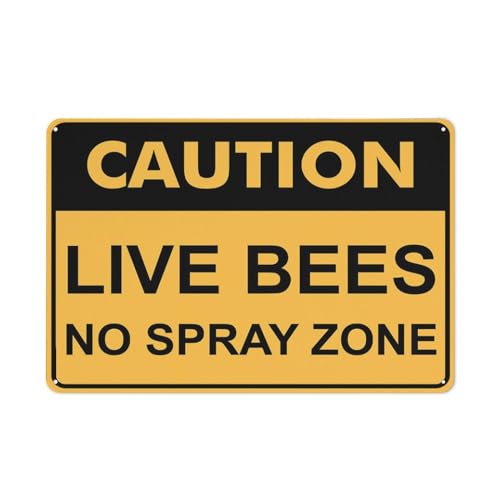
Compladeta Caution Live Bees No Spray Zone Sign
Compladeta · 12 x 8 inches (listed) · outdoor rated · gate, fence, or roof-door mounting
Our verdict: Not a decoration. The audience is the contractor who shows up while you are at work: the landscaper with a backpack sprayer, the exterminator treating the neighboring wall, the roofer with a torch. One sign at the access point is the cheapest risk reduction in urban beekeeping.
Urban apiaries are surrounded by people whose job involves chemicals, and none of them know your hives are there. The Compladeta caution live bees no spray zone sign ($9.99) goes on the gate, the roof door, or the fence line where a crew would enter, and it does its work on days you are not home.
Pair it with a note to your building manager or HOA landscaping contact. Signage plus one email is a better pesticide defense than either alone, and pesticide exposure is one of the few urban risks you genuinely cannot inspect your way out of.
Who should buy it
Anyone with hives on shared property, in an HOA, on a rooftop with maintenance access, or adjacent to a neighbor who uses a lawn service.
What we don't like
A sign only works where a crew will actually look, so placement matters more than the sign itself, and it does nothing about drift from a property two doors down.
- Size
- 12 x 8 inches (listed)
- Use
- Gate, fence, roof access door
- Audience
- Landscapers, pest control, maintenance crews
- Price
- $9.99
Pros
- Addresses a risk you cannot inspect for
- Works when you are not home
- Trivially cheap relative to a lost colony
Cons
- Only effective if placed at the actual access point
- No help against drift from neighboring properties
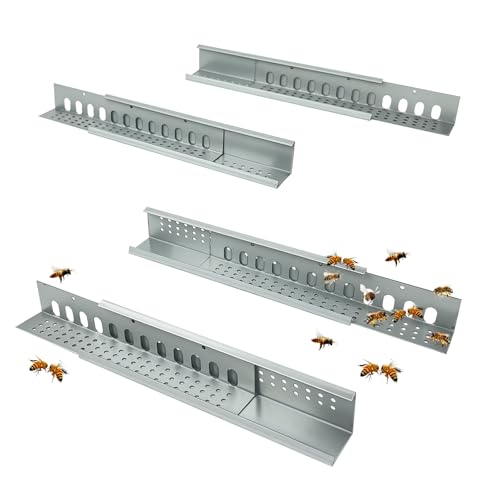
GJD Entrance Reducer and Sliding Mouse Guard, 4-Pack
GJD · 4-pack stainless (listed) · sliding adjustment · reducer plus mouse guard in one part
Our verdict: City hives sit close together and close to other people's hives, which concentrates robbing pressure in a dearth. A sliding metal reducer lets you dial the entrance down in ten seconds without swapping wooden blocks, and the same part keeps rodents out in October.
Two jobs, one part. The GJD entrance reducer and sliding mouse guard 4-pack ($18.99) handles summer robbing defense for a small or newly installed colony and fall rodent exclusion, and the four-pack covers two hives with spares, which is right because wooden reducers get lost the first time you set one down in tall grass.
Dearth management is more urgent in a dense urban setting than in an isolated rural yard, simply because there are more colonies within flight range. The rest of that toolkit, including full robbing screens, is in our robbing screens guide.
Who should buy it
Urban and suburban keepers, anyone running small or newly installed colonies, and anyone whose fall gets cold enough for mice to go house-hunting.
What we don't like
A reducer is not a robbing screen, and in a serious robbing event you want the screen; fit also varies slightly across bottom board brands, so check yours.
- Count
- 4 pieces
- Material
- Stainless steel (listed)
- Function
- Adjustable entrance reduction plus mouse guard
- Season
- Summer dearth and fall
- Price
- $18.99
Pros
- One part covers robbing and rodent season
- Slides to adjust without swapping blocks
- Four-pack covers two hives with spares
- Metal survives a season better than wood
Cons
- Not a substitute for a true robbing screen
- Fit can vary by bottom board brand
Step one: read the code, the covenants, and the lease
Before a dollar is spent, three documents decide whether you can keep bees where you live. The first is your municipal or county code. Search it for "bees," "apiary," "beekeeping," and "hive." Most US cities that address beekeeping at all regulate the same short list of things: how many colonies per lot or per square foot of lot, how far hives must sit from property lines and dwellings, whether a flyway barrier is required and how tall, whether an on-site water source is required, and whether hives must be registered with the city or the state. Some cities require a permit with a small fee, some require neighbor notification, and a small number still prohibit hives outright.
The second document is your HOA covenant, if you have one. HOAs can be stricter than the city and frequently are, and an HOA prohibition is enforceable even where the city is permissive. Read the covenant before you assume the city code is the last word. The third document is your lease, if you rent, including a roof-access clause if you are eyeing the roof. A landlord's written permission is not optional, and in most buildings it also determines whether the roof can legally hold the load.
Above all three sits state law. Many states require or invite apiary registration with the department of agriculture, often free, and registration plugs you into the state apiarist's inspection program and pesticide notification lists. That framework, and how state preemption sometimes overrides city rules, is laid out in beekeeping laws by state. Extension programs are the other reliable starting point for the local picture: most land-grant universities publish a state beekeeping page, and the multi-state Bee Health hub is a good jumping-off point.
The flyway barrier: the one technique that makes urban beekeeping work
Honey bees leave the entrance low and fast, then climb. Left alone on flat ground, that climb happens over the next 15 to 30 feet, which in a city is exactly the distance to the sidewalk, the shared driveway, or the neighbor's patio table. A flyway barrier changes the geometry: put a solid, opaque, roughly 6-foot obstruction 2 to 5 feet in front of the entrance and the bees must climb immediately, which puts them well above head height by the time they cross the property line. This is the reason so many urban ordinances specify a barrier, and it is the reason experienced city keepers install one even where no rule requires it.
What counts as a barrier: a solid fence panel, a dense hedge, a lattice screen with a shade-cloth backing, a garage wall, or on a rooftop, a parapet or a purpose-built windbreak panel. What does not count: a chain-link fence, an open-slat fence with gaps, or anything short enough for a tall adult to look over. The barrier must be opaque enough that the bees treat it as a wall, and it must be wide enough that they cannot simply route around the end. Aim to extend it several feet past each side of the hive.
Two refinements. First, point the entrance at the barrier, not parallel to it, so departing bees hit the climb immediately. Second, use the barrier to your advantage on the human side: a hedge screens the hive from view, and a hive nobody can see is a hive nobody complains about. The broader siting logic, sun, drainage, morning light, and windbreaks, is in our hive placement guide, and it all still applies in a city. The barrier is simply the piece that gets promoted from nice-to-have to load-bearing.
Water: give them yours before they find the neighbor's
The second-most-common urban complaint after stings is bees at a swimming pool, a pet bowl, a birdbath, or a dripping hose bib on someone else's property. This happens because bees imprint on reliable water sources early in the season and keep returning, and because a colony in a heat wave can consume a surprising volume of water for evaporative cooling. Once a few hundred foragers have learned the neighbor's pool, moving them is genuinely hard.
The fix is timing, not equipment. Establish water on your own property weeks before the bees arrive, in early spring, and keep it full without interruption. Bees prefer water with landing surfaces and a bit of scent to it: pebbles or corks in a shallow dish, a pond edge, a damp rag over a bucket rim. Clean, deep, sterile water in a smooth bowl is the least attractive option and the most likely to drown bees. A purpose-made set like the Retyion bee watering stations ($17.83) gives you four shallow landing platforms to spread around the yard, which matters when a single dish gets shaded, tipped, or emptied on a 95-degree afternoon.
Place water between the hive and the direction of the temptation when you can, and place more than one source so a dry dish is never the only dish. Redundancy is the whole strategy. Our full comparison of watering options, including floating and ceramic designs, is in the bee water station guide, and the same principle carries into hot regions, where water stops being a courtesy and becomes survival equipment, as we cover in beekeeping in hot climates.
How many hives fit: density and the honest ceiling
Two hives is the right number to start with in a city for the same reasons it is right anywhere: a second colony gives you a comparison, a source of eggs or brood to rescue a queenless hive, and better odds that something survives the first winter. In a city it is also frequently the ceiling, and not because of forage. It is because ordinances often cap hive counts by lot size, because a small yard has room for exactly one good site, and because goodwill is a finite resource that four hives spend faster than two.
Forage-wise, urban colonies usually do fine. The limits you hit first are human. If your lot is under a tenth of an acre, if the only site is 12 feet from a shared fence line, or if the roof access is a single narrow stair, plan for two and be honest that expansion means a second location, not a fifth box in the same corner. Many urban keepers end up with a home yard of two and an out-yard at a friend's place or a community garden, which is a better answer than crowding.
Because space is the constraint, equipment scale matters more in the city than in a field. An 8-frame setup like the Honey Lake 8-frame beehive starter kit ($79.79) has a smaller footprint on a deck or roof and, more importantly, much lighter boxes: a full 8-frame deep is meaningfully easier to lift than a full 10-frame deep, which commonly runs in the 80 to 90 pound range as a listed estimate. The full tradeoff, including comb management and the wintering debate, is in 8-frame vs 10-frame beehives.
Neighbor diplomacy: the conversation that prevents the complaint
The most effective urban beekeeping tool is a conversation, and its timing is everything. Talk to the immediate neighbors before the bees arrive, not after the first sting and not after they spot a white box through a gap in the fence. The conversation is short and has three parts: you are keeping two hives, here is where they will be and how the barrier keeps flight paths overhead, and here is your phone number if anything ever concerns them. Do not oversell the ecological benefits; people who feel lectured feel managed.
The second part is the allergy question, asked directly and early: does anyone in the household have a diagnosed sting allergy? If the answer is yes, that is a real constraint on siting and possibly on whether you keep bees at that address at all, and it deserves genuine weight rather than reassurance. What sting reactions actually look like, and the difference between a normal local reaction and a systemic one, is covered in our bee sting safety guide.
The third part is ongoing: honey in the fall, a heads-up before you do anything unusual like a swarm retrieval or a harvest day, and immediate requeening of any colony that turns defensive. Temperament is manageable and it is your responsibility. A hot colony in a rural yard is an annoyance; a hot colony in a city is a complaint file. Stock temperament varies by genetics, and the practical differences between Italian, Carniolan, and other commonly sold lines are laid out in types of honey bees.
Signage does quiet work here too. A small, calm sign on the gate or the roof door like the Compladeta caution live bees no spray zone sign ($9.99) tells building maintenance, pest control crews, and landscapers what they are walking into. That last audience is the point: a contractor spraying a wasp nest on the adjacent wall is a real risk to a rooftop apiary, and a sign is the cheapest insurance available.
Rooftop beekeeping: wind, heat, weight, and access
Rooftops are the classic urban solution and they are genuinely good sites: full sun, no ground-level foot traffic, flight paths that start 30 feet up. They also add four problems that ground-level yards do not have.
Wind. Roofs are windy in a way that ground yards are not, and wind does three things: it chills the cluster, it makes landing harder for loaded foragers, and it will eventually take a telescoping cover to the street below. Strap every hive to a stand or a ballast block, use a ratchet strap over the lid, and build or place a windbreak on the prevailing side. Conveniently, a windbreak and a flyway barrier are often the same panel.
Heat load. A black membrane roof in July is a genuinely brutal microclimate, and hives sitting directly on it cook. Get the hives up on a stand, provide afternoon shade if the roof has none, and take ventilation seriously. The full hot-weather management set, screened bottoms, upper entrances, and shade strategy, is in beekeeping in hot climates, and it applies to a Chicago rooftop in August as much as to a Texas backyard.
Weight and structure. A single hive in full honey flow, boxes plus bees plus stores plus stand, is a concentrated load of several hundred pounds in a footprint of about two square feet. That is a question for the building owner and, if there is any doubt at all, a licensed engineer. Do not guess, and do not let a beekeeping guide, this one included, be your structural authority.
Access. Access is the problem that decides whether rooftop beekeeping is sustainable for you personally, and it gets its own section next.
The stairs problem: getting a 90-pound super down three flights
Here is the part that rarely makes it into the romantic rooftop-apiary article. A full 10-frame deep of honey commonly runs 80 to 90 pounds as a listed estimate, and a full medium super runs roughly 50 pounds. On harvest day you are not carrying one; you are carrying several, down a stairwell, possibly through a hatch, possibly around a landing turn, in a bee suit, in August. If that sentence made you wince, plan around it now rather than discovering it in your second season.
The practical answers, in order of how much they help. First, run 8-frame equipment and medium supers exclusively for honey, which drops the worst carry from about 90 pounds to about 40 to 45. Second, harvest frame by frame into a covered tote rather than moving whole boxes, which is slower but turns one impossible lift into eight manageable ones. Third, schedule a second person for harvest day, every time, not as a favor but as a standing arrangement. Fourth, do the extraction close to the roof if you can: hauling capped frames down and empty frames up beats hauling honey twice.
The gear that changes this math is boring and worth buying: a good hand truck rated for the stairwell, a covered frame tote, and a lightweight hive tool you can operate one-handed. The step-by-step of the harvest itself, uncapping through bottling, is in how to harvest honey, and the extraction hardware comparison is in our honey extractor guide. What we would add for city keepers specifically: rent or borrow before you buy an extractor, because storing a 20-gallon stainless drum in an apartment is its own problem.
Swarms in the city: liability, optics, and a plan
A swarm is a normal, healthy reproductive event and, in a city, a public one. A cloud of 15,000 bees settling on a bus stop railing or a parked car will generate phone calls, and how that afternoon goes depends almost entirely on whether you had a plan before it happened. The plan has three parts.
Prevent. Swarm prevention is management: give the colony space ahead of the flow, watch for queen cells in the spring buildup window, and be willing to split rather than let a strong hive make its own decision. Everything on that list is in how to prevent swarming and how to split a hive. Urban keepers should be more aggressive about prevention than rural keepers, because the cost of failure is different.
Respond. Know how you will catch one before you need to. Have a nuc box, a ladder you actually trust, a spray bottle, and a plan for what you do if the swarm is 20 feet up on someone else's property, which is the answer: you ask permission, and if the answer is no, you call it in. How to catch a swarm covers the technique.
Delegate. Get the phone number of your local club's swarm-removal coordinator now and keep it in your phone. Most county associations run a swarm list, and most cities route calls to it. Being on that list yourself is also the single best public-relations move available to an urban beekeeper: you become the person who solves bee problems in the neighborhood rather than the person who caused one.
Urban forage is usually better than you expect
New city keepers often assume their bees are starving amid the concrete. Usually the opposite is true, which is part of why the practice has grown so fast in North American and European cities over the last two decades (Wikipedia: urban beekeeping). Cities are planted with an enormous diversity of ornamentals, street trees, and flowering shrubs on staggered bloom schedules, plus unmanaged lots, rail corridors, parks, and thousands of small gardens. Compared with a landscape of one crop that blooms for two weeks and then offers nothing, an urban forage map is often longer and steadier, which is why urban colonies frequently build well and why urban honey is so variable in flavor from block to block.
What cities do lack is a big, single, predictable main flow, so urban honey crops can be less dramatic and less seasonal in shape. They also concentrate two hazards: ornamental pesticide use on neighboring properties, and the summer dearth in areas with heavy irrigation-driven green that is not actually producing nectar. Watch your hives, not the greenery.
You can improve your own block cheaply. Linden, catalpa, and locust street trees do more for a colony than any flower bed, and where you control planting, choosing successional bloom beats choosing pretty. Our list of what actually earns space is in the best plants for honey bees, and the broader case for supporting pollinators without keeping a hive at all, which is the right answer for many city dwellers, is in how to help bees without beekeeping.
The gear that changes in a city
Most of the beekeeping kit list is the same in Brooklyn and in Nebraska. Four items change.
Box size. Go 8-frame, and go mediums for honey. The footprint and the weight both matter more in a city, and the comb-interchange penalty is small if you commit to one system from the start.
Entrance control. Small colonies in tight quarters need help defending, and city yards concentrate robbing pressure because the hives are close together. A set of adjustable reducers like the GJD entrance reducer and sliding mouse guard 4-pack ($18.99) covers both jobs, the summer robbing season and the fall rodent season, on both hives. The rest of the robbing toolkit is in robbing screens and entrance reducers.
Water. Covered above, and worth repeating because it is the item city keepers most often postpone and most often regret postponing.
Signage. Not for the neighbors so much as for the crews: landscapers, exterminators, roofers, and utility workers who have no idea there is an apiary behind the parapet. A no-spray sign is $10 and prevents the failure mode you cannot undo.
Everything else, the suit, the smoker, the tool, the feeder, is the standard list, priced in the beekeeping cost index. If you are still deciding whether the whole project fits your life, start at how to start beekeeping and come back here for the city layer.
A realistic first urban season
Winter: read the code, the covenant, and the lease. Take a class. Join the county association, which in urban areas is often unusually active and is where you will learn what actually flies in your city. Order two nucs from a local producer. Sort out roof access or yard siting in writing with whoever owns the property.
Early spring: install the flyway barrier and the water stations before anything else, and let the water run for weeks so it is established. Set the stand, level it, strap it. Have the neighbor conversation. Assemble and paint equipment, and let it off-gas.
Install through midsummer: normal beekeeping, on a 7 to 10 day inspection rhythm, with two urban modifiers. Inspect early in the day or on weekday mornings when fewer neighbors are outside, and keep inspections short and calm in a dearth, when colonies get testy and robbing starts easily.
Late summer and fall: mite treatment on schedule, because a city colony that collapses is also a public event and a robbing hazard for every hive within two miles. Treat at or before the widely cited threshold of roughly 2 to 3 mites per 100 bees, per the Honey Bee Health Coalition guidance. Then fall feeding, entrance reduction, and winter prep. If your city has real winters, the moisture-first approach in beekeeping in cold climates applies on a rooftop with extra force, because wind exposure up there is worse than anything on the ground.
Year two: you will know whether your block has a July dearth, whether the roof is workable in August heat, and whether your neighbors have become allies. Those three answers, not the honey, are what your first urban season was actually for.
More gear worth comparing
Beyond this guide: the highest-rated gear across every category and budget, with a live price check on each.




As an Amazon Associate we may earn from qualifying purchases, at no cost to you.
Quick shop: every pick
Skip the scroll: the whole lineup, with a live price check on each.
- Honey Lake 8-Frame Beehive Starter KitBest Small-Footprint StarterHoney Lake · $79.79Check Price
- Retyion Bee Watering Station, 4-PackBest Water Solution for a Small YardRetyion · $17.83Check Price
- Compladeta Caution Live Bees No Spray Zone SignBest Insurance Against a Pesticide CrewCompladeta · $9.99Check Price
- GJD Entrance Reducer and Sliding Mouse Guard, 4-PackBest Entrance Control for Tight QuartersGJD · $18.99Check Price
How we chose
We built this guide around the rules that actually recur across US municipal beekeeping ordinances: hive caps, setbacks, flyway barriers, water requirements, and registration.
We do not name or quote any specific city ordinance, because they change and because a wrong quote is worse than no quote. Read your own code.
Product picks are limited to gear whose job changes in a city: lighter boxes, water stations, entrance control, and signage.
Prices come from our verified offer table and were checked at publication.
Rooftop guidance stops short of structural engineering. Load questions go to your building owner or a licensed engineer, not to a beekeeping site.
Key terms
- Flyway barrier
- A solid, opaque obstruction roughly 6 feet tall placed 2 to 5 feet in front of the hive entrance, forcing bees to climb immediately so their flight path crosses property lines well above head height. Required by many urban ordinances and worth installing even where it is not.
- Setback
- The minimum distance an ordinance requires between a hive and a property line, dwelling, or public way. Commonly in the range of 5 to 25 feet in US municipal codes, but entirely local; read your own code.
- Imprinting (on water)
- The tendency of foragers to learn a reliable water source early in the season and return to it persistently. The reason your water station must be established before the bees arrive rather than after they discover the neighbor's pool.
- Robbing
- Bees from stronger colonies looting a weaker hive, triggered during a dearth by exposed syrup or honey. More acute in cities because colony density within flight range is higher. Managed with reduced entrances, no spills, and short dearth-season inspections.
- Out-yard
- A second apiary site away from home, often at a friend's property, a community garden, or a farm. The standard urban answer to wanting more hives than your lot or ordinance allows.
- Swarm list
- A roster maintained by most county beekeeping associations of members willing to collect swarms. Being on it is both a service and the best public-relations asset an urban beekeeper has.
- Dearth
- A stretch with little nectar available. In cities it can be masked by irrigated green landscaping that produces no nectar, so judge by hive weight and colony behavior rather than by how green the block looks.
Questions, answered
can you keep bees in a city
In most US cities, yes. Backyard and rooftop beekeeping is legal in the large majority of American municipalities, usually subject to rules on hive count, setbacks, a flyway barrier, and an on-site water source. A minority of cities prohibit hives, and HOA covenants and leases can be stricter than city code, so check all three before buying anything.
how close can a beehive be to a property line
It depends entirely on your local ordinance, which commonly specifies something in the range of 5 to 25 feet, sometimes with an exception if a flyway barrier is present. Because the number is local and changes, read your own municipal code rather than trusting any national figure, including one on this page.
what is a flyway barrier for bees
A solid, opaque obstruction about 6 feet tall placed a few feet in front of the hive entrance, so departing bees must climb immediately and cross the property line above head height. A fence panel, a dense hedge, or a lattice screen with backing all work. Chain link and open-slat fences do not, because bees fly straight through them.
how do I keep my bees out of my neighbor's pool
Establish your own water source weeks before the bees arrive and never let it run dry. Bees learn a reliable source early and keep returning, so the goal is to win the imprint rather than to break a habit later. Use multiple shallow stations with landing surfaces, keep them full through heat waves, and place them between the hive and the pool where possible.
how many beehives can you have in a small backyard
Two is the right start and often the honest ceiling for a small urban lot. The limit is usually ordinance and goodwill rather than forage. If you want more colonies, most urban keepers add an out-yard at a friend's property or a community garden rather than crowding a tenth-acre lot.
is rooftop beekeeping a good idea
It can be excellent: full sun, no ground-level foot traffic, and flight paths that start above everyone. It adds four problems though. Wind demands straps and a windbreak, heat load on a dark roof demands shade and ventilation, structural load is a question for the building owner or an engineer, and stair access decides whether harvest day is sustainable. Solve access before you commit.
how much does a full honey super weigh
A full 10-frame deep commonly runs about 80 to 90 pounds as a listed estimate, and a full medium super runs roughly 50 pounds. In an 8-frame system both numbers drop substantially. If your apiary is up or down a flight of stairs, run 8-frame mediums for honey and plan on a second person for harvest day.
do I need to tell my neighbors I am keeping bees
Some ordinances require notification, and where they do not, it is still the single most effective thing you can do. Talk to the immediate neighbors before the bees arrive, explain where the hives will be and how the flyway barrier keeps flight paths overhead, ask directly whether anyone has a diagnosed sting allergy, and give them your phone number.
what happens if my bees swarm in the city
A swarm in a city is a public event, so plan for it. Prevent aggressively with space and splits in the spring buildup window, keep a nuc box and a plan ready to catch one, and have your county association's swarm coordinator in your phone. If the swarm lands on someone else's property, you ask permission first and call the swarm list if the answer is no.
is urban honey safe to eat
Yes, and urban honey is often unusually varied in flavor because city forage is so diverse. The real urban concern is not the honey, it is pesticide exposure to the colony itself from neighboring lawn and building treatments, which is why signage and a conversation with your building's landscaping contractor matter.
Filed under Explainer
Part of Beekeeping 101
Keep reading
Beekeeping Laws by State
The regulatory framework behind the ordinance homework: registration, state preemption, and where to look things up.
The Beehive Placement Guide
Sun, drainage, windbreaks, and entrance orientation: the siting fundamentals a flyway barrier sits on top of.
8-Frame vs 10-Frame Beehives
The weight and footprint tradeoff that decides whether a rooftop apiary stays sustainable.
The Best Bee Water Stations
Every watering option compared, for the one urban task that must be done before the bees arrive.
Beekeeping in Hot Climates
Shade, ventilation, and water: everything a black rooftop membrane in July makes urgent.
The Bee Sting Safety Guide
What normal and systemic reactions look like, for the conversation you will have with every neighbor.