Our Pick: MayBee
Check PriceHow to Prevent Swarming: The Levers, in Order
Most swarm prevention is one purchase and one habit: a spare super, put on before the bees need it. A medium box like the MayBee 10-frame medium super ($44.99) costs less than a tank of gas and solves the congestion half of the swarm equation, and congestion is the half you actually control. Everything else in this guide is what you do when space alone is not enough.
By The BeehiveKits Hive Desk2026-08-2920 min read Fact-checked against verified Amazon listingsHow we research
Swarming has three ingredients and needs all three: a congested brood nest, a strong incoming nectar flow, and a queen whose pheromone signal is thinning with age. Take any one away and the impulse mostly evaporates. That is the pressure model, and it explains why every real lever, supering early, opening the brood nest, splitting, Demaree, requeening on schedule, works by removing an ingredient, while the popular non-lever, cutting queen cells, removes only the evidence.
The other thing worth internalizing early: by the time you find charged queen cells, you are not preventing a swarm, you are managing one. The signal ladder runs from backfilled brood comb to drone comb to empty queen cups to cups with eggs to capped cells, and the useful interventions live at the top of that ladder, two to three weeks before anything dramatic looks like it is happening. A colony inspected every 7 to 10 days in spring gives you that lead time. A colony inspected monthly does not.
This page pairs directly with how to split a hive, which is the decisive lever explained in full, and with how to catch a swarm for the day prevention loses. If a swarm leaves you with two colonies where you wanted one strong one, how to combine two hives is the fix. Standard disclosure, plainly: no brand paid to appear here, and some links go to Amazon, where a purchase may earn us a small commission at no extra cost to you. Prices were verified at publication and drift; check the live listing.
What to know
- Swarming needs three things at once: a congested brood nest, a strong nectar flow, and an aging queen. Remove any one and the impulse usually collapses.
- The signal ladder runs early to late: nectar backfilling the brood nest, then drone comb, then empty queen cups, then cups with eggs, then capped cells. Capped cells mean you are late.
- Give space before the bees need it. When 7 to 8 of 10 frames are drawn and covered with bees, the next box goes on that day, not next inspection.
- Cutting queen cells without fixing crowding does not work. The colony rebuilds cells in days and may already have swarmed with a queen you never saw.
- A split is the most reliable prevention there is, because it removes crowding, population, and the queen surplus in one move.
- Requeen on a schedule. A first-year queen swarms far less than a third-year queen, and a marked queen tells you at a glance how old she is.
- Inspect every 7 to 10 days through spring. A colony can go from first swarm-cell egg to departed swarm inside that window.

MayBee 10-Frame Langstroth Medium Super Box
MayBee · 10-frame Langstroth medium super · beeswax dipped (listed)
Our verdict: Congestion is the one swarm ingredient you fully control, and a spare medium super is how you control it. Buy it in winter, put it on in April before it looks necessary, and you have removed the most common trigger from the equation.
Most swarms we have watched leave were preventable with a box that was sitting in a shed twenty feet away. The MayBee 10-frame medium super box ($44.99) is our default unit for space because mediums are the boxes people actually lift: roughly 50 pounds full against a deep's 80 to 90, which means you add them on schedule instead of postponing.
Beeswax dipped rather than painted, standard Langstroth dimensions, and interchangeable with the rest of your medium equipment. Buy two per hive. An unfilled super costs nothing; a swarm costs the crop, half the bees, and the queen. Frames to fill it are in frames and foundation.
Who should buy it
Every beekeeper heading into spring, especially anyone standardizing on medium boxes to keep lifting weights sane. Two spares per hive is the right stocking level.
What we don't like
It arrives as a box, not a solution: frames and foundation are separate, and a medium holds less than a deep so growing colonies need more of them.
- Type
- Medium super
- Frames
- 10-frame Langstroth
- Coating
- Beeswax dipped (listed)
- Full weight
- About 50 lbs (listed estimate)
- Price
- $44.99
Pros
- Light enough to add on time, every time
- Standard Langstroth dimensions
- Beeswax dipped rather than painted
- Cheapest swarm prevention per dollar
Cons
- Frames and foundation sold separately
- Less capacity per box than a deep

Mann Lake Pro Nuc 5-Frame Plastic Nuc Box
Mann Lake · 5-frame plastic nuc · locking lid · ventilated (listed)
Our verdict: The day you find charged queen cells, the correct move needs a five-frame box within arm's reach. A Pro Nuc on the shelf turns that discovery from a crisis into a twenty-minute manipulation with a colony at the end of it.
Splitting is the decisive lever, and splitting requires somewhere to put the frames. The Mann Lake Pro Nuc ($38.81) is the cheap, weatherproof, ventilated, locking-lid box that makes an emergency split a decision rather than a scramble. Pull the queen and two or three frames into it, leave the cells with the parent, and the swarm impulse is spent.
It is a working box rather than a wintering box, and that is fine for its job here. The full method is in how to split a hive; the box field is in nuc boxes and swarm traps.
Who should buy it
Anyone running two or more hives through swarm season. Keep two on the shelf, because swarm cells and swarm calls never show up one at a time.
What we don't like
Thin plastic is a poor insulator for winter, and the entrance needs reducing immediately so a new split can defend itself.
- Frames
- 5 deep frames
- Material
- Molded plastic (listed)
- Lid
- Locking (listed)
- Best for
- Emergency and preventive splits
- Price
- $38.81
Pros
- Cheapest way to act on swarm cells immediately
- Locks and vents for transport
- Stackable and weatherproof
Cons
- Not an overwintering box in cold climates
- Needs an entrance reducer out of the gate

The Interceptor Pro Complete Swarm Trap Kit
The Interceptor · Complete assembled swarm trap kit (listed) · sized to scout-bee preferences
Our verdict: Prevention fails sometimes, and a well-placed trap turns those failures into recovered colonies plus a share of the neighborhood's swarms. The Interceptor's argument is retrieval: hang it, bait it, and take it down loaded without a wrestling match.
Scout bees choose cavities by volume, entrance size, height, and scent, and a purpose-built box hits those numbers without you guessing. The Interceptor Pro complete swarm trap kit ($175.00) arrives assembled and rigged to hang and come back down, which is where homemade traps turn into a two-person evening.
Honest framing: a deep box with a reduced entrance and a lure catches swarms too, for a fraction of the price. You pay the Interceptor premium for build, siting hardware, and retrieval. Cheaper approaches and lure comparisons are in swarm catching gear, and the capture procedure is how to catch a swarm.
Who should buy it
Keepers who lose swarms to tall trees, anyone taking swarm calls in their area, and sideliners who treat caught swarms as a real source of increase.
What we don't like
It is the price of four nuc boxes, and a lure is an ongoing consumable. A plain deep with old comb catches bees at a fraction of the cost if you do not mind the retrieval.
- Type
- Complete swarm trap kit
- Condition
- Assembled (listed)
- Use
- Hang and retrieve
- Price
- $175.00
Pros
- Sized and shaped to what scout bees actually pick
- Designed for hanging and safe retrieval
- Arrives assembled and ready to bait
Cons
- Expensive next to a spare deep box
- Lures are a recurring cost
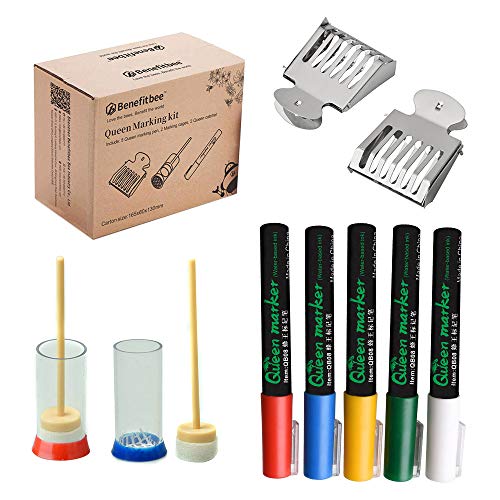
benefitbee Queen Bee Marking Kit
benefitbee · Queen marking kit with markers and marking cage (listed) · standard year colors
Our verdict: Requeening on a schedule is a real swarm lever, and it is unusable if you do not know how old your queens are. A dot of the year's color turns that into a one-second read every time you find her.
Half of swarm management is bookkeeping. The benefitbee queen bee marking kit ($21.99) supplies the markers and the cage to do it safely, using the standard color-per-year system, and it answers three questions at once: how old she is, whether the colony superseded her without your knowledge, and whether the queen in front of you is the one you introduced.
It also makes her findable, which every manipulation on this page quietly depends on: Demaree, splitting, and requeening all begin with locating the queen. Marking technique and the introduction sequence are in how to requeen a hive.
Who should buy it
Anyone who intends to requeen on a schedule, run Demaree, or split with confidence. Also the single best purchase for a beekeeper who keeps losing twenty minutes per inspection hunting for the queen.
What we don't like
Marking a queen takes a steady hand and a first attempt that will make you nervous, and paint pens dry out if the caps are not seated.
- Includes
- Queen markers and marking cage (listed)
- System
- Standard color-per-year marking
- Use
- Queen age tracking and identification
- Price
- $21.99
Pros
- Makes queen age readable at a glance
- Reveals unnoticed supersedure immediately
- Cuts queen-finding time on every manipulation
Cons
- First marking attempt is nerve-racking
- Pens dry out if stored badly
The pressure model: three ingredients, not one cause
Swarming is how a honey bee colony reproduces at the colony level: the old queen leaves with roughly half the workforce and a belly full of honey, and the parent hive raises a new queen from the cells left behind (Wikipedia: swarming). It is not a malfunction, it is success, and that is exactly why you cannot argue a healthy colony out of it. You can only remove the conditions.
Ingredient one: congestion. The brood nest fills with brood and incoming nectar until the queen runs out of empty cells to lay in and the bees run out of room to cluster. Congestion is also what thins queen pheromone distribution through the colony, because the substance moves bee to bee and a jammed hive circulates it poorly.
Ingredient two: a strong flow. Colonies swarm during abundance, not during scarcity. A hive with nectar pouring in has the resources to send half its population out with a reasonable chance of survival, and that same nectar is what backfills the brood nest and creates the congestion in the first place.
Ingredient three: an aging queen. Queen mandibular pheromone is part of what suppresses queen rearing, and older queens produce less of it. A well-mated first-year queen in a colony with room almost never triggers swarm preparations. A third-year queen in the same box is a different story.
The signal ladder: five rungs from early to too late
Colonies telegraph swarm preparation for weeks. The trick is knowing which signals are early and which mean the decision has already been made.
| Rung | What you see | Lead time | Response |
|---|---|---|---|
| 1. Backfilling | Fresh nectar shining in cells at the top and center of brood frames where eggs should be | 2 to 4 weeks | Add space now; consider opening the brood nest |
| 2. Drone comb and drones | A surge of drone brood along frame bottoms and edges, drones flying | 2 to 3 weeks | Normal in spring, but read it as the season's starting gun |
| 3. Empty queen cups | Acorn-shaped bowls on comb faces and bottom bars, nothing inside | Weeks, or nothing | Not news by itself. Note it, check space and queen age |
| 4. Charged cups | Cups holding an egg or a larva floating in royal jelly | About 8 to 10 days | The colony has decided. Split, or run Demaree, this week |
| 5. Capped swarm cells | Peanut-shaped cells sealed on frame bottoms, often several | Hours to days | Assume the queen may already be gone. Manage, do not prevent |
Two supporting signals worth reading. A colony that suddenly seems quieter at the entrance during a flow may have already swarmed. A colony where the queen has slimmed down and stopped laying heavily, with workers restricting her feed, is within days of leaving, because a laying queen is too heavy to fly and the bees prepare her for the trip.
Location tells you which kind of cell you are looking at. Cells hanging from the bottom bars and frame edges, several at once, in a crowded colony are swarm cells. A small number on the comb face in a colony with plenty of room are supersedure cells, meaning the bees are quietly replacing a failing queen, and the correct response there is usually patience. The distinction, and how to read the rest of a frame, is in how to do a hive inspection.
Lever 1: give space before they need it
This is the lever that prevents most swarms and takes the least skill. The working rule: when 7 to 8 of 10 frames in the top box are drawn and covered with bees, the next box goes on that day. Not next inspection. Bees fill space at the speed of the flow, and during a strong flow the gap between "plenty of room" and "no room at all" can be a week.
What space to add, in order of usefulness. A super with drawn comb is the best thing you own during a flow, because bees can fill it immediately with no wax-building delay. A super with foundation is second, and works fine on a strong flow, though a colony will sometimes ignore foundation above an excluder until the flow gets hard. A second brood box is what a first-year colony gets in spring, giving the queen more laying room rather than more storage. A MayBee 10-frame medium super box ($44.99) is the standard unit for this because a full medium runs roughly 50 pounds instead of a deep's 80 to 90, and boxes you can actually lift are boxes you actually add on time.
Two mistakes to avoid. First, adding one box at a time to a colony in a raging flow, so you are always one week behind; strong colonies in May can take two supers at once and thank you for it. Second, keeping supers off because you are worried about the bees not filling them. An unfilled super costs you nothing. A swarm costs you half the colony, most of the crop, and the queen. The frame and foundation options that go inside are in frames and foundation.
Lever 2: open the brood nest and checkerboard
Supering adds storage above. Opening the brood nest adds laying room inside, which is a different problem and often the real one. A colony in April can have empty supers above and a brood nest so packed with nectar and pollen that the queen has nowhere to lay, and bees read that as full even with a whole empty box overhead.
Opening the brood nest: insert one or two frames of drawn comb or foundation into the middle of the brood area, between frames of brood, during a flow with a strong colony. The bees draw and fill it fast, the queen gets laying room, and the sense of congestion breaks. Do it only with a genuinely strong colony in warm weather during a flow, because splitting the brood nest with foundation in a cool snap or a weak colony can chill brood.
Checkerboarding: alternating drawn or empty frames with frames of capped honey in the box above the brood nest, in very early spring, to disrupt the colony's read of its own stores. Practitioners report good results, and it is genuinely popular in some regions, but it is a more advanced technique that wants an early start and enough drawn comb to play with. Beginners get 90 percent of the benefit from simply supering early and inserting a frame or two into the nest.
Lever 3: split, the one that actually decides it
Nothing else removes two of the three ingredients at once. A split takes out population and congestion in a single afternoon, and the queenless half gets a fresh queen out of it, which handles the third ingredient too. If you want to be confident a colony is not going to swarm, split it.
The variants and the full frame recipe live in how to split a hive, but the swarm-control shorthand is worth having here. Preventive split, made before cells appear: divide the strong colony, give both halves brood, eggs, stores, and bees, and you have converted a swarm risk into an increase. Emergency split, made after you find charged cells: pull the old queen out with two to three frames of brood and stores into a nuc, leave the best one or two cells with the parent, and let the parent finish what it started. That is very nearly what the colony was going to do, minus the part where the bees end up forty feet up a pine tree.
Housing is cheap: a Mann Lake Pro Nuc 5-frame box ($38.81) is the whole cost of an emergency split, and having two on the shelf in April is the difference between managing swarm cells and watching them. Keep the nuc for six weeks and either promote it to a full hive, sell it, or use it as a fall combine candidate. Overwintering it instead is covered in how to overwinter nucs.
Lever 4: the Demaree method, in outline
Demaree is the classic answer to a specific problem: you want to prevent the swarm without losing the field force that makes honey. It keeps the colony whole and productive while separating the queen from the mass of brood that is crowding her, and it is why serious honey producers use it instead of splitting during the flow.
The outline, on a strong double-deep in swarm season:
1. Find the queen and place her, on one frame of open brood, into the bottom box. 2. Fill the rest of that bottom box with drawn comb or foundation, so she has a full box of empty laying room. 3. Put a queen excluder over that bottom box. 4. Add honey supers above the excluder. 5. Place the box holding all the remaining capped brood on top of the supers. 6. Come back in 7 to 10 days and remove every queen cell the bees have built in that top brood box, because with no queen above the excluder they will try.
What happens next is the point: the brood up top emerges over three weeks and joins the workforce, the nurse bees migrate up to tend it, the queen has an empty box to fill, and the colony is simultaneously uncrowded and at full strength for the flow. The cost is real: it is a heavy, fiddly manipulation that requires finding the queen and returning on schedule to cut cells in one specific box, and if you skip that return visit the colony can raise a queen up top and swarm anyway. Try it in your third season, not your first.
Lever 5: requeen on a schedule
Queen age is the ingredient beekeepers ignore longest. A colony headed by a first-year queen is markedly less swarm-prone than the same colony headed by a two or three-year-old, and swapping queens on a rhythm quietly removes a whole category of spring problem. Commercial operations requeen annually because the economics are obvious; backyard keepers often run a queen until she visibly fails, which is exactly the state that triggers both swarming and supersedure.
A workable backyard schedule: requeen every year or two, in late summer if you can, because a queen introduced in August has all fall to prove herself and heads into spring at peak laying. Penn State's queen introduction guidance is the technical read; our step-by-step is how to requeen a hive. Selecting for stock that swarms less is a longer game, and the biology is in the queen bee biology guide.
None of this works if you do not know how old your queen is, which is the whole argument for marking. The benefitbee queen bee marking kit ($21.99) uses the standard color-by-year system, and a marked queen tells you three things in one glance: how old she is, whether the colony superseded her without telling you, and, if she is suddenly unmarked, that something happened while you were not looking. It also makes her findable, which every manipulation in this guide depends on.
Why cutting queen cells alone fails
It is the most intuitive response and the least effective one. You find swarm cells, you scrape them off, the frames look clean, you close up satisfied. Three things go wrong.
The colony rebuilds. Nothing about the crowding changed, so the bees start new cells from young larvae within a day or two, and you are now committed to returning every 7 days to cut again. Miss one visit at the wrong moment and they are gone. Miss one cell tucked into a corner of comb, and they are gone.
The queen may already have left. Capped swarm cells often mean the prime swarm departed days ago, and the cells you are cutting are the colony's only path back to a laying queen. Cut them all and you have converted a swarmed but recoverable colony into a hopelessly queenless one. Always check for eggs before you touch a cell.
They swarm anyway, with a virgin. A crowded colony stripped of cells can still throw an afterswarm once a virgin emerges from a cell you missed, and afterswarms are smaller and even less likely to succeed than the prime swarm.
Cell removal has exactly one legitimate role, and it is as a component of something larger: in Demaree you remove the cells in the top box because the rest of the manipulation has already fixed the crowding. Cells without the manipulation is not a plan, it is a delay. The rule of thumb we use: if you are cutting cells, you should be doing something else in the same visit that changes the colony's actual situation.
Swarm season by region
Swarm season is roughly the six weeks around your area's main spring buildup, when fruit bloom, dandelion, or the first big flow lands and colony population peaks against the space available. The calendar shifts with latitude and elevation, and the local beekeeping club will beat any national chart, but here is the working shape of it.
| Region | Peak swarm window | What to watch |
|---|---|---|
| Gulf South, Florida, coastal Southwest | Late February through April | Very early buildup; supers often need to go on in February |
| Southeast and lower Midwest | Late March through May | Fruit bloom is the starting gun; often a second smaller wave in early summer |
| Mid-Atlantic and mid Midwest | April through late May | Dandelion into black locust; the classic 7-to-10-day inspection season |
| Northern tier, New England, upper Midwest | Mid May through June | Compressed and intense; colonies build fast when it finally warms |
| Mountain West and high elevation | Late May through early July | Short season, so a swarm costs a larger share of the year's crop |
| Pacific Northwest | April through June | Long, wet spring; watch for congestion during rain-bound stretches |
Two regional wrinkles. In hot climates, a late summer flow can produce a second, smaller swarm season, which is discussed in beekeeping in hot climates. In the far north, the compressed season means a May swarm costs proportionally more, which is a strong argument for preventive splits over reactive management; see beekeeping in cold climates. State-level rules on hive placement and swarm capture vary too, and are collected in beekeeping laws by state.
The inspection cadence that buys you lead time
Every lever here needs warning, and warning comes from a schedule. Through swarm season, inspect every 7 to 10 days. That number is not arbitrary: a colony can move from laying the first egg in a queen cup to the swarm departing in roughly that span, so an inspection interval inside it means you always catch the preparation while it is still preparation.
What you are checking, in about four minutes per colony: space (is the top box 70 to 80 percent drawn and covered?), backfilling (is nectar showing up in the middle of brood frames?), bottom bars (tilt the upper box up and look at the bottom bars of its frames, which is where swarm cells hang and where a whole inspection can be skipped by looking), and queen age from your notes. That upward tilt of the top box, checking bottom bars without a full teardown, is the single highest-value ten seconds in spring beekeeping.
Write it down. Colonies do not swarm out of nowhere; they swarm out of a trend you did not track. Three lines per hive per visit, space status, backfilling yes or no, cells yes or no, gives you the pattern that makes the decision obvious a week before you would otherwise have noticed. The note-keeping habit and the full inspection method are in how to do a hive inspection, and the season-level version is the first-year calendar.
If they swarm anyway: bait hives and traps
Prevention is not perfect and swarm season is short, so keep a bait hive up. A well-placed trap catches your own swarms often enough to be worth the effort, and catches other people's swarms more often than that, which is a free colony. Research on swarm nest-site preference is consistent about the basics: a cavity of roughly 40 liters, an entrance of about 1 to 2 square inches near the bottom, up off the ground, with old comb or lemongrass-scented lure inside.
A purpose-built trap saves you rigging one from a spare deep. The Interceptor Pro complete swarm trap kit ($175.00) is the premium option: assembled, sized to what scouts actually choose, and built to hang and then come down with bees in it without a fight. It is not cheap, and a plain deep with a reduced entrance and a lure works, but the Interceptor is designed around retrieval, which is the part improvised traps make miserable. The full field, including budget builds and lures, is in swarm catching gear and nuc boxes and swarm traps.
When a swarm does land somewhere reachable, the capture procedure is its own skill and lives in how to catch a swarm. And when the parent colony that swarmed comes out of it queenless and dwindling in late summer, the honest fix is usually to merge it rather than nurse it, which is how to combine two hives.
Half-measures, myths, and things that partly work
Clipping the queen's wing. It does not prevent the swarm; it prevents the queen from leaving with it. The bees still issue, cluster, discover she is missing, return, and then swarm again when a virgin emerges. Meanwhile the clipped queen is often lost in the grass. Some commercial operations clip for other reasons. It is not swarm prevention.
Removing drone comb. Drone brood removal is a legitimate varroa tactic, discussed in when to treat for varroa, and it has no meaningful effect on swarming. Drones are a symptom of the season, not a cause of the swarm.
Ventilation and shade. Genuinely helpful for colony comfort and worth doing, and a bearding colony on a hot evening is often just hot rather than swarm-bound. Ventilation alone does not prevent swarming, but heat stress on top of congestion makes everything worse. Placement guidance is in the beehive placement guide.
Swarm lures on your own hives. No. Lures attract scouts to a cavity; they do not make bees stay home.
Reversing brood boxes in spring. A traditional move: swap the empty bottom box to the top so the cluster, which has worked its way upward over winter, has room above. It genuinely helps in early spring, and it also risks splitting a brood nest across the boxes if done carelessly. Look before you reverse, and skip it if brood spans both boxes.
Just adding a super, forever. Works more often than beekeepers expect, and it is why lever one is lever one. But it fails on old queens and on colonies whose brood nest is backfilled, which is why the rest of this list exists.
Putting it together: a swarm season plan
Late winter. Build or buy the boxes now. Two spare supers and a nuc box per hive means you are never making decisions based on what is in the shed. Confirm your queens' ages from your notes and decide which colonies are requeening candidates for late summer.
First warm inspection. Assess strength and stores, reverse boxes only if the brood nest is not split across them, and put the first super on earlier than feels necessary. Note the date of first drone brood; that is your season's clock starting.
Through the buildup. Inspect every 7 to 10 days. Tilt the top box and read the bottom bars. Add space at 70 to 80 percent. Open the brood nest with a frame or two of comb in strong colonies on warm flow days.
At the first charged cup. Stop optimizing and act: split, or run Demaree if you want the honey crop intact. Cutting cells is not the plan.
After the flow. Swarm pressure drops off with the flow. Shift attention to mites, stores, and requeening, and evaluate what your splits became. If a split never got going, combine it; if it thrived, decide whether it winters as a full hive or as a nuc under the nuc overwintering plan. If any colony needs relocating for space or sun, do it now with how to move a beehive rather than in the middle of swarm season.
How to Prevent a Honey Bee Colony from Swarming
- 1
Know your queen's age before the season starts
Check your notes or the mark on her back to establish how old each queen is. First-year queens rarely trigger swarm preparations, while two and three-year-old queens are a standing risk, and knowing which colonies carry old queens tells you where to concentrate effort.
- 2
Stage spare boxes before you need them
Have at least two spare supers and one nuc box per hive on the shelf before the first warm week. Every lever in swarm prevention depends on being able to act the day you see the signal, not the week the order arrives.
- 3
Start the 7 to 10 day inspection rhythm in early spring
Once daytime highs reach the 60s and the colony is building, inspect every 7 to 10 days. A colony can go from the first egg in a queen cup to a departed swarm inside that window, so a longer interval means you find out afterward.
- 4
Tilt the upper box and read the bottom bars
Before any full teardown, break the seal on the upper box and tilt it up to look at the bottom bars of its frames. Swarm cells hang there, and this ten-second check answers the most important question of the visit.
- 5
Add space at 70 to 80 percent, not at 100
When 7 to 8 of 10 frames in the top box are drawn and covered with bees, put the next box on that day. Drawn comb is best, foundation works during a strong flow, and an unfilled super costs nothing while a swarm costs half the colony.
- 6
Check the brood nest for backfilling
Look for fresh nectar shining in cells at the top and center of brood frames where the queen should be laying. Backfilling is the earliest reliable swarm signal and gives you two to four weeks of lead time.
- 7
Open the brood nest on strong colonies during a flow
Insert one or two frames of drawn comb or foundation into the middle of the brood area of a strong colony on a warm day during a flow. This gives the queen laying room inside the nest, which supering above does not. Skip it in cool weather or in weak colonies.
- 8
Split the colony when signals stack up
If the colony is crowded, the flow is on, and charged queen cups appear, split it. A split removes congestion, population, and the aging queen problem at once and is the most reliable prevention available. Give both halves brood, eggs, stores, and bees.
- 9
Run a Demaree if you want to keep the honey crop
Put the queen on one frame of open brood in a bottom box of empty comb, add an excluder, then supers, then the box of remaining capped brood on top. Return in 7 to 10 days and remove every queen cell built in that top box, without fail.
- 10
Manage, do not cut, when you find capped cells
Capped swarm cells mean the decision is made and the queen may already be gone. Check for eggs first, then take the old queen out into a nuc if she is still present and leave one or two good cells with the parent. Cutting every cell can leave the colony hopelessly queenless.
- 11
Requeen on a schedule, ideally in late summer
Replace queens every one to two years, preferring a late summer introduction so the new queen proves herself before winter and enters spring at peak laying. Mark her with the year color so the next season's decisions take five seconds.
- 12
Keep a baited trap up through swarm season
Set a swarm trap of roughly 40 liters with a small low entrance, old comb, and a lure, up off the ground and away from the apiary. It catches your escapes and the neighborhood's, and a caught swarm is a free colony.
More gear worth comparing
Beyond this guide: the highest-rated gear across every category and budget, with a live price check on each.




As an Amazon Associate we may earn from qualifying purchases, at no cost to you.
Quick shop: every pick
Skip the scroll: the whole lineup, with a live price check on each.
- MayBee 10-Frame Langstroth Medium Super BoxBest Way to Give Space FastMayBee · $44.99Check Price
- Mann Lake Pro Nuc 5-Frame Plastic Nuc BoxBest Box for an Emergency SplitMann Lake · $38.81Check Price
- The Interceptor Pro Complete Swarm Trap KitBest Swarm Trap (Premium)The Interceptor · $175.00Check Price
- benefitbee Queen Bee Marking KitBest Way to Track Queen Agebenefitbee · $21.99Check Price
Key terms
- Backfilling
- Incoming nectar stored in brood nest cells the queen needs for laying. The earliest reliable swarm signal, giving two to four weeks of warning, and a direct sign the colony has more food coming in than storage space available.
- Queen cup vs charged cell
- A cup is an empty acorn-shaped bowl colonies keep around year-round and means nothing on its own. It becomes a charged cell, and real news, once it holds an egg or a larva floating in royal jelly.
- Swarm cell vs supersedure cell
- Swarm cells hang from frame bottoms and edges, usually several at once, in a crowded colony. Supersedure cells sit on the comb face in small numbers in an uncrowded colony, meaning the bees are quietly replacing a failing queen.
- Demaree method
- A swarm control manipulation that puts the queen on empty comb in the bottom box under an excluder, with all the capped brood moved above the supers. It relieves congestion while keeping the colony intact for the honey flow, and requires a return visit to remove queen cells from the top box.
- Checkerboarding
- Alternating drawn or empty frames with frames of capped honey above the brood nest in very early spring, to disrupt the colony's assessment of its own stores. An advanced technique that needs an early start and spare drawn comb.
- Opening the brood nest
- Inserting one or two frames of drawn comb or foundation into the middle of the brood area of a strong colony during a flow, giving the queen laying room inside the nest rather than storage room above it.
- Afterswarm
- A secondary, smaller swarm that leaves with a virgin queen after the prime swarm has already departed. A colony can throw several, which is one reason cutting cells in a crowded hive does not end the problem.
- Prime swarm
- The first and largest swarm to leave a colony, carrying the old mated queen and roughly half the workforce. It typically departs shortly before or around the time the first queen cells are capped.
Questions, answered
what causes bees to swarm
Three things together: a congested brood nest, a strong nectar flow, and an aging queen whose pheromone signal is thinning. Swarming is how a colony reproduces, so it happens during abundance rather than during hardship. Removing any one of the three, usually congestion, largely removes the impulse.
how do i know if my hive is going to swarm
Read the ladder. Nectar backfilling the middle of brood frames is the earliest signal, two to four weeks out. A surge of drone comb follows. Empty queen cups mean little on their own, but cups holding an egg or a larva in royal jelly mean the colony has decided and you have roughly eight to ten days. Capped swarm cells on the bottom bars mean the swarm may already be gone.
will adding a super stop bees from swarming
Often yes, if you add it early enough. Congestion is the ingredient you control, and the rule is to add the next box when 7 to 8 of 10 frames are drawn and covered with bees, not when the box is full. It fails on colonies with old queens and on colonies whose brood nest is already backfilled, which is why splitting and requeening exist as backup levers.
does cutting queen cells stop swarming
No, and it can make things worse. The crowding that caused the cells has not changed, so the colony rebuilds within days. Worse, capped cells often mean the old queen already left, and cutting every cell in that situation leaves the colony hopelessly queenless. Check for eggs first, and if you cut cells, do it as part of a manipulation that actually fixes the crowding, such as Demaree.
when is swarm season for honey bees
Roughly the six weeks around your area's main spring buildup. That is late February through April on the Gulf Coast, April into late May in the Mid-Atlantic and Midwest, and mid May into June in the northern tier and mountain West. Fruit bloom or dandelion is the practical starting gun in most regions, and a local club calendar beats any national chart.
how often should i inspect for swarm cells in spring
Every 7 to 10 days. A colony can go from the first egg laid in a queen cup to a departed swarm inside that window, so a longer interval means you learn about it afterward. You do not need a full teardown each time: tilt the upper box and look at the bottom bars of its frames, which is where swarm cells hang.
should i split my hive to prevent swarming
It is the most reliable prevention available, because it removes crowding, population, and the aging queen problem in one move. Do it preventively, before cells appear, and you control the frames and the timing. Once you find charged cells, split anyway, but take the old queen out into a nuc and leave the best cells with the parent colony.
does clipping the queen's wing prevent swarming
No. It prevents that particular queen from flying away with the swarm, but the bees still issue, cluster, and then return, and they swarm again when a virgin emerges. The clipped queen is frequently lost in the grass in the process. Clipping has other uses in commercial management, but it is not swarm prevention.
what is the demaree method of swarm control
A manipulation that keeps the colony intact for the honey flow while removing the congestion. You put the queen on one frame of open brood in a bottom box full of empty comb, add a queen excluder, then honey supers, then place all the remaining capped brood in a box on top. The brood emerges above and joins the workforce while the queen has a full box to lay in. You must return in 7 to 10 days to remove queen cells from the top box.
my hive swarmed, what should i do now
Leave the parent colony alone. It has queen cells and needs about four weeks to produce a laying queen, and opening it during the virgin's mating window risks losing her. Confirm eggs at roughly day 28 before intervening. Meanwhile, check that the remaining colony has stores, reduce the entrance since its population has halved, and keep a baited trap up in case of an afterswarm.
Filed under Explainer
Part of How-To Guides
Keep reading
How to Split a Hive
The decisive swarm lever in full: three methods, the frame recipe, and the 28-day queen clock.
How to Catch a Swarm
When prevention loses: baiting, capturing, and hiving a swarm safely.
How to Requeen a Hive
Scheduled requeening, safe introduction, and the queenless decision tree.
How to Do a Hive Inspection
The 7-to-10-day rhythm and the bottom-bar check that catches swarm cells in time.
The Best Swarm Catching Gear
Traps, lures, and retrieval kit compared, from a spare deep to a purpose-built interceptor.
How to Combine Two Hives
The newspaper method for merging a swarmed-out colony back into strength before winter.