Our Pick: benefitbee
Check PriceQueen Bee Biology: How a Queen Is Made, Mated, and Replaced
The short answer: a queen bee is not born, she is built. Any fertilized egg in a colony can become a queen or a worker, and the only thing that decides it is diet. A larva fed royal jelly continuously, rather than switched to a bread-and-water mix of pollen and honey after about three days, develops ovaries, a mating instinct, and the fastest development clock in the hive: she emerges on roughly day 16 from the egg, against 21 for a worker and 24 for a drone. Everything else about her, the mating flight, the sperm she stores for life, the pheromone that holds the colony together, follows from that one dietary fork.
By The BeehiveKits Hive Desk2026-08-2924 min read Fact-checked against verified Amazon listingsHow we research
Understanding the queen is the highest-leverage biology a beekeeper can learn, because nearly every colony problem is a queen problem wearing a costume. Spotty brood, a hive that will not build, sudden defensiveness, drone brood in worker cells, a colony that swarms in April: each of those traces back to what the queen is doing, what she is signaling, or whether she is still there. Read the queen correctly and most inspections resolve in ninety seconds. Read her wrong and you spend a season fighting symptoms.
This page runs the whole biological arc, then the practical translation: how to find her, how to mark her without hurting her (a kit like the benefitbee queen marking set runs $21.99), how to tell a swarm cell from a supersedure cell from an emergency cell by position and shape alone, and when to replace her. Standard disclosure, plainly: no brand paid to appear here, and some links go to Amazon, where a purchase may earn us a small commission at no extra cost to you.
What to know
- Queens are made, not born: any worker larva under about three days old can become a queen if workers feed it royal jelly continuously instead of switching it to pollen and honey.
- Development clock: queen 16 days from egg, worker 21, drone 24. That 16-day figure is why an emergency queen is the colony's fastest possible recovery from queenlessness.
- A queen mates once in her life, on one to several flights over a few days, with roughly ten to twenty drones at a drone congregation area, and stores their sperm in her spermatheca for years.
- She decides caste at the moment of laying: fertilize the egg for a worker, withhold sperm for a drone. Drone brood in worker-sized cells means she is out of stored sperm or gone.
- Queen mandibular pheromone (QMP) is the colony's cohesion signal. When it fades, workers start queen cells within hours, and after weeks of queenlessness workers themselves begin laying.
- Queen cell position and shape tell you the colony's intent: bottom bars and frame edges mean swarming, mid-face cells mean supersedure, and remodeled worker cells mean an emergency.
- Peak laying runs up to roughly 1,500 to 2,000 eggs a day in a strong colony during a flow, more than her own body weight in eggs daily.
- Textbook lifespan is three to five years. Modern reality in many US apiaries is one to two, which is why annual or biennial requeening is now standard practice rather than a luxury.
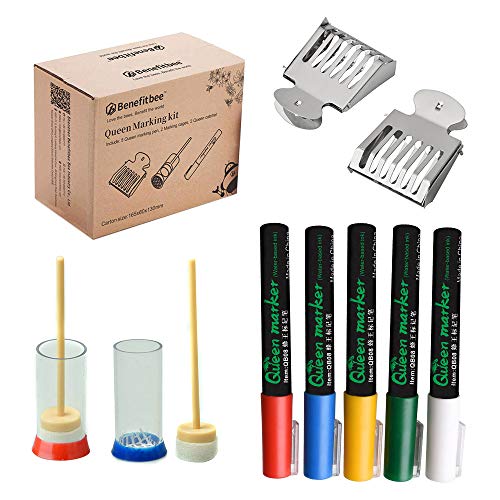
benefitbee Queen Bee Marking Kit
benefitbee · 5 queen marking pens (international color code) · plunger-style marking cage (listed)
Our verdict: Marking is the cheapest inspection speed-up in beekeeping. A dot on the thorax turns a twenty-minute queen hunt into a ten-second confirmation, and the color tells you her birth year, which is the number that actually drives requeening decisions.
The case for marking is entirely practical. An unmarked queen in a two-deep colony can eat half an inspection, and the tally of queens lost to beekeepers who kept pulling frames looking for her is not small. The benefitbee queen marking kit ($21.99) includes the five-color pen set matching the international year code plus a plunger cage that presses her gently against the comb while the paint dries.
Technique matters more than the kit. One small dot on the thorax only, never the abdomen or head, applied indoors or on a warm calm day, dried for several seconds before release. Mark mated laying queens only: never a virgin, who still has mating flights ahead of her. Pair it with the age discipline in how to requeen a hive.
Who should buy it
Any beekeeper past their first season, anyone running more than one colony, and anyone who has ever spent an entire inspection failing to find the queen.
What we don't like
The marking cage takes practice to use without stressing her, and paint pens dry out if left uncapped. Marking is also a hands-on-the-queen operation, so nervous first-year keepers should watch a mentor do it once first.
- Includes
- 5 marking pens, marking cage (listed)
- Color code
- International queen year colors
- Use
- Mated laying queens only, never virgins
- Marking spot
- Thorax, one small dot
- Price
- $21.99
Pros
- Turns queen-finding from a search into a glance
- Color code records her birth year without a notebook
- Includes the cage, so no separate purchase
- Cheap relative to the value of the queen it protects
Cons
- Requires handling the queen, which takes nerve the first time
- Pens dry out if not capped properly

YOFAN Queen Bee Catcher Set
YOFAN · 6-piece queen handling set with marking tools (listed)
Our verdict: Fingers are a bad queen-handling tool. This set gives you a clip catcher and press cage so you can move her into a nuc, hold her for marking, or cage her for a split without risking the injury that ends a colony's season.
Every beekeeper who has dropped a queen in the grass buys one of these afterward. The YOFAN queen catcher set ($9.95) is the cheapest item in this guide and the one with the worst downside if you skip it: a crushed or lost queen costs a colony three to four weeks of brood production at minimum, and possibly the season.
It earns its keep during splits and requeening especially, when you need her contained and identified before the frames move. The splitting procedure that puts it to work is how to split a hive.
Who should buy it
Everyone who intends to split, requeen, or mark. If you plan to ever deliberately move a queen, this is the tool that should be in the box before you try.
What we don't like
Multipiece budget sets vary in finish, and the clip-style catchers need a gentle hand: too firm a squeeze on the abdomen is exactly the injury you bought the tool to prevent.
- Pieces
- 6-piece set (listed)
- Type
- Clip catcher plus marking accessories
- Best use
- Splits, requeening, marking
- Price
- $9.95
Pros
- Prevents the single most expensive beginner accident
- Cheapest insurance in the whole hive kit
- Useful during every split and requeening
Cons
- Budget build quality varies piece to piece
- Clip catchers still require a careful hand

APlayfulBee Queen Rearing Kit
APlayfulBee · Complete grafting system: cell cups, cell bar frame components, cages (listed)
Our verdict: Everything in this article becomes actionable the moment you can produce queens on demand. This is the low-commitment entry point: enough cups and cages to raise a handful of locally mated queens from your own best colony.
Raising three or four queens a season changes the economics and the timing of a small apiary. The APlayfulBee queen rearing kit ($19.71) supplies the plastic cell cups, bar hardware, and cages a first attempt needs, which is the right scale for a keeper who wants queens from their own surviving stock rather than a mail-order box.
Success here is mostly about the larva age and the strength of the starter colony, not the plastic. Graft larvae under three days old, use a genuinely crowded queenless starter, and expect a mediocre take rate on your first try. The full field of kits and methods is in best queen rearing kits.
Who should buy it
Second- and third-year beekeepers running three or more colonies who want local queens on their own schedule, and anyone who has watched one colony winter noticeably better than the rest.
What we don't like
Grafting has a real learning curve and needs sharp eyes and steady hands, and the kit assumes you can supply the strong queenless starter colony that does the actual work.
- Includes
- Cell cups, cell bar components, cages (listed)
- Method
- Grafting
- Best for
- Hobby scale, a few queens per season
- Key requirement
- Larvae under 3 days old
- Price
- $19.71
Pros
- Queens mated to local drones from your own surviving stock
- Removes the three-week brood gap emergency queens impose
- Low cost entry into a skill that compounds
- Pairs directly with splitting for apiary growth
Cons
- Grafting is genuinely fiddly the first several times
- Requires a strong queenless starter colony you have to build
What a queen actually is
Strip the crown off and the queen is a specialized organ of a larger animal. The honey bee colony behaves as a superorganism: the workers are its body and its brain, the brood is its growth, and the queen is its reproductive tissue. She does not command anything. She does not decide when the colony swarms, when it forages, when it evicts drones, or when it replaces her. Workers make every one of those calls, and workers can and do execute her when she stops performing. Colonies are not monarchies; they are ruthless cooperatives that happen to keep one fertile female on staff.
What she does have is a body built for one job. She is longer than a worker, with a tapered abdomen extending well past her folded wings, ovaries that fill most of her body cavity, a smooth curved sting she uses almost exclusively on rival queens, and a specialized organ called the spermatheca that no worker has in functional form. She cannot forage, cannot make wax, cannot feed herself efficiently, and cannot survive alone for more than a few days. Her entire existence is a bet the colony places on one insect's fertility. If you are new to the cast of characters, the other 99 percent of the hive is covered in our worker and drone bee guide (Wikipedia: queen bee).
Any larva can be a queen: the royal jelly switch
This is the fact that stops people cold at dinner parties, and it is true: there is no queen egg. A fertilized honey bee egg is genetically ambiguous between worker and queen, and the caste is assigned by nurse bees, after hatching, with food. Every larva in the colony is fed royal jelly, a protein-rich glandular secretion from the heads of young nurse bees, for its first two to three days. Then almost all of them are weaned onto a coarser mix of pollen and honey sometimes called bee bread, and their reproductive development shuts down. They become workers.
The larvae the colony has selected for queenhood never get weaned. They are fed royal jelly continuously and in enormous surplus, swimming in it, in a vertically hanging peanut-shaped cell built specially for them. That uninterrupted royal jelly diet triggers a completely different developmental program: functional ovaries with roughly 150 to 180 ovarioles instead of a worker's handful, a spermatheca, a larger body, a smooth sting, a shorter tongue, no pollen baskets, no wax glands, and a dramatically longer lifespan (Wikipedia: royal jelly).
The practical consequence is the single most useful fact in beekeeping: a queenless colony with eggs or very young larvae can make itself a new queen. That is why the standard rescue for a queenless hive is a frame of open brood from a neighboring colony, and why every experienced keeper tells beginners to run two hives instead of one. It is also why the age of the grafted larva matters so much in queen rearing: a larva older than about three days has already been partly weaned and will produce an undersized, poorly developed queen even if the colony finishes the job.
The 16-day clock: queens develop fastest
All three castes run the same basic sequence, egg for three days, larva for a feeding period, then capping and pupation, but at different speeds. The queen's accelerated timeline is a direct product of her diet, and it is the number every beekeeper should have memorized because it drives inspection scheduling, split timing, and swarm control.
| Stage | Queen | Worker | Drone |
|---|---|---|---|
| Egg | 3 days | 3 days | 3 days |
| Larva (open, being fed) | about 5.5 days | about 6 days | about 6.5 days |
| Cell capped on day | about day 8 | about day 9 | about day 10 |
| Pupa (capped) | about 8 days | about 12 days | about 14 days |
| Emerges on about | day 16 | day 21 | day 24 |
| Sexually mature | about day 22 to 28 (after mating) | n/a | about 10 to 14 days after emergence |
Read down the queen column and the beekeeping calendar falls out of it. A colony that goes queenless today can have a capped queen cell in about a week, a virgin in roughly sixteen days, a mated queen flying in another week or so, and eggs on the frame around day 24 to 30. That three-to-four-week brood gap is why a queenless colony looks alarmingly empty a month later even when everything went right, and why panicked beekeepers who tear down emergency cells on day ten usually make the problem permanent. The full recovery timeline and the decision of whether to let them or requeen is in how to requeen a hive (Bee Health, eXtension).
Emergence, piping, and the fight between virgins
When a queen finishes pupating she chews a neat circular lid off the bottom of her cell and walks out onto the comb: a slim, nervous, fast-moving virgin, noticeably less regal-looking than the fat mated queen most beekeepers picture. She is not sexually mature yet, and she has one urgent piece of business first: eliminating the competition.
Colonies rarely raise one queen cell. Swarm preparations routinely produce ten to twenty, staggered by a day or two, which is deliberate insurance against the many ways a virgin can fail. The first queen out patrols the combs hunting the other cells and, when she finds one, chews through its wax wall and stings the developing queen inside. Workers often help by tearing the cell open for her. Where two virgins emerge close together they fight directly, grappling on the comb until one lands a sting; queens are the only bees whose sting is built for repeat use, precisely for this.
The soundtrack is one of the strangest things in the hive. A free-running virgin produces a sharp, rising call called piping, often written as tooting, by pressing her thorax to the comb and vibrating her flight muscles. Mature queens still inside their cells answer with a duller quacking. Workers appear to use the exchange to manage the sequence, sometimes holding later queens in their cells and feeding them through a slit while the first virgin decides matters. If you ever hear a faint, electronic-sounding chirp from a hive on a spring evening, you are listening to a colony in the middle of replacing its queen, which usually means it is also about to swarm. What to do about that is how to prevent swarming.
The mating flight: drone congregation areas
Roughly five to ten days after emerging, on a warm calm afternoon, the virgin queen leaves the hive for the only meaningful trips of her life. She orients on short practice flights first, then flies out, often a mile or more, to a drone congregation area: a specific patch of open air, typically fifty to a hundred feet up, where thousands of drones from colonies across the surrounding landscape gather every afternoon during the season. These areas are stable across years, used by generation after generation of bees that never met each other, and how the bees locate them is still not fully explained.
The logic of the system is elegant. Because the drones come from many different colonies over a wide radius, and because the queen flies away from her own hive to reach them, inbreeding is largely avoided. She mates in flight with roughly ten to twenty drones, commonly cited in that range and sometimes higher, over one flight or several across a few days. Each drone's mating is fatal: his endophallus everts explosively, he is paralyzed and falls away, and the audible pop is one of the few sounds in nature that ends a life on contact. The next drone removes the previous one's mating sign and adds his own.
The risks are entirely on the queen. She is outside, alone, and edible: birds, dragonflies, and weather all take queens on mating flights, and a cold wet spring can strand a virgin in the hive past her window, after which she becomes a permanently unmated drone layer. Roughly speaking, expect a meaningful percentage of virgins to simply not come back, which is why colonies raise many cells and why queen breeders run mating nucs in numbers. This is also why moving a hive during the two-week mating window is a genuinely bad idea, covered in how to move a beehive.
The spermatheca: one week of mating, a lifetime of eggs
Everything the queen collects on those flights, roughly five to six million sperm from a dozen or more fathers, is transferred into a single pea-sized organ called the spermatheca, where it is stored alive for the rest of her life. She never mates again. Every egg she fertilizes over the next several years draws from that one deposit, made in a few hours of flying during the first two weeks of her adult life.
Two consequences matter for beekeepers. First, a colony is genetically a family of half-sisters: all the workers share the same mother but have a dozen or more different fathers, producing distinct patrilines within one hive. That diversity is not incidental. Colonies with more genetically diverse workforces are generally better at thermoregulation, disease resistance, and steady foraging, which is one reason a poorly mated queen produces a colony that underperforms in ways that have nothing to do with her egg count.
Second, the spermatheca is a finite tank, and running dry is a specific, diagnosable failure mode. As stored sperm depletes, the queen begins fertilizing fewer eggs, and worker-sized cells start filling with drone brood: the tall, bullet-shaped domed cappings beekeepers call a drone layer. A colony in that state is on a countdown, because drones do no work and the worker population is no longer being replaced. It is one of the clearest requeen-now signals on the frame, and we cover reading it alongside the other terminal diagnoses in how to diagnose a deadout.
When she starts laying, and how you confirm it
A newly mated queen typically begins laying two to five days after her final mating flight, which puts first eggs somewhere around three to four weeks after the original queen cell was capped. Beginners routinely blow this up by inspecting too often and too early. A virgin queen disturbed during her orientation and mating window can be balled by her own workers when she returns, or simply fail to fly, and there is nothing useful to see in a hive that has a virgin in it anyway.
The discipline that works: after a colony caps a queen cell, close it up and stay out for three weeks. Then look for eggs, not for the queen. Eggs are the only proof that matters, they are visible as tiny upright grains of rice in the cell bottoms, and their presence means a laying queen was there within the last three days. Hold the frame with the sun over your shoulder and tip it until light reaches the cell floor; reading glasses are not an admission of defeat.
A brand new queen's first pattern is often ragged, with scattered cells and the occasional double-laid cell, and that is normal for the first week or two. Judge her on her third or fourth week, when a good queen produces a solid, concentric slab of brood covering most of a frame with only a scatter of skipped cells. The inspection routine for reading a frame properly, in the right order, is in how to do a hive inspection.
Fertilized or not: how she decides worker versus drone
Here is the mechanism that makes honey bee genetics so odd. The queen controls the sex of every egg she lays, at the moment she lays it, by choosing whether to release sperm from her spermatheca as the egg passes. Fertilized eggs are diploid and become females, workers or queens depending on diet. Unfertilized eggs are haploid, carrying only her genes, and develop into drones. This system, called haplodiploidy, means a drone has a grandfather but no father, and it is the reason a colony's genetic bookkeeping does not resemble anything in the vertebrate world.
She does not appear to be making a free choice. Before laying, the queen dips her head into the cell and measures it, and cell width is the cue: standard worker-sized comb, about five cells to the inch, prompts a fertilized egg, while the wider drone comb the workers build at frame edges and in gaps prompts an unfertilized one. Workers therefore set drone production by deciding how much drone comb to build, which is why colonies raise thousands of drones in spring and almost none in autumn. A queen laying drones in worker cells has lost the ability to fertilize, not the ability to count.
This is also the biology under a queen excluder. The queen's larger thorax will not pass a properly spaced excluder grid, while workers slip through freely, so honey supers above one stay brood-free. It is why beekeepers can harvest clean comb at all, and the tradeoffs of running one are argued out in our frames and foundation guide (University of Minnesota Extension).
Queen mandibular pheromone: the colony's cohesion signal
The queen governs nothing, but she does broadcast. Her mandibular glands produce a blend of compounds known as queen mandibular pheromone (QMP), which attendant workers pick up as they groom and feed her, then distribute through the whole colony by trophallaxis and contact within hours. Every bee in the hive is effectively reading a chemical status line that says the queen is here and she is laying well.
What that signal does is remarkable in scope. It suppresses ovary development in workers, so tens of thousands of females stay functionally sterile. It suppresses the impulse to build queen cells. It attracts and stabilizes the retinue that feeds and grooms her. It helps hold a swarm together in flight and on the branch, which is why a swarm cluster forms around wherever the queen lands. It contributes to comb building, foraging motivation, and brood rearing cues. QMP is not a mood; it is the operating signal that turns 50,000 individual insects into one animal.
Beekeepers exploit it constantly without thinking about it. A caged queen is accepted by a strange colony over three or four days precisely because her pheromone diffuses through the candy plug and screen while the workers grow used to it, which is the entire mechanism behind slow-release introduction cages. And the reason a hive turns loud and unfocused within hours of losing its queen is that the signal stopped, not that the bees are grieving.
When the pheromone fades
The failure cascade is predictable, and knowing its stages tells you how long a colony has been in trouble. Within roughly fifteen minutes to a few hours of losing the queen, the colony notices: the sound of the hive rises to a restless roar, workers run over the combs, and defensiveness climbs. Within about a day, workers select young larvae in worker cells and begin remodeling those cells downward into emergency queen cells. If the colony had eggs or larvae under three days old at the moment of loss, it usually recovers on its own.
If there were no young larvae, or the emergency queen fails to mate, the colony enters the terminal stage. With no QMP and, critically, no open brood pheromone either, worker ovaries begin developing after roughly two to four weeks. These laying workers can only produce unfertilized eggs, so the colony fills with drone brood in worker cells, often several eggs jammed into a cell and stuck to the sidewalls rather than centered on the floor. That scatter-laid, multiple-eggs-per-cell pattern is the fingerprint that distinguishes laying workers from a drone-laying queen.
Laying-worker colonies are the hardest routine fix in beekeeping. They usually reject introduced queens, sometimes killing several in a row, because dozens of workers now behave as pseudo-queens. The practical options are all unglamorous: repeated frames of open brood from a strong hive over several weeks, or simply combining the remnant with a queenright colony over newspaper, which is honest triage rather than defeat. That procedure is how to combine two hives.
Reading queen cells: supersedure, swarm, or emergency
Finding queen cells during an inspection is a fork in the road, and the wrong turn costs you a colony or a honey crop. All three types are the same peanut-shaped, vertically hanging, heavily textured wax structure, but position, count, and context tell you what the colony intends. Learn to read them and you can respond correctly in fifteen seconds with the frame still in your hands.
| Type | Where they are | How many | What it means | What to do |
|---|---|---|---|---|
| Swarm cells | Bottom bars and lower frame edges, hanging into open space | Often 5 to 20, staggered in age | The colony is crowded and preparing to reproduce by splitting | Act now: split, or run swarm control. Cutting cells alone rarely works |
| Supersedure cells | Middle of the comb face, on the flat | Usually 1 to 3 | The colony judges the current queen failing and is quietly replacing her | Usually let them, or requeen deliberately with a known-mated queen |
| Emergency cells | Anywhere there was young larvae, built out of remodeled worker cells and often stepping out from the comb face at an angle | Several to many | The queen died or was lost suddenly, and the colony is improvising | Leave the best cells alone, or introduce a mated queen to save three weeks |
Two field notes that save beginners real money. First, a queen cup is not a queen cell: cups are the empty acorn-shaped starter bowls colonies keep on hand year round, and finding a dozen of them means nothing. It becomes a cell when there is an egg or larva swimming in jelly inside it. Second, an emergency cell built from a horizontal worker cell often produces a smaller queen than a purpose-built swarm cell does, because the larva spent its first days on a worker diet. That is an argument for buying or raising a good queen rather than accepting whatever the emergency produces, and the case for both routes is in how to split a hive (Penn State Extension: queen introduction).
Laying rate at peak: the numbers that make a colony
At the height of a spring buildup, a good queen lays up to roughly 1,500 to 2,000 eggs per day, commonly cited in that range, which exceeds her own body weight in eggs every twenty-four hours (Wikipedia: queen bee). She does it by laying almost continuously, roughly one egg every twenty to forty seconds around the clock, pausing only to be fed and groomed by her retinue. She cannot even feed herself at that rate; attendants do it for her.
Run the arithmetic and colony dynamics stop being mysterious. A summer worker lives about six weeks, so a colony holding steady at 50,000 bees must replace roughly 1,200 bees a day just to break even. That number, not the queen's ambition, is why laying rate governs everything: fall below the replacement rate and the population slides, sustain above it during a flow and the colony explodes into swarm preparations. Beekeepers who wonder why their hive stalled in June are usually looking at a queen who is laying 600 eggs a day, not 1,500.
She is also not laying at that rate alone. Workers cap her ceiling: they decide how much comb is drawn, how much of it is cleaned and polished for eggs, how much nurse-bee capacity exists to feed larvae, and how much space the honey band leaves in the brood nest. A queen limited by a honey-bound brood nest looks like a bad queen and is not, which is why the first question when brood drops is always whether she has anywhere left to lay. Yield consequences run through how much honey per hive.
Lifespan: the textbook says five years, the yard says two
The classic figure is three to five years, and it is real: queens have lived past five in favorable conditions, an astonishing lifespan for an insect whose sisters last six weeks on the same genome. The mechanism is partly the royal jelly diet and partly a metabolic profile that avoids the oxidative wear a forager racks up. A queen is the same animal as a worker, living twenty to forty times longer, on different food.
The yard tells a harsher story. Across much of US beekeeping, queens are now commonly failing or being superseded in their first or second year. The usual suspects are cumulative rather than singular: varroa and the viruses it transmits, miticide and agricultural pesticide residues accumulating in wax, poor mating weather producing undermated queens, shipping and banking stress on commercially reared queens, and nutritional gaps in monoculture landscapes. National colony loss surveys have run in the neighborhood of 40 to 50 percent annually in recent years, and queen problems are consistently among the causes beekeepers name (Bee Informed Partnership).
The working conclusion most experienced keepers reach is unromantic: treat the queen as an annual or biennial consumable, not a five-year fixture. Requeening on your schedule, in a strong colony, during good weather, with a queen of known provenance beats requeening in September because the colony collapsed. Mite control does more for queen longevity than anything else you can buy, which is why when to treat for varroa belongs in the same conversation as queen management.
What a failing queen looks like on the frame
You will diagnose a failing queen far more often than you will watch one, so learn the tells. None of these is conclusive alone; two or three together mean act.
Spotty brood pattern. A solid slab with a scatter of empty cells, sometimes called shotgun brood. It can also mean disease or hygienic behavior removing infected pupae, so check the empty cells: clean and polished suggests the queen skipped them, sunken or perforated cappings point at disease instead.
Drone brood in worker cells. Bullet-shaped domed cappings across flat worker comb means she has run out of stored sperm. Combined with a single egg centered per cell, that is a drone-laying queen; multiple eggs stuck on cell walls means laying workers instead, and the fixes are entirely different.
Falling population without a flow explanation. Fewer bees each visit, brood area shrinking week over week, supers not being worked. Rule out mites and starvation first, then look at her laying rate.
Supersedure cells with a queen present. When the colony builds mid-face queen cells while the queen is still walking around, the bees have already voted. Trust them; they have far better information than you do.
Sudden defensiveness or a broken pattern after a supersedure. A poorly mated replacement, or one that mated with unfavorable local drones, can change a colony's temperament sharply. Genetics travel through the queen, so temperament problems are almost always requeening problems.
No eggs, no young larvae, and a rising roar. The colony is queenless and knows it. Confirm with a second look after three days rather than acting on one glance, since a queen can be temporarily off-lay after a shock, a move, or a hard dearth. The response menu is in how to requeen a hive.
Finding her, marking her, and handling her safely
Finding the queen gets much easier once you stop hunting for her. Look for the pattern instead: a small circle of clear comb where workers have opened a space, backs oriented inward, on a frame of eggs and young larvae near the center of the brood nest. She will usually be in that ring, moving away from the light, longer than everything around her and moving with a different gait. Work the second frame in from the brood nest edge, keep your shadow off the comb, and go slowly. Frames pulled abruptly send her running to the far side.
Marking her is worth the ten minutes it costs. A marked queen is findable in seconds instead of half an hour, and the color code tells you her age at a glance, which is the whole point when you are deciding whether to requeen. A kit like the benefitbee queen marking kit ($21.99) bundles the marker pens with a plunger-style press-in cage that holds her against the comb without pressure on her abdomen. Mark a single small dot on the thorax, never the abdomen, never the head, and let it dry a few seconds before releasing her.
For handling her at all, whether marking, caging for a split, or moving her into a nuc, a dedicated catcher is far safer than fingers. The YOFAN queen catcher set ($9.95) is a nine-dollar tool that prevents a very expensive accident: crushing her, or dropping her in the grass where she is effectively gone. Two rules that override everything else: never handle a queen on a cold or windy day, and never mark a virgin, since she still has flying to do and any interference during her mating window is a colony-level risk.
Raising your own queens
Once the biology above clicks, queen rearing stops looking like an advanced discipline and starts looking like scheduling. Everything you need is contained in the 16-day clock and the royal jelly switch: put larvae under three days old into a colony with no queen and abundant nurse bees, and it will raise queens on your timetable rather than its own.
The classic method is grafting: transfer very young larvae with a fine tool from a breeder colony into artificial plastic cell cups on a bar, then hand the bar to a strong queenless starter colony that finishes them into capped cells. A starter set like the APlayfulBee queen rearing kit ($19.71) covers the cups, bars, and cages for a first attempt at hobby scale, and the graftless approaches, cutting a strip of comb, or confining the queen on a plug frame, work fine for a keeper who only needs three or four queens a season.
Why bother? Because raising your own means queens mated to your local drones, from colonies you watched survive your winters, available on the day you need one rather than three weeks after you order. It also solves the timing problem that ruins so many splits: a mated queen introduced immediately saves the three-to-four-week brood gap an emergency queen imposes. The full gear comparison is in best queen rearing kits, and the splitting math that makes queens worth raising is in how to split a hive.
Why the queen is the whole colony's future
Every genetic trait that determines whether a colony thrives arrives through the queen and the dozen drones she met on one afternoon: hygienic behavior that helps suppress varroa and foulbrood, temperament, spring buildup speed, overwintering thrift, propolis habit, honey drive. You cannot train these into a colony. You can only choose them, by choosing queens.
That is the whole argument for taking queen selection seriously rather than accepting whatever a package supplier ships. Locally adapted stock, from someone keeping bees in your climate, generally outperforms distant commercial stock in survival, and race differences are real and worth understanding, which is why we wrote types of honey bees. It is also the argument for keeping notes: the colony that wintered on the least feed with the fewest mites is the one whose daughters you want, and that judgment is only possible if you wrote down which queen was where.
The short version for a second-year beekeeper: know how old every queen in your yard is, mark them, judge them by brood pattern in their third week, replace them before they fail rather than after, and buy or raise from stock that has survived where you live. Do that and most of the rest of beekeeping becomes maintenance. The season-by-season version of that discipline is the first-year beekeeping calendar, and the money side of it is the beekeeping cost index.
More gear worth comparing
Beyond this guide: the highest-rated gear across every category and budget, with a live price check on each.




As an Amazon Associate we may earn from qualifying purchases, at no cost to you.
Quick shop: every pick
Skip the scroll: the whole lineup, with a live price check on each.
- benefitbee Queen Bee Marking KitBest Queen Marking Kitbenefitbee · $21.99Check Price
- YOFAN Queen Bee Catcher SetBest Queen Handling ToolYOFAN · $9.95Check Price
- APlayfulBee Queen Rearing KitBest First Queen Rearing KitAPlayfulBee · $19.71Check Price
Key terms
- Royal jelly
- The protein-rich glandular secretion nurse bees produce. All larvae get it for two to three days; queen larvae are fed it continuously, which is the sole trigger that makes a queen instead of a worker.
- Queen cell
- The vertically hanging, peanut-shaped wax cell in which a queen develops. Position and count distinguish swarm cells (frame bottoms, many), supersedure cells (comb face, few), and emergency cells (remodeled worker cells).
- Queen cup
- An empty acorn-shaped wax bowl colonies keep on hand year round. Only becomes a queen cell when an egg or larva in jelly appears inside it, so finding cups alone means nothing.
- Virgin queen
- A newly emerged, unmated queen. Slimmer and faster than a mated queen, she pipes, destroys rival cells, and takes mating flights five to ten days after emerging. Never mark or disturb one.
- Drone congregation area (DCA)
- A specific patch of open air, typically 50 to 100 feet up, where thousands of drones from many colonies gather each afternoon. Queens fly to a DCA to mate, which keeps colonies outbred.
- Spermatheca
- The pea-sized organ in which a queen stores several million sperm from her mating flights, alive, for the rest of her life. She never mates again; running it dry produces a drone-laying queen.
- Haplodiploidy
- The honey bee sex system: fertilized (diploid) eggs become females, unfertilized (haploid) eggs become drones. The queen chooses by releasing or withholding sperm as she lays.
- Queen mandibular pheromone (QMP)
- The chemical signal from the queen's mandibular glands, spread colony-wide by contact and food sharing. It suppresses worker ovaries and queen cell building, and holds swarms together.
- Supersedure
- The colony quietly replacing a failing queen without swarming, usually via one to three queen cells on the comb face. Trust it: the bees have better information about her than you do.
- Drone layer
- A queen out of stored sperm, laying unfertilized eggs in worker cells and producing bullet-domed drone cappings across flat comb. One egg per cell, centered, distinguishes her from laying workers.
- Laying worker
- A worker whose ovaries developed during prolonged queenlessness, laying only unfertilized (drone) eggs, often several per cell and stuck to cell walls. Very hard to requeen; usually combined out.
- Patriline
- The set of workers in a colony fathered by one drone. Because a queen mates with a dozen or more drones, a colony contains many patrilines, and that genetic diversity improves colony performance.
Questions, answered
how is a queen bee made
By diet, not by birth. Any fertilized egg can become a queen or a worker, and nurse bees decide by what they feed the larva. All larvae get royal jelly for two to three days; the ones destined to be queens are fed royal jelly continuously in a special vertical cell, which switches on full ovary development, a spermatheca, and a faster growth clock. That is why a queenless colony with young larvae can build itself a new queen.
how long does it take for a queen bee to develop
About 16 days from egg to emergence, compared with 21 days for a worker and 24 for a drone. She then needs another five to ten days to mature and take mating flights, and typically begins laying two to five days after mating. Practically, a colony that loses its queen today is usually about three to four weeks from having eggs again.
how many times does a queen bee mate
Once in her life, in the sense that she mates during a single window of one to several flights across a few days shortly after emerging, then never again. On those flights she mates with roughly ten to twenty drones at a drone congregation area and stores several million sperm in her spermatheca, drawing on that supply for years of egg laying.
how many eggs does a queen bee lay per day
Up to roughly 1,500 to 2,000 a day at peak in a strong colony during a good flow, which is more than her own body weight in eggs every 24 hours. She lays close to continuously, about one egg every twenty to forty seconds, while attendant workers feed and groom her. Her real ceiling is usually set by available polished comb and nurse bee capacity, not by her.
how do i tell a swarm cell from a supersedure cell
Position and count. Swarm cells hang off the bottom bars and lower frame edges into open space, and there are usually many of them, five to twenty, staggered in age. Supersedure cells sit on the flat face of the comb, and there are usually only one to three. Emergency cells are remodeled worker cells and stick out from the comb face at odd angles. Swarm cells mean act now; supersedure cells usually mean let them.
how long do queen bees live
The textbook range is three to five years, but in much of US beekeeping today queens commonly fail or are superseded in their first or second year. Varroa and the viruses it spreads, pesticide and miticide residues in wax, poor mating weather, and shipping stress all shorten queen life. Most experienced keepers now plan on requeening every one to two years rather than waiting for failure.
what does a failing queen look like
Spotty brood with clean skipped cells, a brood area shrinking week over week without a dearth to explain it, drone brood capped in flat worker comb, supersedure cells built while she is still present, or a sudden change in colony temperament. Any one can have another explanation, so look for two or three together before you act, and always rule out mites and starvation first.
what happens if a hive loses its queen
Within hours the hive gets noticeably louder and more restless as her pheromone fades, and within about a day workers begin remodeling cells around young larvae into emergency queen cells. If there were eggs or larvae under three days old, the colony usually recovers on its own in three to four weeks. If not, or if the new queen fails to mate, laying workers eventually develop and the colony is very hard to save.
should i mark my queen bee
Yes, once you are past your first season. A marked queen is found in seconds instead of half an inspection, and the international color code records her birth year, which is the number that drives your requeening decisions. Mark one small dot on the thorax of a mated laying queen only, on a warm calm day, and never mark a virgin who still has mating flights ahead of her.
why does my queen lay drone eggs in worker cells
She has run out of stored sperm, which happens to old queens and to queens that mated poorly in bad weather. Fertilized eggs make workers, unfertilized eggs make drones, and once the spermatheca is empty she can only lay drones. One centered egg per cell points at a drone-laying queen; multiple eggs stuck to cell walls points at laying workers instead, and the two problems have completely different fixes.
Filed under Explainer
Part of Beekeeping 101
Keep reading
Worker and Drone Bees: The Other 99 Percent
The workforce this queen produces: task progression by age, the waggle dance, winter bees, and why drones matter.
How to Requeen a Hive
The procedure side of this page: when to replace her, how to introduce a caged queen, and how to confirm acceptance.
Best Queen Rearing Kits
Grafting tools, cell cups, and mating nuc gear for producing your own locally mated queens.
How to Split a Hive
Turning one colony into two, and the queen timing that decides whether the split thrives or stalls.
How to Prevent Swarming
What to do the day you find swarm cells on the bottom bars, and how to stop finding them at all.
Types of Honey Bees
Italian, Carniolan, Russian, Buckfast: the genetics you are actually choosing when you choose a queen.