Our Pick: Apimaye
Check PricePoly vs Wooden Beehives: Which One Wins
Verdict first: if you keep bees where winter is the leading cause of death in your apiary, buy the insulated polymer hive. The Apimaye Ergo Insulated Bee Hive Set with PRO Frames at $320 is the version we would own, and its insulation and moisture management earn back the premium in colonies that are alive in March. Everywhere else, buy wood: the BeeCastle 10 Frame Langstroth at $179.21 or the Honey Lake 10-Frame Langstroth Starter Kit at $159.99 costs roughly half as much, fits every accessory in America, and can be repaired with a screw and a scrap of pine.
By The BeehiveKits Hive Desk2026-08-2916 min read Fact-checked against verified Amazon listingsHow we research
 Best Overall
Apimaye Ergo Insulated Bee Hive Set with Plastic PRO Frames
Apimaye · 4.6
$320.00
That is a climate answer, not a materials-science preference, and it is worth being precise about why. A polymer hive is not better at being a box. It is better at holding heat and managing moisture, and those two things dominate colony survival in cold, wet winters and matter far less in a Georgia January. Buy the property you actually need.
The two options are also not equally standardized, which is a bigger deal than the spec sheets suggest. A wooden 10-frame Langstroth is a commodity: every frame, feeder, queen excluder, escape board, and extractor basket sold in this country was designed to fit it, descending from L. L. Langstroth's 1852 movable-frame patent and the 3/8 inch bee space (Wikipedia). Polymer systems are Langstroth-compatible in frame dimensions but proprietary in almost everything else: lids, bottom boards, feeders, and the way boxes stack and lock.
Below we run the honest case for each side, the insulation and condensation physics that make the poly argument real, and a ten-year cost table using our verified prices. If you want the poly field ranked rather than compared, our insulated hive guide covers it, and our 10-frame guide ranks the wooden side.
What to know
- Cold, wet winters (Upper Midwest, Northeast, Mountain West, Pacific Northwest): buy poly. Insulation plus moisture management is worth the premium where winter kills colonies.
- Mild winters, tight budget, or a first hive: buy wood. You save roughly $135 to $160 per hive and lose almost nothing that matters in a warm climate.
- The real poly advantage is condensation control, not raw warmth. Warm walls stop the cold ceiling drip that kills clusters that were not actually cold.
- Poly is dramatically lighter empty, which matters every single time you lift a box, and it never needs painting or a maintenance weekend.
- Wood is the standard: every accessory, every mentor's spare part, every used-equipment listing assumes it. Poly is Langstroth-compatible in frames only.
- Over ten years the gap narrows but does not close: wood needs paint and eventual repair, poly needs UV protection and has no cheap repair path at all.
- Both are vulnerable to mice and woodpeckers. Mouse guards and hardware cloth are not optional on either material.
At a glance
| Product | Material | Side | What it solves | Price | Check price |
|---|---|---|---|---|---|
| Apimaye Ergo Insulated Set with PRO Frames | Insulated polymer | Poly | Complete insulated system, frames included | $320.00 | Check Price |
| Apimaye Ergo Insulated 10 Frame Set | Insulated polymer | Poly | Same hive for keepers who already own frames | $295.00 | Check Price |
| BeeCastle 10 Frame Langstroth, beeswax coated | Beeswax-dipped wood | Wood | Weather protection already done, universal fit | $179.21 | Check Price |
| Honey Lake 10-Frame Langstroth Starter Kit | Beeswax-coated wood | Wood | The budget entry into the standard format | $159.99 | Check Price |
The four hives that define the choice, priced from our verified offer table on August 29, 2026. Two polymer, two wooden, one budget and one flagship on each side.
Apimaye Ergo Insulated Bee Hive Set with Plastic PRO Frames
Apimaye · Insulated double-wall polymer (listed) · 10-frame Langstroth frame compatibility · PRO frames included
Our verdict: The strongest version of the poly argument, and the one we would actually own in a cold state. Double-wall insulated construction, integrated ventilation and moisture management, and plastic PRO frames included, so nothing arrives half-finished. At $320 it is roughly $140 more than a good wooden kit, and in a hard winter that is the cheapest insurance on the list.
What $320 buys is a colony that is still alive in March. The Apimaye Ergo Insulated Bee Hive Set with PRO Frames is a double-wall insulated polymer system (listed) with an integrated ventilated bottom board, a feeder built into the design, and locking boxes that hold together without straps. Frames are included, which matters: the cheaper Apimaye set ships without them, and comparing a frameless set to a complete wooden kit is how people accidentally under-budget by fifty dollars.
The thermal case is not that bees need to be warm. Bees make their own heat, and a healthy cluster manages cold competently. The case is that insulated walls stay closer to cluster temperature, so warm moist air rising off the cluster is far less likely to hit a cold ceiling, condense, and rain back down on the bees. Cold bees survive; cold wet bees frequently do not. That single mechanism is the whole northern argument for polymer, and it is why our insulated hive guide ranks Apimaye at the top of it.
The second, quieter advantage is that it never asks anything of you. No painting on arrival, no scraping and repainting in year four, no rot at the bottom board, no assembly weekend with a nail gun and a square. For a keeper whose limiting resource is time rather than money, that is a real purchase, and the full Apimaye review covers what a season of ownership actually looks like.
Who should buy it
Buy it if you keep bees somewhere winter kills colonies, if you have lost hives to damp rather than cold, or if you want a hive that needs no maintenance ever. It is also the right call for keepers who cannot face an assembly-and-painting project before the bees arrive.
What we don't like
It is a proprietary system: lids, bottom boards, and feeders are Apimaye parts, not commodity ones, so a broken component means an order rather than a trip to the hardware store. It costs $140 more than a good wooden kit, plastic frames get drawn more reluctantly than wax-coated wood, and polymer has no repair path. A cracked box is a replaced box.
- Construction
- Double-wall insulated polymer (listed)
- Frames
- Plastic PRO frames included
- Maintenance
- None: no paint, no rot, no assembly
- Compatibility
- Langstroth frame dimensions; proprietary hive parts
- Best climate
- Cold and wet winters
- Price
- $320.00
Pros
- Insulation plus moisture management where winter kills colonies
- Zero maintenance: never needs paint, never rots
- Much lighter empty than equivalent woodenware
- Frames included, so the price is the real price
- Locking boxes hold together without ratchet straps
Cons
- $140 more than a comparable wooden kit
- Proprietary lids, bottoms, and feeders
- No repair path: damage means replacement
- Plastic frames need waxing and patience
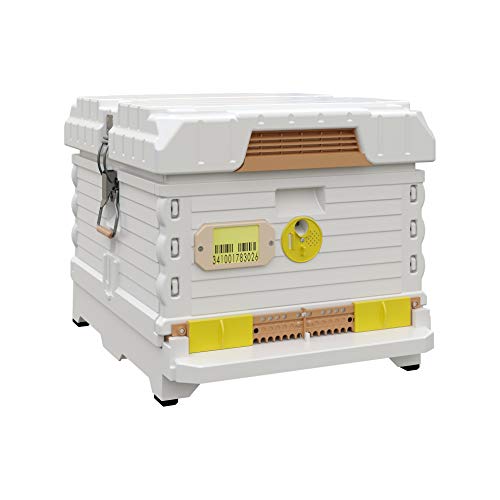
Apimaye Ergo Insulated 10 Frame Bee Hive Set
Apimaye · Insulated double-wall polymer (listed) · 10-frame Langstroth · frames NOT included
Our verdict: Identical thermal argument, $25 cheaper, no frames in the box. If you already run wax-coated wooden frames and want to keep them, this is the honest way to buy into polymer. If you do not own frames, add the cost of ten before you compare it to anything.
The frameless set is the right buy for exactly one kind of keeper: the one who already owns frames. The Apimaye Ergo Insulated 10 Frame Bee Hive Set is the same insulated polymer system at $295 with the frames left out, which makes it a genuine saving if you are moving overwintered wooden frames into a warmer box, and a false economy if you are starting from zero.
There is a real bee-behavior reason to want your own frames here. Colonies draw wax-coated wooden frames faster than bare plastic, so a keeper who wants maximum comb production in year one may prefer to pair the insulated polymer body with wooden frames from our frames and foundation guide. The hive body does the thermal work; the frames do the comb work. There is no rule that says they have to come from the same box.
Who should buy it
Buy it if you already own drawn or wax-coated frames, or if you specifically want wooden frames inside a polymer body for faster comb drawing. It is the frugal poly entry for a keeper expanding rather than starting.
What we don't like
For a first hive it is a trap: $295 plus a set of frames lands close to the $320 complete set, with an extra order and a wait. It carries every other polymer drawback too: proprietary parts, no repair path, and UV exposure that wants shade or a cover.
- Construction
- Double-wall insulated polymer (listed)
- Frames
- Not included
- True cost
- Add frames before comparing to complete kits
- Compatibility
- Langstroth frame dimensions; proprietary hive parts
- Price
- $295.00
Pros
- Same insulation and moisture management for $25 less
- Lets you pair polymer walls with wax-coated wooden frames
- Sensible for keepers expanding an existing operation
Cons
- Poor value for a first hive once frames are added
- Same proprietary-parts and no-repair limitations

BeeCastle 10 Frame Langstroth Bee Hive, 100% Beeswax Coated
BeeCastle · 10-frame Langstroth · 100 percent beeswax dipped (listed) · universal American standard
Our verdict: The wooden case at its best: beeswax-dipped so the weather protection is bee-safe and already done, on dimensions that every accessory in the country fits. At $179.21 it is $140 under the flagship polymer set, and every part of it can be repaired with tools you already own.
Wood is not the compromise; it is the standard, and the standard has advantages nothing proprietary can buy. The BeeCastle 10 Frame Langstroth arrives dipped in beeswax (listed), which is the coating we prefer on wooden equipment because it protects the timber without introducing anything you would rather bees not chew on. More importantly, it is a plain 10-frame Langstroth, which means every feeder, excluder, escape board, robbing screen, quilt box, and extractor basket in the American supply chain fits it.
That universality is worth real money over time. A replacement box is a commodity purchase, not a proprietary order. A cracked corner is a screw and a scrap of pine. A neighbor with spare equipment can hand you a super that fits. When you sell up or scale down, wooden Langstroth gear has a resale market that specialized systems simply do not. Our starter kit roundup and 8-frame vs 10-frame comparison map the rest of that ecosystem.
The honest thermal caveat: a single-wall pine box is roughly three quarters of an inch of softwood, and in a hard winter that is not much. Wooden-hive keepers in cold climates close the gap with a winter wrap, a quilt box or moisture board above the cluster, and upper ventilation. That stack costs $50 to $90 and gets a wooden hive most of the way to polymer's winter behavior for a fraction of the price difference.
Who should buy it
Buy it if you are in a moderate climate, if budget matters, if you plan to expand and want every added box to be cheap, or if you want equipment your mentor and your club can actually help you with. It is our default recommendation for a first hive nearly everywhere south of the hard-winter line.
What we don't like
Wood is work. It weathers, it eventually wants attention at the joints and the bottom board, and even beeswax-dipped equipment will not last forever untouched. It is heavier empty than polymer, and in a cold winter it needs a wrap and moisture management to compete on survival.
- Construction
- Pine, dipped in 100 percent beeswax (listed)
- Format
- 10-frame Langstroth, universal standard
- Maintenance
- Periodic inspection, eventual re-treatment
- Repairability
- Full: screws, glue, replacement parts
- Best climate
- Mild to moderate; cold with a wrap
- Price
- $179.21
Pros
- $140 under the flagship polymer set
- Universal format: every accessory in America fits
- Repairable with basic tools and scrap lumber
- Beeswax coating is bee-safe protection, already applied
- Real resale market for used woodenware
Cons
- Single-wall insulation is thin for hard winters
- Heavier empty than polymer
- Wants eventual maintenance and re-treatment

Honey Lake 10-Frame Langstroth Beehive Starter Kit
Honey Lake · 10-frame Langstroth starter kit · beeswax coated (listed) · standard footprint
Our verdict: At $159.99 this is the number that anchors the whole comparison: exactly half the flagship polymer set. For a first hive in a moderate climate, it is all the box a colony needs, and the $160 you did not spend buys a suit, a smoker, and your first year of mite treatments.
The strongest argument against polymer is arithmetic. The Honey Lake 10-Frame Langstroth Beehive Starter Kit at $159.99 is a beeswax-coated (listed) standard-format hive, and it houses a colony exactly as well as a $320 one does in June. The polymer premium buys winter performance and maintenance freedom, both of which are real, and neither of which a first-year keeper in Tennessee is going to notice.
Where the savings should go is not a rhetorical question. A first-year budget that redirects $160 from the hive to protective gear, a mite monitoring kit, and fall feed is a better-defended colony than one in an expensive box with a cheap suit and no varroa plan. Given that national annual colony losses are commonly reported in the 40 to 50 percent range (Bee Informed Partnership), and that mites and starvation drive far more of that than box material, spend accordingly. Our cost index lays out the whole first-year number, and the Honey Lake kit review covers this specific hive in ownership detail.
Who should buy it
Buy it if this is your first hive, if you are adding boxes to an existing yard, or if you want to spend your budget on the things that actually determine survival. In a mild climate it is not a compromise at all.
What we don't like
Budget woodenware means budget joinery: expect to check the fit, seal any gaps, and accept that it will want maintenance sooner than a premium wooden kit. It is a bad choice for a hard-winter yard unless you add a wrap and moisture management on top.
- Construction
- Beeswax-coated wood (listed)
- Format
- 10-frame Langstroth starter kit
- Price vs flagship poly
- Exactly half
- Maintenance
- Expect earlier attention than premium wood
- Price
- $159.99
Pros
- Half the price of the flagship polymer set
- Standard format with the full accessory ecosystem
- Frees budget for gear that affects survival more
- Fully repairable and replaceable
Cons
- Budget joinery wants checking and sealing
- Needs a wrap and moisture control in cold country
The verdict, stated plainly
Buy polymer if winter is what kills your bees. Insulated hives are not a luxury upgrade in the Upper Midwest, New England, the Mountain West, or the wet Pacific Northwest; they are a targeted fix for the specific way colonies die there, which is cold plus moisture rather than cold alone. The premium is roughly $140 per hive against a good wooden kit, and a single saved colony pays for it twice over once you price a package plus a queen plus a lost season.
Buy wood everywhere else. In a mild or moderate climate, insulation buys you very little and standardization buys you a great deal: cheap expansion, universal accessories, easy repair, borrowed parts, and a resale market. If your winters do not routinely kill colonies, the polymer premium is money that would do more good in your mite plan, your protective gear, or your second hive.
And there is a third answer people forget: a wooden hive plus a wrap plus a moisture board gets most of the way to polymer's winter behavior for $50 to $90. That is not as elegant as an insulated box and it is a job you do every fall, but it is the correct answer for a lot of keepers in the middle of the map. Our wraps and stands guide covers the parts.
What a polymer hive actually is
The insulated-hive tradition comes out of northern Europe, where expanded polystyrene hives have been mainstream for decades: light, thick-walled, thermally excellent, and inexpensive to mold. Polystyrene itself is a rigid, closed-cell foam material with well-known insulating behavior and equally well-known weaknesses, notably ultraviolet degradation and vulnerability to chewing (Wikipedia).
The Apimaye sets sold in the American market are not classic expanded polystyrene. They are injection-molded double-wall plastic with insulation between the walls (listed), which is a meaningfully tougher construction: harder surfaces, better resistance to handling damage, and less appetite for a rodent's teeth than bare foam. The tradeoff is cost and weight, both of which sit above European foam hives and below equivalent woodenware.
What every polymer system shares is a design philosophy: the hive is an engineered assembly rather than a stack of boxes. Ventilation, moisture channels, feeder integration, and box locking are designed in. That is exactly why it works better in winter, and exactly why its parts do not interchange with anything else. Our insulated hive guide ranks the field.
What a wooden hive actually is
A wooden Langstroth hive is stacked pine boxes holding hanging removable frames, dimensioned around the 3/8 inch bee space that keeps frames movable instead of glued in with comb, patented by L. L. Langstroth in 1852 (Wikipedia). The wall is typically about three quarters of an inch of softwood. That is the entire thermal specification, and it has not changed in 170 years.
Modern wooden kits differ mainly in protection. Beeswax dipping, which both our wooden picks use (listed), saturates the timber with wax for weather resistance without introducing a coating you would rather bees not contact. The alternative is exterior latex paint on outside surfaces only, never inside, which is cheap, effective, and a job you repeat every few years. Some keepers use pure tung oil instead; it is bee-safe and beautiful and needs redoing more often.
The wooden hive's real specification is not thermal at all. It is compatibility. Ten-frame Langstroth dimensions are the American standard, so the box you buy today accepts the feeder you buy in 2029 and the escape board your neighbor lends you next August. Nothing in the polymer world can claim that.
Insulation: what it does and does not do
Start with the correction that resolves most confusion: bees do not heat the hive. They heat the cluster. A winter colony maintains its own core temperature by consuming honey and shivering, and it is perfectly capable of doing that inside a thin wooden box, which is how American beekeeping worked for a century and a half.
What insulation changes is the energy cost and the wall temperature. A better-insulated box loses heat more slowly, so the cluster spends less honey holding its temperature, which shows up as more stores remaining in March. It also keeps the inner wall and ceiling surfaces closer to cluster temperature, and that second effect is the one that matters most, for reasons the next section covers.
A rough sense of scale, without pretending to a measured R-value on any specific product: three quarters of an inch of softwood provides roughly the insulating value of a single-pane assembly, which is to say very little. A double wall with an insulating layer between is several times better. Neither figure means much on its own; what matters is that the difference is large enough to change wall surface temperature, and small enough that a wrap and a moisture board can close much of it on the wooden side. University extension guidance on cold-climate wintering emphasizes exactly that combination of stores, moisture control, and wind protection (University of Minnesota Extension).
Condensation: the failure mode that actually kills colonies
This is the heart of the poly argument, and it deserves its own section because most keepers get it backwards. Colonies in cold climates are usually not killed by cold air. They are killed by water.
The mechanism: a winter cluster produces heat and water vapor as it metabolizes honey. That warm, moist air rises. If it reaches a cold ceiling, it condenses there, and the resulting droplets fall back down onto the cluster. Wet bees cannot maintain cluster temperature, and a wet cluster in January is a dead colony by February. The same colony, dry, would have survived the identical temperature.
Insulated walls and lids reduce this by keeping interior surfaces warmer, so vapor is less likely to condense above the bees and more likely to leave through designed ventilation. Polymer hives typically also build the ventilation path and moisture management in. That is the whole northern case: not warmth, dryness.
Critically, the wooden side can solve the same problem, just manually. Upper ventilation, a quilt box or moisture board full of wood shavings above the inner cover, a slight forward tilt so any condensate runs out the entrance rather than onto the frames, and an insulating panel under the telescoping cover will get a wooden hive dry through a hard winter. It is a fall chore rather than a purchase. Our winterizing guide walks the whole sequence, and our winter beekeeping guide covers the season around it.
Weight and handling
Empty, polymer wins clearly. A polymer deep is noticeably lighter than a pine deep, and the difference compounds every time you break a hive down for an inspection, restack four boxes, or move a colony. For keepers with bad backs, bad knees, or bad shoulders, this is not a footnote; it is frequently the reason they chose polymer at all.
Full, the difference mostly disappears, because honey is the weight. A full deep 10-frame box of honey runs roughly 80 to 90 pounds by common listed estimates, and a full medium around 50; against those numbers the box material is a rounding error. If lifting full supers is your limiting factor, the fix is medium boxes rather than a different material. Our deep vs medium supers comparison resolves that one directly.
There is a second-order handling issue on the light side: a light empty hive is a hive the wind can move. Polymer hives generally solve this with locking boxes and integrated tie points, but on an exposed stand, strap or weight either material. A lid in the neighbor's yard is a bad morning.
UV, painting, and how each material ages
Wood's aging problem is water and time. Rain, freeze-thaw, and sun open joints, lift grain, and eventually rot the parts that stay wet, which in practice means bottom boards and the lower rims of boxes. The fix is coating: beeswax dipping (already done on both our wooden picks), exterior latex on outer surfaces only, or a bee-safe oil. Budget an afternoon every few years. Never coat interior surfaces.
Polymer's aging problem is ultraviolet light. Polystyrene and many plastics embrittle and chalk under prolonged sun exposure, which is a documented weakness of the material class (Wikipedia). Manufacturers address it with UV-stabilized formulations and pigment, and the injection-molded Apimaye construction is considerably more robust than bare foam, but the physics do not go away. Site polymer hives with afternoon shade where you can, and inspect for surface degradation the way you would inspect wood for rot.
The honest summary: wood needs maintenance you can perform, polymer needs siting you can control. Neither is maintenance-free in the strict sense, but polymer comes far closer, and for a keeper who genuinely will not paint a hive, that is a reason to buy it rather than a reason to feel guilty about wood.
Mice, woodpeckers, and other things that eat hives
Mice are a winter problem on both materials and a worse one on foam. A mouse that gets past the entrance in November will nest in the warm quiet corner of a hive body, destroy comb, and stress the cluster all winter, and on foam construction it will chew straight through the wall to make its door. Injection-molded polymer resists this better than bare polystyrene, but the entrance is the entrance: fit a mouse guard on every hive of every material in the fall. Our entrance reducers and guards guide covers the hardware, which costs under $20.
Woodpeckers are primarily a wooden-hive problem in cold regions, where a bird learns that a hive is a box full of noisy insects and starts drilling. The standard fix is wrapping the hive in hardware cloth or a wrap that denies a grip. Polymer's harder surface is less appealing to a woodpecker, which is a genuine if minor advantage.
Bears, skunks, and raccoons do not care what the box is made of. Those are fencing and stand-height problems, covered in our apiary predators guide, and no material choice substitutes for an electric fence where bears are present.
Standardization, resale, and mentor compatibility
This is wood's decisive advantage and it is chronically underweighted by people comparing spec sheets. A 10-frame Langstroth wooden hive is a commodity in the most useful sense: interchangeable with everything, everywhere.
Three concrete consequences. First, accessories: every feeder, queen excluder, escape board, quilt box, robbing screen, slatted rack, and extractor basket in the American market is built to that footprint. Second, mentorship: when your club mentor comes over to look at a problem, they know your equipment, and when you need a spare box in July, someone in the club has one in their garage. Third, resale: used wooden Langstroth gear sells, and specialized systems mostly do not.
Polymer systems are Langstroth-compatible where it counts least and proprietary where it counts most. The frames fit standard dimensions, which is genuinely useful, but the lids, bottoms, feeders, and stacking hardware are the manufacturer's. Break one and you order one. That is not a dealbreaker; it is a cost of ownership that never appears on the price tag, and you should know about it before you buy rather than in year three.
Repairability and the ten-year cost table
Here is the math, run per hive over ten years using our verified prices plus realistic maintenance. Bees, frames, feed, treatments, and protective gear are identical on both sides and excluded.
| Line item | Poly (Apimaye PRO set) | Wood (BeeCastle beeswax) | Wood (Honey Lake budget) |
|---|---|---|---|
| Purchase | $320.00 | $179.21 | $159.99 |
| Winter kit needed in cold climate | None | Wrap and moisture board, about $60 | Wrap and moisture board, about $60 |
| Coating and maintenance, 10 years | $0 | About $30 in paint or oil | About $30 in paint or oil |
| Expected repair or replacement | One part order, call it $40 | Scrap lumber and screws, about $15 | Likely one box replacement, about $50 |
| Ten-year total, cold climate | $360 | $284 | $300 |
| Ten-year total, mild climate | $360 | $224 | $240 |
Two readings, both honest. In a mild climate wood wins by roughly $120 to $135 per hive over a decade, which is a real margin and gets multiplied by every hive you own. In a cold climate the gap narrows to about $60 to $76 per hive, at which point one saved colony flips the entire calculation, because replacing a dead-out means a package or nuc plus a lost honey season.
What the table cannot price is repairability itself. A wooden hive is fixable indefinitely; boxes get rebuilt, bottom boards get replaced, and a hive from 2005 is still in service. A cracked polymer box has no repair path. Ten years is roughly the horizon where that stops being theoretical.
How the bees themselves respond
Colonies do fine in both. There is no meaningful evidence that bees dislike living in polymer, and plenty of European operations have run foam hives for decades at commercial scale. A few practical behavior notes are worth having.
Colonies propolize aggressively in polymer hives, sealing seams and coating interior surfaces, which is normal and slightly increases the effort of prying boxes apart. Plastic frames, which usually ship with polymer systems, are drawn more reluctantly than wax-coated wooden frames: wax them, add them to a strong colony on a flow, and be patient in year one. That is a frames issue rather than a hive-body issue, and it is solvable by simply using wooden frames inside the polymer body.
Summer heat is the question people ask least and should ask more. Insulation cuts both ways: it slows heat gain as well as heat loss, which is generally helpful, but a well-insulated hive in full southern sun still needs the ventilation path kept open and shade in the afternoon. Our placement guide and hot-climate guide cover siting for both materials.
The honest case for poly
It targets the actual northern failure mode. Warm interior surfaces plus designed ventilation means less condensation above the cluster, and condensation is what kills colonies that were not really too cold. That is a specific fix for a specific problem, which is more than most upgrades in this hobby can claim.
It removes maintenance completely. No assembly, no painting, no re-coating, no rot. For keepers whose real constraint is time rather than money, and for anyone who knows themselves well enough to admit the hive will never get repainted, that is worth the premium on its own.
It is much lighter empty, and it lowers winter feed demand. A colony spending less honey on heat goes into March with more stores, which means less emergency feeding and fewer late-winter starvation losses. Read our Apimaye ownership review for what a full season of that looks like in practice.
The honest case for wood
It costs roughly half. $159.99 to $179.21 against $295 to $320 is not a marginal difference, and in a first-year budget the saved money buys the gear that actually determines survival: a decent suit, a mite testing kit, treatments, and fall feed. Our cost index shows what the whole first year costs and where the pressure points are.
It fits everything and it is fixable forever. Universal accessories, borrowable spares, commodity replacement parts, real resale value, and repair with a screw and a scrap. Ten years in, a wooden hive is still repairable and a cracked polymer box is not.
Your mentor and your club run it. This sounds sentimental and is intensely practical. Beekeeping advice is transmitted hive-side by people pointing at equipment. Running the same equipment as everyone within driving distance of you means the help you get is help that applies. For a first hive, that is a stronger argument than any thermal spec on this page.
Pick poly if / pick wood if
Pick poly if: your winters are long, cold, or wet; you have lost colonies to damp rather than starvation; you will not maintain wooden equipment and know it; lifting matters because of your back, knees, or age; you value a system that arrives assembled and never asks anything of you again; you are running few enough hives that a $140 per-hive premium is affordable.
Pick wood if: your winters are mild or moderate; budget is a live constraint; you plan to expand and want every added box to cost half as much; you want every accessory in the country to fit; you have a mentor or club running standard equipment; you value being able to repair rather than replace; you might sell equipment later.
Pick wood plus a winter kit if: you are in the cold middle of the map and the ten-year table above looks close. A $179.21 hive plus a $26.99 wrap plus a moisture board is a genuinely competitive winter setup for well under the polymer price, at the cost of a fall chore every year.
What we would actually buy
For a first hive in Minnesota, Vermont, Montana, or Maine: the Apimaye Ergo Insulated Set with PRO Frames at $320, without hesitation. The winter is the risk, the hive addresses the winter, and the premium is smaller than one replacement colony.
For a first hive in most of the rest of the country: the BeeCastle beeswax-dipped Langstroth at $179.21, or the Honey Lake kit at $159.99 if the budget is tight, with the savings redirected to gear and treatments.
For an existing keeper adding an insulated colony to an established wooden yard: the frameless Apimaye set at $295, running your own wax-coated wooden frames inside it. That combination, insulated walls and readily drawn frames, is the setup we would run if we could only own one hive in cold country and wanted comb built fast.
More gear worth comparing
Beyond this guide: the highest-rated gear across every category and budget, with a live price check on each.


As an Amazon Associate we may earn from qualifying purchases, at no cost to you.
Quick shop: every pick
Skip the scroll: the whole lineup, with a live price check on each.
- Apimaye Ergo Insulated Bee Hive Set with Plastic PRO FramesThe Poly Side, CompleteApimaye · $320.00Check Price
- Apimaye Ergo Insulated 10 Frame Bee Hive SetPoly Without Paying Twice for FramesApimaye · $295.00Check Price
- BeeCastle 10 Frame Langstroth Bee Hive, 100% Beeswax CoatedThe Wooden Side, Done ProperlyBeeCastle · $179.21Check Price
- Honey Lake 10-Frame Langstroth Beehive Starter KitThe Cheapest Honest EntryHoney Lake · $159.99Check Price
How we chose
We compare complete hive systems at our verified prices (checked August 29, 2026), not box-for-box, because polymer hives are sold as systems and wooden hives are sold as kits.
Thermal claims are treated carefully: we describe insulation behavior and condensation physics rather than quoting an R-value nobody has independently measured on these specific products.
Ten-year cost includes the purchase, paint and maintenance on the wood side, and the realistic replacement path on both. Bees, frames, feed, and treatments are identical and excluded.
Durability and damage judgments come from the failure modes each material actually has: rot and woodpecker holes on one side, UV embrittlement and rodent chewing on the other.
Manufacturer figures we cannot independently verify are labeled listed. No brand paid for placement or reviewed this page before publication.
Key terms
- Insulated polymer hive
- A hive body molded from plastic with an insulating layer, or from expanded polystyrene foam. Holds interior surfaces closer to cluster temperature, which reduces both heat loss and condensation above the bees.
- Condensation kill
- The most common cold-climate failure: warm moist air from the cluster condenses on a cold ceiling and drips back onto the bees. Wet bees cannot hold cluster temperature. Insulation and upper ventilation both prevent it.
- Quilt box / moisture board
- An absorbent layer of wood shavings or a moisture-wicking board placed above the inner cover to soak up rising vapor. The wooden hive's answer to what polymer builds in.
- Beeswax dipping
- Saturating wooden hive parts in molten beeswax for weather protection. Bee-safe, already applied on both wooden hives here, and preferable to painting interior surfaces, which you should never do.
- UV degradation
- The embrittlement and chalking of plastics under prolonged sunlight. The main aging mechanism on the polymer side, managed with UV-stabilized formulations, pigment, and afternoon shade.
- Standardization
- The fact that 10-frame Langstroth dimensions are the American default, so accessories, spare parts, and used equipment all interchange. Wood's decisive practical advantage over proprietary systems.
- Total cost of ownership
- Purchase plus maintenance plus repair or replacement across the life of the hive. Wood wins on it in mild climates; a single saved colony can flip it in cold ones.
Questions, answered
are polystyrene beehives better than wooden ones
Better in cold, wet winters, where insulation and moisture management directly attack the way colonies actually die. Not better in mild climates, where the extra $140 per hive buys very little and costs you the universal accessory ecosystem that wooden Langstroth equipment gives you for free.
do bees do better in poly hives
Colonies do fine in both. The measurable difference is winter: an insulated hive holds interior surfaces warmer, which reduces condensation dripping onto the cluster and lowers how much honey the colony burns keeping warm. In summer, both work, and both need shade and ventilation in hot regions.
how long do poly beehives last
Manufacturers list long service lives and injection-molded plastic holds up well, but the limiting factor is ultraviolet exposure, which embrittles plastics over years of direct sun. Site them with afternoon shade where you can. The bigger practical issue is that damage cannot be repaired: a cracked polymer box is a replaced box, where a wooden one is fixable with screws.
do you have to paint a poly beehive
No, and that is a real part of the appeal. Polymer hives arrive finished and never need coating, painting, or re-treating. Wooden hives need exterior paint, beeswax dipping, or a bee-safe oil, redone every few years. Never coat the inside of any hive of any material.
will mice chew through a polystyrene hive
Foam hives are genuinely vulnerable to rodents chewing through the wall, and injection-molded plastic resists it much better. Either way the entrance is the real problem: fit a mouse guard on every hive every fall, regardless of material. A guard costs under $20 and prevents a winter's worth of damage.
can you use wooden frames in a poly hive
Yes, as long as the hive uses standard Langstroth frame dimensions, which the mainstream polymer systems do. It is often the smart move: bees draw wax-coated wooden frames faster than bare plastic, so you get the insulated body and the readily drawn comb at the same time.
is an insulated beehive worth it for winter
In a hard-winter state, yes. The premium is roughly $140 per hive against a good wooden kit, and one saved colony costs more than that to replace once you count the package, the queen, and the lost honey season. In a mild climate, a wrap and a moisture board on a wooden hive achieves most of the same effect for $50 to $90.
can i mix poly and wooden boxes on the same hive
Not reliably. Frame dimensions match, but box rims, lids, bottom boards, and stacking hardware are proprietary on polymer systems, so the stack will not seal or lock properly. Run each hive as a complete system, and if you want both in your yard, keep them as separate hives rather than a hybrid stack.
what is cheaper over ten years poly or wood
Wood, in almost every scenario. Our ten-year table lands at about $360 for the polymer set against roughly $224 to $300 for wooden setups depending on climate and whether a winter wrap is needed. The exception that matters: if the insulated hive prevents even one dead-out over that decade, it pays for itself and then some.
why do beekeepers still use wooden hives
Cost, standardization, and repairability. Wooden Langstroth boxes cost about half as much, accept every accessory in the American supply chain, can be repaired indefinitely with basic tools, hold real resale value, and match the equipment your club and mentor already run. In a moderate climate, none of that is nostalgia.
Filed under Comparison
Keep reading
Best Premium Insulated Beehives
The polymer side ranked, with Apimaye's full range priced out.
Best 10-Frame Beehives
The wooden side ranked: the standard-format kits that anchor the cheap route.
Apimaye Ergo Beehive Review
A full season of ownership in the flagship insulated system.
How to Winterize a Beehive
The wrap, moisture board, and ventilation stack that closes most of the gap on wood.
Best Beehive Stands and Winter Wraps
The $50 to $90 of hardware that makes a wooden hive competitive in cold country.
Beekeeping Cost Index
Where the $140 you save on the box does the most good in a first-year budget.