Our Pick: GJD
Check PriceApiary Predators: Mice, Skunks, Bears, and the Rest
Answer first, ranked by how much damage they actually do to American backyard apiaries: mice, then skunks, then bears, then everything else. Mice are the quiet winter killer and the fix costs about $19 for a four-pack of steel entrance reducers with a built-in mouse guard, installed before the first frost rather than after. Skunks are the most common cause of a hive that has turned inexplicably defensive, and they are answered with a stand that lifts the hive to an uncomfortable height. Bears are the total loss, and they are answered with electric fencing, which is the only thing that works, and nothing else on the market is a substitute.
By The BeehiveKits Hive Desk2026-08-2920 min read Fact-checked against verified Amazon listingsHow we research
The reason to organize this as a field guide rather than a pest list is that predator damage is diagnosed at the entrance. Chewed grass and mud in front of a hive at dawn, deep scratch marks on the landing board, a scatter of chewed-up bee bodies on the ground, shredded comb and a bottom board full of nesting material, a hive knocked off its stand at 3 a.m.: each of those is a different animal, and each one has a different, cheap, permanent answer. Beekeepers lose hives to predators mostly because they misread the evidence for a season, not because the fixes are hard.
This guide runs the whole roster in order of real-world impact, with the hardware that answers each one. Mice and the entrance hardware calendar. Skunks and opossums and the raised-stand and tack-strip defenses. Bears, electric fence specifications, and why extension programs are unanimous that fencing is the only reliable protection. Then the minor characters that beekeepers worry about more than they should: raccoons, birds, robber flies, dragonflies, and praying mantises. And finally the fall yellowjacket problem, which is not technically predation on a strong colony but absolutely finishes a weak one.
Standard disclosure, plainly: no brand paid for placement here and none saw this before publication. Some links go to Amazon, where a purchase may earn us a small commission at no extra cost to you. Prices are approximate at publication, always check the live listing, and check local regulations before installing any fence or taking any action involving wildlife, because the rules vary enormously by state.
What to know
- Mice are the top predator threat to backyard hives by frequency, and the fix is a metal entrance reducer or mouse guard installed before the first frost, not after you find droppings in March.
- A hive that has suddenly turned defensive with scratch marks on the landing board and chewed bee bodies out front has a skunk visiting at night. Raise the hive on a stand and the visits usually stop.
- Electric fencing is the only reliable bear defense. Extension programs across bear country say this without hedging, and no stand, strap, or deterrent substitutes for it.
- The Starkline 35 inch electric netting solar kit (about $425) is the practical bear answer for a backyard yard; Premier 1's ElectroFence Plus starter kit (about $968) is the heavier permanent option.
- Birds, robber flies, dragonflies, and mantises take individual bees and are almost never worth managing. They are interesting, not threatening.
- Fall yellowjackets are the real late-season pressure. Reduce entrances, add robbing screens on weak colonies, and never leave burr comb or spilled syrup in the yard in August and September.
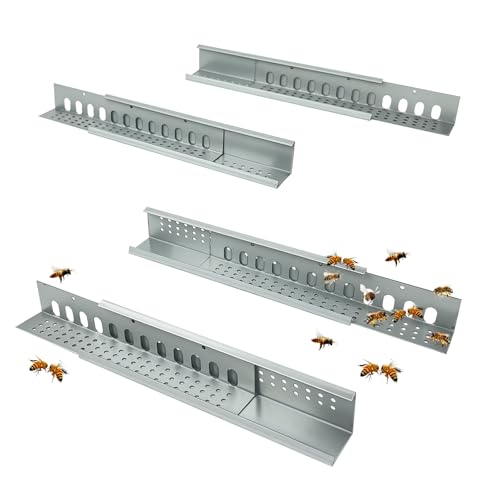
GJD Beehive Entrance Reducer and Sliding Mouse Guard, 4-Pack
GJD · Stainless steel entrance reducer with sliding mouse guard · 4 per pack (listed) · adjustable opening
Our verdict: This is the part that answers the two most common predator problems in American beekeeping with one purchase. It sizes the entrance down for defense against robbers and yellowjackets, and its openings pass bees while excluding mice, which wood cannot do because mice chew wood. Four for about $19 covers a small apiary. Install it in early fall, not December.
One part, two jobs, and both jobs are on the short list of things that actually kill colonies. A GJD stainless steel entrance reducer with sliding mouse guard narrows the entrance so a colony can defend it, which matters against fall yellowjackets and robbing bees, and it does that in steel, which matters against mice. A wooden reducer is not a mouse guard: a mouse will enlarge a wooden opening overnight and move in.
Practical notes: the sliding adjustment lets you run a wide-open summer setting, a reduced dearth setting, and a winter setting from one part, which is genuinely convenient. Check after a week that bees are flowing freely and that dead bees can be cleared through the opening, because a clogged winter entrance is a ventilation problem you created. Four in a pack is right for a small yard, and stainless means they are still usable in ten years.
Who should buy it
Buy these if you keep bees anywhere mice exist, which is everywhere, and especially if you overwinter colonies. They are also the right first purchase for anyone dealing with fall robbing pressure or yellowjackets, since a reduced entrance is step one before any screen.
What we don't like
The sliding mechanism in this price class can bind with propolis and needs a scrape now and then. Fit varies across the huge range of bottom board dimensions in the market, so verify against your equipment. And a mouse guard that clogs with winter dead bees becomes a ventilation problem, which means it is not truly install-and-forget.
- Material
- Stainless steel (listed)
- Functions
- Entrance reducer plus sliding mouse guard
- Count
- 4 per pack (listed)
- Adjustment
- Sliding, multiple opening widths
- Install window
- Early fall, before first frost
- Approx. price
- ~$19
Pros
- Answers mice and robbing pressure with one part
- Steel, so mice cannot chew through it
- Sliding adjustment covers summer, dearth, and winter settings
- Four per pack covers a small apiary
- Effectively permanent hardware at a consumable price
Cons
- Sliding mechanism gums up with propolis
- Fit varies against non-standard bottom boards
- Can clog with winter dead bees if not checked

BeeCastle Beehive Mouse Guard, 4-Pack
BeeCastle · Metal entrance mouse guard plates · 4 per pack (listed) · tacks across the hive entrance
Our verdict: If your reducers are wooden and working, this is the cheaper mental model: leave the reducer alone and add a metal plate that excludes mice. Four for about $20 covers a small yard. It does one job, it does it in metal, and unlike wood it cannot be chewed through in a night.
Sometimes the simplest part is the right part. The BeeCastle metal mouse guard 4-pack is a plate you fix across the hive entrance with openings sized to pass bees and stop mice. No sliding mechanism to gum up with propolis, no adjustment to get wrong, and nothing that changes about the entrance hardware you already like.
The argument for this over an all-in-one reducer is mostly about what you already own. Beekeepers with a drawer of wooden reducers that fit their bottom boards perfectly do not need to replace them; they need to stop mice, and mice are stopped by metal. Beekeepers starting from nothing are usually better served by the combined part, since one item is easier to actually install on schedule than two.
Same timing rule applies and it is the only rule that matters: install in early fall while the colony is still guarding. Same check applies too: after a week, confirm bees are moving freely and dead bees can clear. This is the last item in the entrance hardware family; the robbing side of the category is covered in our robbing screens guide.
Who should buy it
Buy these if you already run wooden entrance reducers you are happy with and simply want mouse exclusion in metal, or if your bottom boards are nonstandard enough that a sliding reducer will not seat properly. Four is a small-apiary quantity.
What we don't like
It does one job, so you still need a reducer for robbing and dearth defense, which means two parts to install instead of one. Fastening a plate to the hive front is slightly more fiddly than sliding a reducer in, and the fixing method is not equally convenient on every bottom board.
- Material
- Metal (listed)
- Function
- Mouse exclusion at the entrance
- Count
- 4 per pack (listed)
- Install window
- Early fall, before first frost
- Approx. price
- ~$20
Pros
- Single-purpose and hard to install wrong
- Metal construction mice cannot chew
- Works alongside entrance reducers you already own
- Four per pack at a low per-hive cost
Cons
- Does not reduce the entrance for robbing defense
- Two parts to manage instead of one
- Mounting is fiddlier than a sliding reducer

MayBee Adjustable Metal Bee Hive Stand
MayBee · Adjustable metal hive stand · adjustable height (listed) · levels on uneven ground
Our verdict: A skunk feeding at a ground-level entrance is comfortable. A skunk reaching up to a raised entrance is exposing its belly to stings, and the visits usually stop. That is the whole mechanism, and it comes bundled with drier woodenware, better airflow, and inspections you will actually finish. About $39.
The cheapest skunk deterrent is geometry. Raise the entrance and the meal becomes uncomfortable. A MayBee adjustable metal hive stand gets the hive to a height that changes the animal's calculation, and unlike most single-purpose deterrents it improves the hive on three other axes at the same time: the bottom board stays out of wet grass, air moves under the hive, and you inspect at a working height instead of bent double.
Adjustable legs are the feature that matters in real yards, because real yards are not level. Set the stand so the hive tilts slightly forward and rain drains out the entrance. Two cautions: legs sink into soft ground over a season, so put a paver under each foot and re-check level each spring, and a raised hive catches more wind, so strap the stack. We compare this stand against the full field in our stands and winter wraps guide.
Who should buy it
Buy it if your hives sit on blocks, pallets, or the ground, if you have skunk or opossum evidence at the entrance, or if your yard is sloped or holds water. It is the single purchase on this page that helps against the most different problems at once.
What we don't like
It is a metal frame at a beekeeping price, and stacked concrete blocks do the basic elevation job for less. The adjustable feet sink in soft ground and need periodic re-leveling. And elevation raises the wind profile, so it creates a small requirement for straps or lid weights.
- Type
- Adjustable metal hive stand
- Height
- Adjustable (listed)
- Predator benefit
- Raises entrance out of comfortable skunk reach
- Other benefits
- Off-ground clearance, airflow, leveling, working height
- Approx. price
- ~$39
Pros
- Direct, non-harmful skunk and opossum deterrent
- Keeps woodenware out of wet ground
- Levels on slopes and sets drainage tilt
- Working height makes inspections thorough
Cons
- Concrete blocks are cheaper for elevation alone
- Feet sink in soft ground
- Raises the hive's wind profile

Starkline 35 in x 164 ft Electric Netting Solar Kit
Starkline · 35 in x 164 ft electric netting · all-in-one solar kit (listed) · net, energizer, and hardware included
Our verdict: In bear country this is not a nice-to-have, it is the only thing that works. What makes this kit the practical pick is that it is complete: net, solar energizer, and hardware in one purchase, which is where piecemeal fence projects usually stall. 164 feet encloses a small apiary with working room, and netting is fast to install and easy to move.
Buy the fence before the bear, not after. A black bear that successfully raids an apiary returns, repeatedly, and teaches the behavior to cubs. A single visit typically destroys multiple hives outright: boxes torn apart, frames carried off, equipment scattered. Extension guidance in bear country, including the wildlife material from Penn State Extension, is unanimous that electric fencing is the only reliable protection, and the Starkline electric netting solar kit is the version most backyard beekeepers can actually install in an afternoon.
The all-in-one packaging is the real argument here. Beekeepers who buy netting and plan to source an energizer separately frequently end up with an unpowered fence sitting in a garage, or a mismatched energizer that cannot hold the line hot. Matched components remove that failure mode. Netting is also movable, which suits beekeepers who relocate hives seasonally or want to reconfigure a yard. Before you buy, call your state wildlife agency: several bear states offer cost-share, technical guidance, or specific standards for beekeepers, and our beekeeping laws by state guide points at the right offices.
Who should buy it
Buy it if you keep bees anywhere black bears are present, which includes far more of the country than most new beekeepers realize, and especially if your yard borders woods, brush, or a creek corridor. Install it before you have a loss, since a fence put up after the first raid protects less reliably.
What we don't like
It is a real expense against a threat that may never materialize in your particular yard, which makes it a hard purchase psychologically. Netting requires an ongoing mowing and trimming commitment, and the day the fence line grows in is the day the fence stops working. Solar energizers underperform in deeply shaded sites and short northern winter days.
- Size
- 35 in tall x 164 ft (listed)
- Kit
- Netting, solar energizer, and hardware (listed)
- Power
- Solar
- Use
- Bear exclusion around apiaries
- Portability
- Movable netting
- Approx. price
- ~$425
Pros
- The only category of defense that actually stops bears
- Complete kit removes the usual mismatched-component failure
- Fast to install and movable between sites
- 164 feet encloses a small apiary with working room
Cons
- Significant cost against an uncertain threat
- Requires ongoing vegetation control on the fence line
- Solar performance suffers in shade and short winter days

Premier 1 ElectroFence Plus Starter Kit
Premier 1 Supplies · ElectroFence Plus starter kit (listed) · Premier 1 fencing system · permanent apiary and livestock use
Our verdict: This is the fence you buy when the alternative is losing an apiary annually. Premier 1's fencing is a standard reference in livestock and wildlife exclusion, and the ElectroFence Plus starter kit is built for a permanent installation rather than a seasonal one. At about $968 it is the most expensive item we recommend anywhere on this site, and in the right yard it is the cheapest.
Scale changes the math. A backyard beekeeper with three hives can rationally decide a $425 netting kit is the right level of investment. A sideliner with fifteen colonies in a permanent out-yard on the edge of timber is looking at a different number on the loss side, and the Premier 1 ElectroFence Plus starter kit is what that beekeeper installs. Premier 1 is a name that shows up constantly in extension fencing recommendations for a reason: the systems are engineered, the components match, and the support material is thorough.
Everything in the fencing rules section above still applies and applies harder to a permanent installation: clear the fence line and keep it clear, ground the energizer to specification rather than by feel, test voltage on a schedule with an actual tester, and bait the fence at installation so the first bear contact is educational. A permanent fence that has quietly gone dead is more dangerous than no fence, because you have stopped watching.
Honest framing on the price: this is a livestock-grade fencing system, and beekeepers are buying into a product built for a broader agricultural market. If you keep other animals, that is a bonus. If you keep only bees and have a small yard, the netting kit above is very likely the correct purchase and this one is more fence than you need.
Who should buy it
Buy it if you run a permanent out-yard in serious bear country, if you have already lost hives to a bear, or if you keep livestock alongside bees and want one fencing system that serves both. It suits sideliners whose equipment investment has passed the point where a netting kit feels like adequate insurance.
What we don't like
It is close to a thousand dollars, which is more than most backyard beekeepers have invested in their entire apiary. It is a permanent installation, so it does not suit anyone who moves hives seasonally. And it is a livestock fencing system rather than a beekeeping product, which means part of what you are paying for is capability you will never use.
- Type
- ElectroFence Plus starter kit (listed)
- Use
- Permanent apiary and livestock exclusion
- Brand
- Premier 1 Supplies
- Best for
- Permanent out-yards and heavy bear pressure
- Approx. price
- ~$968
Pros
- Engineered, matched system from a reference fencing brand
- Built for permanent installation rather than seasonal use
- Serves livestock as well as apiary exclusion
- The right level of protection for a high-value out-yard
Cons
- Most expensive item we recommend anywhere
- Permanent installation, not portable
- More fence than a three-hive backyard needs
Rank the threats honestly before you buy anything
Beekeepers spend money on predators in almost exactly the wrong order. New beekeepers worry about bears, which most of them will never see, and about birds, which do not matter. They buy nothing for mice, which will kill more of their colonies than everything else on this page combined. The correct ordering, by how often a given predator actually costs an American backyard beekeeper a colony, looks like this.
| Predator | How often it costs a hive | What it does | The fix |
|---|---|---|---|
| Mice | Common, nationwide | Nest inside over winter, destroy comb, stress the cluster | Metal entrance reducer or mouse guard before first frost |
| Skunks and opossums | Common in most regions | Nightly feeding at the entrance, colony stress and defensiveness | Raised stand, then tack strips if needed |
| Yellowjackets and hornets | Common in fall | Rob and finish weak colonies | Reduced entrances, robbing screens, yard hygiene |
| Bears | Rare outside bear country, catastrophic within it | Total destruction of hives and equipment | Electric fencing, and nothing else |
| Raccoons | Occasional | Pry at lids, disturb hives at night | Ratchet straps and weighted lids |
| Birds, robber flies, dragonflies, mantises | Effectively never | Take individual foragers | Nothing; this is normal ecology |
Notice that the two most common threats are answered for under $60 combined, and the catastrophic one is answered by a single purchase you either need or do not. That is the whole budget conversation. Everything else is worry, and worry is not a line item. The broader budget picture for a first apiary lives in our beekeeping cost index.
Mice: the quiet killer nobody plans for
A mouse in a beehive in November is a winter-long disaster that unfolds silently. Here is how it happens. In early fall, while nights are cooling but before beekeepers start thinking about winter, mice go house hunting. A beehive is warm, dry, sheltered, full of food, and defended by insects that have gone cluster-passive in the cold. A mouse walks in the front door, moves to a back corner of the bottom box, chews out several frames of comb to make room, and builds a nest of grass, leaves, and shredded wax.
What it does from there is worse than the comb damage. The nest occupies space the cluster needs. The mouse urinates in the hive, and the smell is severe enough that bees will sometimes abandon the affected area. It disturbs the cluster repeatedly through winter, which costs the colony stores it cannot replace until spring. And you will not know any of this until March, because you should not be opening hives in January.
The hardware is trivially cheap. A GJD stainless steel entrance reducer and sliding mouse guard 4-pack at about $19 does both jobs in one piece: it sizes the entrance down for winter defense and its openings pass bees while blocking mice. If you would rather run a dedicated guard over a wooden reducer, the BeeCastle metal mouse guard 4-pack at about $20 is the same idea in a metal plate that tacks across the front.
Two field notes. Wooden entrance reducers alone are not mouse guards; mice chew wood, and a determined mouse will enlarge a wooden opening in a night. And check that bees can still clear dead bees through whatever you install, because a guard that clogs with winter dead is a guard that suffocates ventilation at the entrance. We compare the full entrance hardware category in our robbing screens and entrance reducers guide.
Skunks and opossums: reading the night visit
The most common misdiagnosis in beekeeping is "my bees turned mean." A colony that was pleasant in June and is aggressive in August, that boils out at the entrance the moment you approach, and that stings before you have opened anything, very often has a skunk visiting every night. The mechanism is exactly what it sounds like: the skunk comes to the entrance after dark, scratches at the landing board, and eats the guard bees that come out to investigate. Night after night. The colony learns that something at the entrance means attack, and by the time you show up in daylight, that lesson is fully installed.
The evidence is specific and easy to read once you know it. Look for shallow scratch marks in the wood of the landing board and the front of the bottom box. Look for matted, trampled grass directly in front of the hive. Look on the ground for small chewed-up wads: skunks chew bees and spit out the indigestible parts, and those wads are essentially a signature. Look for droppings near the hive, which frequently contain visible bee parts. And note the timing: this is a dawn diagnosis, not a midday one. Striped skunks are nocturnal and mostly insectivorous, which is exactly why a beehive is such an appealing nightly stop.
Opossums do a similar thing with a similar signature and usually less persistence. Both are answered the same way, and the primary answer is height. A skunk feeding at a ground-level entrance can stand comfortably on all fours. Raise the hive on a stand and it has to stretch up, exposing its belly to stings, and the visits usually stop. A MayBee adjustable metal hive stand at about $39 gets the entrance to a height that makes the meal genuinely unpleasant, and it pays for itself in inspection ergonomics and off-the-ground woodenware regardless.
One more clue that saves a lot of unnecessary requeening: if you were about to requeen a colony for aggression, walk the yard at dawn first. Requeening a colony that is being farmed by a skunk every night fixes nothing, and you will have spent money and a queen on the wrong diagnosis. Our requeening guide is the right call for genuinely hot genetics, and this section is the check you run before you get there.
Bears: electric fencing is the only answer
There is no hedge in this section, because there is no hedge in the literature. If you keep bees where black bears live, an electric fence is the only reliable protection for your apiary. Straps do not stop a bear. Weight on the lid does not stop a bear. Ratchet-strapping hives to a pallet does not stop a bear; it produces a bear dragging a pallet. Noise devices, lights, dogs, and repellents produce, at best, a delay. Extension programs in bear country, including the wildlife and beekeeping guidance published by Penn State Extension, are unanimous on this point, and the reason they are unanimous is that they collect the failure reports.
The behavioral fact behind the unanimity: a black bear that successfully raids an apiary will come back, repeatedly, and will teach the behavior to cubs. Bears are not after honey primarily; they are after brood, which is high-value protein. A single visit typically destroys multiple hives, not just knocks them over: boxes are torn apart, frames are carried off, and the equipment loss often exceeds the bee loss. This is why the correct sequence is to fence before you have a problem rather than after.
For most backyard and sideliner yards, electrified netting is the practical answer. A Starkline 35 inch by 164 foot electric netting all-in-one solar kit at about $425 includes the net, the solar energizer, and the hardware, which is what makes it the realistic purchase: a piecemeal fence where you source the energizer separately is where most projects stall. Netting is fast to install, movable, and enclosing a small apiary with 164 feet of it is straightforward.
For a permanent installation, a larger yard, or a site where you want a fence you will not be moving, the Premier 1 ElectroFence Plus starter kit at about $968 is the heavier-duty option from a company whose fencing is a standard reference in livestock and wildlife exclusion. It is a serious purchase, and it is the right one when the alternative is losing an apiary annually.
Finally, check your state. Several states with significant bear populations offer cost-share programs, technical assistance, or specific fence standards for beekeepers, and a few require certain measures before damage compensation is available. That information lives with your state wildlife agency and state apiary program, and it is worth a phone call before you spend $425 or $968. Our beekeeping laws by state guide is the starting point for finding the right office.
Raccoons and other lid-lifters
Raccoons are a nuisance-tier predator with an unusual capability: hands. A raccoon cannot destroy a hive the way a bear can, but it can pry at a telescoping cover, tip a lightweight lid, scratch at an entrance the way a skunk does, and generally disturb a colony repeatedly at night. In some yards raccoons will work an entrance for weeks, producing exactly the defensive-colony problem skunks cause.
The fix is mechanical and cheap. Strap each hive with a ratchet strap so the lid cannot be levered off, or put a heavy weight, a brick or a paver, on each cover. A strap is better because it also holds the whole stack together in wind and is the same item you use to move hives. Raising hives on a stand helps here too, as does keeping the yard clean of anything that smells like food.
Opossums fall into this same tier and are managed identically. So do the occasional reports of larger animals, deer knocking hives over while browsing, cattle using a hive as a scratching post, dogs digging near a stand. All of those are answered by a stand, a strap, and where livestock is the issue, a simple perimeter fence that has nothing to do with electricity.
Birds, robber flies, dragonflies, and mantises: interesting, not threatening
Every year beekeepers post photos of a bird catching bees at the entrance and ask what to do about it. The answer is nothing. In most of the United States, bird predation on honey bees is ecologically normal and numerically irrelevant. A colony at peak strength has tens of thousands of bees and loses foragers constantly to weather, age, and predation; a flycatcher taking a handful a day does not register against natural attrition. The famous specialist bee predators, the bee-eaters, are not North American birds, and where they do occur they are a beekeeping concern in a way that North American flycatchers, kingbirds, and swallows simply are not.
Robber flies are the same story with better photographs. These are large predatory flies that ambush insects in flight, including honey bees, and watching one take a forager is genuinely dramatic. They are individual predators taking individual bees, and there is no management response that is worth your time. Dragonflies likewise: in some regions late-summer dragonfly swarms will work an apiary and take bees, and it looks alarming, and the colony does not notice.
Praying mantises will sit at a hive entrance and pick off bees one at a time. Some beekeepers relocate them; most watch. Spiders build webs near entrances and catch bees; brush the webs off when you inspect if it bothers you.
The one honest caveat: if your colony is already tiny, every source of loss compounds. A five-frame nuc losing bees to everything at once is a colony in trouble, but the trouble is the colony's size, not the mantis. Fix the bee-to-comb ratio and the ecology stops mattering, which is the same principle that governs beetles in our small hive beetle guide.
Fall yellowjackets and hornets: the pressure that finishes weak colonies
This is the seasonal problem most likely to actually cost you a hive after mice. In late summer and fall, yellowjacket colonies are at peak population and their natural food is running out. They turn to scavenging and raiding, and a honey bee colony is a concentrated source of both sugar and protein. A strong hive with a well-defended entrance handles this fine. A weak, queenless, small, or recently disturbed colony does not, and once yellowjackets establish a raiding pattern the colony can be stripped in days.
The signature is distinct from robbing by other honey bees, though the two often happen together. Watch the entrance: yellowjackets are faster, more erratic, and visibly different in shape and color, and they will be picking off individual bees as well as going for stores. Dead bees on the ground with the thorax opened is a hornet or yellowjacket signature. Wasps working the front of a hive at the same time every afternoon is a raiding pattern, not a coincidence.
The answers are all about the entrance and the yard. Reduce entrances hard on any colony that is not strong, which is exactly what an entrance reducer is for; the GJD stainless steel reducer 4-pack covers this and the mouse job with one part. Add a robbing screen to weak colonies, which reroutes the entrance so raiders cannot find the way in while the resident bees learn the new path. And clean the yard: no burr comb on the ground, no exposed wet supers, no spilled syrup, no open feeder buckets. Our robbing screens and entrance reducers guide compares the screens in detail and is the right page if you are already under pressure.
One clarification worth making, because it comes up constantly: honey bee robbing, where a strong hive raids a weak one, is not predation but it looks identical from ten feet away and has the same outcome. The management is the same too: reduce the entrance, screen it, and fix the underlying weakness. If the weak colony is not going to make it, combining it with a strong one is usually the better call than defending it; our guide to combining hives covers the newspaper method.
The stand: the one purchase that answers three predators
If you buy one thing after reading this page, buy a stand. Height is a defense against skunks and opossums, because it turns a comfortable ground-level meal into an exposed stretch. Height keeps the bottom board out of wet grass, which reduces the damp microclimate that mice, mold, and small hive beetles all prefer. And height makes inspections faster and more thorough, which is a diagnostic benefit that shows up everywhere else in your beekeeping.
A MayBee adjustable metal hive stand at about $39 does all three, and the adjustable legs solve the practical problem most yards actually have, which is that the ground is not level. Set the stand so the hive tilts slightly forward and water drains out the entrance instead of pooling on the bottom board.
Two cautions. Adjustable legs can sink into soft ground over a season, so check level every spring; a paver under each foot solves it permanently. And a raised hive has a bigger wind profile, so strap the stack or weight the lid, which you should be doing anyway for raccoons. We compare stands against the alternatives in our stands and winter wraps guide.
Entrance hardware: what to install and when
Almost every predator on this page is answered at the entrance, which makes entrance hardware the highest-leverage $20 in beekeeping. The confusion is that three different jobs get done by parts that look similar: reducing the opening for defense, blocking mice specifically, and rerouting the entrance to defeat robbers. One part can do the first two; the third needs a screen.
| Hardware | Job | When to install |
|---|---|---|
| Wooden entrance reducer | Sizes the entrance for defense | New colonies, weak colonies, dearth, fall |
| Metal reducer with mouse guard | Defense plus mouse exclusion | Before the first frost, every colony |
| Metal mouse guard plate | Mouse exclusion over an existing entrance | Before the first frost, every colony |
| Robbing screen | Reroutes the entrance against robbers | Late summer and fall on weak colonies |
The GJD stainless steel entrance reducer and sliding mouse guard 4-pack at about $19 is the one-part answer for the first two jobs and the version we would put on a four-hive yard. The BeeCastle metal mouse guard 4-pack at about $20 is the plate-style alternative if you already run wooden reducers and just want the mouse job handled in metal.
Whatever you install, verify two things after a week: that bees are moving through it freely, and that dead bees can be cleared through the opening. A guard that clogs is a guard that suffocates the entrance in midwinter, which is a self-inflicted version of the exact problem you were trying to prevent.
Fencing specifics: getting an electric fence to actually work
Most electric fence failures are installation failures, not equipment failures. The four things that go wrong, in order of frequency: vegetation growing into the fence line and grounding it out, an undersized or dead energizer, poor grounding at the energizer itself, and a fence that was installed after the bear already learned the yard.
Vegetation. Grass and weeds touching an electrified net or wire drain the charge continuously, and a fence at low voltage is a fence a bear walks through. Mow or trim the fence line on a schedule, or lay down a weed barrier under it at installation. This is the single most common reason a fence that worked in May fails in July.
Energizer and grounding. Buy enough energizer for the fence length and then some, and install the ground rods to the manufacturer's specification rather than the shortcut version. A weak ground is functionally identical to a weak energizer. All-in-one solar kits like the Starkline package solve most of this by matching the components for you, which is a large part of their value.
Testing. Own a fence tester and use it. Voltage is not something you can assess by looking, and the failure mode is silent until the day it is not. Check after storms, after mowing, and monthly otherwise.
Baiting. The standard practice is to hang bacon, foil smeared with something greasy, or a similar attractant directly on the fence at installation so a bear's first investigation is nose to hot wire. That single contact is what teaches avoidance. A bear that walks the perimeter of an untested fence and never touches it has learned nothing.
Layout. Enclose the whole apiary with working room inside, not a tight ring around the hives, so a bear reaching over the fence cannot reach equipment. Keep the fence line clear of anything a bear could climb or use as a bridge.
Reading the evidence: a dawn diagnostic key
Walk the yard at first light once a week and this whole page becomes a five-minute routine. Predator sign is freshest at dawn, before dew burns off and before the day's bee traffic scuffs the ground. Here is the key.
Scratch marks on the landing board, trampled grass out front, small chewed wads on the ground, and a colony that has become aggressive: skunk or opossum. Raise the hive.
Chewed comb, a nest of grass and shredded wax in a corner of the bottom box, droppings, and a strong urine smell when you open in spring: mouse. This is a diagnosis you make too late; install guards next fall in early fall.
Hives knocked over, boxes torn apart, frames carried off, deep claw marks in woodenware, and equipment scattered over a wide area: bear. Fence, immediately, and contact your state wildlife agency.
A lid moved or levered off, hives disturbed but intact, small handlike tracks in mud: raccoon or opossum. Strap the lids.
Wasps working the entrance in a pattern, dead bees with opened thoraxes, and a weak colony under visible daily pressure: yellowjackets. Reduce the entrance, screen it, clean the yard.
Nothing at the entrance, but a colony that is dwindling anyway: not a predator. That is a mite, queen, or disease question, and our deadout diagnosis guide and varroa treatment guide are the right pages. Predator diagnosis is valuable partly because it rules things out fast.
A predator calendar for a backyard apiary
Spring. Remove or open mouse guards once the weather is reliably mild and the colony is building, so bees can move freely and clear debris. Check stand level after winter heave. Inspect the fence line if you run one, since winter is hard on netting and the first spring bears are hungry and exploratory.
Early summer. Low predator season, high management season. This is when to install a stand you have been meaning to buy, put in a fence before the yard grows, and get straps on every hive. Nothing is under pressure yet, which is exactly why the work gets done.
Late summer. Robbing season starts. Reduce entrances on weak colonies, deploy robbing screens, stop open feeding, and get religious about yard hygiene: no burr comb, no wet supers, no spilled syrup. Yellowjacket populations peak from here through fall.
Early fall. The mouse deadline. Install metal entrance reducers or mouse guards on every colony while nights are still mild and bees are still guarding. Do this before you do the wrap, before you do the feeding, before anything else in the winterizing sequence, because it is the item with a real calendar deadline attached.
Winter. Walk the yard after storms and check that entrances are clear of snow and dead bees. Confirm hives are still upright and strapped. Do not open colonies. If you find evidence of a mouse now, you are dealing with a problem that started in October, and the lesson is for next year.
How to Predator-Proof a Backyard Apiary
- 1
Assess the yard before you place a hive
Full sun, firm ground, and a site you can reach in winter. Note whether you are in bear country, whether the yard borders brush or a creek, and whether the ground stays wet, which invites everything from mice to mold.
- 2
Put every hive on a stand
A stand at working height keeps hives off wet ground, discourages skunks and opossums, and makes inspections fast. Level it and set a slight forward tilt so water drains out the entrance.
- 3
Install electric fencing first if you are in bear country
Do this before you have bees, not after your first loss. A bear that finds hives once will return, and a fence installed after the first raid protects far less reliably than one that was there from day one.
- 4
Reduce entrances and fit mouse guards before the first frost
Mice house-hunt in early fall, before beekeepers usually think about it. Install a steel entrance reducer or mouse guard while nights are still mild and the bees can still defend the front door.
- 5
Add tack strips or hardware cloth for persistent skunks
If a skunk keeps returning despite a raised stand, a board of upward-facing carpet tack strips or a bent hardware cloth apron in front of the entrance makes standing there unpleasant without harming the animal.
- 6
Manage fall robbing pressure
From late summer, reduce entrances on weak colonies, add robbing screens where needed, and remove every source of exposed honey, burr comb, and spilled syrup from the yard.
- 7
Strap lids and weight covers
A ratchet strap around each hive stops raccoons and opossums from levering a lid off and keeps a hive together in wind. It also slows a bear down, though it will not stop one.
- 8
Walk the yard at dawn once a week
Predator evidence is freshest at first light: scratch marks, disturbed grass, tracks, chewed bees, and knocked-over equipment. A weekly two-minute walk catches problems while they are still cheap.
More gear worth comparing
Beyond this guide: the highest-rated gear across every category and budget, with a live price check on each.



As an Amazon Associate we may earn from qualifying purchases, at no cost to you.
Quick shop: every pick
Skip the scroll: the whole lineup, with a live price check on each.
- GJD Beehive Entrance Reducer and Sliding Mouse Guard, 4-PackBest Entrance HardwareGJD · ~$19Check Price
- BeeCastle Beehive Mouse Guard, 4-PackBest Dedicated Mouse GuardBeeCastle · ~$20Check Price
- MayBee Adjustable Metal Bee Hive StandBest Skunk DefenseMayBee · ~$39Check Price
- Starkline 35 in x 164 ft Electric Netting Solar KitBest Bear Fence for Most YardsStarkline · ~$425Check Price
- Premier 1 ElectroFence Plus Starter KitBest Heavy-Duty FencePremier 1 Supplies · ~$968Check Price
Key terms
- Mouse guard
- A metal plate or reducer with openings sized to pass honey bees while excluding mice, installed across the entrance in early fall. Wood does not work for this job, because mice chew through a wooden reducer overnight.
- Entrance reducer
- A part that narrows the hive entrance so a colony can defend a smaller opening. Used on new and weak colonies, during dearth, and through fall and winter against robbers, yellowjackets, and cold.
- Robbing screen
- A screened entrance attachment that reroutes the way in, so resident bees learn the new path while robbers and wasps mill uselessly at the old entrance scent. The standard defense for a weak colony under fall pressure.
- Skunk sign
- The diagnostic set for a nightly skunk visit: shallow scratch marks on the landing board, trampled grass in front of the hive, small chewed wads of bee bodies on the ground, and a colony that has become unusually defensive.
- Tack strip deterrent
- A board of carpet tack strips laid points-up, or a folded hardware cloth apron with cut ends upward, placed in front of a hive entrance. It makes standing there unpleasant for a skunk or opossum without harming the animal.
- Fence baiting
- Hanging an attractant such as bacon or greasy foil directly on an electric fence at installation, so a bear's first investigation results in a nose-to-wire shock. The lesson, not the barrier, is what protects the apiary.
- Grounding out
- The loss of fence voltage when vegetation or another conductor contacts the electrified line and drains the charge to earth. It is the most common reason a working electric fence quietly stops working.
- Fall robbing
- The late-season pressure on weak colonies from yellowjackets, hornets, and stronger honey bee colonies as natural forage runs out. Managed with reduced entrances, robbing screens, and strict yard hygiene.
Questions, answered
how do I keep mice out of my beehive
Install a metal entrance reducer or mouse guard in early fall, while nights are still mild and the colony is actively guarding its entrance. Wooden reducers do not count, because mice chew through wood in a night. Installing in December often seals a mouse inside rather than keeping one out, and you will not discover it until spring.
what is scratching at my beehive at night
Almost certainly a skunk or an opossum. Look for shallow scratch marks on the landing board, trampled grass in front of the hive, and small chewed wads of bee bodies on the ground. A colony being visited nightly often turns defensive during the day, which beekeepers frequently misdiagnose as bad genetics.
why did my bees suddenly become aggressive
Before you requeen, walk the yard at dawn and look for skunk sign. A colony being farmed by a skunk every night learns that something at the entrance means attack, and it will meet you the same way. Other honest causes include queenlessness, robbing pressure, and a recent disturbance, but nightly predation is the one people miss most.
how do I protect beehives from bears
Electric fencing, and nothing else. Straps, weights, and pallets do not stop a black bear, and deterrents produce a delay at best. Install the fence before you have a problem, keep vegetation off the fence line, test the voltage on a schedule, and bait the fence at installation so the bear's first contact is nose to wire. Contact your state wildlife agency, since several bear states offer cost-share or technical help for beekeepers.
do I need an electric fence for my beehives
Only if black bears are present in your area, in which case yes, unequivocally. Bear range covers far more of the United States than most new beekeepers assume, including plenty of suburban edges, so check with your state wildlife agency rather than guessing. Outside bear country, mice and skunks are your actual predators and both are answered for under $60.
are birds a threat to honey bees
Not in North America, practically speaking. Flycatchers, kingbirds, and swallows take individual foragers, and a strong colony loses far more bees to weather and old age every day than to birds. The specialist bee-eaters that genuinely trouble beekeepers are not North American species. The exception is a very small colony, where the problem is the colony's size, not the bird.
how do I stop yellowjackets from attacking my hive
Reduce the entrance hard, add a robbing screen to weak colonies, and clean the yard of every source of exposed honey: no burr comb on the ground, no wet supers sitting out, no spilled syrup, no open feeding. Yellowjacket populations peak in late summer and fall as their natural food runs out, and they finish colonies that are already weak.
will a hive stand keep skunks away
Usually, yes. A skunk feeding at a ground-level entrance stands comfortably; a skunk reaching up to a raised entrance exposes its belly to stings and generally stops coming. If it persists, add a board of carpet tack strips points-up or a folded hardware cloth apron in front of the entrance, both of which deter without harming the animal.
when should I put mouse guards on beehives
Early fall, before the first frost and before mice start house hunting, which is earlier than most beekeepers think. This is the one item in the winterizing sequence with a hard calendar deadline. Put guards on while the weather is still mild and the colony is guarding, then verify after a week that bees can move freely and clear dead bees through the openings.
do raccoons bother beehives
They can. Raccoons have hands, so they pry at telescoping covers, tip light lids, and scratch at entrances the way skunks do. The fix is a ratchet strap around each hive or a heavy weight on every cover, plus a stand to raise the whole thing. Straps also hold hives together in wind, which makes them worth having regardless.
Filed under Explainer
Part of Hive Health
Keep reading
Small Hive Beetle Guide
The pest just below this page's size threshold, and the soil, sun, and stand strategy it shares.
Wax Moths in Beehives
The scavenger that moves in after a colony fails, and the storage protocol that protects your comb.
The Best Robbing Screens and Entrance Reducers (2026)
The full entrance hardware category, compared: reducers, guards, and screens for fall pressure.
How to Winterize a Beehive
Where mouse guards fall in the fall sequence, and why they come before the wrap.
The Best Beehive Stands and Winter Wraps (2026)
Stands compared in detail, plus the wrap-by-climate decision for cold regions.
Beehive Placement Guide
Siting for sun, drainage, access, and the predator pressure your yard already has.