Our Pick: KAGZ
Check PriceHive Top Feeder vs Entrance Feeder: Which Should You Buy?
The verdict: buy a hive top feeder as your primary feeder, and the KAGZ Hive Top Feeder at $37.99 is the one we would start with. It holds a listed gallon and a half directly above the cluster, refills without opening the brood nest, and keeps syrup inside the hive where robbers cannot smell an easy meal. Keep an entrance feeder for small doses you intend to stand and watch, and the AukBeeFun 4-pack at $13.99 is the cheap way to own several.
By The BeehiveKits Hive Desk2026-08-2913 min read Fact-checked against verified Amazon listingsHow we research
This is not a close comparison and we are not going to pretend it is. Robbing is the deciding factor. A colony being robbed loses its stores, often loses its queen, and can be dead inside forty-eight hours; small colonies, new packages, and late-season hives are the usual victims, and an entrance feeder is the most reliable way to start one. Everything else, capacity, drowning, cold-weather uptake, refill convenience, points the same direction.
That said, entrance feeders exist for reasons and we cover them honestly below: they are cheap, they let you see syrup level from ten feet away without touching the hive, and for a small measured dose under supervision they are perfectly fine. Frame feeders are the credible third option and we cover those too. What follows is the whole argument, plus the four feeders we would actually buy.
What to know
- Robbing risk decides it: an entrance feeder advertises free syrup to every colony in range and is the classic way to trigger a robbing frenzy.
- Capacity favors top feeders by an order of magnitude: about 1.5 gallons over the cluster versus a quart or two on the doorstep.
- Drowning is a design problem, not a syrup problem. Look for ladders, screened channels, or floats, and never fill a feeder that lacks them.
- Top feeders refill from above without opening the brood nest, which means you feed on cold days without breaking the cluster's heat.
- Bees will not cross a cold gap to reach a distant feeder. Syrup directly over the cluster gets taken; syrup at the entrance in October often does not.
- Frame feeders are the strong third option: excellent uptake, no robbing advertisement, but they cost you a frame of space and drown bees without a good ladder.
At a glance
| Pick | Type | Capacity | Robbing risk | Price | Check price |
|---|---|---|---|---|---|
| KAGZ Hive Top Feeder | Top feeder, 10 frame | 1.5 gallons, listed | Low | $37.99 | Check Price |
| NUOMIC Top Feeder, 2 pack | Top feeder, 6 channels | Listed by seller | Low | $58.99 | Check Price |
| Foxhound Bee Co Entrance Feeder | Entrance feeder | Half gallon, listed | High | $33.99 | Check Price |
| AukBeeFun Entrance Feeders, 4 pack | Entrance feeder | Jar-dependent | High | $13.99 | Check Price |
The four feeders, sorted by where the syrup sits. Capacities as listed by the seller; prices verified against live listings on 2026-08-29.

KAGZ Hive Top Bee Feeder for 10 Frame Beehive, 1.5 Gallons
KAGZ · 10-frame hive top feeder, 1.5 gallon capacity (listed)
Our verdict: This is the feeder we would put on a new colony without hesitating. At $37.99 it holds a listed 1.5 gallons, which is roughly a week of heavy feeding for a package, sits directly over the frames where bees reach it without leaving the hive, and refills by lifting only the outer cover.
The best feeder is the one that keeps syrup inside the hive. The KAGZ Hive Top Feeder sits above the frames under the outer cover, so the syrup never becomes a scent trail leading strange bees to your entrance. That single property is worth more than every other feature on this page.
Capacity is the second argument. A listed gallon and a half means you visit a hungry package roughly weekly instead of every other day, and each visit is a lift of the outer cover rather than an inspection. Fewer disturbances means less propolis broken, less heat lost, and less chance of chilling brood on a cool spring evening.
Check the drowning provisions before the first fill, as with any feeder. Bees walk down to syrup and need a way back up; a feeder without ladders or a float will accumulate dead bees. Our feeder roundup ranks the whole field and our syrup guide covers ratios and timing.
Who should buy it
Buy it if you are installing a package, feeding a nuc onto foundation, building up fall stores, or keeping bees anywhere robbing pressure is real, which is most places in late summer. It is the default feeder for a 10-frame hive.
What we don't like
It needs headroom, so you want a shim or an empty box under the outer cover. And syrup left in it too long grows mold, which means emptying at the end of a feeding period rather than forgetting about it.
- Type
- Hive top feeder (listed)
- Capacity
- 1.5 gallons (listed)
- Fit
- 10-frame beehive (listed)
- Refill access
- Lift outer cover only
- Robbing exposure
- Low, syrup stays inside the hive
- Price
- $37.99
Pros
- Large capacity means fewer refills
- Syrup stays inside the hive, away from robbers
- Refills without opening the brood nest
- Bees reach it without leaving the hive in cool weather
Cons
- Needs headroom above the frames
- Must be emptied and cleaned rather than left standing

NUOMIC 2 Pack 10 Frame Beehive Top Feeder, 6 Channels
NUOMIC · 2 pack, 10 frame hive top feeder, 6 channels, food grade (listed)
Our verdict: At $58.99 for two, this comes in under thirty dollars per hive, which makes it the obvious buy for anyone running a pair of colonies. The listed six-channel design gives bees more access points, which matters when a strong colony is taking syrup down fast in fall.
Beekeepers should run two hives, and two hives need two feeders. The NUOMIC 2 Pack Top Feeders solve that in one order at $58.99, which is cheaper per unit than buying singles. The listed six-channel layout means more bees can access syrup simultaneously, which shows up in fall when you are trying to get twenty pounds of stores into a colony before the weather closes.
The channel design also tends to reduce drowning, because bees work along defined runs rather than swimming across an open reservoir. Inspect the ladders and screens on arrival and add a float if you see bees struggling; a handful of clean sticks or a piece of window screen works.
Fall feeding is the job these earn their price on. Getting a light colony up to weight before winter is one of the highest-value actions in the beekeeping year, and the fall guide covers the schedule.
Who should buy it
Buy it if you run two colonies, which every beginner should, or if you want a spare feeder so a hive is never waiting on a wash-and-dry cycle during heavy fall feeding.
What we don't like
Buying two commits you to the format, and capacity is listed rather than specified in the way we would like. Same headroom requirement as any top feeder.
- Type
- Hive top feeder (listed)
- Count
- 2 feeders (listed)
- Channels
- 6 (listed)
- Material
- Food grade (listed)
- Fit
- 10-frame beehive (listed)
- Price
- $58.99
Pros
- Under thirty dollars per hive
- Multi-channel access suits heavy fall feeding
- Channel design reduces drowning versus open reservoirs
- Spare feeder means no downtime for cleaning
Cons
- Only worth it if you run two or more hives
- Capacity stated loosely by the seller

Foxhound Bee Co Plastic Entrance Feeder, Half Gallon
Foxhound Bee Co · Plastic entrance feeder, half gallon (listed), 2 count
Our verdict: If you want an entrance feeder, buy a good one. At $33.99 the Foxhound holds a listed half gallon, which is far more than a mason jar, and comes from a beekeeping supplier rather than a generic import. It still carries every robbing risk described on this page.
Entrance feeders have one genuine virtue: you can read the syrup level from across the yard. That is not nothing. You know when a colony needs a refill without suiting up, lighting a smoker, or lifting a lid, and for a beekeeper checking a hive before work, that visibility has real value. The Foxhound Bee Co Entrance Feeder is the best-built version we would point at, with a listed half-gallon capacity that beats the quart jars most entrance feeders use.
Use it the way it should be used: during a strong flow when robbing pressure is low, on a strong colony that can defend itself, for a measured dose you intend to check on. Do not use it on a new package, on a small colony, or in late summer when the flow has stopped and every colony in the neighborhood is looking for a target.
If you do get robbing, close the entrance down immediately, remove the feeder, and consider a robbing screen. Our robbing screens guide covers the hardware that stops it.
Who should buy it
Buy it if you want at-a-glance syrup monitoring on strong colonies during a flow, if you are feeding a small measured dose you plan to watch, or if you need a feeder that adds no height to a stack.
What we don't like
It puts syrup at the front door, which is the single riskiest place to put it. It also sits outside the hive, so in cold weather bees may not travel to it at all.
- Type
- Entrance feeder (listed)
- Capacity
- Half gallon (listed)
- Count
- 2 (listed)
- Robbing exposure
- High
- Cold weather uptake
- Poor
- Price
- $33.99
Pros
- Syrup level visible without opening the hive
- Adds no height to the stack
- Larger capacity than typical jar feeders
- Built by an actual bee supply company
Cons
- Highest robbing risk of any feeder type
- Bees may not travel to it in cold weather
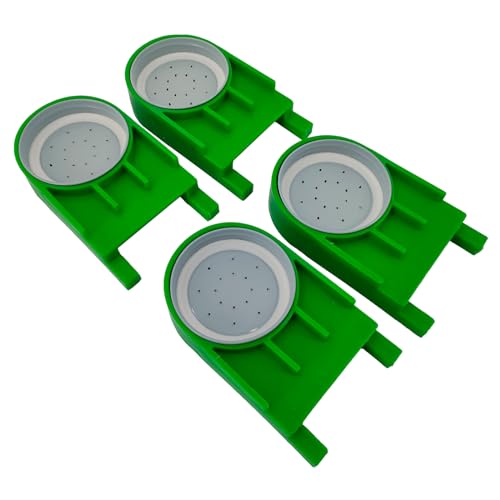
AukBeeFun 4 Pack Bee Entrance Feeder
AukBeeFun · 4 pack bee entrance feeder, green (listed)
Our verdict: At $13.99 for four these cost about three and a half dollars each, which is the right price for a tool with a narrow correct use. Buy them for small supervised doses across several hives, or for medicating and stimulating during a flow. Do not use them as your main feeder.
Cheap tools are fine when you understand their job. The AukBeeFun 4 Pack Entrance Feeders take a standard jar and let you put a small measured amount of syrup on several colonies at once, which is genuinely useful for stimulating brood rearing in early spring or dosing feeding supplements across a yard.
What they are not is a bulk feeding solution. A quart of syrup disappears from a building colony in a day or two, so as a package's main feeder this means daily visits, and every one of those refills is an opportunity for the smell of syrup to reach a neighboring colony. Use them alongside a top feeder, not instead of one.
If you are feeding supplements rather than plain syrup, the entrance feeder's visibility is actually an advantage, since you can see exactly how fast a dose is going down. Our supplements roundup covers what goes in the jar.
Who should buy it
Buy them if you run several hives and want a cheap way to deliver small measured doses, or as a supplementary feeder alongside a top feeder rather than a replacement for one.
What we don't like
Jar-dependent capacity means frequent refills, the plastic is value grade, and every one of them is an invitation to robbers if you leave it out after a flow ends.
- Type
- Entrance feeder (listed)
- Count
- 4 (listed)
- Capacity
- Jar-dependent
- Robbing exposure
- High
- Cost per feeder
- About $3.50
- Price
- $13.99
Pros
- Cheapest per-hive feeding option here
- Good for small measured or supplement doses
- Syrup level visible without opening the hive
- Enough units to cover a small apiary
Cons
- Small capacity means frequent refills
- Value-grade plastic and jar-dependent fit
The short answer
Buy a hive top feeder as your primary feeder. It holds enough syrup to matter, it refills without opening the brood nest, bees reach it without leaving the hive in cool weather, and, decisively, it keeps the syrup inside where a robbing colony cannot smell an unguarded meal. That is the whole case and it wins every category that carries consequences.
Buy an entrance feeder for one job only: a small measured dose on a strong colony during a flow, when you will be around to watch it. They are cheap, they let you read the syrup level without touching the hive, and used that way they are perfectly reasonable tools. Used as a main feeder on a new package in August, they are how beekeepers lose colonies.
Robbing: the reason this comparison is not close
Robbing is what happens when a colony decides another colony's stores are easier to take than nectar is to gather. It starts with a few scouts probing an entrance, escalates as recruits arrive, and can become a frenzy of thousands of bees within an hour. The defending colony fights, loses bees, often loses its queen, and can be stripped and dead inside two days. It is most likely in late summer and fall when flows have stopped, and the victims are almost always small or weak colonies.
An entrance feeder does three things that invite it. It puts the smell of sugar at the front door, where every scout bee in the neighborhood is already looking. It creates spillage and drips on the landing board that stray bees find. And it forces the defending colony to guard the resource at the exact point it is most vulnerable. Once robbing starts at an entrance feeder, removing the feeder often does not stop it, because the neighborhood has already learned the address.
A top feeder puts the syrup behind the hive's own defensive line. Robbers would have to fight their way through the entrance to reach it, which is a very different proposition. Guidance from extension bee-health programs consistently recommends internal feeders and reduced entrances during dearth for exactly this reason. If you feed in fall, feed inside.
The rest of the anti-robbing kit, reduced entrances, robbing screens, and not spilling syrup in the yard, is covered in our robbing screens and entrance reducers guide.
The full comparison table
| Factor | Hive top feeder | Entrance feeder | Frame feeder |
|---|---|---|---|
| Where the syrup sits | Above the frames, inside | At the entrance, outside | In the brood box, inside |
| Robbing risk | Low | High | Low |
| Typical capacity | About 1 to 2 gallons | A quart to a half gallon | About 1 gallon |
| Refill disturbance | Lift the outer cover | None. Swap the jar | Full hive opening |
| Cold weather uptake | Good. Directly over the cluster | Poor. Bees will not cross a cold gap | Good, if adjacent to the cluster |
| Drowning risk | Moderate without ladders | Low | High without a good ladder |
| Space cost | Headroom above frames | None | One or two frames of comb space |
| Level visible without opening | No | Yes | No |
| Best use | Primary feeder, all seasons | Small supervised doses in a flow | Heavy feeding when frames are spare |
| Price here | $37.99 to $58.99 | $13.99 to $33.99 | See our feeder roundup |
Capacity, and what a colony actually drinks
Capacity is not a vanity spec. A package installed on bare foundation needs to build an entire nest out of wax, and wax costs energy the colony does not have banked. In a heavy spring feeding period a building colony can take a quart a day, sometimes more, which means an entrance feeder holding a quart is a daily errand and a top feeder holding a gallon and a half is a weekly one.
Fall is the harder test. Getting a light colony up to overwintering weight can mean delivering twenty or more pounds of stores in a matter of weeks, and every gallon of 2:1 syrup only becomes a fraction of that once the bees drive the water out. Doing that through a quart jar is not a plan; it is a chore that will not get finished before the weather closes. This is the situation the NUOMIC 2 Pack Top Feeders exist for, and the winter feed guide covers the fondant and candy board options for when it is too cold for syrup entirely.
One rule regardless of capacity: stop feeding syrup before honey supers go on. Sugar syrup stored and capped in a super is not honey and should not be sold or labeled as such.
Drowning, and the designs that prevent it
Bees drown in feeders. It is the most avoidable loss in beekeeping and it is entirely a design problem. A bee walking down to a syrup surface needs a route back up, and a smooth plastic wall above a liquid does not provide one. A poorly designed feeder can accumulate hundreds of dead bees in a week, which is both a waste and a source of fermenting mess.
The features that solve it: ladders, textured or ribbed surfaces bees can climb; screened channels, mesh running down into the syrup so bees stand on the screen and drink through it; and floats, wooden or plastic rafts that give bees a dry landing on the surface. Multi-channel top feeders like the NUOMIC design tend to do well because bees work defined runs rather than open water.
Check every feeder before its first fill and improvise if the provisions look thin: a handful of clean straw, a piece of window screen bent into a ramp, or a few sticks laid across the surface all work. Entrance feeders are actually good on this measure, since bees drink through small holes in an inverted jar and never meet an open liquid surface at all. That is one of their two genuine advantages.
Refilling without opening the hive
Every hive opening costs the colony something. You break propolis seals the bees will rebuild, you release heat the brood nest needs, and on a cool day you risk chilling brood. Feeding is by definition something you do repeatedly over weeks, so the cost of a refill compounds.
A top feeder refills by lifting the outer cover and pouring. The frames stay covered, the brood nest stays sealed, and the whole operation takes under a minute without a smoker. An entrance feeder refills without touching the hive at all, which is technically better, though the difference between "one minute, no smoke" and "no contact" is small in practice. A frame feeder is the worst case: refilling means opening the hive, pulling the outer cover, the inner cover, and possibly a super, and reaching into the brood box.
This is why frame feeders, despite excellent uptake, are usually filled in bulk at the start of a feeding period rather than topped up frequently. It is also why we do not recommend them as a first feeder for someone still learning to handle a hive calmly.
Cold weather: why bees will not walk to the door
Here is the mechanism that catches beekeepers out every October. As temperatures drop, a colony contracts into a cluster to conserve heat, and the bees on the outside of that cluster are cold and largely immobile. The colony does not send foragers wandering around a chilly hive to look for food; it moves as a unit, slowly, upward through comb it is already touching. Honey bee thermoregulation is a cluster behavior, not an individual one.
Syrup at the entrance is therefore outside the colony's reach in cold weather, even though it is only a foot away. Beekeepers watch an entrance feeder sit untouched in November and conclude the bees do not need it, when what is actually happening is that they cannot get to it. Syrup directly above the cluster, in a top feeder, is in contact with the bees and gets taken.
There is a temperature floor regardless of feeder type. Below roughly 50F bees take syrup poorly, and cold syrup in a hive is a moisture problem the colony has to deal with. When it gets genuinely cold, switch from liquid to solid: fondant, candy boards, or dry sugar laid on newspaper over the frames. Our winter feed guide covers those, and our winterizing walkthrough covers where they sit in the stack.
Frame feeders: the credible third option
A frame feeder, sometimes called a division board feeder, is a hollow plastic reservoir shaped like a frame that hangs in the brood box in place of one or two frames. It typically holds around a gallon, sits right beside the cluster, and carries essentially no robbing risk because it is deep inside the hive.
Where it wins: uptake is excellent because the syrup is adjacent to the bees, capacity is good, and it adds no height to the stack, which matters if your hive is already tall or you are short. Commercial and sideline operations use them heavily.
Where it loses: it costs you a frame or two of comb space, which is real estate a building colony wants. It drowns bees enthusiastically without a proper ladder, and many budget versions ship with inadequate ones. And every refill means fully opening the hive, which is exactly what you want to avoid in cold or dearth conditions.
Our take: excellent second feeder for heavy spring feeding when you have spare frame space, poor first feeder for a beginner. The full field including frame feeders is ranked in the bee feeders guide.
When to feed at all
Feeding is a tool, not a routine. The situations that genuinely call for syrup: a newly installed package or nuc drawing comb on bare foundation, a colony that is light on stores going into winter, a colony recovering after a dearth, and a spring stimulation feed to encourage brood rearing ahead of the flow. Outside those, a colony with adequate stores in a decent flow does not need your help.
Ratios are simple. Spring and comb-building: 1:1 by weight, sugar to water, which mimics nectar and stimulates wax production. Fall stores: 2:1, thicker, so the bees have less water to evaporate before capping. Use plain white granulated sugar, never brown sugar, molasses, or honey from an unknown source, which can carry disease. Our syrup feeding guide covers mixing, storage, and mold prevention.
And the hard rule again: no syrup while honey supers are on. What you are storing then is sugar, not honey, and both the label and your reputation depend on the difference.
Pick a top feeder if / pick an entrance feeder if
Pick a hive top feeder if: you are feeding a new package or nuc; you are building fall stores; you keep bees anywhere robbing pressure exists, which is nearly everywhere after the flow ends; you want to feed in cool weather; or you want one feeder that handles every situation. Start with the KAGZ Hive Top Feeder at $37.99, or the NUOMIC 2 Pack at $58.99 if you run two hives.
Pick an entrance feeder if: you want a small measured dose on a strong colony during an active flow; you want to read syrup level from across the yard without touching the hive; you are delivering a feeding supplement rather than bulk syrup; or your stack has no headroom to spare. Buy the Foxhound Bee Co Entrance Feeder at $33.99 for the better build, or the AukBeeFun 4 Pack at $13.99 to cover several hives cheaply.
Pick a frame feeder if: you are feeding heavily in spring, you have frame space to spare, and you are comfortable opening a hive to refill. Add a ladder if the one it ships with looks thin.
What we would actually buy
For one hive: the KAGZ Hive Top Feeder at $37.99, plus a shim or empty medium to give it headroom under the outer cover. That is the whole feeding setup for a first year, and it will still be the right feeder in year ten.
For two hives, which is what we recommend every beginner start with: the NUOMIC 2 Pack Top Feeders at $58.99, under thirty dollars a colony, with the six-channel layout that handles heavy fall feeding.
Add the AukBeeFun 4 Pack at $13.99 for spring stimulation doses and supplements, understanding exactly what they are for and when to take them off. Then buy an entrance reducer and, if you keep bees in a robbing-heavy area, a robbing screen from our robbing screens guide. For the cold months when syrup stops working entirely, the fondant and candy boards in our winter feed guide take over.
More gear worth comparing
Beyond this guide: the highest-rated gear across every category and budget, with a live price check on each.



As an Amazon Associate we may earn from qualifying purchases, at no cost to you.
Quick shop: every pick
Skip the scroll: the whole lineup, with a live price check on each.
- KAGZ Hive Top Bee Feeder for 10 Frame Beehive, 1.5 GallonsBest OverallKAGZ · $37.99Check Price
- NUOMIC 2 Pack 10 Frame Beehive Top Feeder, 6 ChannelsBest for Two HivesNUOMIC · $58.99Check Price
- Foxhound Bee Co Plastic Entrance Feeder, Half GallonBest Entrance FeederFoxhound Bee Co · $33.99Check Price
- AukBeeFun 4 Pack Bee Entrance FeederBest ValueAukBeeFun · $13.99Check Price
How we chose
We judge feeders on the four things that decide outcomes: robbing exposure, how much syrup they hold, whether bees drown in them, and whether you can refill without breaking the cluster.
Capacities and channel counts are reported as listed by the seller. We flag manufacturer figures rather than asserting volumes we have not measured.
Robbing and cold-weather guidance is grounded in extension bee-health sources, cited inline, because this is where beginners lose colonies.
We assume 1:1 syrup in spring and 2:1 in fall, and we assume you stop feeding syrup before honey supers go on. Both are standard practice.
Prices come from live Amazon listings verified on the byline date. No brand paid for placement in this or any BeehiveKits guide.
Key terms
- Hive top feeder
- A shallow reservoir that sits above the frames under the outer cover, typically holding a gallon or more, refilled without opening the brood nest.
- Entrance feeder
- An inverted jar or reservoir sitting in the hive entrance. Cheap and visible, but it puts syrup at the front door where robbers find it.
- Frame feeder
- A hollow reservoir shaped like a frame that hangs inside the brood box. Great uptake, no robbing risk, costs comb space and requires opening the hive to refill.
- Robbing
- One colony stripping another's stores. Escalates fast, can kill a small colony in days, and is most likely during dearth. The main reason to feed inside the hive.
- Dearth
- A period with little or no nectar available. Robbing pressure peaks here, which is exactly when beekeepers reach for feeders.
- 1:1 syrup
- Equal parts sugar and water by weight. Mimics nectar, stimulates comb building and brood rearing. The spring ratio.
- 2:1 syrup
- Two parts sugar to one part water by weight. Thicker, less water for the bees to evaporate. The fall ratio for building winter stores.
- Cluster
- The ball a colony forms in cold weather to conserve heat. It moves as a unit through comb it touches, which is why distant feeders go untouched in winter.
Questions, answered
hive top feeder vs entrance feeder which is better
A hive top feeder, in nearly every situation. It holds far more syrup, keeps it inside the hive where robbers cannot reach it, and lets bees feed without leaving the cluster in cool weather. Entrance feeders are cheap and let you see the syrup level from a distance, which makes them fine for small supervised doses on strong colonies during a flow, and poor for anything else.
do entrance feeders cause robbing
They significantly raise the risk. An entrance feeder puts the smell of sugar at the front door, creates drips on the landing board, and forces the colony to defend the resource at its most vulnerable point. Robbing is most likely in late summer and fall when flows have stopped, and small or new colonies are usually the victims. Feed inside the hive during dearth.
how much syrup does a new package of bees need
A building colony can take a quart a day or more while drawing comb, and heavy feeding may continue for several weeks until the box is drawn out. That is why capacity matters: a gallon and a half top feeder is a weekly refill where a quart jar is a daily errand. Feed 1:1 syrup in spring and stop before honey supers go on.
why won't my bees take syrup from the feeder
Three common reasons. It is too cold, and below roughly 50F bees take syrup poorly. The feeder is too far from the cluster, which is the classic entrance feeder failure in fall, since a cluster will not cross a cold gap. Or there is a natural flow on and they simply prefer nectar. Move the syrup over the cluster or switch to fondant if it is genuinely cold.
how do you stop bees drowning in a feeder
Look for ladders, screened channels, or floats before you buy, and improvise if the provisions look thin. Clean sticks laid on the surface, a folded piece of window screen, or a wooden raft all give bees a way back out. Multi-channel top feeders tend to do well because bees work defined runs rather than an open liquid surface.
can you feed bees in winter
Not with liquid syrup once it is genuinely cold. Bees take syrup poorly below roughly 50F, and adding water to a hive in winter creates a condensation problem. Switch to solids: fondant, a candy board, or dry sugar on newspaper laid directly over the frames where the cluster can reach it. The best winter feeding is the fall feeding you did in September.
are frame feeders better than top feeders
They have better uptake because the syrup sits right beside the cluster, and they carry no robbing risk. But they cost you a frame or two of comb space, they drown bees without a good ladder, and every refill means fully opening the hive. We treat them as an excellent second feeder for heavy spring feeding and a poor first feeder for a beginner.
when should you stop feeding bees sugar syrup
Stop before honey supers go on, without exception, because syrup stored and capped in a super is sugar and not honey. Otherwise stop when the colony stops taking it, when a strong natural flow starts, or when it gets too cold for the bees to process the water. In fall, aim to finish syrup feeding while daytime temperatures are still reliably above 50F.
what ratio of sugar to water should i feed bees
Use 1:1 by weight in spring, which mimics nectar and stimulates comb building and brood rearing, and 2:1 by weight in fall, which is thicker so the bees have less water to drive off before capping. Use plain white granulated sugar only. Never use brown sugar, molasses, or honey from an unknown source, which can carry disease into your hive.
how many feeders do you need for two hives
One per hive, so two. Feeding is not something you can rotate between colonies, because a hungry colony that runs dry for three days loses ground you then have to make up. A two-pack of top feeders costs under thirty dollars per hive and means both colonies feed on the same schedule, which also makes comparing their progress meaningful.
Filed under Comparison
Keep reading
The Best Bee Feeders (2026)
The full field ranked: top, entrance, frame, and boardman-style feeders compared.
How to Feed Bees Sugar Syrup
Ratios, mixing, mold prevention, and when feeding actually helps a colony.
The Best Winter Bee Feed
Fondant, candy boards, and dry sugar for when it is too cold for syrup.
Best Robbing Screens and Entrance Reducers
The hardware that stops a robbing frenzy before it kills a small colony.
Package Bees vs Nuc
Which bees to buy, and why a package needs far more feeding than a nuc.
How to Winterize a Beehive
Where the feeder sits in the fall stack, and when to switch to solids.