Our Pick: Lehmans
Check PriceSummer Beekeeping: The Flow, the Harvest, and the Dearth
If summer has one purchase that changes the work, it is a bee escape board: the Lehman's Stoney Acres triangle escape board for 10-frame hives ($40.98) clears a super of bees overnight with no smoke, no brushing, and no angry cloud at four in the afternoon, which is the difference between harvest being a pleasure and harvest being the reason people quit. Put it under the super the evening before and lift a nearly empty box the next morning.
By The BeehiveKits Hive Desk2026-08-2918 min read Fact-checked against verified Amazon listingsHow we research
Here is the shape of the season. Colony population peaks in early summer, somewhere between forty and sixty thousand bees in a strong hive, and for a few weeks that population sits on top of the year's best forage. Nectar comes in faster than the bees can dry it, supers fill in days rather than weeks, and the whole apiary smells like whatever is blooming. Then, usually between late June and early August depending on where you live, the flow simply stops. Not tapers: stops. And the colony that was too busy to care about you last week becomes a colony that will follow you to the truck.
That switch is the organizing fact of summer management. Before it, your jobs are space, monitoring, water, and harvest. After it, your jobs are defense: reduced entrances, robbing screens, shorter inspections, no spilled syrup, and an honest reckoning with small hive beetles, which thrive in exactly the hot weak-colony conditions a dearth produces. Get the transition wrong and you can lose a colony in a single afternoon to robbing that started because you left a frame of honey sitting on a hive lid.
This is the summer chapter of a four-season set. It follows the spring guide, hands off to the fall guide, which is the most consequential of the four, and closes with the winter guide. For the whole year at lower magnification, see the first-year beekeeping calendar. Standard disclosure: no brand paid for placement, some links go to Amazon where purchases may earn us a small commission at no extra cost to you, and prices were verified at publication.
What to know
- Summer is two seasons: the flow, where the job is space and harvest, and the dearth, where the job is defense.
- Keep supers ahead through the flow. A colony with nowhere to put nectar stops storing, and you lose crop you already grew.
- Do not leave supers on past the flow. Bees eat stored honey during a dearth, beetles find unattended boxes, and your crop shrinks while you wait.
- Honey is ripe below about 18.6 percent moisture. Capped comb is the field test; a refractometer is the confirmation before you bottle.
- Mite counts continue monthly all summer even though supers restrict what you can do about them, because the July number is what makes the August decision.
- Water is not optional. A colony can consume a remarkable amount in a heat wave, and if you do not supply it, your neighbors will involuntarily.
- In a dearth, one spilled cup of syrup or one exposed frame of honey can start a robbing frenzy that kills a weak colony the same day.
At a glance
| Gear | The summer job it serves | When you need it in hand | Price | Check price |
|---|---|---|---|---|
| Lehman's Triangle Bee Escape Board, 10-Frame | Clear supers before harvest | The week your first super caps over | $40.98 | Check Price |
| VEVOR 2/4 Frame Electric Honey Extractor | Extract the crop | Harvest week, or borrow one | $209.90 | Check Price |
| aichose Honey Refractometer | Confirm moisture before bottling | Before you fill a single jar | $22.88 | Check Price |
| Blythewood Bee Smart Robbing Screen | Dearth defense on weaker colonies | The day the flow stops | $17.50 | Check Price |
| witbee Beetle Blaster Traps, 50-Pack | Small hive beetle pressure | Early summer in the South | $29.99 | Check Price |
| Retyion Bee Watering Station, 4-Pack | Water in heat | Before the first 90F week | $17.83 | Check Price |
The summer gear stack, matched to the job that demands it

Lehman's Stoney Acres Triangle Bee Escape Board, 10-Frame
Lehmans · 10-frame Langstroth fit · triangular one-way maze · no chemicals, no power, no noise
Our verdict: The purchase that makes harvest pleasant rather than adversarial. A triangle escape exploits the bees' own difficulty navigating a maze backward, so they filter down into the brood nest overnight and cannot easily return. You do nothing except place it and come back.
Every method of clearing bees from supers is a tradeoff between speed, smell, noise, and how annoyed the colony gets. The Lehman's triangle bee escape board ($40.98) trades speed for everything else: it takes overnight, and in exchange it requires no repellent, no blower, and no brush, and it leaves the colony essentially undisturbed.
Practical notes. Place it with the triangle side down, under the supers you want cleared and above the brood boxes, in the evening. Give it eight to twenty-four hours; longer than that and bees start finding their way back up. It works best when nights are cool enough to draw bees down to the cluster, and less well in a hot southern August when the supers stay comfortable. Alternatives, including fume boards and one-way entrance escapes, are compared in best bee escape boards.
Who should buy it
Any keeper harvesting more than a frame or two, especially anyone in a suburban yard where a cloud of displaced bees is a neighbor problem as well as a nuisance.
What we don't like
It requires two trips to the apiary and a night of patience, which does not suit someone harvesting on a single Saturday afternoon. It also underperforms in hot weather when bees have no thermal reason to move down.
- Fit
- 10-frame Langstroth (listed)
- Type
- Triangle one-way escape
- Time to clear
- Roughly 8 to 24 hours
- Consumables
- None
- Price
- $40.98
Pros
- No chemicals, noise, or brushing
- Colony stays calm through the whole process
- Reusable indefinitely with no consumables
- Ideal for suburban yards with close neighbors
Cons
- Needs an overnight wait and two apiary trips
- Less effective in hot weather
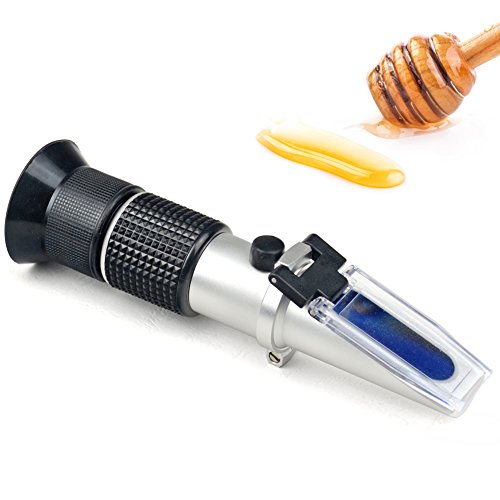
aichose Honey Refractometer
aichose · Reads honey moisture, Brix, and Baume · handheld optical refractometer · calibration solution typically included (listed)
Our verdict: The cheapest insurance in the harvest chain. Honey above roughly 18.6 percent moisture can ferment, and a fermented five-gallon bucket costs many times what this tool does. One drop, one look through the eyepiece, one number.
Capping is the bees' verdict on ripeness and it is usually right, but partly capped frames, mixed batches, and humid harvest weather all introduce doubt. An aichose honey refractometer ($22.88) resolves it in under a minute: a drop on the prism, hold it to the light, read the moisture scale.
Calibrate it before first use with the supplied solution and re-check it occasionally, since optical refractometers drift with temperature and handling. If your reading comes in high, options include running a dehumidifier in a closed room with the supers before extracting, or blending with a drier batch. The full harvest process is in how to harvest honey.
Who should buy it
Anyone who bottles honey for anyone other than themselves, and anyone harvesting in a humid climate where partial capping is common.
What we don't like
Cheap optical units need calibration and careful temperature handling to be trustworthy, and reading the scale takes a little practice. It tells you moisture, not quality or floral source.
- Measures
- Honey moisture, Brix, Baume (listed)
- Type
- Handheld optical refractometer
- Calibration
- Solution typically included (listed)
- Target reading
- Below about 18.6 percent moisture
- Price
- $22.88
Pros
- Prevents fermented honey for the price of a jar lid
- Fast enough to check every batch
- Also reads Brix for mead and syrup work
- Pocket-sized and rugged in its case
Cons
- Needs calibration and warm-up to read accurately
- Optical scale takes practice to read confidently

Blythewood Bee Company Bee Smart Robbing Screen
Blythewood Bee Co · Screened front with offset entry · residents reorient in about 24 hours · installed at the start of the dearth
Our verdict: The most cost-effective way to keep a weak colony alive through a dearth. It works on behavior rather than force: robbers home in on the scent coming straight through the screen, while the colony's own bees quickly learn the offset route around it.
Robbing is fast, and by the time you notice it the arithmetic is usually against you. A Blythewood Bee Smart robbing screen ($17.50) is the preventive version: install it at the start of the dearth on nucs, recent splits, and any colony that looks under-populated for its box count.
Install it before you need it. Resident bees need roughly a day to reorient to the offset entrance, and a colony that is already under attack has no spare capacity for a navigation lesson. Take it off when the fall flow arrives or when the colony is strong enough to defend a normal entrance. Entrance reducers, mouse guards, and the rest of the front-door hardware are compared in robbing screens and entrance reducers.
Who should buy it
Anyone running nucs, splits, or a mismatched pair of colonies through a summer dearth, and everyone in the South, where the dearth is long and severe.
What we don't like
It confuses the colony's own foragers for the first day, so installing mid-crisis is much less effective than installing early. It also needs to come off when the fall flow starts or it throttles a colony that is trying to work.
- Type
- Screened robbing guard with offset entry
- Fit
- Standard Langstroth front (listed)
- Adjustment period
- About 24 hours for residents
- Season used
- Dearth through late summer
- Price
- $17.50
Pros
- Cheap enough to run on every vulnerable colony
- Works on behavior, not brute force
- Reusable season after season
- Pairs naturally with an entrance reducer
Cons
- Must be installed before robbing starts
- Needs removal once the fall flow begins

witbee Beetle Blaster Hive Beetle Traps, 50-Pack
witbee · 50 plastic oil traps · sits between top bars · filled with vegetable or mineral oil by the user
Our verdict: The mainstream mechanical answer to hive beetles, and at fifty traps for thirty dollars the per-hive cost stops being a consideration. Beetles fleeing bee patrols fall in and drown, which converts the colony's own defensive behavior into a trapping mechanism.
Beetle management is a strength problem first and a trap problem second, but traps are the part you can buy. witbee Beetle Blaster traps ($29.99 for 50) wedge between top bars, hold a shallow reservoir of oil, and catch beetles that the bees chase into the gaps.
Fill with vegetable or mineral oil only, keep the fill level below the rim so it does not slosh into comb, and swap them when they fill. Run them alongside the structural fixes that matter more: right-sized boxes for the colony's population, prompt extraction of harvested supers, and hives sited on dry, sunny ground where larvae struggle to pupate. Full pest profile in the small hive beetle guide.
Who should buy it
Every keeper in the Southeast and Gulf states, and anyone anywhere running colonies that are under-populated for their box count.
What we don't like
Traps treat the symptom. A colony with more comb than bees will keep producing beetles no matter how many traps you run, and no trap saves a hive that has already slimed. Refilling and swapping is also a small ongoing chore.
- Quantity
- 50 traps
- Placement
- Between top bars
- Fill
- Vegetable or mineral oil (user supplied)
- Best for
- Warm, humid regions
- Price
- $29.99
Pros
- Per-hive cost is negligible at this quantity
- Uses the colony's own patrolling behavior
- No chemicals inside the hive
- Easy to inspect and swap
Cons
- Does not fix the underlying strength problem
- Oil refills are an ongoing chore

Retyion Bee Watering Station, 4-Pack
Retyion · 4 shallow garden watering stations · landing surface prevents drowning · sited near the apiary before hot weather
Our verdict: A twenty-dollar answer to two problems at once: colony welfare in a heat wave and the neighbor relations that determine whether backyard beekeeping stays legal in your town. The only trick is establishing them early, because bees are loyal to the water source they found first.
Bees need a lot of water in hot weather and they are not particular about where it comes from, which is the problem. Retyion bee watering stations ($17.83 for four) give you multiple shallow sources with landing surfaces so bees can drink without drowning.
Set them out in early spring, before the pool cover comes off next door. Keep them topped up on a schedule, since a station that goes dry for two days teaches the colony to look elsewhere. Some keepers add a pinch of salt or leave a little algae, both of which appear to make a source more attractive. The full range of watering approaches, from these to converted birdbaths, is in best bee water stations.
Who should buy it
Every backyard keeper, and urgently anyone whose neighbors have a pool, hot tub, pet bowl, or air conditioner condensate line within a few hundred yards.
What we don't like
Small reservoirs dry out fast in real heat, which means a daily or near-daily top-up habit. Bees also frequently prefer a muddy puddle you did not build, and there is not much you can do about that.
- Quantity
- 4 stations
- Depth
- Shallow with landing surface
- Placement
- Near but not directly at hive entrances
- Set out
- Early spring, before hot weather
- Price
- $17.83
Pros
- Cheap fix for a real neighbor problem
- Multiple stations spread the load
- Landing surface prevents drownings
- Easy to refill on a routine
Cons
- Small volume needs frequent topping up
- Bees may still prefer a source you did not choose

VEVOR 2/4 Frame Electric Honey Extractor
VEVOR · 2 frames tangential or 4 frames radial (listed) · electric drive · stainless drum with honey gate (listed)
Our verdict: The size most backyard keepers with two to six hives land on, and the point at which extraction stops being an all-day project. The real argument is not speed, it is that spinning returns intact drawn comb to the colony while crush and strain destroys it.
Crush and strain works and costs nothing, but it burns the comb, and comb is expensive for bees to build. A VEVOR 2/4 frame electric extractor ($209.90) returns each frame intact, which means next season's colony starts with drawn comb instead of foundation and can put nectar into storage immediately.
Before you buy: check whether your club lends one. Borrowing for a season tells you whether four frames is enough for your operation, and many keepers discover they want more capacity while others discover they harvest twice a year and could rent forever. Sizing logic is in the honey extractor size guide, the full verdict is in the VEVOR extractor review, and the whole field is in best honey extractors.
Who should buy it
Keepers running two to six colonies who harvest annually and have somewhere sticky-tolerant to work. Below two colonies, borrow. Above eight, look at six-frame and larger units.
What we don't like
It is the single largest summer expense on this page, it needs real storage space, and cleanup is a genuine chore. Lightweight extractors also want to walk across the floor if frames are unbalanced, so plan to secure it.
- Capacity
- 2 frames tangential or 4 radial (listed)
- Drive
- Electric motor (listed)
- Drum
- Stainless steel with honey gate (listed)
- Best for
- 2 to 6 colonies
- Price
- $209.90
Pros
- Returns drawn comb instead of destroying it
- Electric drive makes a multi-hive harvest practical
- Honey gate feeds straight into a strainer and bucket
- Sized sensibly for a backyard operation
Cons
- The biggest single summer purchase here
- Storage and cleanup are real considerations
What the colony is doing: peak, then pivot
Early summer is the top of the curve. The spring buildup has run its course, the queen has been laying at capacity for weeks, and the colony now holds its maximum population of the year, with a foraging force large enough to exploit the main flow at full intensity. Nectar arrives as a dilute sugar solution, roughly 70 to 80 percent water depending on the source, and the colony's entire indoor operation reorganizes around drying it: bees fan continuously, spread nectar in thin films across cell walls, and only cap a cell once the moisture is low enough for the honey to keep. Capping is the bees' own quality certificate, which is why we treat it as the primary field test for ripeness.
Then the flow ends. In most temperate regions the main flow shuts down between late June and mid-July, and the colony's program flips from acquisition to conservation within about a week. The queen slows her laying, because there is no point rearing foragers for an empty landscape. Drones start getting pushed toward the edges and eventually evicted. Guard behavior intensifies sharply. And the colony begins evaluating its neighbors as a food source, which is the origin of every robbing story you will hear at a club meeting.
You can read the switch without a calendar. Flight looks aimless rather than purposeful. Bees start investigating your truck, your gloves, the lid you set down. Fewer bees are bearding out front on hot evenings and more are patrolling entrances. Nectar stops appearing as shiny uncapped liquid in the top super. Once you see this pattern, everything in the second half of this guide applies and everything in the first half stops applying.
Meanwhile the mite population is doing its own thing, invisibly. Varroa reproduces in capped brood, and a summer colony has had months of abundant brood to work with, so mite numbers that looked fine in May often look alarming in July. Extension programs and the Honey Bee Health Coalition both stress that late-summer mite loads climb faster than beekeepers expect, partly because the bee population starts falling while the mite population keeps rising, which pushes the mites-per-hundred-bees ratio up from both directions at once.
How to work a summer apiary without making things worse
Three practical adjustments make the whole season easier.
Time your visits. Mid-morning to early afternoon on a clear day puts the maximum number of foragers in the field and the minimum number in your face. In a heat wave, work early; a colony opened at 2pm in 98F weather loses thermal control you spent nothing to disrupt and everything to restore.
Shorten your inspections as the season progresses. During the flow, a full inspection is fine and useful. During a dearth, every minute a hive is open is a minute its stores are advertised to the neighborhood. Dearth-season inspections should answer one or two specific questions and close.
Never set honey down outdoors. Not on the lid, not on the truck tailgate, not in an open bucket. During a flow you might get away with it. During a dearth it is how a robbing frenzy starts, and once started it is extremely hard to stop. Every frame of honey you remove goes straight into a covered box or a closed vehicle.
The general inspection technique, including smoke discipline and frame handling, is in how to do a hive inspection. Summer only changes the pacing and the stakes.
Job 1: Keep supers ahead through the flow
Same principle as spring, higher stakes: add the next super when the current one is roughly 70 to 80 percent drawn and occupied. A colony that runs out of room during a strong flow does one of two things, and neither is what you want. It either backfills the brood nest with nectar, which crowds the queen and can trigger a late swarm, or it simply slows collection, which means the flow is passing through your yard and into somebody else's hive.
During a heavy flow a strong colony can fill a medium super in under a week, so checking weekly during the flow is not excessive. You do not need a full inspection for this: tilt the top box, judge weight, and lift the outer frames of the top super to see whether they are being worked. If the outer frames are drawn and holding nectar, add a box.
Where to add it is a small debate with a practical answer. Top supering, putting the new box on top, is easier and works fine. Bottom supering, putting the new box directly above the brood nest under the existing supers, arguably matches the bees' preference to store upward and outward from the nest and reduces the distance foragers travel. In a backyard operation the difference is minor; do whichever you will actually keep up with. Deep versus medium supers, and why we default to mediums, is argued in deep vs medium supers.
The corollary that beginners miss: take supers off when the flow ends. Honey left on the hive through a dearth gets eaten, and honey left on an under-populated hive gets colonized by small hive beetles and wax moths. If a super is capped and the flow is over, it belongs in your kitchen, not on the colony.
Job 2: Monitor mites monthly, even though you cannot treat
This job feels pointless to beginners and is the most quietly important thing on the summer list. With supers on, most treatments are unavailable to you, so what is the value of counting? The value is that the July count is the input to the August decision, and the August decision is the one that determines whether the colony sees March.
The mechanism is worth stating plainly. Winter bees, the physiologically distinct, long-lived bees that carry a colony through winter, are reared beginning in late summer. If they are reared in a high-mite colony, they emerge damaged and virus-loaded and do not live the six months the job requires. That is why our fall guide calls August the year's most important month, and why your July number is the number that tells you how urgent August is.
Count monthly with the same method and the same sample size so the numbers are comparable: about half a cup of bees, roughly 300, from a brood frame, using an alcohol wash or a sugar roll. Options and technique comparisons are in best mite monitoring tools. Extension thresholds sit around 2 to 3 mites per 100 bees for action, with lower numbers warranted the closer you get to winter-bee rearing.
Two summer treatment nuances worth knowing. If your count is genuinely alarming in July, pulling the crop early so you can treat is a legitimate and sometimes correct call; a smaller harvest beats a dead colony. And formic acid formulations are the ones most often labeled for use with supers in place, but temperature windows and label restrictions vary, so the label is the authority, not this page or any other. Chemistry-by-chemistry detail is in best varroa mite treatments, and the timing logic in when to treat for varroa.
Job 3: Water and shade, which are not optional
Bees need water for two things: diluting stored honey to feed brood, and evaporative cooling of the hive on hot days. In a heat wave a strong colony will move a substantial volume of water, and it will get that water from the nearest reliable source. If that source is your neighbor's pool, their dog bowl, or the condensate drip under their air conditioner, you now have a neighbor problem on top of a bee problem, and neighbor problems are how backyard apiaries get legislated out of existence.
Supply water before summer, not during it. Bees imprint on water sources and are stubborn about switching, so a station established in spring is used all summer while one set out in July is often ignored in favor of the pool they already know. Shallow water with abundant landing surface is the requirement: bees drown in open water and need something to stand on. A four-pack of shallow stations like the Retyion bee watering stations ($17.83) lets you put water in several places near the hives and top them up on a routine. Corks, stones, marbles, and floating wood all work as landing surfaces; the full survey is in best bee water stations.
Shade is regional. In the South and Southwest, afternoon shade in July and August is a genuine welfare measure, and shade cloth on a simple frame is cheaper than losing comb to a heat collapse. In the North, full sun is usually correct year-round. The nuance, along with entrance orientation and windbreak logic, is in the beehive placement guide and beekeeping in hot climates.
One thing you will see and should not panic about: bearding. A curtain of bees hanging on the front of the hive on a hot evening is the colony making room inside for airflow, not a swarm warning. It is normal and generally a sign the colony is large and managing itself.
Job 4: Harvest the main flow
Harvest timing is set by the bees, not by the calendar: take honey when the frames are capped, and take it at the end of the flow rather than the end of summer. The standard field rule is that a frame is ready when roughly 80 percent or more of its cells are capped. Uncapped honey in the middle of an otherwise capped frame is usually fine; large uncapped areas mean the bees have not finished drying it, and extracting it can push your whole batch over the moisture line.
Confirm with a refractometer before you bottle. Honey keeps because its water content is low enough to inhibit fermentation, and the working threshold used across the industry is about 18.6 percent moisture, with lower being safer; the chemistry background is summarized in the Wikipedia entry on honey. An aichose honey refractometer ($22.88) costs less than one ruined five-gallon bucket and takes about a minute to use. If you sell or gift honey, this is not optional equipment.
Clearing bees from supers is the step that decides whether harvest is fun. Options, roughly in order of how we rate them: a triangle escape board placed under the super the evening before, which uses the bees' own one-way behavior and requires nothing from you; a fume board with a repellent, fast but smelly and weather-dependent; a blower, effective and loud; and brushing every frame individually, which works and makes you unpopular with your bees. A Lehman's triangle bee escape board ($40.98) is our default, with the full field in best bee escape boards.
Extraction. Your first harvest can be done with a knife, a bucket, and gravity, using crush and strain, which destroys the comb. An extractor spins honey out and gives the comb back, which is the real economic argument: drawn comb returned to the hive is worth roughly a month of colony labor. A VEVOR 2/4 frame electric extractor ($209.90) is the size most backyard keepers land on, and many clubs lend one, which is a genuinely better first move than buying. Sizing logic is in the honey extractor size guide, the full process in how to harvest honey, and yields in how much honey per hive.
One rule that protects the whole harvest: always leave the colony enough. A backyard hive should never be stripped. What you take is genuine surplus above what the colony needs to reach the fall feeding season, and in a first-year colony that surplus is often zero.
Job 5: Dearth management, the second half of summer
The dearth is when good beekeepers cause the most damage, because habits formed during the flow become dangerous. Four rules cover most of it.
Reduce entrances on anything not strong. A small entrance is defensible by a small guard force; a full-width entrance on a weak colony is an open door. Entrance reducers are a few dollars and they come out again when the fall flow arrives; the field is compared in robbing screens and entrance reducers.
Put robbing screens on the vulnerable colonies. A robbing screen works on a behavioral asymmetry: resident bees learn the indirect route in and out within a day, while robbers, who orient to the smell coming through the screen, batter at the wrong spot and give up. A Blythewood Bee Smart robbing screen ($17.50) on a recently split colony or a small nuc during a dearth is cheap insurance against a total loss.
Do not feed syrup with supers on, and be careful feeding at all. If a colony genuinely needs feeding during a dearth, the supers come off first, the feeding happens inside the hive, ideally at dusk, and nothing spills. Open-air or community feeding during a dearth is how you turn one hungry colony into a yard-wide fight. The syrup mechanics are in how to feed bees sugar syrup.
Recognize robbing early. The signs: bees fighting on the landing board, bees tumbling in pairs on the ground, a frantic zigzag flight pattern in front of the hive rather than the orderly in-and-out of foraging, wax cappings scattered on the bottom board, and defenders investigating cracks in the boxes rather than the entrance. If you see it, close the entrance down to a single bee width immediately, drape a wet sheet over the hive, and consider moving the victim colony out of the yard. Once robbing runs unchecked for a day, the colony is usually gone.
Job 6: Small hive beetle pressure
Aethina tumida, the small hive beetle, is a scavenging beetle that thrives in warm, humid conditions and in colonies that cannot patrol all of their comb. Adults are a nuisance; the larvae are the disaster, tunnelling through comb, defecating in honey, and causing it to ferment into a foul slime that a colony will sometimes abscond from entirely. The characteristic smell of a slimed hive is something you will only need to encounter once.
The defining insight for management is that beetles are a strength problem before they are a chemistry problem. A colony with more bees than comb patrols every frame and confines beetles into propolis jails where they starve. A colony with more comb than bees, which is exactly what you create by leaving too many boxes on a weak or recently split hive, cannot. So the first countermeasures are: do not over-super weak colonies, do not leave harvested supers sitting in a shed unprotected, and combine hopeless colonies rather than nursing them.
Then traps. Oil traps are the mainstream mechanical answer, sitting between top bars and filling with beetles that flee bee patrols and drown. A pack like the witbee Beetle Blaster traps, 50-pack ($29.99) costs little enough to run two per hive continuously through the southern summer. Fill with vegetable or mineral oil, not with anything that will contaminate honey, and change them when they fill.
Two habitat notes matter as much as traps. Beetle larvae leave the hive to pupate in soil, so hives on hard, dry, sunny ground suffer less than hives on soft moist shade, which is a real siting consideration in the Southeast. And harvested supers are a beetle buffet: extract promptly rather than storing full supers for a week. The full pest profile is in the small hive beetle guide.
Job 7: Ventilation, and what to leave alone
Colonies handle heat themselves, competently, given the raw materials. They fan at the entrance in coordinated lines, they spread water films across comb to evaporate, and they beard outside to reduce internal congestion. Your job is to not obstruct that and to supply water, not to engineer a climate.
Useful ventilation measures, in order of how much we would bother: make sure the entrance is not choked down on a strong colony in July, because a reducer left on from spring can genuinely limit airflow on a big hive; provide shade in genuinely hot regions; and, if your inner cover has a notch, orient it open. A screened bottom board provides some passive airflow and is a reasonable default in the South, though its ventilation benefit is often overstated; the honest comparison is in screened vs solid bottom boards.
Things we would skip: propping lids with sticks, which mostly creates a robbing entrance you cannot defend; elaborate upper entrances during robbing season, for the same reason; and any scheme that adds openings to a colony at exactly the time of year when openings are liabilities. Ventilation is a real need in July and a much smaller one than moisture management is in January, which the winter guide takes up.
The summer shopping list, in the order you will reach for it
Everything below serves a specific job on this page.
| Buy | Because | Price |
|---|---|---|
| Retyion bee watering stations, 4-pack | Set water before the first heat wave, not during | $17.83 |
| witbee Beetle Blaster traps, 50-pack | Continuous beetle pressure in warm regions | $29.99 |
| Lehman's triangle bee escape board | Clears a super overnight with no fight | $40.98 |
| aichose honey refractometer | Confirms your crop will not ferment | $22.88 |
| Blythewood Bee Smart robbing screen | The day the flow stops, weak colonies need one | $17.50 |
| VEVOR 2/4 frame electric extractor | Returns drawn comb instead of destroying it | $209.90 |
Borrow before you buy: extractors are the classic club loaner, and using one before purchasing tells you what size you actually need. What we would not buy in summer: additional full hive kits (order them in the winter sales instead, per the cost index), or a fume board if you have an escape board that works.
Summer mistakes that cost people colonies
Leaving supers on too long. The most common summer error. Once the flow ends, honey on the hive is honey being eaten, and boxes on a shrinking colony are comb nobody is patrolling, which is a beetle and wax moth invitation. Pull capped supers at the end of the flow.
Opening hives during a dearth and starting a robbing frenzy. A long inspection in August, with frames of honey set on the lid, is a broadcast announcement. If you must inspect in a dearth, go in with a specific question, work fast, keep everything covered, and get out. Robbing that begins during your inspection frequently does not stop when you leave.
Ignoring water. Bees will find water somewhere. Deciding where is one of the few genuinely neighborly things you can do as a backyard keeper, and it costs under twenty dollars.
Harvesting uncapped frames. High-moisture honey ferments, and a fermented bucket is a total loss that also taints your reputation if you gave it away. Capped is the field test, and the refractometer is the confirmation.
Stripping the colony. Take surplus, not stores. A colony robbed by its own beekeeper in July needs feeding in September, which costs you money and costs them condition.
Skipping mite counts because you cannot treat. Covered above. The count is what makes August decisive rather than reactive.
Panicking about bearding. Bees on the front porch on a hot evening are managing their house. Bees pouring out in a cloud at 10am in May are swarming. These look nothing alike once you have seen both.
Regional adjustments: South, Midwest, North
The summer split between flow and dearth happens everywhere, but its timing, length, and severity vary enormously.
| South (zones 8 to 9) | Midwest / mid-Atlantic (zones 5 to 7) | North and high elevation (zones 3 to 4) | |
|---|---|---|---|
| Main flow | April into June | Mid-May into early July | June into August |
| Dearth | Long and severe, June to September | July to late August, often broken by goldenrod | Short or nearly absent some years |
| Main harvest | June | Late June to July | August |
| Beetle pressure | High, year-round concern | Moderate, worst in wet summers | Low |
| Heat management | Shade and water are welfare items | Water always, shade in heat domes | Full sun stays correct |
South. Your summer dearth functions as a second winter: long, hot, forage-free, and genuinely capable of starving colonies. Feeding during the southern dearth is common and needs the full robbing precautions. Small hive beetles are a first-order pest rather than a nuisance, and hive placement on dry sunny ground materially reduces pressure. Harvest is earlier than the rest of the country expects, often complete by the end of June, and the mite clock runs faster because brood rearing barely pauses. More in beekeeping in hot climates.
Midwest and mid-Atlantic. The baseline. The characteristic pattern is a strong late-spring flow, a July dearth, and then a genuine fall flow from goldenrod and aster that can partly refill the colony. That fall flow is a gift and also a trap, because it can tempt you into leaving supers on into September when you should be feeding and treating. Pull the summer crop, do the mite work, and treat any fall flow as the bees' income rather than yours.
North. The season is compressed and the flow often runs later and longer, sometimes straight into August with basswood, clover, and fireweed depending on where you are. The dearth may be brief or nearly absent, which lowers robbing pressure but also compresses the gap between harvest and fall feeding to almost nothing. Plan the harvest and the fall program as one continuous operation rather than two seasons, and read the fall guide before you pull your supers, not after. Cold-climate specifics are in beekeeping in cold climates.
What summer is preparing you for
Summer ends by handing you a decision with a deadline, and the handoff is the most important transition in the beekeeping year.
The moment your supers come off, the varroa window reopens, and the clock on winter bees starts. Winter bees are reared from roughly August into September, they must live six months instead of six weeks, and they can only do that if they were reared by a colony with a low mite load. That single biological fact is why our fall beekeeping guide opens by saying, plainly, that fall is the most important season of the four. Your July mite count told you how urgent it is; your August treatment is the answer.
The second handoff is weight. Whatever you left the colony after harvest is the starting balance for fall feeding, and the target in cold-winter regions is roughly 40 to 60 pounds of stores. A colony you harvested aggressively in July needs more syrup in September, which costs money and warm weather you may not have. Judging that balance is part of the harvest decision, not a separate one.
The third is comb. Supers you extract now go into storage, and stored comb is wax moth and beetle habitat unless you protect it. Handle that in the week you extract rather than the week you discover it, using the approaches in the wax moths guide.
Then the set continues: fall, then winter, then back to spring. If you want all of it in month order, with everything else the year asks of you alongside, the first-year beekeeping calendar is the map.
More gear worth comparing
Beyond this guide: the highest-rated gear across every category and budget, with a live price check on each.




As an Amazon Associate we may earn from qualifying purchases, at no cost to you.
Quick shop: every pick
Skip the scroll: the whole lineup, with a live price check on each.
- Lehman's Stoney Acres Triangle Bee Escape Board, 10-FrameClearing Supers Before HarvestLehmans · $40.98Check Price
- aichose Honey RefractometerConfirming Honey Moistureaichose · $22.88Check Price
- Blythewood Bee Company Bee Smart Robbing ScreenDearth DefenseBlythewood Bee Co · $17.50Check Price
- witbee Beetle Blaster Hive Beetle Traps, 50-PackSmall Hive Beetle Pressurewitbee · $29.99Check Price
- Retyion Bee Watering Station, 4-PackSummer WaterRetyion · $17.83Check Price
- VEVOR 2/4 Frame Electric Honey ExtractorExtracting the CropVEVOR · $209.90Check Price
How we chose
We split the season the way the bees do, at the end of the main flow, because nearly every summer management rule changes sign at that moment.
Job order follows consequence: tasks whose failure costs you a colony or a crop come before tasks that cost you convenience.
Gear picks are limited to items a specific summer job requires. Harvest equipment you can reasonably borrow is flagged as borrowable.
Honey moisture, varroa, and small hive beetle claims are grounded in extension and industry sources, linked inline.
Prices come from our verified offer table and were checked at publication. Specs we cannot independently confirm are written as listed.
No brand paid for inclusion, and we say plainly where a cheaper approach beats a purchase.
Key terms
- Main flow
- The period of heaviest nectar availability, when a colony at peak population stores most of its annual surplus. Its start and end dates are local and are the true schedule behind supering, harvest timing, and the beginning of dearth management.
- Dearth
- A stretch with little or no nectar available, classically mid-to-late summer and severe in the South. Colonies turn defensive, robbing risk spikes, brood rearing slows, and every beekeeping habit formed during the flow becomes a liability.
- Robbing
- Bees from stronger colonies looting a weaker hive's stores. Triggered by exposed honey or syrup during a dearth, recognizable by fighting on the landing board and scattered wax cappings, and extremely difficult to stop once fully underway.
- Bee escape board
- A one-way device placed under honey supers so bees can leave but not easily return, clearing the boxes overnight. Triangle escapes use a maze that bees navigate readily in one direction and poorly in the other, with no chemicals or noise.
- Honey moisture
- The water content of extracted honey, the number that determines whether it keeps or ferments. The working industry threshold is about 18.6 percent, with lower being safer. Capping is the field test; a refractometer is the confirmation before bottling.
- Small hive beetle
- Aethina tumida, a scavenging beetle whose larvae tunnel through comb and ferment stored honey into an unusable slime. Primarily a problem in warm, humid regions and in colonies with more comb than bees to patrol it.
- Bearding
- A curtain of bees hanging on the outside of the hive on hot evenings, making internal room for airflow and reducing heat load. Normal and generally a sign of a large, healthy colony. Not to be confused with the sudden mid-morning cloud of a swarm.
- Crush and strain
- Harvesting honey by crushing comb and letting it drain through a filter, requiring no extractor but destroying the drawn comb. Fine for a first small harvest; expensive in colony labor once you are running multiple supers.
Questions, answered
when should i harvest honey from my beehive
Harvest when the frames are capped, roughly 80 percent or more, and when the main flow has ended rather than at the end of summer. Honey left on the hive through a dearth gets eaten, and boxes on a shrinking colony attract beetles and wax moths. In the South that often means June; in the North it can be August.
how do i get bees out of honey supers
The calmest method is a triangle bee escape board placed under the supers in the evening, which clears them overnight with no smoke or chemicals. Fume boards with a repellent are faster but smelly and weather-dependent, blowers work but are loud, and brushing every frame works while thoroughly annoying the colony.
what moisture should honey be before bottling
Below about 18.6 percent water, with lower being safer, because honey above that threshold can ferment in the jar. Capped comb is the field test since bees only cap honey they consider finished, and a handheld refractometer is the confirmation. If a batch reads high, dehumidify the supers in a closed room before extracting or blend with a drier batch.
why are my bees so aggressive in august
Because the nectar flow has ended. During a dearth colonies become highly defensive, guard bees increase, and any exposed honey or syrup triggers robbing. This is normal seasonal behavior rather than a queen problem. Respond with reduced entrances, robbing screens on weak colonies, shorter inspections, and scrupulous care about spilled syrup and uncovered frames.
should i feed my bees during a summer dearth
Only if the colony is genuinely light, and only with full robbing precautions: supers off first, feeding inside the hive, ideally at dusk, and nothing spilled. Never feed syrup with honey supers in place, because syrup stored in supers is not honey. In the South, dearth feeding is routine; in the North it is often unnecessary.
how much water do bees need in summer
More than most beginners expect, since bees use water both to dilute stored honey for feeding brood and to cool the hive evaporatively in heat. Provide multiple shallow sources with landing surfaces so they cannot drown, set them out in early spring so bees imprint on them before discovering a neighbor's pool, and keep them topped up on a routine.
can i treat for mites in the summer with supers on
Most treatments prohibit it, so in practice the answer is usually no. Formic acid formulations are the ones most commonly labeled for use with supers in place, but temperature windows and restrictions vary and the label is the authority. Keep counting monthly anyway, because your July number determines how urgent your August treatment is.
how do i stop bees from robbing another hive
Act immediately: reduce the victim's entrance to a single bee width, drape a wet sheet over the hive to disrupt the robbers' orientation, remove any exposed honey or syrup from the yard, and consider moving the colony out of the apiary entirely. Prevention beats response: entrance reducers and robbing screens installed at the start of the dearth, before any attack.
how do i get rid of small hive beetles
Start with colony strength, since beetles thrive where there is more comb than bees to patrol it. Right-size the boxes, combine hopeless colonies, extract harvested supers promptly, and site hives on dry sunny ground where larvae struggle to pupate. Then run oil traps between the top bars, filled with vegetable or mineral oil, and swap them when they fill.
is bearding on the front of the hive a problem
No. Bees hanging on the front of the hive on a hot evening are making room inside for airflow and reducing the heat load, which is normal management behavior in a strong colony. Provide water and shade in hot regions and leave them to it. A swarm looks completely different: a sudden mid-morning cloud rather than a still curtain at dusk.
Filed under Explainer
Keep reading
Fall Beekeeping Guide
Read this the week your supers come off: winter bees, mite timing, feeding to weight, and combining weak colonies.
Spring Beekeeping Guide
What set up your summer: buildup, swarm control, splits, and the mite count that had to happen before supers.
Winter Beekeeping Guide
Hands off, heft monthly, control condensation, and use the late-winter broodless window.
Your First-Year Beekeeping Calendar
The whole year in month order, from December ordering through your first anniversary inspection.
How to Harvest Honey
The full harvest procedure behind job 4: clearing, uncapping, extracting, straining, and bottling.
Robbing Screens & Entrance Reducers
The hardware behind dearth defense, compared, with notes on when each one comes on and off.