Our Pick: BPFY
Check PriceThe Best Honey Jars and Labels (2026)
Our pick for most backyard beekeepers who sell or gift their honey is the BPFY 30-pack of 6 oz hexagon glass jars with gold lids at $28.99, which works out to roughly 97 cents per jar and looks like triple that on a market table. Hexagon glass with a gold metal lid is the closest thing small-scale honey has to a uniform: it photographs well, it stacks well, and customers reach for it before they reach for anything in a mason jar. Pair it with the 40-pack of honey label stickers at $12.50 and you have a finished, sellable product for about $1.28 in packaging.
By The BeehiveKits Hive Desk2026-08-2817 min read Fact-checked against verified Amazon listingsHow we research
Here is the honest shape of this decision. Packaging is a margin question wearing a design costume. A strong hive gives you 30 to 60 pounds of surplus in a normal year (our honey-per-hive explainer runs the numbers), and every one of those pounds leaves your kitchen in some container. Put it in a recycled pickle jar and it is a favor for neighbors; put it in a hexagon jar with a clean label and it is an $8 to $12 product. The packaging spend that makes that difference is 60 cents to a dollar and a half per unit, which is why we price every pick in this guide per jar, not per case.
The second question is where the honey is going, because the right container is different for each destination. Market tables and gift baskets want glass hex jars. Your own kitchen wants a squeeze bottle or a dispenser that does not glue itself to the shelf. High-volume sellers moving a 5-gallon bucket a month want inexpensive plastic bottles by the case. And favors for a wedding or a bee-club event want the mini jars. We route you by destination in the decision framework below, before the first product card.
One disclosure, plainly: no brand paid for a spot in this guide and no seller saw it before publication. Links go to Amazon; if you buy through one we may earn a small commission at no extra cost to you, and that never moves a pick. Prices are the verified listings at publication, always check the live page. And jars are the last station of harvest day, not the first: the extractor, strainers, and buckets that fill them are in our guides to the best honey extractors and honey harvesting equipment, and the full workflow is in how to harvest honey.
What to know
- Our pick is the BPFY 30-pack of 6 oz hexagon jars ($28.99, about $0.97 per jar): the market-table standard look at the best per-jar price in the hex class.
- Labels are cheap credibility: the $12.50 40-pack of honey stickers finishes a jar for pennies, and the Nancy Nikko personalized sets ($23.49 to $30.50) put your apiary name on the lid for about $1.30 to $1.70 per jar.
- Selling honey from home kitchens falls under state cottage food rules in most of the US; requirements vary by state, so check your state program before your first market day.
- Price-per-jar math decides your margin: hex glass runs about $0.97 to $1.30 per unit, bulk plastic bottles about $0.98, and mini favor jars about $0.67.
- Hexagon glass earns a real premium: the same honey commonly sells for several dollars more in a hex jar with a clean label than in a repurposed mason.
- Match the container to the destination: hex glass for markets and gifts, squeeze bottles for daily use, 48-count plastic for volume, minis for favors and samples.
At a glance
| Product | Best for | Size and count (listed) | Per unit | Price | Check price |
|---|---|---|---|---|---|
| BPFY Hexagon Jars, 30-Pack | Our Pick (market tables) | 6 oz glass, 30 jars, gold lids | About $0.97 | $28.99 | Check Price |
| BIGIVACA Hexagon Jars, 30-Pack | Best Gift-Ready Set | 6 oz glass, 30 jars, dippers included | About $1.05 | $31.42 | Check Price |
| Accguan Hexagon Jars, 20-Pack | Best Larger Hex Jar | 10 oz glass, 20 jars, silver lids | About $1.30 | $25.99 | Check Price |
| XING-RUIYANG Mini Hex Jars, 30-Pack | Best for Favors and Samples | 1.5 oz glass, 30 jars | About $0.67 | $19.99 | Check Price |
| Little Giant Skep Jar | Best Statement Jar | Skep-shaped glass, airtight lid | Single jar | $31.59 | Check Price |
| Encheng 12 oz Mason Jars | Best Workhorse Mason | 12 oz glass, multi-pack (count as listed) | See listing | $26.99 | Check Price |
| SkyJourney Squeeze Bottles, 24-Pack | Best Squeeze Bottle | 16 oz plastic, 24 bottles | About $1.12 | $26.99 | Check Price |
| Didaey Honey Bottles, 48-Pack | Best Bulk Bottling Value | 12 oz plastic, 48 bottles | About $0.98 | $46.99 | Check Price |
| Hunnibi No-Drip Dispenser | Best Kitchen Dispenser | 8 oz glass, no-drip valve | Single unit | $14.99 | Check Price |
| Nancy Nikko Wildflower Labels | Best Personalized Labels | Sets of 18, personalized | About $1.69 | $30.50 | Check Price |
| Nancy Nikko 2-Inch Round Labels | Best Lid Labels | 2-inch round, personalized set | See listing | $23.49 | Check Price |
| Honey Jar Labels, 40-Pack | Best Budget Labels | 40 stickers, pre-printed designs | About $0.31 | $12.50 | Check Price |
The 2026 honey jar and label shortlist at a glance. Counts and capacities are the sellers' listed figures; prices verified against the live listings on 2026-08-28.

BPFY 6 oz Hexagon Glass Jars with Gold Lids, 30-Pack
BPFY · 6 oz hexagon glass (listed) · 30 jars per case · gold metal lids · about $0.97 per jar
Our verdict: This is the case we point sellers at first, because it is the exact look customers expect premium honey to wear, at the best per-jar price in the hex class. Thirty 6 oz hexagon jars with gold metal lids for $28.99 is about 97 cents a unit, and a filled, labeled hex jar this size routinely sells for $6 to $8 at US farmers markets. The packaging pays for itself on the first jar.
Hexagon glass is the uniform of small-batch honey, and this is the cheapest way to wear it. Walk any farmers market and count: the tables charging the most for honey are selling it in hex jars with metal lids, and the tables charging the least are selling it in whatever was clean. The BPFY 30-pack of 6 oz hexagon jars gets you onto the first kind of table for about 97 cents a jar. The gold lids are the detail that matters most; gold-on-amber is the color pairing customers read as premium honey before they read a single word of your label.
In use, the case earns its keep. The lug-style metal lids seat with a quarter turn and seal properly, the glass is clear enough to show off a light spring honey or a dark fall one, and the straight hex sides take a rectangular or oval label without wrinkling. Thirty jars is also the honest batch size for a hobby harvest: a strong hive's surplus fills roughly two to four cases of this size, so one or two cases cover a small apiary's market season. Fill them from a bottling bucket with a honey gate rather than a ladle and the whole run takes an evening.
Who should buy it
Buy this case if you sell at markets, run a farm stand, or give serious gifts: it is the standard premium look at the lowest per-jar cost in the class. It is also the right first jar for a new seller testing whether the market premium is real (it is).
What we don't like
Glass ships like glass: inspect the case on arrival, because a cracked jar or two per case is a running risk with every glass multi-pack on Amazon, and factor it into your per-jar math. The 6 oz size also means more filling, capping, and labeling per pound sold than a bigger jar, and lug lids are single-season equipment; do not reuse them for sold product.
- Capacity
- 6 oz per jar (listed, volume)
- Count
- 30 jars per case (listed)
- Material
- Clear glass, hexagon body
- Lid
- Gold metal lug lid (listed)
- Per-jar cost
- About $0.97
- Price
- $28.99
Pros
- Cheapest per-jar price in the hex class here
- Gold-lid hex look customers read as premium
- Metal lug lids seal properly for retail
- Flat hex faces take labels cleanly
- 30-count matches a hobby harvest batch
Cons
- Glass multi-packs risk shipping breakage
- Small size means more labor per pound sold
- Lids are one-use for sold product
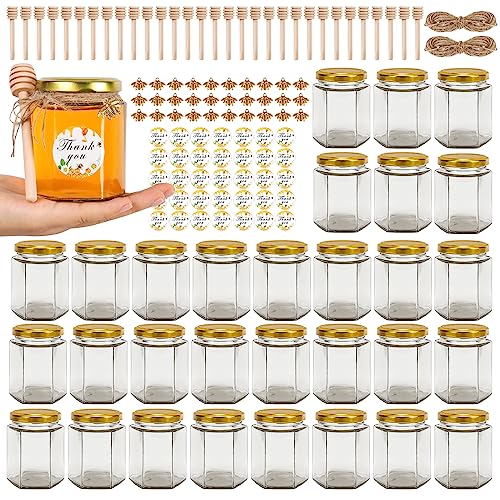
BIGIVACA 6 oz Hexagon Honey Jars with Wood Dippers, 30-Pack
BIGIVACA · 6 oz hexagon glass (listed) · 30 jars with gold lids · wood dippers included (listed) · about $1.05 per jar
Our verdict: The BIGIVACA case is the BPFY formula with the gift problem pre-solved: 30 hex jars with gold lids plus wood honey dippers, for about $1.05 a jar. A hex jar with a mini dipper tied to the lid is a complete present with zero further effort, which is exactly what you want in December when the harvest is jarred and everyone you know expects honey.
The dipper is a 20-cent accessory that finishes a gift. A plain jar of honey is a nice gesture; a hex jar with a wooden dipper tied across the gold lid with twine is a product someone photographs. The BIGIVACA 30-pack with wood dippers bundles both parts, and the roughly 8-cent premium per jar over our top pick is less than buying dippers separately in any quantity we can find. For holiday gifting, teacher gifts, thank-yous, and wedding-adjacent events a step up from the mini jars, this is the case to keep in the closet.
As market inventory it works the same way the BPFY case does: same listed 6 oz hex format, same gold-lid shelf presence, same label-friendly flat faces. Some sellers tie the dipper on and charge a dollar more per jar, which more than recovers the difference; others hold the dippers back for gift season. Either way, check the seller's live listing for the dipper count, accessory counts change between listing revisions, and weigh a filled jar before printing net-weight labels, exactly as with every volume-rated jar in this guide. If the jars are destined for a market table, add the labels from the picks below and the finished unit still lands close to a dollar and a quarter in packaging.
Who should buy it
Buy the BIGIVACA case if a meaningful share of your harvest leaves as gifts, or if you want a market-table upsell (jar plus dipper) without sourcing accessories separately. It is the best one-box answer for holiday honey.
What we don't like
You pay about 8 cents more per jar than our top pick, which only makes sense if you will actually use the dippers. Glass-shipping breakage risk applies as with every case here, and accessory counts on listings like this drift between revisions, so confirm what ships before you build a gift plan around it.
- Capacity
- 6 oz per jar (listed, volume)
- Count
- 30 jars per case (listed)
- Lid
- Gold metal lid (listed)
- Extras
- Wood honey dippers included (listed)
- Per-jar cost
- About $1.05
- Price
- $31.42
Pros
- Jar plus dipper is a finished gift in one box
- Cheaper than buying dippers separately
- Same premium hex-and-gold market look
- Dipper upsell recovers the price gap at market
Cons
- Slight per-jar premium if dippers go unused
- Accessory counts vary between listing revisions
- Usual glass multi-pack breakage risk

Accguan 10 oz Hexagon Glass Jars with Silver Lids, 20-Pack
Accguan · 10 oz hexagon glass (listed) · 20 jars per case · silver metal lids · about $1.30 per jar
Our verdict: The Accguan 20-pack is the hex jar for customers who already know they like your honey: a listed 10 oz volume that holds most of a pound of honey by weight, silver lids that read clean and modern, and a per-jar cost of about $1.30. Sell it at the classic one-pound price point and the bigger jar makes you more per minute of bottling labor than any 6 oz unit can.
Small jars win new customers; bigger jars keep the regulars. The 6 oz hex is the right first-purchase size, low commitment, gift friendly, but your repeat buyers at a weekly market will ask for more honey per trip, and filling twice as many small jars for them is pure wasted labor. The Accguan 10 oz hexagon jars are the step up that keeps the premium hex look: a filled jar lands most of the way to a pound of honey by weight (weigh and label your actual number), which puts it at the $10-to-$14 price point most US markets support for local honey.
The silver lids are a genuine style choice rather than a compromise. Gold-on-amber is traditional; silver reads more modern and photographs cleanly against dark honeys. If you run both sizes on one table, the lid colors conveniently mark the sizes at a glance. Build quality follows the class formula: metal lug lids that seal, flat faces for labels, clear glass that sells the honey inside. Twenty jars per case is the one real limitation, a strong hive will out-produce a single case, so volume sellers should plan on multiples, and as always with glass cases, count survivors on arrival. Fill from a gated bucket, wipe threads before capping, and this jar runs a market season without drama; the full bottling-day sequence is in our honey harvesting walkthrough.
Who should buy it
Buy the Accguan case if you have repeat customers, a farm-stand shelf, or family-size buyers: it is the premium hex look at the near-pound size where per-jar labor pays best. Also the right jar if silver-and-glass suits your label design better than gold.
What we don't like
About $1.30 per jar is the most expensive glass in this guide per unit, and 20 per case means reordering more often than the 30-count sets. The bigger jar is also a bigger gifting commitment; keep a 6 oz case around for first-time buyers and stocking stuffers.
- Capacity
- 10 oz per jar (listed, volume)
- Count
- 20 jars per case (listed)
- Lid
- Silver metal lid (listed)
- Body
- Hexagon, flat label faces
- Per-jar cost
- About $1.30
- Price
- $25.99
Pros
- Near-pound size hits the best market price point
- Keeps the premium hex look at larger volume
- Silver lids flatter dark honeys and modern labels
- Less filling and labeling labor per pound sold
Cons
- Highest per-jar cost of the glass picks
- 20-count case runs out fast in a good year
- Too big for casual gifts and first-time buyers

XING-RUIYANG 1.5 oz Mini Hexagon Honey Jars, 30-Pack
XING-RUIYANG · 1.5 oz mini hexagon glass (listed) · 30 jars per case · about $0.67 per jar
Our verdict: The mini hex is a different product category wearing the same glass: at a listed 1.5 oz and about 67 cents a jar, these are favors, samples, and marketing, not grocery. For weddings, showers, market taste-testers, and gift-basket accents, the XING-RUIYANG 30-pack is the cheapest way to put your honey and your label in fifty more hands.
Minis are marketing you get paid for. A 1.5 oz jar holds a couple of tablespoons of honey, which is exactly enough to convert someone: enough for tea and toast, small enough that nobody hesitates to take one. The XING-RUIYANG mini hexagon jars put that sample in real glass with the same hex geometry as your retail jars, so the favor advertises the product it samples. Wedding and shower favor orders are also quietly excellent business for small apiaries: couples routinely pay $3 to $5 per filled favor jar, and your cost in glass and honey is well under a dollar.
Practical notes from the small-jar trenches: filling minis through a honey gate is slow and drippy, so decant into a squeeze bottle first and fill from that (the SkyJourney bottles below double as filling tools). The tiny lids want the small round labels rather than anything rectangular, which is exactly what the 2-inch Nancy Nikko round set below is for, though on a jar this small even a 2-inch label may wrap the lid edge, so test one before printing a batch. And minis are the one class where per-jar labor genuinely exceeds the honey's value, so price the labor, not the honey, when quoting favor orders.
Who should buy it
Buy the minis for wedding and shower favor orders, market taste-testers, gift-basket accents, and bee-club events. They are the cheapest per-unit glass in this guide and the best return-per-jar marketing a small apiary can do.
What we don't like
Filling and capping 30 tiny jars is fiddly work, and the per-pound packaging cost is the worst in the guide (that is the nature of minis, not a flaw of this case). Lid diameter limits your label options to small rounds, and these are too small to satisfy anyone as an actual honey purchase.
- Capacity
- 1.5 oz per jar (listed, volume)
- Count
- 30 jars per case (listed)
- Body
- Mini hexagon glass
- Best use
- Favors, samples, gift baskets
- Per-jar cost
- About $0.67
- Price
- $19.99
Pros
- Cheapest per-unit glass in the guide
- Favor orders pay several times the packaging cost
- Same premium hex look as the retail sizes
- Perfect sample size to convert market browsers
Cons
- Slow, sticky filling at this scale
- Worst packaging cost per pound of honey
- Only small round labels fit

Little Giant Glass Skep Honey Jar
Little Giant · Skep-shaped glass jar (listed) · airtight lid (listed) · single statement piece
Our verdict: The Little Giant skep jar is the opposite of a case of hex jars: one sculptural, beehive-shaped glass vessel with an airtight lid, priced like the giftware it is. Nobody bottles a harvest in these. You fill one for your own counter, or you fill one as the crown of a gift basket, and it does a job no flat-sided jar can: it makes the honey look like an heirloom.
Every apiary needs one jar that is not inventory. The skep, the woven dome hive of pre-Langstroth beekeeping, is the universal icon of honey, and the Little Giant glass skep jar turns it into the container itself. Filled with a clear light honey and set on a kitchen counter, it reads as decor; presented as a gift, it outclasses any labeled retail jar you own. Little Giant is a familiar name in beekeeping hardware (their bee brush is in half our readers' tool rolls), and the lid here is listed airtight, which matters because a display jar gets opened and reclosed for months.
Where it fits commercially is narrow but real: the top of your price ladder. A market table sells more $8 hex jars when a $20-plus filled skep jar sits beside them, partly as anchor pricing and partly because a few customers a day genuinely want the special one. At $31.59 empty it is not a volume play and does not pretend to be; treat it as giftware, price the filled version accordingly, and keep one filled at home for the counter. It also makes a fine engagement or housewarming gift from a beekeeper, alongside the other ideas in our gifts for beekeepers guide.
Who should buy it
Buy the skep jar as your own countertop honey vessel, as the premium tier of a gift basket, or as the price anchor at the top of a market table. It is the one jar in this guide bought for the object, not the ounces.
What we don't like
It is $31.59 for a single jar, which is a whole case of hex jars. The sculpted shape takes labels poorly (use a hang tag instead), it is awkward to fill and slower to clean than straight-sided glass, and as sold product it only makes sense at giftware prices.
- Style
- Skep (beehive) shaped glass
- Lid
- Airtight (listed)
- Count
- Single jar
- Best use
- Display, gifts, price anchor
- Labeling
- Hang tag recommended
- Price
- $31.59
Pros
- The most giftable single object in the guide
- Airtight lid suits months of countertop use
- Anchors the top of a market price ladder
- From a long-standing beekeeping hardware brand
Cons
- Case-of-jars money for one vessel
- Sculpted glass resists standard labels
- Slow to fill and clean

Encheng 12 oz Regular Mouth Mason Jars
Encheng · 12 oz regular-mouth mason glass (listed) · multi-jar case (count as listed) · two-piece lids
Our verdict: The Encheng mason case is for the share of your harvest that does not need to be pretty: pantry stock, family jars, barter honey, and the customers who ask for the plain jar because they reuse them. Mason-format glass with two-piece lids seals as well as anything in this guide, and the familiar shape carries its own farm-honest credibility.
Not every jar needs to earn a premium; some just need to hold honey well. The Encheng 12 oz mason jars are the guide's utility infielder: regular-mouth mason format, 12 oz listed volume that holds roughly a pound of honey by weight, and two-piece metal lids whose seal quality is the whole reason the mason format has survived a century. This is the jar for the honey you will eat yourself, the jars that go to family by the box, and the pantry reserve that sits for a year, where a reliable seal matters more than shelf presence because honey stored well is effectively immortal.
There is also a real market niche for the plain jar. A subset of farmers-market buyers actively prefers mason-packed honey, it signals homestead over boutique, and reuses the jars for canning. Run masons as your value tier a dollar or two under the hex jars and both tiers sell better. One buying note: this listing is sold as a multi-jar case and the count has varied between listing revisions, so check the live page and compute your own per-jar price before comparing against the hex cases; the format is only a bargain when the count makes it one. Wide-format labels from the 40-pack below fit the smooth band between the mason embossing cleanly.
Who should buy it
Buy the masons for pantry stock, family and barter honey, and a value tier on a market table. They are also the right jar if your customers are canners who will reuse the glass, which in rural markets is a genuine selling point.
What we don't like
The case count on this listing has drifted between revisions, so verify it before doing per-jar math. Mason glass earns no premium at market, embossed faces fight larger labels, and two-piece lids are slower to cap in quantity than lug lids.
- Capacity
- 12 oz per jar (listed, volume)
- Format
- Regular-mouth mason
- Count
- Multi-jar case (count as listed)
- Lid
- Two-piece metal lid and band
- Best use
- Pantry, family, value tier
- Price
- $26.99
Pros
- Mason two-piece lids seal dependably for storage
- Roughly a pound of honey per jar
- Customers reuse them, which some prefer
- Right jar for the eat-it-yourself share of harvest
Cons
- Verify case count before comparing prices
- No packaging premium at market
- Embossed glass limits label placement

SkyJourney 16 oz Refillable Honey Squeeze Bottles, 24-Pack
SkyJourney · 16 oz squeeze bottles (listed) · 24 per case · refillable food-grade plastic (listed) · about $1.12 each
Our verdict: Squeeze bottles are how most Americans actually use honey day to day, no spoon, no drips, one hand, and the SkyJourney 24-pack is the best case price on the format here. At about $1.12 a bottle it serves two jobs at once: retail inventory for the customers who ask for squeezable, and the filling tool that makes every small jar in this guide easier to pack.
Meet customers where their toast is. Glass hex jars win the gift table, but a large share of repeat honey buyers want the format they grew up with: a squeeze bottle by the stove. The SkyJourney 16 oz squeeze bottles cover that demand in one case, listed food-grade plastic, flip caps, and a full-pound-plus capacity that makes the per-fill price look generous next to small glass. On a market table, running squeeze bottles alongside hex jars typically splits the audience cleanly: gifts and first-timers go glass, households restocking go squeeze.
The second job is the sleeper feature: a squeeze bottle is the best small-jar filling tool a hobby bottler can own. Decant from your bottling bucket into two or three of these, and filling mini jars, sampler flights, or the last inch of a retail jar becomes precise instead of drippy. Warm honey flows best; if a bottle crystallizes, stand it in warm water rather than microwaving it hard, both to protect the plastic and because gentle warming is kinder to the honey. One honest note on retail: plastic reads value, not premium, so label these for your everyday tier and let the glass carry the top shelf.
Who should buy it
Buy the squeeze case for your everyday-use tier, for repeat household customers, and as filling tools for every other container you own. If your family goes through honey weekly, this is also simply the format you will reach for.
What we don't like
Plastic caps the price you can charge; nobody pays hex-jar premiums for a squeeze bottle. Crystallized honey is more awkward to rescue in plastic than in glass, flip-cap valves need a wipe after each use to stay clean, and 24 bottles is a lot if you only wanted a couple of filling tools.
- Capacity
- 16 oz per bottle (listed, volume)
- Count
- 24 bottles per case (listed)
- Material
- Food-grade plastic (listed)
- Cap
- Flip-top dispensing cap
- Per-bottle cost
- About $1.12
- Price
- $26.99
Pros
- The format most households actually use daily
- Doubles as the best small-jar filling tool
- Refillable, light, and shatterproof for markets
- Pound-plus capacity at about $1.12 a unit
Cons
- Plastic caps your retail price
- Crystallization is harder to fix than in glass
- Flip caps need wiping to stay presentable

Didaey 12 oz Plastic Honey Bottles with Lids, 48-Pack
Didaey · 12 oz plastic bottles (listed) · 48 per case · about $0.98 per bottle
Our verdict: The Didaey 48-pack is the case you buy when the harvest is measured in buckets: forty-eight 12 oz bottles for $46.99, about 98 cents each, in a shatterproof format that survives a truck, a folding table, and a customer's backpack. It is the volume seller's default, and the count is the point.
At volume, packaging is logistics. A 5-gallon bucket holds roughly 60 pounds of honey, and 60 pounds is about eighty 12 oz (by weight) fills; a two-bucket harvest will burn through jar cases faster than most hobbyists expect. The Didaey 48-pack of 12 oz honey bottles answers that arithmetic in one box: enough containers for most of a bucket, at a per-unit price under a dollar, in plastic that does not care how it is stacked in a truck bed. For high-turnover tables, roadside stands, and honor-box farm stands where glass is a liability, this is the workhorse case.
The format sits between the squeeze bottles and the glass: a classic honey-bottle profile with a screw cap, lighter to transport than glass and faster to cap than mason bands. Per-jar math is the whole pitch, so hold the line on it: at about 98 cents a unit plus a 31-cent label from the budget 40-pack below, a bottle that retails for $8 to $10 carries some of the best margin in this guide, hex glass included. The tradeoff is the same one every plastic pick makes: it reads everyday, not artisan, so pair this case with a small glass tier if your market rewards presentation. And as with all volume-rated bottles, fill one, weigh it, and label actual net weight; the full bottling sequence is in our harvest walkthrough.
Who should buy it
Buy the Didaey case if you move buckets, not jars: high-turnover market tables, farm stands, fundraisers, and any operation where transport weight and breakage matter. It is the best pure margin play in the guide.
What we don't like
Plastic presentation caps your price ceiling, and 48 units is dead inventory for a one-hive apiary. Screw caps on honey bottles also collect drips down the threads more than lug lids do; wipe threads at filling time or the caps glue themselves on.
- Capacity
- 12 oz per bottle (listed)
- Count
- 48 bottles per case (listed)
- Material
- Clear plastic (listed)
- Cap
- Screw cap
- Per-bottle cost
- About $0.98
- Price
- $46.99
Pros
- 48 units approaches a full bucket of capacity
- Best margin math in the guide with budget labels
- Shatterproof for transport and farm stands
- Under a dollar per unit
Cons
- Everyday look, not premium
- Far too much inventory for tiny apiaries
- Screw threads collect drips without care

Hunnibi 8 oz No-Drip Glass Honey Dispenser
Hunnibi · 8 oz glass body (listed) · no-drip trigger valve (listed) · single dispenser
Our verdict: The Hunnibi dispenser solves the one honey problem every household has: the sticky ring under the jar. Hold it over the tea, press, release, and the valve cuts the stream cleanly with no drip and no dipper to park. At $14.99 it is the best quality-of-life purchase in this guide, and a reliably excellent gift.
This is the jar you buy for the kitchen, not the market. Every beekeeping household eats its own honey daily, and daily use is where ordinary jars fail: drips down the side, a glued-down lid, a dipper resting on a saucer. The Hunnibi no-drip glass dispenser replaces that whole ritual with a trigger valve at the base: honey flows while you press and stops clean when you release. The glass body shows the honey, the 8 oz listed capacity refills weekly from your bulk stock, and the counter stays dry, which sounds small until you have lived with it.
Two practical notes. First, valve dispensers love liquid honey and hate crystallized honey; when the contents start to set, refill from your warmed bulk supply rather than fighting the valve (creamed or firmly crystallized honey belongs in jars, not dispensers). Second, this is a strong add-on sale and gift: sellers who display one working dispenser on the market table, filled with their own honey, report it moves both the dispenser conversation and the honey itself. It also slots naturally into gift baskets alongside a hex jar and a dipper, and into our gift guide thinking: useful daily, under $20, and clearly bee-adjacent.
Who should buy it
Buy the Hunnibi for your own counter first; every daily honey eater should own a no-drip dispenser. It is also a proven gift and a smart demonstration piece on a market table filled with the honey you are selling.
What we don't like
It only loves liquid honey; crystallizing contents clog the valve and want a warm-water rescue. The 8 oz capacity means frequent refills for heavy users, and the valve assembly has more parts to wash than any plain jar.
- Capacity
- 8 oz (listed)
- Body
- Glass (listed)
- Valve
- No-drip trigger dispenser (listed)
- Count
- Single unit
- Best use
- Countertop daily use, gifts
- Price
- $14.99
Pros
- Genuinely ends drips and sticky counters
- Glass body displays the honey
- Excellent gift and market demo piece
- Under $15
Cons
- Crystallized honey clogs the valve
- Small capacity for heavy households
- More parts to clean than a jar

Nancy Nikko Personalized Wildflower Honey Labels, Sets of 18
Nancy Nikko · Personalized printing (listed) · wildflower design · sets of 18 · about $1.69 per label
Our verdict: The Nancy Nikko wildflower set is the shortcut to looking like an established brand: professionally designed labels printed with your apiary name and details, in a wildflower style that flatters amber glass. At about $1.69 per label it is the most expensive paper in this guide, and for gift jars and premium tiers it is worth every cent.
A personalized label converts a jar of honey into a jar of YOUR honey. Customers at a market buy the story as much as the sweetness, and the single strongest storytelling tool under two dollars is your apiary's name printed in a design you could not have made at home. The Nancy Nikko personalized wildflower labels do exactly that: you supply the wording, they print sets of 18 in a wildflower motif that looks hand-illustrated and reads premium on a hex jar. This is the label for the top of your line: gift jars, holiday sets, and the premium tier on your table.
Use the personalization to do compliance work as well as branding: labeling rules for honey sold to the public generally expect the product name, the net weight, and the producer's name and address on the package, per the general food-labeling framework the FDA maintains and the cottage-food rules most states layer on top. Ordering those details printed, rather than hand-writing them, is what separates a table that looks licensed from one that looks like a bake sale. At $30.50 per 18, save these for jars selling at $10 and up, and cover the volume tiers with the budget 40-pack below; a two-label strategy is what most successful small sellers actually run.
Who should buy it
Buy the Nancy Nikko set when you are ready to sell under a name: premium jars, gift sets, and any tier where the label needs to carry your brand and your required details in one professional pass.
What we don't like
About $1.69 per label often costs more than the jar under it, so it only pencils on premium-priced units. Sets of 18 do not divide evenly into 30-jar cases, and personalized printing means proofread carefully; a typo ships in quantity.
- Count
- Sets of 18 (listed)
- Style
- Wildflower, personalized text
- Personalization
- Apiary name and details (listed options)
- Per-label cost
- About $1.69
- Best pairing
- 6-10 oz hex jars, gift sets
- Price
- $30.50
Pros
- Professional design with your apiary name
- Carries required label details cleanly
- Makes a small operation read established
- Flatters amber honey in glass
Cons
- Costs more than most jars it goes on
- 18-count sets mismatch 30-jar cases
- Typos in personalization ship in bulk

Nancy Nikko Personalized 2-Inch Round Honey Labels
Nancy Nikko · 2-inch round labels (listed) · personalized "from the hives of" printing · set count as listed
Our verdict: The round sibling of the wildflower set puts your name on the one surface every stacked jar shows: the lid. Personalized 2-inch rounds in the "from the hives of" style finish a gold lid like a wax seal, fit the mini jars nothing rectangular fits, and pair with a plain side label to brand a jar from two angles for less than the full wildflower treatment.
Stacked jars sell from the top down. On a market table, in a gift basket, or in a customer's pantry, jars stack, and a stacked jar shows its lid, not its face. The Nancy Nikko 2-inch round labels claim that surface: a personalized round in the "from the hives of" style, centered on a gold or silver lid, reads like a seal and identifies your jar from above at a glance. It is the finishing detail that photographs disproportionately well, which matters more every year that market sellers also sell through Instagram.
The rounds also solve two placement problems the rectangles cannot. Mini favor jars have no flat face big enough for a standard label, but their lids take a round (test fit on the 1.5 oz minis; on the smallest lids a 2-inch round may wrap the edge, which some sellers actually like as a tamper hint). And the skep jar, which resists side labels entirely, takes a lid round plus a hang tag gracefully. Run the rounds as your everywhere-label, add the wildflower rectangles on premium tiers, and put the required name, weight, and address details on whichever surface has room; the two-label look is the most polished per dollar in this guide.
Who should buy it
Buy the rounds if your jars stack, gift, or photograph: they brand the lid, rescue the mini jars and skep jar from labellessness, and complete the two-label premium look with the wildflower set.
What we don't like
A lid label alone cannot carry all required sale details on most layouts, so plan a side label or tag too. Confirm the set count on the live listing before doing per-label math, and check the 2-inch diameter against your smallest lids before printing a batch.
- Diameter
- 2 inches (listed)
- Style
- Round, personalized, "from the hives of"
- Placement
- Lids, minis, hang-tag pairing
- Count
- Set count as listed
- Best pairing
- Gold-lid hex jars, mini jars
- Price
- $23.49
Pros
- Brands the lid, the surface stacked jars show
- Only label format that fits the minis
- Reads like a seal on metal lids
- Pairs with side labels for a premium look
Cons
- Cannot carry full sale details alone
- Verify count and lid fit before batch printing
- Personalized: proofread before ordering
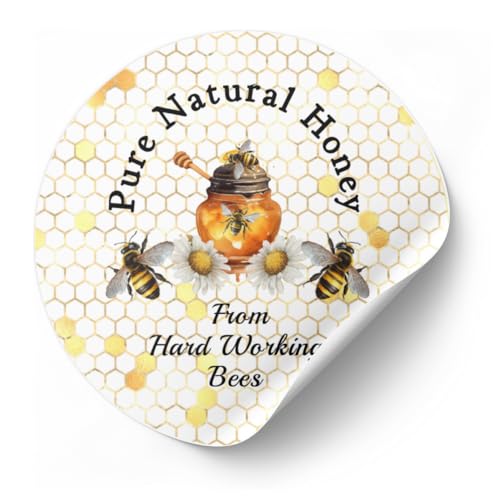
Honey Jar Labels, 40-Pack Stickers
Generic · 40 pre-printed labels (listed) · raw and natural honey designs · about $0.31 per label
Our verdict: The budget 40-pack is the label math that makes volume selling work: pre-printed raw-honey designs at about 31 cents each, ready to stick the day the box arrives. They are not personalized and not pretending to be; they are the fastest way to make a case of plain bottles look like a product instead of a chore.
At the value tier, the label's job is legitimacy, not branding. A plain plastic bottle of honey looks homemade in the wrong way; the same bottle with a printed honey label looks intentional. The 40-pack of honey jar labels delivers that upgrade at about 31 cents a unit, which is the only label price that makes sense on a 98-cent Didaey bottle or a mason destined for barter. Pre-printed designs mean zero lead time and zero proofreading risk, and forty covers most of a bulk case.
The limitation is the flip side of the price: generic designs carry no apiary name, so you add your required details, your name and address and the jar's net weight, with a small printed address label or a neat hand stamp, which most states' cottage-food style rules expect on food sold to the public (rules vary by state; check yours, and see our label-rules break above). For the two-tier strategy we recommend, these are the workhorses: budget stickers on the volume plastic and masons, Nancy Nikko personalization on the glass that earns it. Spending 31 cents to make an $8 sale close faster is the easiest math in this guide.
Who should buy it
Buy the 40-pack to label your volume tier: bulk plastic bottles, masons, fundraiser jars, and any honey priced to move. It is also the zero-risk way for a first-season seller to test a market table before investing in a brand.
What we don't like
No personalization means your apiary name and required details still need a second label or stamp. Design selection is whatever the pack ships, and adhesive quality on budget label packs varies; press them on clean, dry glass and test one jar overnight before doing the batch.
- Count
- 40 labels (listed)
- Style
- Pre-printed raw and natural honey designs
- Personalization
- None
- Per-label cost
- About $0.31
- Best pairing
- Bulk plastic bottles, masons
- Price
- $12.50
Pros
- About 31 cents per finished jar
- Zero lead time or proofing risk
- Right cost tier for sub-dollar bottles
- Covers most of a bulk case per pack
Cons
- No apiary name or custom details
- Second label or stamp still needed for compliance
- Budget adhesives want a test jar first
More gear worth comparing
Beyond this guide: the highest-rated gear across every category and budget, with a live price check on each.



As an Amazon Associate we may earn from qualifying purchases, at no cost to you.
Quick shop: every pick
Skip the scroll: the whole lineup, with a live price check on each.
- BPFY 6 oz Hexagon Glass Jars with Gold Lids, 30-PackBest OverallBPFY · $28.99Check Price
- BIGIVACA 6 oz Hexagon Honey Jars with Wood Dippers, 30-PackBest Gift-Ready SetBIGIVACA · $31.42Check Price
- Accguan 10 oz Hexagon Glass Jars with Silver Lids, 20-PackBest Larger Hex JarAccguan · $25.99Check Price
- XING-RUIYANG 1.5 oz Mini Hexagon Honey Jars, 30-PackBest for Favors and SamplesXING-RUIYANG · $19.99Check Price
- Little Giant Glass Skep Honey JarBest Statement JarLittle Giant · $31.59Check Price
- Encheng 12 oz Regular Mouth Mason JarsBest Workhorse MasonEncheng · $26.99Check Price
- SkyJourney 16 oz Refillable Honey Squeeze Bottles, 24-PackBest Squeeze BottleSkyJourney · $26.99Check Price
- Didaey 12 oz Plastic Honey Bottles with Lids, 48-PackBest Bulk Bottling ValueDidaey · $46.99Check Price
- Hunnibi 8 oz No-Drip Glass Honey DispenserBest Kitchen DispenserHunnibi · $14.99Check Price
- Nancy Nikko Personalized Wildflower Honey Labels, Sets of 18Best Personalized LabelsNancy Nikko · $30.50Check Price
- Nancy Nikko Personalized 2-Inch Round Honey LabelsBest Lid LabelsNancy Nikko · $23.49Check Price
- Honey Jar Labels, 40-Pack StickersBest Budget LabelsGeneric · $12.50Check Price
How we chose
We rank jars by the question that decides a market table: does the packaging earn back more than it costs. A jar that adds $1 of cost and $3 of perceived value wins; a cheap jar that drags the product down to gift-jar prices loses, even at half the money.
Per-jar cost is computed from the listed pack count and the verified price, and we print it on every card. Sellers quote case prices because cases sound cheap; margins are made per unit.
Seal quality is a pass/fail gate. Honey is hygroscopic, it pulls moisture from the air, and a lid that does not seal lets the top layer of a jar creep above the roughly 18.6 percent moisture line where fermentation becomes a risk, per the guidance summarized by the extension Bee Health program. Metal lug lids and proper mason bands pass; loose-fitting decorative lids do not.
Capacities and counts are quoted as listed, and we flag the volume-versus-weight trap on every relevant card: a "6 oz" jar is a volume figure, and honey is heavy, so the honey inside weighs more than 6 ounces. Your label must state net weight, so weigh a filled jar before you print.
Labels are judged like packaging, not stationery: adhesive that survives a sticky thumb, print that survives sunlight on a market table, and space for the details labeling rules expect (product name, net weight, and your name and address).
No brand has bought a placement. Prices come from the verified offer table on the publication date and are re-checked on update; a listing that goes dark or doubles in price loses its slot.
Key terms
- Cottage food law
- State-level rules allowing home kitchens to sell low-risk foods, honey included in most states, directly to consumers. Requirements vary by state but usually include specific label elements and sometimes revenue caps or registration.
- Net weight
- The weight of the honey alone, excluding the container, and the number labeling rules expect on the jar. Jar sizes like "6 oz" are volume figures; honey is denser than water, so a filled jar weighs more than its volume number suggests.
- Lug lid
- A metal lid that seats with a partial turn onto matching glass threads, the standard closure on hex honey jars. Seals well for retail, but treat them as single-use for sold product.
- Hexagon jar
- The six-sided glass jar that has become the visual shorthand for premium small-batch honey. Flat faces take labels cleanly, and cases price from roughly $0.67 (minis) to $1.30 (10 oz) per jar.
- Skep
- The woven dome hive of pre-modern beekeeping and the universal honey icon. Skep-shaped jars trade practicality for shelf presence, which is precisely their job.
- Hygroscopic
- Moisture-attracting, which honey is. An unsealed jar slowly pulls water from the air, raising moisture toward the roughly 18.6 percent line where fermentation becomes possible; a proper lid seal prevents it.
- Crystallization
- The natural formation of sugar crystals in honey over time. Harmless and reversible with gentle warm-water heating; it matters for packaging because crystallized honey clogs squeeze valves and dispensers.
- Price anchor
- A deliberately premium item, like a filled skep jar, placed on a market table to make mid-priced items look reasonable. It sells occasionally and earns its keep even when it does not.
Questions, answered
What size jar is best for selling honey at a farmers market?
Run two sizes: a 6 oz-class hexagon jar for first-time buyers and gifts, and a 10-12 oz-class container for repeat customers. The small hex jar earns the highest price per ounce and lowers the barrier for a first purchase; the near-pound size rewards regulars and cuts your bottling labor per pound sold. Sellers running a single size almost always leave one of those audiences behind.
How much should I charge for a jar of honey?
Price from your local market, not your costs: local raw honey in most US markets supports roughly $1 to $1.50 per ounce of net weight at small-jar sizes, which puts a 6 oz-class hex jar at $6 to $9 and a near-pound jar at $10 to $14. Check what established tables near you charge and price within that range. Underpricing is the classic new-seller mistake; the packaging in this guide exists precisely to justify the going rate.
Do I need a license to sell honey from my backyard hives?
In most US states, small-scale direct sales of home-produced honey fall under cottage food laws, which typically require specific label elements (product name, net weight, your name and address, and often a home-produced disclosure) rather than a commercial license, though some states add registration, a course, or revenue caps. Rules genuinely vary by state, so read your state's cottage food program page before your first sale. Our beekeeping laws by state guide is a starting point.
What has to be on a honey label?
The common requirements are the product name ("honey", or an honest descriptive name), the net weight of the honey in ounces and grams, and the producer's name and address; many states' cottage food rules add a disclosure that it was produced in a home kitchen. Net weight trips people up: weigh a filled jar and subtract the empty jar, because a "6 oz" jar is a volume figure and the honey inside weighs more than 6 ounces.
How many jars do I need for a 5-gallon bucket of honey?
A full 5-gallon bucket holds roughly 60 pounds of honey. That is about eighty 12 oz (by weight) fills or roughly one hundred sixty 6 oz fills, so plan on two of the 48-count bottle cases or five to six 30-jar hex cases per full bucket. Most hobby harvests do not fill a bucket per hive; a strong hive's 30 to 60 pound surplus is one to three 30-jar hex cases.
Are hexagon jars really worth the extra cost over mason jars?
For honey being sold or gifted, yes, and it is not close: the hex-and-gold-lid format is the visual signal of premium small-batch honey, and the same honey routinely sells for several dollars more in it. The per-jar difference between a hex case and a mason case is well under a dollar, and the price difference it supports at market is a multiple of that. For pantry stock and honey you will eat yourself, save the money and use masons.
Glass or plastic for honey?
Both are food-safe; the choice is about the job. Glass earns premium prices, displays the honey, and rescues crystallized contents gracefully in a warm-water bath, so it wins for retail and gifts. Plastic is shatterproof, light, and cheap per unit, so it wins for volume selling, farm stands, kids, and daily-use squeeze bottles. Most sellers end up running glass as the premium tier and plastic as the volume tier.
Why did my bottled honey ferment or foam in the jar?
Almost always moisture: honey bottled above roughly 18.6 percent water can ferment, and honey extracted from uncapped frames or stored in unsealed jars is how the moisture gets in. Bottle only ripe honey (a $20-class refractometer settles it per batch), use lids that actually seal, and store jars closed. Properly dry, sealed honey is effectively shelf-stable indefinitely; crystallization, unlike fermentation, is natural and harmless.
How do I label jars for a wedding favor order?
Use the mini 1.5 oz hex jars with a 2-inch personalized round label on the lid, printed with the couple's names and date instead of your apiary details; favors are gifts, not retail, so the sales-label rules are not the constraint. Quote the order on your labor, not the honey: filling and labeling dozens of tiny jars is the real cost, and $3 to $5 per finished favor is a normal and fair price.
How should customers store the honey they buy from me?
Sealed, at room temperature, out of direct sun; no refrigeration, which only accelerates crystallization. Tell them crystallized honey is natural and fixes in a warm water bath, and consider printing that line on your label or a card, because "my honey went bad" (it almost never has) is the most common repeat-customer question a seller fields.
Filed under Buyer's Guide
Part of Honey Harvest
Keep reading
How to Harvest Honey
The full path from capped frame to filled jar: pulling supers, extracting, straining, and the bottling day that ends at these jars.
The Best Honey Harvesting Equipment (2026)
The bottling bucket, honey gate, strainer, and refractometer that fill every jar in this guide cleanly and to the right moisture.
The Best Honey Extractors (2026)
Where the honey comes from: manual and electric extractors ranked by hive count, from $108 to the 8-frame VIVO.
How Much Honey Does One Hive Produce?
The yield math that tells you how many cases of jars a season actually needs.
The Best Comb Honey Supplies
The other premium product: cut-comb honey commands the highest prices at market and needs its own packaging.
The Best Gifts for Beekeepers
Dispensers, skep jars, and the rest of the giftable side of the honey house.