Our Pick: aichose
Check PriceHow to Sell Honey: Rules, Labels, Pricing, and Where to Sell It
The short answer: selling honey is one of the most accessible small food businesses in the country, because honey is a single-ingredient shelf-stable product that most states treat favorably under cottage food or similar exemptions. But favorably is not the same as freely, the rules genuinely differ state to state, and the only correct first step is to contact your own state department of agriculture and confirm what applies to you. Everything else, labeling, pricing, packaging, channel, is downstream of that call.
By The BeehiveKits Hive Desk2026-08-2921 min read Fact-checked against verified Amazon listingsHow we research
The second thing to understand is where the money actually is. Liquid honey in a jar is the entry product and the thinnest margin: you are competing against grocery shelf prices in the customer's head whether that comparison is fair or not. The margin lives one rung up the ladder, in comb honey, creamed honey, infused and hot honey, and wax products, where there is no supermarket anchor price and where a pound of the same honey can return two or three times as much. Beekeepers who make real money selling honey almost always got there by climbing that ladder rather than by selling more jars.
This page covers the sequence in order: verify your rules, get the moisture right before you bottle anything (a refractometer runs $22.88 and prevents the one mistake that can wreck a whole batch), label correctly, price with arithmetic instead of vibes, pick a channel that fits your volume, and then climb. It is written for the beekeeper with three to twenty hives who is tired of giving honey away. Standard disclosure, plainly: no brand paid to appear here, and some links go to Amazon, where a purchase may earn us a small commission at no extra cost to you. We are beekeepers and editors, not lawyers or accountants, so treat this as orientation and verify anything legal with your state.
What to know
- Rules vary by state and honey is often treated favorably, but you must confirm with your own state department of agriculture before your first sale. Do not rely on any article, including this one, for what applies where you live.
- Federal labeling basics for a jar of honey: the name of the food, an accurate net weight statement, and the name and place of business of the producer or packer. Your state may require more.
- Raw and local are marketing words with no single federal legal definition. Use them honestly and narrowly, and never make health claims about honey.
- Never sell honey without checking moisture. Above roughly 18.6 percent it can ferment in the jar, and one fermented case will cost you more customers than a season of good honey wins.
- Price by the ounce, not by the jar, then sanity check against your local market. Wholesale generally runs roughly half of your retail price, and it buys you volume and time rather than margin.
- Farmers markets pay the most per jar and cost the most in hours. Farm stands and repeat local customers are the best hourly rate. Shipping liquid honey is a leaky, heavy, low-margin business.
- The value-added ladder, comb, creamed, infused, hot honey, and wax products, is where margin actually improves, because there is no grocery shelf anchor price for any of it.
- Honey is not safe for infants under 12 months. That is a real safety fact, not a marketing footnote, and many producers put it on the label voluntarily.
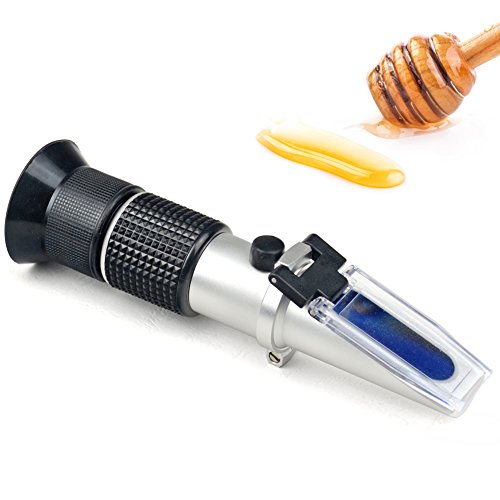
aichose Honey Refractometer
aichose · Honey moisture, Brix, and Baume scales (listed) · optical, no batteries
Our verdict: If you sell honey, this is not optional equipment. One drop, one reading, and you know whether the batch is below the roughly 18.6 percent moisture threshold where honey is stable. One fermented case costs more in reputation than a lifetime of refractometers.
Giving honey away is forgiving. Selling it is not. The aichose honey refractometer ($22.88) reads moisture optically from a single drop, no batteries, calibrated once with the included reference. Test every bucket at extraction, mark the reading on the lid, and hold back anything over roughly 18.5 percent for mead or bee feed.
It also settles arguments with yourself about borderline frames, which is where humid-climate beekeepers lose batches. Pair it with the harvest discipline in how to harvest honey.
Who should buy it
Anyone who intends to sell, trade, or gift honey at any volume, and especially beekeepers in humid regions where borderline uncapped frames are routine.
What we don't like
Needs a one-time calibration and a temperature-aware reading habit, and budget optics reward reading the instructions carefully once rather than guessing.
- Scales
- Honey moisture, Brix, Baume (listed)
- Type
- Optical, handheld
- Safe threshold
- At or below about 18.6% moisture
- Calibration
- Included reference (listed)
- Price
- $22.88
Pros
- Prevents the single worst mistake a honey seller can make
- No batteries, works anywhere, reads in seconds
- Cheap relative to one lost case of product
- Doubles as a check on borderline uncapped frames
Cons
- Requires initial calibration
- Readings need basic temperature awareness

BPFY 6 oz Hexagon Glass Jars, 30 Pack
BPFY · 30 x 6 oz hexagon glass jars with airtight gold lids (listed)
Our verdict: Hex glass reads as honey before a customer gets to the label, and 6 oz is the size that moves as a gift and as a first purchase. Thirty jars is a sane first market run at a packaging cost you can build into a price.
Glass outsells plastic on a market table every time, and the hexagon shape does half your branding for free. The BPFY 30-pack of 6 oz hex jars with gold lids ($28.99) is the sensible first case: enough for a market day, in the size customers reach for when they do not know you yet.
Remember the weight math when you label these: a jar sized 6 oz by volume holds meaningfully more than 6 ounces of honey by weight, and the label must state net weight. The wider field of jars, squeeze bottles, and dispensers is in best honey jars and labels.
Who should buy it
First-time sellers building a market table, and established sellers who want a gift-size and impulse-buy option alongside their pound jars.
What we don't like
Glass is heavy and breakable, which makes this the wrong package for anything you plan to ship. And 30 jars goes fast on a good market day, so order a spare case.
- Count
- 30 jars
- Size
- 6 oz by volume (listed)
- Lids
- Airtight gold lids included (listed)
- Best for
- Gift and first-purchase size
- Price
- $28.99
Pros
- Hex glass signals honey before the label is read
- The size that moves best to new customers
- Lids included, so no separate sourcing
- Per-jar packaging cost you can price around
Cons
- Heavy and breakable, poor choice for shipping
- One case covers only a single busy market day

Nancy Nikko Personalized Wildflower Honey Labels
Nancy Nikko · Personalized printed honey labels, sets of 18 (listed)
Our verdict: Two identical jars, one labeled properly and one with tape and a marker, do not sell at the same price. Personalized labels turn a jar of honey into a product from a named apiary, which is the entire story a local honey buyer is paying for.
Labeling is the highest-return dollar in a small honey operation and the last thing most hobbyists do. Nancy Nikko personalized wildflower honey labels ($30.50) handle the design and printing for beekeepers who would rather manage bees than page layouts, sized for standard jars so application is not a fight.
Confirm what your state requires on the label before you order a large quantity, and leave room for a net weight statement rather than treating it as an afterthought. The full jar and label pairing guide is best honey jars and labels.
Who should buy it
Beekeepers selling to anyone outside their own household, and gift-givers who want jars that look like they came from somewhere rather than out of a garage.
What we don't like
Personalized print runs are not easily changed, so any state disclosure requirement or design fix means reordering. Confirm your label requirements before you commit to a quantity.
- Type
- Personalized printed labels
- Quantity
- Sets of 18 (listed)
- Personalization
- Apiary name (listed)
- Order after
- Confirming state label requirements
- Price
- $30.50
Pros
- Turns a jar into a branded product customers can find again
- No design or printing work on your end
- Sized for standard jars, so application is quick
Cons
- Reordering required if state requirements change your label
- Sets of 18 means multiple orders for a real market run
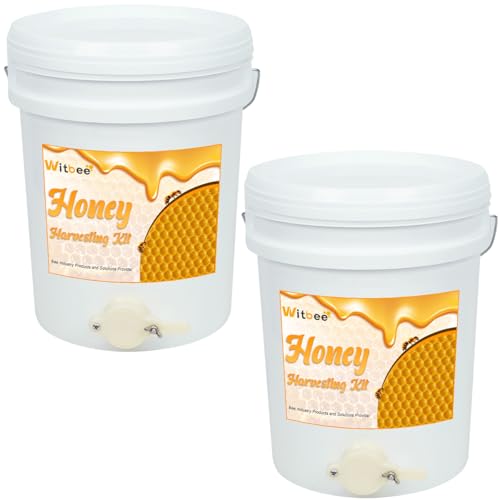
witbee 5 Gallon Honey Buckets with Gates, 2 Pack
witbee · 2 x 5 gallon food-grade buckets with leak-proof honey gates (listed)
Our verdict: Bottling from a gated pail instead of scooping is the difference between a clean two-hour session and a sticky all-day mess. Two buckets lets one settle while you draw from the other, which is the whole workflow at hobby scale.
Every honey seller eventually builds the same setup: extract into one bucket, let it settle so wax fines and air rise, then bottle from the gate below the foam line. The witbee 2-pack of 5 gallon honey buckets with gates ($59.99) covers that workflow for a hobby harvest, and five gallons holds roughly 60 pounds of honey, so two pails handle most small-apiary years.
Store them sealed, cool, and dry: honey is hygroscopic and a loose lid in a humid garage will raise your moisture reading. The rest of the harvest line, uncapping through straining, is in honey harvesting equipment.
Who should buy it
Anyone bottling more than a few jars at a time, and every beekeeper who has tried to fill jars with a ladle exactly once.
What we don't like
Full buckets are heavy enough to be awkward, roughly 60 pounds of honey plus the pail, and budget gates need checking and tightening before you trust one over a full table.
- Count
- 2 buckets
- Capacity
- 5 gallons each (roughly 60 lbs of honey)
- Gate
- Leak-proof honey gate included (listed)
- Material
- Food grade (listed)
- Price
- $59.99
Pros
- Gated bottling is faster and far cleaner than scooping
- Two pails let one settle while the other bottles
- Sealed storage protects honey from humidity
- Right capacity for a hobby apiary's annual harvest
Cons
- A full pail is heavy and awkward to move
- Check and tighten budget gates before trusting them

YeloDeer 5 Gallon Honey Bucket Heater
YeloDeer · 5 gallon bucket band heater, 86F to 302F twist control (listed)
Our verdict: Cold honey pours slowly, traps bubbles, and tempts beekeepers into stovetop shortcuts that destroy flavor and aroma. A band heater holds a bucket at bottling temperature and doubles as the fix for jars that crystallize on a customer's shelf.
The two moments a honey seller needs heat are bottling day and the January call about a jar that went solid. The YeloDeer 5 gallon honey bucket heater ($39.99) wraps a pail with a twist-adjustable band, listed across an 86 to 302 degree F range, so you can hold honey at a pourable temperature rather than chasing it with a stove.
Use the low end of that dial. The point of raw honey is that it was not cooked, so gentle and slow beats fast and hot every time, and rushing it costs you exactly the aroma customers pay a premium for. Crystallization itself is normal physics, not spoilage, as explained in does honey go bad.
Who should buy it
Sellers bottling in a cool garage or basement, anyone in a cold climate bottling after fall, and producers who want a safe way to reliquefy crystallized inventory.
What we don't like
Wide-range band heaters make it easy to overheat honey if you turn the dial up to save time. Keep it low, be patient, and never treat it as a fast decrystallizer.
- Fits
- 5 gallon buckets
- Range
- 86F to 302F twist control (listed)
- Uses
- Bottling temperature, decrystallizing
- Caution
- Use the low end to protect raw honey quality
- Price
- $39.99
Pros
- Makes cold-weather bottling practical and clean
- Reliquefies crystallized inventory without a stove
- Adjustable, so you can stay gentle
- Cheaper than a dedicated warming cabinet
Cons
- Easy to overheat honey if you rush it
- Sized for 5 gallon pails only
Start here: find out what your state actually requires
Before jars, labels, or prices, make one phone call or visit one website: your state department of agriculture. That is the agency that will tell you, for your state, whether honey sales fall under a cottage food exemption, whether you need a license or registration, whether there is a sales volume ceiling, whether your kitchen or extraction area needs inspection, whether direct-to-consumer sales are treated differently from wholesale, and what your label must say.
We are going to be conspicuously unhelpful about the specifics, on purpose. There are fifty states plus territories, the rules change, and honey-specific provisions are frequently tucked into food-safety code rather than beekeeping code. Any article that confidently tells you what license you need is either wrong for most readers or will be wrong within two years. What we will not do is invent a rule, a fee, or a threshold, and you should be suspicious of any beekeeping site that does. The state-by-state directory of where to start looking, including apiary registration requirements that are a separate matter from food sales, is in beekeeping laws by state.
Three other numbers worth having before you call: how many pounds you expect to sell in a year, where you intend to sell it (your own property, a farmers market, a retail store, online, across state lines), and whether you will sell anything beyond plain honey. Those three answers usually determine which set of rules you land in, and having them ready turns a confusing call into a five-minute one.
What cottage food law generally does, and why honey often benefits
Cottage food laws are state statutes that let individuals produce certain low-risk foods in a home kitchen and sell them directly to consumers without the commercial kitchen licensing that a restaurant or food manufacturer would face. They typically define an allowed foods list, cap annual sales, restrict where you can sell, and require specific labeling, often including a statement that the product was made in a home kitchen not subject to state inspection (Wikipedia: cottage food laws in the United States).
Honey tends to land on the favorable side of these frameworks for a straightforward reason: it is a single-ingredient, shelf-stable, high-sugar, low-water-activity food with no realistic pathogen growth pathway when properly cured. Many states also carve honey out separately from general cottage food rules, sometimes with its own exemption for small producers. That is the general pattern nationally. It is not a promise about your state, and the exact wording of your state's exemption is the thing that governs.
Watch for the boundary cases, because this is where beekeepers get surprised. Adding anything to the jar, cinnamon, chili, lavender, can move your product out of a plain honey exemption and into a different category with different rules. Selling wholesale to a store is frequently treated differently from selling at a market. And crossing state lines, or shipping, can change which rules apply entirely. Ask about those specifically rather than assuming the plain-honey answer covers them.
Federal labeling basics for a jar of honey
Separate from state rules, packaged food sold in the US carries federal labeling expectations. For a jar of pure honey with no other ingredients, the core elements are short and worth getting right the first time (FDA: food):
The name of the food. Call honey honey. If it is a single floral source you can name it, but the standard practice is that a floral designation should reflect what the bees actually worked. Wildflower is the honest default for most backyard honey. If anything has been added, the name has to reflect that: honey with cinnamon is not honey.
Net quantity of contents. The weight of honey in the jar, not the jar's fluid capacity, stated in both US customary and metric on the lower portion of the label front. This trips up beekeepers constantly because honey is sold by weight and jars are sized by volume: a jar described as 8 ounces by volume holds roughly 12 ounces of honey by weight, since honey is substantially denser than water. Weigh a filled jar, subtract the empty jar, and print that number.
Name and place of business. The producer, packer, or distributor and a real address, so a customer or a regulator can find you. Many small producers use a business name plus city and state; check what your state expects here, since some require a full street address.
Ingredients, if more than one. Pure honey does not need an ingredient list. The moment you infuse it, it does, in descending order by weight.
Your state may add requirements on top of these, most commonly a cottage food disclosure statement and sometimes lot or date coding. Ask when you call, and design your label after you know, not before you print five hundred of them.
What raw and local can and cannot claim
Raw. There is no single federal legal definition of raw honey. In common industry usage it means honey that has not been heated beyond about hive temperature and has not been finely filtered, so it retains pollen and its natural enzyme content and crystallizes on its normal schedule. Practically everything a hobby beekeeper bottles qualifies. Use the word if it is accurate for what you do, and understand it is a description of process, not a certification anyone issued you. If you warm honey to bottle it, keep it gentle and be honest about it. The full raw versus processed comparison is in raw honey vs regular honey.
Local. Also undefined and also useful. It is honest when the bees producing the honey are kept within a plausible local radius of where you sell it. It is not honest when you buy drums and repack them, which is a real practice and the reason your customers are suspicious. The strongest version of local is specific: the town, the year, and the season. Cherry Creek Road, fall 2026 is a better label than local honey, and it is unfalsifiable in the good way because it is true.
What you cannot say. Do not make health claims. Do not say your honey treats, cures, prevents, or relieves anything, including allergies, and do not imply it with careful phrasing either. That is where a pleasant small business becomes a regulatory problem, and it is also just not something you can support. Sell honey on what it is: fresh, traceable, single-apiary, and better tasting than the shelf. That story works.
One thing you should say. Honey is not safe for infants under 12 months because of the risk of infant botulism from dormant spores (FDA). It is harmless to older children and adults. Many small producers add a short line to the label voluntarily, and we think that is the right call whether or not your state requires it.
Quality control: do not sell a jar you have not tested
One fermented case will do more damage to a small honey business than a whole bad season, because the customer who opens a foaming jar in December tells everyone. Fermentation happens when honey is bottled above roughly 18.6 percent moisture, at which point naturally present osmotolerant yeasts can go to work. The bees cure honey to about 17 to 18 percent and cap it as their own certification, which is why the ancient rule is harvest capped frames (Bee Health, eXtension).
The check takes ten seconds. A drop of honey on the prism of an aichose honey refractometer ($22.88), read against the light, gives you the moisture percentage directly. Test each bucket, not each jar, and write the number on the lid with a marker. If you are at or below about 18.5 percent you are fine; if you are over, that honey belongs in mead or in the feeding jar, not on a customer's shelf. The full harvest sequence that gets you ripe honey in the first place is how to harvest honey.
Two other quality habits worth building before your first sale. First, settle and strain properly: let bottling buckets rest a day or two so wax fines and air rise, then draw from the gate below them. Clarity sells, and cloudiness from trapped air makes honey look wrong to a customer who does not know why. Second, control your bottling temperature. Cold honey pours slowly and traps bubbles, and beekeepers who fight it with a stove ruin the product. A gentle bucket band like the YeloDeer 5 gallon bucket heater ($39.99) holds a bucket at a bottling-friendly temperature without cooking the honey, and it doubles as your decrystallizing tool for jars that set up on the shelf.
Pricing: do the per-ounce math, then check your market
Most beekeepers price by picking a number for a jar, which is how you end up selling a 12 ounce jar for less per ounce than a 1.5 ounce wedding favor. Price by the ounce instead, then multiply. It takes two minutes and it makes your whole lineup coherent.
The method: pick your target retail per ounce, then apply it across every size with a modest discount for larger jars, since customers expect volume to be cheaper per ounce and larger jars cost you less in packaging and handling per ounce sold. So if your target is a dollar an ounce, a 12 ounce jar lands near 12 dollars, a 1 pound jar somewhere close to 15, and a quart somewhere near 40, adjusted to round, sayable numbers. Small novelty sizes go the other direction, priced well above your per-ounce target because the packaging dominates the cost and the buyer is buying a gift, not honey.
Now the part no article can do for you: setting the number. Local honey retail prices vary enormously by region, by channel, and by year, and anyone quoting you a national figure is guessing. Go survey your actual market. Visit two farmers markets and the local co-op or farm store, write down what other beekeepers are charging per ounce for comparable jars, and price within that band. Below the band and you are training your customers to undervalue honey for everyone; far above it without a differentiated product and you will stand at a table all morning.
Two cost realities to build in. Your packaging is not free: jars, lids, labels, and market fees can easily eat a meaningful share of a low-priced jar, so run the numbers per unit before you set a price you cannot afford. And your time is the largest input. A market day is often eight hours all in, and the honest question is what you cleared per hour, not per jar. The full input side of the operation is in the beekeeping cost index.
Retail versus wholesale: two different businesses
The rough industry convention is that wholesale runs about half of retail: you sell to the store at roughly half the shelf price and the store takes the rest. That ratio varies, some shops work on smaller margins for local products, some consignment arrangements land differently, but plan around half and be pleasantly surprised.
| Retail direct | Wholesale to shops | |
|---|---|---|
| Price per jar | Full | Roughly half |
| Your time per jar sold | High: you staff every sale | Low: one delivery moves a case |
| Volume ceiling | Limited by market days and foot traffic | Limited by how many accounts you can supply consistently |
| Customer relationship | Direct, repeatable, tells your story for you | Owned by the shop |
| Packaging burden | Higher: presentation matters most | Consistent labeling and reliable supply matter most |
| Regulatory footprint | Often the simplest category in a state's rules | Frequently treated differently, ask specifically |
The trap to avoid is doing wholesale at retail volumes: if you only have 300 pounds a year, giving half the value away to a shop rarely makes sense. Wholesale earns its discount when you have more honey than time, which usually starts somewhere north of ten or fifteen productive hives. Until then, sell direct and spend your effort on repeat customers, who cost nothing to reacquire.
Where to sell: four channels, honestly compared
Farmers market. The highest price per jar and the highest cost in hours. You will pay a stall fee, spend a day, and answer the same six questions about allergies and bee decline all morning. It works when your local market has real traffic and when you treat it as customer acquisition rather than a sales channel: the goal is turning market shoppers into people who text you in November.
Farm stand or front-porch sales. The best hourly rate in the business, especially with an honor box or a simple sign, because your time cost is near zero. Volume is limited by traffic past your property, and it depends entirely on whether your state permits it and on your comfort with an unattended box. For beekeepers on a road with any traffic at all, this is the most underrated channel there is.
Local wholesale. Coffee shops, bakeries, farm stores, gift shops, restaurants. Half the money, a fraction of the time, and it scales. The requirement is reliability: a shop that runs out twice stops reordering. Do not pursue wholesale until you can supply consistently through a bad year.
Online and shipping. Be realistic. Honey is heavy, glass breaks, shipping is expensive, and platform fees compound it, so plain liquid honey generally ships at a poor margin. Where online works is high-value and low-weight: comb honey sections, infused and hot honey, wax products, gift sets, and small sampler packs. Sell the story and the specialty online, and sell the pound jars locally. What sells well as a gift, and how those sets are built, is in honey gift sets.
Jars: pick a size lineup and stick to it
Package selection is where new sellers overthink and overspend. The working advice is to run two or three sizes, not seven: a small size that functions as a gift and an impulse buy, a mid size that is your workhorse, and optionally a large size for repeat customers who already trust you. More sizes means more inventory sitting in boxes, more label variants, and a table that looks like a warehouse instead of a shop.
Glass outsells plastic at every market we have ever stood at. It looks like a product rather than a commodity, and the classic hex jar in particular signals honey before anyone reads the label. A case like the BPFY 30-pack 6 oz hex jars with gold lids ($28.99) covers a first market run in the size that moves best as a gift and a first-time purchase, at a per-jar packaging cost you can actually build into a price. Plastic squeeze bottles have their place, mainly for regular customers buying in volume and for anything shipped, where breakage risk dominates.
Two practical notes. Buy lids and jars together in matched cases rather than sourcing separately, and buy one case more than you think you need, since running out of jars mid-bottling is worse than storing a spare case. And remember the weight-versus-volume issue from the labeling section: your jar's stated capacity in ounces is a volume, and the number on your label must be the honey's net weight. The full field of jars, bottles, and dispensers is ranked in best honey jars and labels.
Labels: the cheapest upgrade you will ever make
Two jars of identical honey side by side, one with a printed label and one with masking tape and a Sharpie, will not sell at the same price. Labeling is the single highest-return dollar in a small honey business, and it is the thing hobbyists skip longest.
What a good honey label does: satisfies the required elements from the labeling section above, names your apiary, states the town, and gives the customer something to hold onto so they can find you again. Printed sets like the Nancy Nikko personalized wildflower honey labels ($30.50) handle the personalization for producers who do not want to run their own design and printing, and they are sized for standard jars, which matters more than it sounds when you are applying a hundred of them.
Design advice, briefly: leave room for the net weight statement rather than squeezing it into a corner as an afterthought, keep the apiary name readable from three feet away at a market table, and do not print a year's supply until your state has confirmed what your label needs to carry. Printing five hundred labels and then learning you need a disclosure line is the classic and entirely avoidable mistake.
The value-added ladder: where the margin actually lives
Here is the part most beekeepers discover three seasons late. Liquid honey in a jar is anchored in the customer's mind against grocery store honey, however unfair that comparison is, and that anchor caps your price. Every rung up the following ladder removes the anchor, because there is no supermarket price for any of it.
Rung one: creamed honey. Controlled crystallization, a texture rather than an additive, spreadable and never drippy. It requires patience and temperature control rather than equipment, and it routinely commands a solid premium over the same honey liquid. Customers who find it once come back for it. The category is covered in honeycomb and creamed honey.
Rung two: infused and hot honey. Chili, cinnamon, and herb infusions have moved from novelty to staple, and hot honey in particular now sells at prices plain honey cannot approach. The catch is regulatory: adding an ingredient usually changes your product category and your labeling obligations, so this is a specific question for your state before you make a batch. The market context is in best hot honey.
Rung three: comb honey. The highest price per pound a hobby apiary can produce, sold exactly as the bees made it, with no extractor involved. The cost is planning: comb honey wants fresh foundationless or thin foundation frames drawn during a strong flow, and the comb is consumed with the sale rather than returned to the colony. The program is in comb honey supplies.
Rung four: wax and hive products. Cappings wax is the cleanest wax a hive produces and it is currently sitting in a bucket in most hobbyists' garages. Rendered into blocks, candles, lip balm, or wraps, it converts a byproduct into a product line with far better margin per pound than honey, and it sells year round rather than in a harvest season burst. Start with how to render beeswax and the candle side in beeswax candle making supplies.
The strategic point: a hobby apiary that sells 300 pounds of liquid honey and one that sells 150 pounds of honey plus comb, creamed, and candles can gross similar money, and the second one is far less dependent on a good honey year. Diversification here is not a growth tactic, it is risk management.
The unglamorous half: records, storage, and insurance
Records. Write down what came off which yard, when, at what moisture, and into which bucket. Lot tracking sounds like overkill at 200 pounds until a customer calls about a jar and you have no idea which extraction it came from. A number on a lid and a notebook line is enough at hobby scale.
Bulk storage. Honey lives in food-grade buckets between extraction and bottling, and the gate matters more than the bucket: bottling from a gated pail is fast and clean, bottling by scooping is neither. A pair like the witbee 5 gallon honey buckets with gates ($59.99) covers a hobby harvest with one settling and one bottling. Store buckets sealed, cool, and dry, since honey is hygroscopic and will pull moisture from humid air through a loose lid.
Crystallization. It will happen, it is normal, and it is not spoilage. Tell customers that on the label or on a card, because the ones who do not know will think the jar went bad. For your own inventory, gentle warming brings it back; direct heat and microwaves damage the product and the reputation.
Insurance and taxes. Selling anything is a business activity. Product liability coverage exists for small food producers, some farmers markets require proof of it to give you a stall, and income from sales is income. We are not your accountant and every situation differs, so ask a local professional rather than a beekeeping forum. Bee club members in your state are the fastest route to knowing what is normal locally.
A realistic first season
Here is what a sane first year of selling looks like for a beekeeper with three to six hives, harvesting perhaps 100 to 250 pounds in a decent year.
Call your state department of agriculture in late winter, before the season starts, so the answer is not blocking you in August. Test moisture on every bucket at extraction. Bottle into two sizes, mostly the smaller one, because first-time buyers buy small. Get real labels printed once you know what they must carry. Price by the ounce inside your local market's band. Sell first to the people who already know you, coworkers, neighbors, church, the school, since that honey moves without a market fee or a stall shift. Take the rest to one farmers market day, not eight, and treat it as research: watch what sells, listen to what people ask for, and collect a way to reach the ones who love it.
Then, next season, climb one rung. Make creamed honey, or plan for comb, or render your cappings into candles for the holiday market. That single move typically does more for your revenue than adding two hives, and it does not require another 40 pounds of equipment or another colony to overwinter. If you want the other honest revenue stream that does not involve selling honey at all, read the pollination services guide, though we will spoil the ending: for most backyard beekeepers, selling honey wins.
How to sell your first case of honey
- 1
Confirm the rules with your state before anything else
Contact your state department of agriculture and ask specifically about selling honey: whether a cottage food or honey-specific exemption applies, whether you need a license or registration, any annual sales cap, where you may legally sell, and exactly what your label must carry. Ask separately about infused products and about wholesale, since both are often treated differently from plain honey sold direct.
- 2
Harvest only capped, ripe frames
Pull supers that are at least about three quarters capped. Capping is the colony's own certification that the honey is cured, and extracting unripe nectar is the root cause of most fermented honey. Leave the colony its winter stores, roughly 40 to 60 pounds in cold regions, before you count anything as surplus.
- 3
Test the moisture of every bucket
Put one drop of honey on a refractometer prism and read the moisture scale. At or below roughly 18.5 to 18.6 percent the honey resists fermentation and is safe to sell. Above that, hold it back for mead or for feeding bees. Write the reading on the bucket lid so you never guess later.
- 4
Settle and strain, then hold at bottling temperature
Let honey rest in a gated bucket for a day or two so wax fines and air bubbles rise, then draw from the gate below them. Warm the bucket gently with a purpose-built band heater if the honey is too cold to pour cleanly. Avoid stovetop heat, which damages flavor and aroma and defeats the point of raw honey.
- 5
Weigh your jars and calculate real net weight
Fill a jar, weigh it, then subtract the weight of an identical empty jar and lid. That number, the honey's net weight, is what your label must state, not the jar's fluid capacity. Honey is denser than water, so a jar sized as 8 ounces by volume typically holds around 12 ounces of honey by weight.
- 6
Design and print your label after you know the requirements
Include the name of the food, the net weight statement, and your name and place of business, plus any disclosure statement your state requires and an ingredient list if you added anything. Add a voluntary infant warning noting that honey is not for children under one year. Print a small first run so a rule change or a design fix does not waste five hundred labels.
- 7
Set prices by the ounce against your local market
Survey two farmers markets and a local farm store to find the per-ounce band other producers are working in. Pick your per-ounce number inside that band, apply it across your sizes with a small volume discount on larger jars, and round to clean numbers. Verify that your packaging and market fees still leave a margin you are willing to work for.
- 8
Sell your warm market first, then test one public channel
Move the first case through people who already know you: neighbors, coworkers, and local businesses. Those sales cost nothing to acquire and build the repeat base that carries future years. Then try a single farmers market day or a farm stand and treat it as research rather than a revenue plan.
- 9
Climb one rung of the value ladder next season
Pick one value-added product to add: creamed honey, comb honey, an infused line if your state permits it, or candles and wax products from your cappings. Confirm the rules for that product before you make it. One rung typically improves revenue more than adding two hives, and it makes your income less dependent on a single good honey year.
More gear worth comparing
Beyond this guide: the highest-rated gear across every category and budget, with a live price check on each.



As an Amazon Associate we may earn from qualifying purchases, at no cost to you.
Quick shop: every pick
Skip the scroll: the whole lineup, with a live price check on each.
- aichose Honey RefractometerBest Quality Controlaichose · $22.88Check Price
- BPFY 6 oz Hexagon Glass Jars, 30 PackBest Starter Jar CaseBPFY · $28.99Check Price
- Nancy Nikko Personalized Wildflower Honey LabelsBest Personalized LabelsNancy Nikko · $30.50Check Price
- witbee 5 Gallon Honey Buckets with Gates, 2 PackBest Bulk Storagewitbee · $59.99Check Price
- YeloDeer 5 Gallon Honey Bucket HeaterBest Bottling Temperature ControlYeloDeer · $39.99Check Price
Key terms
- Cottage food law
- State legislation allowing certain low-risk foods to be made at home and sold directly to consumers without commercial kitchen licensing. Terms, allowed foods, sales caps, and labeling vary by state; honey is often treated favorably.
- Net weight
- The weight of honey in the jar, excluding the container, which is what a label must state. Not the same as the jar's fluid capacity: honey is denser than water, so a jar sized 8 oz by volume holds roughly 12 oz by weight.
- Raw honey
- Common industry usage for honey not heated beyond about hive temperature and not finely filtered, so it retains pollen and enzymes. A process description, not a federally defined certification.
- Value-added product
- Anything made from your honey or wax that sells above the price of plain liquid honey: creamed, infused, hot honey, comb, candles, and balms. Where small apiary margin actually improves.
- Wholesale price
- The price you charge a shop that resells your honey, conventionally around half of retail. Buys volume and time rather than margin, and usually only makes sense once you have more honey than selling hours.
- Fermentation threshold
- Roughly 18.6 percent moisture. Honey bottled above it can ferment in the jar because naturally present yeasts become active. The reason a refractometer is mandatory equipment for anyone selling honey.
- Creamed honey
- Honey with controlled fine crystallization, producing a spreadable texture. No additives involved, just seeding and temperature control, and it typically commands a meaningful premium over the same honey sold liquid.
- Lot tracking
- Recording which extraction and which yard each bucket and batch came from. At hobby scale a number on a lid and a notebook line is enough, and it is what lets you answer a customer question about a specific jar.
Questions, answered
do i need a license to sell honey
It depends entirely on your state, and you need to ask them directly. Many states treat honey favorably under cottage food or honey-specific exemptions for small producers selling directly to consumers, but licensing, registration, sales caps, and inspection requirements genuinely differ. Contact your state department of agriculture before your first sale, and ask separately about infused products and wholesale, which are often handled differently.
what has to be on a honey label
At the federal level, the core elements are the name of the food, an accurate net weight statement in both US customary and metric units, and the name and place of business of the producer or packer. Pure honey needs no ingredient list; anything infused does. Your state may add requirements such as a cottage food disclosure statement, so confirm before printing a large run of labels.
how much should i sell my honey for
Price by the ounce rather than by the jar, then check your figure against your actual local market. Visit two farmers markets and a farm store, note what other producers charge per ounce for comparable jars, and set your number inside that band. Prices vary widely by region and channel, so any national figure is a guess. Make sure jars, lids, labels, and market fees still leave a margin you are willing to work for.
can i call my honey raw
If it is accurate, yes. Raw has no single federal legal definition, but in common usage it means honey not heated beyond roughly hive temperature and not finely filtered, which describes almost everything a hobby beekeeper bottles. Use it as an honest process description, keep any bottling warmth gentle, and do not attach health claims to it.
is it better to sell honey at a farmers market or wholesale
Farmers markets pay the most per jar and cost the most in hours, which makes them best as customer acquisition rather than a pure sales channel. Wholesale to local shops pays roughly half of retail but moves a case in one delivery, so it earns its discount only once you have more honey than selling time, generally somewhere past ten or fifteen productive hives. Farm stand sales usually deliver the best hourly rate of all.
how do i keep my honey from fermenting in the jar
Harvest only capped frames, and test every bucket with a refractometer before bottling. Honey at or below roughly 18.6 percent moisture resists fermentation; above that, naturally present yeasts can become active and the jar can foam and sour. Hold high-moisture honey back for mead or bee feed. Store sealed and dry, since honey pulls moisture out of humid air through a loose lid.
can i ship honey to customers
You can, but the economics are poor for plain liquid honey: it is heavy, glass breaks, and shipping plus platform fees eat the margin fast. Shipping also raises jurisdictional questions, so ask your state about selling out of state. Online works far better for high-value low-weight items like comb honey, infused and hot honey, wax products, and gift sets. Sell the pound jars locally.
what is the most profitable thing to make from honey
Almost anything other than plain liquid honey, because liquid honey is anchored against the grocery store price in the customer's head. Comb honey typically returns the highest price per pound, creamed and infused honeys command solid premiums, and wax products from cappings convert a byproduct you already have into a year-round product line. Confirm the rules for infused products with your state before you make a batch.
why did my honey crystallize and can i still sell it
Crystallization is glucose settling out of solution, and it is normal physics rather than spoilage. Most honeys do it eventually, some within weeks. You can sell crystallized honey, and some beekeepers sell it deliberately as spun or creamed honey, but you should tell customers what it is so they do not think the jar went bad. Gentle warming in a bucket band heater returns it to liquid; direct heat damages the product.
do i need insurance to sell honey at a farmers market
Many markets require proof of product liability coverage before giving you a stall, and it is worth having regardless once you sell to strangers. Requirements vary by market and by state, so ask the market manager and your state department of agriculture. Local bee club members are usually the fastest source of what is normal and what it costs in your area, and a local insurance agent can quote the actual policy.
Filed under Explainer
Part of Honey Harvest · Honey & Bee Products
Keep reading
Best Honey Jars and Labels
The packaging half of this page: hex jars, squeeze bottles, dispensers, and personalized label sets compared.
Beekeeping Laws by State
Where to start looking for your state's rules on apiary registration, which is a separate question from food sales.
How to Harvest Honey
Getting ripe, sellable honey out of the hive: pulling supers, uncapping, extracting, straining, and bottling.
Best Comb Honey Supplies
The highest price per pound a hobby apiary can produce, and the planning it takes to get there.
How to Render Beeswax
Turning the cappings bucket in your garage into blocks, candles, and balms with far better margin than honey.
The Pollination Services Guide
The other revenue stream, honestly assessed, and why most backyard beekeepers should sell honey instead.