Our Pick: aichose
Check PriceDoes Honey Go Bad? What Actually Happens in the Jar
The short answer: properly made, properly sealed honey does not spoil. It is too dry and too acidic for bacteria and most yeasts to live in, so a jar in your cupboard will still be honey in twenty years. What it will do is crystallize, which looks alarming and is completely harmless, and it can darken and lose aroma slowly with age and warmth. There is exactly one real failure mode, fermentation, and it only happens to honey that was bottled too wet or that absorbed water afterward. If you want to know for certain which side of that line your honey is on, a $22.88 refractometer such as the aichose honey refractometer reads the moisture in seconds.
By The BeehiveKits Hive Desk2026-08-2917 min read Fact-checked against verified Amazon listingsHow we research
Almost every honey emergency people bring us turns out to be crystallization. The jar went cloudy, grainy, pale, or solid, and the instinct is to throw it out. Do not. That is honey behaving exactly as raw honey behaves, and thirty minutes in a warm water bath undoes it. The important part is the temperature ceiling: keep the water below about 104F and you get your honey back intact, go hotter and you will hand yourself a jar of generic sweetness with the floral character boiled off.
The genuinely bad honey is rarer and easier to identify than people expect. It smells sour or yeasty rather than floral, it may fizz, foam, or push its lid up, and it tastes like something halfway to mead. That is fermentation, driven by moisture, and it is a beekeeper's harvest mistake far more often than a consumer's storage mistake. We will show you both how to recognize it and how to make sure it never happens to honey you bottle yourself.
Standard disclosure: no brand paid to appear here, prices are the listed prices we verified, and some links go to Amazon, where a purchase may earn us a small commission at no extra cost to you.
What to know
- Sealed honey does not spoil. Low water activity, a pH of roughly 3.4 to 4.5, and enzyme-generated hydrogen peroxide stack three defenses against microbes.
- Crystallization is glucose leaving solution. It is normal, reversible, and often a sign the honey was minimally processed.
- Fix a set jar in a warm water bath below about 104F. Never microwave it, never boil it, and never store honey in the refrigerator.
- The one real failure is fermentation, which needs moisture above roughly 18 to 19 percent. Ripe honey sits at 17 to 18 percent.
- Best-by dates on honey are commercial quality dates, not safety dates.
- Honey darkens and loses aroma with age and heat. That is quality drift, not spoilage.
- No honey of any kind is safe for infants under 12 months. This is the one absolute rule on the page.
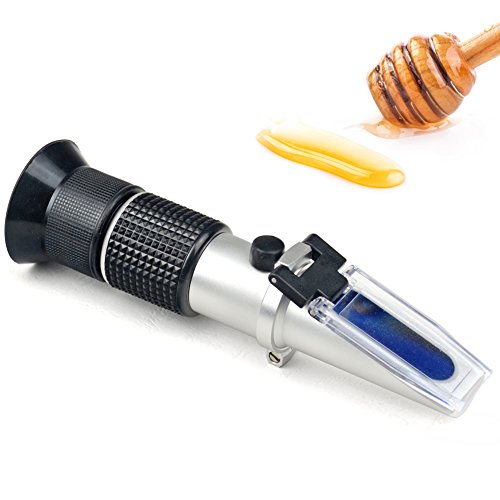
aichose Honey Refractometer
aichose · Honey moisture, Brix and Baume scales (listed) · optical, no batteries · includes calibration reference
Our verdict: Every fermented bucket of honey traces to moisture nobody measured. One drop on the prism tells you whether a jar is under the roughly 18.6 percent line where honey is stable, which converts a guess into a fact.
If you bottle your own honey, buy in bulk from a beekeeper, or simply want to know rather than assume, the aichose Honey Refractometer ($22.88) settles it. Put one drop on the prism, close the plate, hold it toward a light, and read the moisture scale. Under about 18.6 percent and the honey is stable indefinitely. Over it and you have a jar with a clock running.
It is an optical instrument, so there are no batteries to die at the worst moment, and it carries Brix and Baume scales alongside the honey moisture scale (listed). Calibrate it once with the included reference, read at a stable room temperature, and it will keep telling you the truth for years. It is the same tool we recommend on the production side in how to harvest honey.
Who should buy it
Anyone who bottles honey, buys it by the bucket, or has ever thrown out a jar they were not sure about. It is also the right gift for a first-year beekeeper approaching their first harvest.
What we don't like
Requires a one-time calibration and a temperature-aware reading habit, and the optics at this price reward reading the instructions carefully once rather than guessing.
- Scales
- Honey moisture, Brix, Baume (listed)
- Type
- Optical, handheld
- Power
- None required
- Calibration
- Included reference (listed)
- Key threshold
- About 18.6% moisture
- Price
- $22.88
Pros
- Answers the fermentation question in seconds
- No batteries, nothing to fail on harvest day
- Cheap relative to a single ruined bucket of honey
- Works for jarred honey and bulk pails alike
Cons
- Needs an initial calibration
- Readings should be taken at a stable temperature

YeloDeer 5 Gallon Honey Bucket Heater
YeloDeer · Fits 5 gallon pails · adjustable 86F to 302F twist control (listed) · wrap-style heater
Our verdict: A crystallized bucket cannot go in a sink, and the improvised alternatives all involve too much heat. A thermostatic wrap holds a low set point for hours, which is the only method that returns bulk honey to liquid with its aroma intact.
Once you are past jar scale, the physics stop being friendly. A YeloDeer 5 Gallon Honey Bucket Heater ($39.99) wraps a standard pail and holds a temperature you set, so twenty-five or thirty pounds of set honey comes back over hours instead of being blasted back in minutes. The listed range runs from 86F all the way to 302F, and we want to be blunt about that: the top of that dial exists for other jobs. For honey, set it low and walk away.
Our working ceiling is about 104F, the same number that governs the jar method, with a little patience substituted for every degree above it you were tempted to use. A softer alternative for smaller pails is the Dreyoo Thermo Bucket Belt with Insulated Wrap ($34.99). The rest of the bottling and warming kit is covered in honey warmers and decrystallizers.
Who should buy it
Beekeepers bottling their own harvest, anyone who buys honey by the five-gallon pail, and small producers who need to re-liquify stored crop before a market day.
What we don't like
The wide temperature range is a trap: nothing about honey needs the upper two thirds of that dial, and an unattended high setting will darken a whole pail. Treat it as a low-heat device with an unnecessary maximum.
- Fits
- 5 gallon honey pails
- Listed range
- 86F to 302F twist control
- Recommended setting
- Low, under about 104F for honey
- Type
- Wrap-around band heater
- Price
- $39.99
Pros
- Handles a full pail, which no kitchen method can
- Thermostatic control instead of improvised heat
- Far cheaper than a dedicated warming cabinet
- Reusable season after season
Cons
- Listed maximum temperature is wildly higher than honey should ever see
- Slow by design, so plan hours ahead of a bottling session

Le Creuset Stoneware Honey Pot, 14 oz
Le Creuset · Stoneware, 14 oz capacity · lidded with dipper well · non-reactive glazed interior
Our verdict: The top storage rules are keep it sealed, keep it at room temperature, and keep water out. A proper lidded pot does all three while making honey pleasant enough to use that it never gets left open on a humid counter.
Storage advice fails when it is annoying, and a sticky jar with a crusted lid is annoying. The Le Creuset Stoneware Honey Pot (14 oz) ($55.95) is the durable version of the solution: glazed stoneware, non-reactive with honey's acidity, a lid that actually seats, and a dipper well that keeps drips off the counter. Room temperature on a counter is exactly where honey wants to live.
It is a splurge, and we will say so plainly. The same job is done by the QUXIJA Ceramic Honey Jar with Dipper ($16.99) at under a third of the price, and the full field of options sits in honey pots and dispensers. What you buy with the premium here is a piece that will outlive several kitchens and a glaze that shrugs off decades of sticky use.
Who should buy it
People who use honey daily and want it on the counter rather than fighting a jar, and anyone buying a gift for a serious honey household.
What we don't like
The price is entirely about the brand and the ceramic, not about honey performance. A $17 ceramic pot preserves honey exactly as well. Also, 14 oz means refilling from a bigger bottle.
- Material
- Glazed stoneware
- Capacity
- 14 oz
- Closure
- Lidded with dipper well
- Reactivity
- Non-reactive glazed interior
- Storage
- Room temperature counter use
- Price
- $55.95
Pros
- Seals properly, which is the single most important storage rule
- Non-reactive glazed interior suited to an acidic food
- Keeps honey at room temperature and off the refrigerator shelf
- Durable enough to be a decades-long kitchen fixture
Cons
- Expensive for what is functionally a lidded ceramic pot
- 14 oz capacity means regular refills from a larger bottle
The three defenses: why honey does not spoil
Honey is a preservation system that happens to taste good. Three independent mechanisms stack on top of each other, and a microbe would have to defeat all three at once.
| Defense | The mechanism | What it stops |
|---|---|---|
| Low water activity | Ripe honey holds roughly 17 to 18 percent water, and that water is bound up by an enormous concentration of dissolved sugar, so very little of it is available for anything to live on. | Bacteria and nearly all yeasts and molds, which need free water to grow. |
| Low pH | Gluconic acid, produced when the bee enzyme glucose oxidase acts on glucose, pushes honey's pH down to roughly 3.4 to 4.5. | Most spoilage bacteria, which prefer near-neutral conditions. |
| Hydrogen peroxide | That same glucose oxidase reaction generates small, continuous amounts of hydrogen peroxide as honey is diluted. | A low-grade antimicrobial background effect on top of the other two. |
Add osmosis to the list as a fourth mechanism if you like: honey's sugar concentration is so high that it actively pulls water out of any cell that lands in it. The net result is a food that is hostile to microbial life while being an extraordinarily concentrated store of energy, which is exactly what a colony needs from a winter pantry (Wikipedia: honey). The full biological story of how bees engineer it is in how bees make honey.
The catch: honey is hygroscopic
All three defenses depend on the honey staying dry, and honey is hygroscopic, meaning it actively pulls moisture out of humid air. That is the loophole. A jar left open on a humid summer counter will absorb water into its top layer, and if that surface layer gets wet enough, the yeasts that were always present but dormant can begin to work.
This is why the single most important storage rule is the least glamorous one: keep the lid on. Not refrigeration, not a special cupboard, not a dark bottle. A tight lid does ninety percent of the work of keeping honey good forever, and a proper lidded honey pot with a dipper does it while being nicer to use than a sticky jar, which is the entire argument for something like the Le Creuset Stoneware Honey Pot ($55.95).
What crystallization actually is
Honey is a supersaturated sugar solution: it holds more dissolved sugar than it stably can, which means it is always looking for an excuse to drop some out. Glucose is the less soluble of the two main sugars, so glucose is what precipitates, forming crystals that grow on any solid particle already suspended in the honey. A pollen grain, a fleck of wax, an air bubble, a scratch in the jar wall. Fructose stays in solution, so the liquid between the crystals gets proportionally wetter, which is worth remembering because it matters below.
The speed depends almost entirely on the glucose-to-fructose ratio of the nectar the bees worked. High-glucose honeys like clover, canola, and goldenrod can set within weeks. High-fructose honeys like tupelo, acacia, and sourwood can stay liquid for a year or more. Temperature matters too: crystallization runs fastest around 50 to 57F, which is precisely why the refrigerator is the worst possible place to store honey. We charted crystallization speed by varietal in the honey varieties guide.
Crystallized is not spoiled (and is often a good sign)
Say it plainly, because this is the misunderstanding that sends good honey into the trash: a crystallized jar is not bad honey. It is honey that has done what honey does. In fact a jar that sets within a few months is telling you something useful, that it still contains the pollen and fine particles that crystals need as seeds, which means it was not ultrafiltered. Supermarket honey that never crystallizes has usually been heated and finely filtered to remove those seeds, a processing question we take apart in raw honey vs regular honey.
Some people prefer honey crystallized and buy it that way on purpose. Creamed, whipped, or spun honey is simply honey whose crystallization has been controlled to produce a fine, smooth texture instead of a gritty one. Same honey, same sugar, different crystal size. If you find yourself liking the set jar more than the runny one, that category is worth exploring rather than fighting.
How to bring a crystallized jar back
The whole technique is gentle heat plus patience. The reason to stay gentle is that heat drives off the volatile aromatic compounds that carry a honey's floral character, and it raises HMF, the compound the honey trade uses as an index of heat abuse. Cook your jar and you will have functionally converted expensive honey into cheap honey.
Keep the water below about 104F. That is roughly the warmest a hive interior gets, and it is the ceiling we use for everything from decrystallizing a jar to warming a harvest bucket. Above it, aroma starts leaving; well above it, you are pasteurizing your own honey in your kitchen. Expect a small jar to take 20 to 45 minutes and a large one considerably longer, with a couple of water changes.
For plastic squeeze bottles, use the same temperature but check the bottle's own heat tolerance and never place it against a hot pan. For a fully solid jar, loosen the lid first so pressure can equalize, and stir as it softens so the heat does not concentrate at the glass wall.
What not to do to crystallized honey
| Do not | Why |
|---|---|
| Microwave it | Heats unevenly and hits scorching temperatures in local hot spots. Strips aroma, raises HMF, and can crack glass or warp plastic. |
| Boil it or set it on a burner | Far above the 104F ceiling. Caramelizes sugars and permanently changes flavor and color. |
| Refrigerate it, before or after | The 50 to 57F range is the fastest crystallization zone. The fridge causes the problem you are trying to solve. |
| Add water to loosen it | Lowers the sugar concentration and hands the yeasts the moisture they need. This is how you actually spoil honey. |
| Leave it uncovered in a warm bathroom or over a stove | Humid air plus warmth is the exact recipe for surface fermentation. |
One more: do not keep re-melting the same jar over and over. Each cycle costs a little aroma and adds a little HMF. If you have a jar you only use occasionally, buy a smaller one next time, or buy a variety that resists setting.
When honey genuinely is bad: fermentation
Here is the one real failure mode. Honey carries naturally occurring osmotolerant yeasts, dormant and harmless in a properly cured jar because there is not enough available water for them to work. Give them water and they wake up, consuming sugars and producing alcohol and carbon dioxide. That is fermentation, and it is how mead is made deliberately and how a bad batch of honey ruins itself accidentally.
The threshold is moisture. Honey the bees have properly ripened and capped sits around 17 to 18 percent water and is stable. Above roughly 18.6 percent, the risk of fermentation climbs, and by 19 or 20 percent it is close to a certainty given time and warmth. This number is the single most important figure in honey harvesting, which is why extension programs hammer it and why beekeepers own refractometers (Bee Health, eXtension).
Two things push a jar over that line. Either the honey was extracted before the bees finished drying and capping it, which is a harvest error covered in how to harvest honey, or the honey absorbed moisture afterward from a poorly sealed container in a humid room. Consumer honey from a commercial packer is essentially never in the first category.
How to tell if honey has fermented
| Signal | What you will notice | Verdict |
|---|---|---|
| Smell | Sour, yeasty, winey, or beer-like instead of floral and sweet. | Fermented. Discard. |
| Bubbles or foam | Rising bubbles, a persistent frothy layer, or fizz when stirred. | Fermented. Discard. |
| Bulging or popping lid | Carbon dioxide pressure from active fermentation. | Fermented. Discard. |
| Taste | Sharp, sour, alcoholic edge. | Fermented. Discard. |
| White foam layer on a fresh jar | Trapped air bubbles from bottling, which rise and collect. Common in raw honey. | Harmless. Skim or stir. |
| Grainy, pale, or solid | Crystallization. | Harmless. Warm it gently. |
| White frosting on the jar wall | Air bubbles trapped against the glass during crystallization. | Cosmetic only. |
| Darkening over years | Slow non-enzymatic browning with age and warmth. | Quality drift, not spoilage. |
The three bottom rows are what people mistake for spoilage roughly nine times out of ten. Trust your nose above everything else on this table: fermenting honey announces itself, and honey that smells like honey is honey.
Measuring moisture: the number that settles it
If you bottle your own honey, buy honey in bulk, or simply want certainty rather than inference, a honey refractometer answers the question in seconds. A drop of honey goes on the prism, you hold it toward a light, and a scale tells you the water percentage. Below about 18.6 percent, the honey is stable. Above it, plan to use it quickly, refrigerate it (fermentation slows in the cold even though crystallization speeds up), or turn it into mead deliberately rather than accidentally.
The aichose Honey Refractometer ($22.88) is the standard hobby tool, optical, no batteries, with honey moisture plus Brix and Baume scales. The TRZ Honey Refractometer (10 to 32% water) ($19.00) covers the same job for a couple of dollars less. Either one pays for itself the first time it stops you from bottling a bucket that would have fermented, which is the argument we make at greater length in honey harvesting equipment.
Storage rules, ranked by how much they matter
| Rule | Why | How much it matters |
|---|---|---|
| Keep it tightly sealed | Honey pulls water from humid air, and moisture is the only thing that can spoil it. | Critical |
| Room temperature, roughly 60 to 75F | Warm enough to stay liquid longer, cool enough to avoid aroma loss and darkening. | High |
| Never refrigerate | 50 to 57F is the peak crystallization zone. | High |
| Use a clean, dry spoon every time | A wet or crumb-loaded spoon introduces both moisture and foreign material. | High |
| Away from the stove, dishwasher, and direct sun | Repeated warming accelerates darkening and aroma loss. | Medium |
| Glass or food-grade plastic, not reactive metal | Honey is acidic and can react with some bare metals over long storage. | Medium |
| Freezing is fine but pointless for a pantry jar | Freezing halts crystallization and holds quality, which is useful for bulk storage, not for a table jar. | Low |
A dedicated honey pot with a lid and a dipper handles the top four rules in one object, which is why they have been a kitchen fixture for centuries. A budget version like the QUXIJA Ceramic Honey Jar with Dipper (10oz) ($16.99) does the same work as the expensive one; the wider field is in honey pots and dispensers.
What best-by dates on honey actually mean
A best-by date on a honey jar is a commercial quality date, not a safety date. Packers set it to manage inventory, to bound their own quality claims, and because retail systems expect a date on the label. It is not a statement that the honey becomes unsafe, and honey does not have a spoilage clock in the way milk or bread do.
What is true is that honey drifts in quality. Over years, especially in a warm cupboard, it slowly darkens, loses its floral top notes, and accumulates HMF. A five-year-old jar is completely safe and noticeably less interesting than it was. Our practical rule: ignore the date on the label, trust your nose, and buy jar sizes you will actually finish within a year or two so the drift never becomes visible.
The 3,000-year-old tomb honey, told honestly
You have heard the story: archaeologists opened an Egyptian tomb, found sealed pots of honey, and the honey was still edible after thousands of years. It is the most repeated fact in the honey world and it deserves careful handling, because the underlying chemistry is real and the specific anecdote is not well documented.
What is solid: honey's low water activity and acidity genuinely do make it capable of surviving for extraordinarily long periods when sealed, and honey has genuinely been recovered from ancient burial contexts, where it was used as a grave good and as a preservative. What is shakier: the widely repeated claim that a particular jar was tasted and found perfectly good is passed from article to article without a clear primary source behind it, and the vessels in question were not sealed under laboratory conditions for three millennia. The honest framing is that honey can last indefinitely, and that the tomb story is a colorful illustration of that principle rather than a documented taste test (Wikipedia: honey).
We think the true version is more impressive than the legend anyway. You do not need an archaeological anecdote to justify honey's shelf life. A sealed jar in your own cupboard, twenty years from now, will still be honey, and that is a verifiable claim you can run yourself.
Bulk honey: buckets, warmers, and the same 104F rule
Everything above scales up badly. A five-gallon pail of crystallized honey cannot be rescued in a sink, and the temptation is to apply serious heat, which is exactly how a good harvest becomes flat, dark, high-HMF honey. The correct tool is a low-and-slow bucket warmer with a thermostat, held under the same ceiling.
A YeloDeer 5 Gallon Honey Bucket Heater ($39.99) wraps a pail and holds a set temperature so the honey liquefies over hours rather than minutes; a softer alternative is the Dreyoo Thermo Bucket Belt with Insulated Wrap ($34.99), which fits 2 to 5 gallon pails. Set them low. The listed temperature range on these devices goes far higher than honey should ever see, and the fact that a device can reach 300F is not an invitation. The bottling-side equipment picture is in honey warmers and decrystallizers.
The one absolute rule: no honey for infants
This is the only genuine safety warning on this page, and it is not negotiable. Do not give honey, in any form, to a child under 12 months of age. Honey can contain dormant bacterial spores that are harmless to older children and adults, whose established gut flora keeps them in check, but that an infant's immature digestive system cannot manage. This is the reason infant botulism is associated with honey, and every major food safety authority draws the line at the first birthday (FDA, Wikipedia: botulism).
The rule covers all honey: raw, pasteurized, filtered, organic, manuka, local, expensive, cheap. It covers honey on a pacifier, honey stirred into a bottle, honey in a teething remedy, and honey baked into food given to an infant. After the first birthday, honey is treated like any other food. If you have questions about your own child, ask your pediatrician rather than a shopping guide.
One related note: people with allergies to bee products or specific pollens can react to honey, and to related products such as bee pollen and propolis. If that describes you, talk to your clinician before adding a new honey to your diet.
Quick answers, in one table
| Situation | Verdict | What to do |
|---|---|---|
| Jar is solid and grainy | Fine | Warm water bath below 104F. |
| Jar has white patches on the glass | Fine | Nothing. Trapped air, cosmetic. |
| Honey is darker than when you bought it | Fine | Use it. Store cooler next time. |
| Best-by date passed two years ago | Fine | Smell it. If it smells like honey, it is honey. |
| Foam layer on a new jar | Fine | Skim or stir it in. |
| Smells sour or yeasty, fizzes, lid bulges | Fermented | Discard the jar. |
| Visible mold on the surface | Contaminated | Discard. Usually means water got in. |
| You added water to loosen it last month | At risk | Use immediately or discard. You lowered the sugar concentration. |
| Anyone under 12 months wants some | No | Not until the first birthday. No exceptions. |
How to decrystallize honey without ruining it
- 1
Loosen the lid
Crack the lid so warming air and pressure can escape, but leave it resting on the jar so no water or steam gets into the honey.
- 2
Fill a pot or bowl with warm water
Use water you could comfortably hold your hand in, below about 104F. Hot tap water is usually right. Do not use boiling water and do not put the pot on the burner with the jar in it.
- 3
Stand the jar in the water
The water level should reach roughly the honey line. Do not submerge the lid. A dish towel under the jar keeps glass off a hot pan bottom.
- 4
Wait and stir
Give it 20 to 45 minutes for a small jar. Stir every 10 minutes or so with a clean dry spoon to move heat through the crystals rather than concentrating it at the glass.
- 5
Change the water as it cools
Replace with fresh warm water once or twice. Patience at low temperature beats speed at high temperature every time.
- 6
Dry the jar and reseal
Wipe the rim and lid completely dry before closing. Any water left at the seal is exactly what causes trouble later.
- 7
Store it warmer next time
Keep the jar at normal room temperature, away from the refrigerator and away from the 50 to 57F range where crystallization runs fastest.
More gear worth comparing
Beyond this guide: the highest-rated gear across every category and budget, with a live price check on each.



As an Amazon Associate we may earn from qualifying purchases, at no cost to you.
Quick shop: every pick
Skip the scroll: the whole lineup, with a live price check on each.
- aichose Honey RefractometerBest Certainty Toolaichose · $22.88Check Price
- YeloDeer 5 Gallon Honey Bucket HeaterBest for Bulk HoneyYeloDeer · $39.99Check Price
- Le Creuset Stoneware Honey Pot, 14 ozBest Everyday StorageLe Creuset · $55.95Check Price
Key terms
- Water activity
- The fraction of water in a food that is actually available to microbes. Honey's sugar concentration binds nearly all of its water, which is the first of its three defenses against spoilage.
- Glucose oxidase
- A bee-added enzyme that acts on glucose to produce gluconic acid and small amounts of hydrogen peroxide, giving honey both its low pH and a mild antimicrobial background.
- Hygroscopic
- Moisture-attracting. Honey pulls water from humid air, which is why a tight lid is the single most important storage rule.
- Crystallization
- Glucose coming out of a supersaturated solution and forming crystals on suspended particles. Normal, harmless, reversible, and faster in raw honey than in filtered honey.
- Fermentation
- Osmotolerant yeasts consuming honey sugars once moisture rises above roughly 18.6 percent, producing alcohol and carbon dioxide. The only true way honey spoils.
- HMF (hydroxymethylfurfural)
- A compound that accumulates in honey with heat and age. Used across the honey trade as an index of overheating and of storage age.
- Refractometer
- An optical instrument that reads a liquid's water content from how it bends light. For honey, the tool that confirms a jar sits below the fermentation threshold.
- Creamed (whipped) honey
- Honey whose crystallization has been deliberately controlled to produce fine, smooth crystals and a spreadable texture. Same honey, different crystal size.
- Infant botulism
- The reason no honey of any kind may be given to a child under 12 months. Honey can carry dormant spores that an infant's immature gut cannot keep in check.
Questions, answered
does honey go bad
Properly cured, sealed honey does not spoil. Its low water activity, pH of roughly 3.4 to 4.5, and enzyme-generated hydrogen peroxide make it inhospitable to bacteria and most yeasts, so a closed jar stays edible essentially indefinitely. It will crystallize and slowly darken with age, neither of which is spoilage. The one real failure is fermentation, which requires moisture above roughly 18.6 percent.
can you eat expired honey
Yes. A best-by date on honey is a commercial quality date rather than a safety date, set for inventory and label reasons. Old honey may be darker and less aromatic than it was, which is quality drift, not spoilage. Smell it: if it smells like honey rather than sour or yeasty, it is honey. The exception is any honey that has visibly molded or fermented, which should be discarded.
why did my honey crystallize
Because honey is a supersaturated sugar solution and glucose eventually comes out of it, forming crystals on pollen grains, wax flecks, and air bubbles. High-glucose honeys like clover and goldenrod set within weeks; high-fructose ones like tupelo and acacia can stay liquid for a year. Cold storage speeds it up, with the 50 to 57F range being the fastest, which is why the refrigerator is the worst place for honey.
how do you fix crystallized honey
Loosen the lid, stand the jar in a bowl of warm water below about 104F, and wait 20 to 45 minutes, stirring occasionally and changing the water once or twice as it cools. Do not microwave it, do not boil it, and never add water to thin it. Excess heat strips the volatile aromas that give honey its character and raises HMF, the compound the trade uses to detect overheated honey.
how can you tell if honey is bad
Trust your nose first. Fermented honey smells sour, yeasty, or winey rather than floral, and it may fizz, foam, or push its lid up. Visible mold means water got in. What is not bad: grainy or solid honey (crystallization), a white foam layer on a fresh jar (trapped air), white frosting against the glass (air bubbles), and gradual darkening with age.
can honey ferment
Yes, and it is the only genuine way honey spoils. Honey naturally carries dormant osmotolerant yeasts that cannot work in a properly cured jar because there is not enough available water. Above roughly 18.6 percent moisture they wake up and produce alcohol and carbon dioxide. That happens either because the honey was extracted before the bees finished drying and capping it, or because it absorbed moisture from humid air through a bad seal.
should you store honey in the fridge
No. Refrigerator temperatures sit close to the 50 to 57F band where crystallization runs fastest, so the fridge causes the exact problem people are trying to avoid. Store honey sealed at normal room temperature, roughly 60 to 75F, away from the stove and out of direct sun. Freezing is fine for long-term bulk storage but pointless for a jar you use weekly.
is honey really thousands of years old and still edible
The chemistry that would allow it is real: sealed honey's low water activity and acidity can preserve it for extraordinarily long periods, and honey has genuinely been recovered from ancient burial contexts. The specific and much-repeated claim that archaeologists tasted 3,000-year-old tomb honey and found it perfect is passed around without a clear primary source. The honest version is that honey can last indefinitely, which you can verify with your own cupboard rather than a tomb.
why does honey turn dark over time
Slow non-enzymatic browning, accelerated by warmth. The same process raises HMF, which is why the honey trade treats dark, high-HMF honey as either old or overheated. A darkening jar is safe to eat and has usually lost some of its floral top notes. Keeping honey cool, sealed, and out of sunlight slows the drift considerably.
can babies eat honey
No, not before 12 months. Honey can contain dormant bacterial spores that older children and adults handle without incident but that an infant's immature digestive system cannot control, which is why infant botulism is associated with honey. The rule covers every type of honey, raw or pasteurized, and every route including a pacifier, a bottle, or baked goods. Ask your pediatrician about your own child.
Filed under Explainer
Part of Honey & Bee Products
Keep reading
Raw Honey vs Regular Honey
Why raw honey crystallizes fast and supermarket honey never does, plus the full label decode.
The Honey Varieties Guide
Crystallization speed by varietal, from fast-setting clover to tupelo that stays liquid for a year.
Cooking and Baking with Honey
The same temperature ceiling applied to a saucepan, plus the full sugar substitution math.
Manuka Honey UMF and MGO Explained
Why overheating an expensive jar wrecks one of the four markers you paid to have tested.
How to Harvest Honey
The production side of the moisture rule: capped frames, refractometer checks, and clean bottling.
How Bees Make Honey
Where the 17 to 18 percent moisture number comes from, and why bees cap a cell only when it is ready.