Our Pick: New Zealand Honey Co
Check PriceManuka Honey UMF and MGO Explained: How the Grading Actually Works
The short answer: MGO is a measured number and UMF is a licensed grading system that includes that number plus three more tests. MGO stands for methylglyoxal, the compound that makes manuka honey chemically unusual, and the figure on the label is milligrams of it per kilogram of honey. UMF stands for Unique Manuka Factor, a trademarked quality mark whose licensees must test four markers, not one, and whose published scale converts cleanly: UMF 5+ equals MGO 83+, UMF 10+ equals MGO 263+, UMF 15+ equals MGO 514+, and UMF 20+ equals MGO 829+. If a jar shows a UMF number, you know what its MGO is. If it shows only a vague word like Active or a proprietary K-number, you know considerably less.
By The BeehiveKits Hive Desk2026-08-2918 min read Fact-checked against verified Amazon listingsHow we research
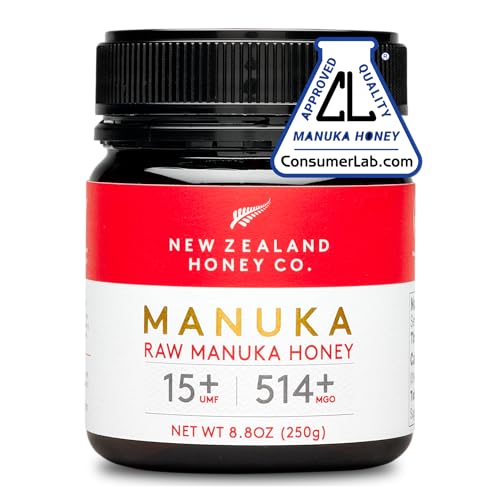 Best Overall
New Zealand Honey Co Raw Manuka UMF 15+ / MGO 514+
New Zealand Honey Co · 4.7
$33.88
 Best Value
New Zealand Honey Co Raw Manuka UMF 10+ / MGO 263+
New Zealand Honey Co · 4.6
$18.88
For most shoppers the sweet spot is a certified mid-grade jar rather than the trophy tier. A UMF 10+ jar such as the New Zealand Honey Co UMF 10+ (MGO 263+) at $18.88 is the honest entry point to genuine certified manuka, and the New Zealand Honey Co UMF 15+ (MGO 514+) at $33.88 is where most people who buy manuka repeatedly end up. The top of the range costs more per jar and, as the math table further down shows, is not always more expensive per MGO point. That is the whole reason this page has a calculator section.
One thing we will not do here is tell you what manuka honey does to a body. This is a labeling and grading explainer, written for shoppers who want to know what they are paying for. People have traditionally used manuka in food and in home remedies, and that tradition is why the category exists, but claims about health effects belong to a clinician and to regulators, not to a product page. Where we mention traditional use, we label it as tradition. Ask a doctor about anything medical.
Standard disclosure: no brand paid to appear here, prices are the listed prices we verified, and some links go to Amazon, where a purchase may earn us a small commission at no extra cost to you.
What to know
- MGO is a lab-measured concentration of methylglyoxal in milligrams per kilogram. Bigger number, more of that compound, higher price.
- UMF is a licensed quality mark that tests four markers (leptosperin, DHA, MGO, and HMF), so it certifies authenticity and freshness, not just potency.
- The published UMF-to-MGO conversion is fixed: 5+/83+, 10+/263+, 15+/514+, 20+/829+.
- KFactor, Bio Active, and plain Active are brand or marketing terms with no shared industry standard behind them. They are not comparable to UMF or MGO.
- MGO forms on the shelf from dihydroxyacetone (DHA) present in manuka nectar, which is why fresh manuka honey is graded on both numbers.
- Cost per MGO point, not price per jar, is the only fair way to compare two certified jars, and net weight has to be in the equation.
- Honey of any kind, manuka included, is not safe for infants under 12 months.
New Zealand Honey Co Raw Manuka UMF 15+ / MGO 514+
New Zealand Honey Co · UMF 15+ certified · MGO 514+ · third-party tested (listed) · New Zealand origin
Our verdict: UMF 15+ is the tier where manuka stops being a curiosity and starts being a pantry item people re-buy. This jar puts the licensed mark, the MGO equivalence, and third-party testing language on the front, which is exactly the paperwork this category runs on.
If you only ever buy one manuka jar, this is the grade we would point you at. New Zealand Honey Co Raw Manuka UMF 15+ (MGO 514+) ($33.88) sits at the point on the curve where the honey is unmistakably manuka in flavor, thick, dark, and mineral, without crossing into collector pricing. On our cost-per-MGO math it worked out around $6.59 per 100 MGO points at the listed price, better value per point than the certified 10+ tier.
What we like structurally is the labeling discipline: a UMF grade, the equivalent MGO figure printed rather than implied, and stated third-party testing. That is the combination the six-point label check above is looking for, and it is what separates a licensed product from a jar with an evocative adjective on it. Confirm net weight against the price before you buy, because jar sizes in this category vary more than in any other honey aisle.
Who should buy it
Anyone who has decided they want real, certified manuka and does not want to keep re-litigating the decision. It is also the grade that reads correctly as a gift without the price becoming a statement.
What we don't like
It is expensive honey by any normal measure, and the price per jar moves with promotions, so the per-MGO math that favors it one week can favor the 20+ tier the next. Check the arithmetic on the day.
- Grade
- UMF 15+
- MGO
- 514+ mg/kg
- Certification
- UMF licensed, third-party tested (listed)
- Origin
- New Zealand
- Cost per 100 MGO
- about $6.59 at listed price
- Price
- $33.88
Pros
- Licensed UMF grade with the MGO equivalence printed
- Better cost per MGO point than the certified 10+ tier at listed prices
- Flavor intensity most people describe as the real manuka experience
- Reads as a serious gift without collector pricing
Cons
- Expensive per ounce compared with any domestic varietal honey
- Jar size must be checked against price; net weight varies across this category
New Zealand Honey Co Raw Manuka UMF 10+ / MGO 263+
New Zealand Honey Co · UMF 10+ certified · MGO 263+ · third-party tested (listed) · New Zealand origin
Our verdict: UMF 10+ is the entry rung of genuine certified manuka, and this is the version of it we would hand a curious first-time buyer. Real licence, real number, roughly half the price of the 15+ tier.
Most people who think they want manuka have never tasted it, and the sensible response to that is not a $60 jar. New Zealand Honey Co Raw Manuka UMF 10+ (MGO 263+) ($18.88) is a licensed, tested, unambiguously genuine jar at the bottom rung of the grade ladder, which makes it the right experiment. If you love it, move up. If you find it too strong or too expensive for what it does on your toast, you have learned that for $18.88 instead of $60.
The tradeoff is visible in the math: at listed prices it costs more per MGO point than the 15+ tier, roughly $7.18 per 100 points. That is normal at the bottom of a premium ladder, where you are paying for the certification overhead across a smaller number. You are buying access to the category, not efficiency.
Who should buy it
First-time manuka buyers, anyone who wants a certified jar for a specific occasion, and people who use manuka occasionally rather than daily.
What we don't like
Worst cost per MGO point of the New Zealand Honey Co grades we priced, and the flavor is noticeably milder than the tiers above, which occasionally disappoints people expecting the intensity they read about.
- Grade
- UMF 10+
- MGO
- 263+ mg/kg
- Certification
- UMF licensed, third-party tested (listed)
- Origin
- New Zealand
- Cost per 100 MGO
- about $7.18 at listed price
- Price
- $18.88
Pros
- Lowest-cost entry into genuinely certified manuka
- Same licence and testing discipline as the higher grades
- Milder flavor that suits people who want manuka in tea, not on a spoon
Cons
- Least efficient of the grades on a cost-per-MGO basis
- Flavor is a step down from the 15+ tier people usually describe

Manuka Health UMF 13+ / MGO 400+ (250g)
Manuka Health · UMF 13+ · MGO 400+ · 250g / 8.8oz listed · New Zealand origin
Our verdict: A textbook example of transparent labeling: a licensed UMF grade, the measured MGO figure beside it, and a stated net weight so the price math is possible. The grade sits between the standard rungs, which is honest rather than evasive.
Manuka Health UMF 13+ / MGO 400+ ($34.95) is the jar we point to when explaining what good labeling looks like. UMF 13+ is not a rung on the standard 5, 10, 15, 20 ladder, and rather than rounding down to 10+ or implying 15+, the brand prints the exact grade and the measured MGO number alongside it. The stated 250g / 8.8oz net weight completes the picture, which matters because a price without a weight is not a price.
On pure cost per MGO point it is the most expensive row in our table, around $8.74 per 100 points, and we are not going to pretend otherwise. What you are paying for is a well-established brand, a clean dual-labeled grade, and a known jar size. If your priority is arithmetic efficiency, the 500g options do better; if your priority is a label you can read without a decoder, this is it.
Who should buy it
Shoppers who value label transparency and a known net weight over squeezing the last cent out of the per-MGO math, and gift buyers who want a widely recognized brand.
What we don't like
The most expensive jar per MGO point in our comparison, and the between-rungs 13+ grade means you cannot compare it against a 15+ jar at a glance without doing the conversion.
- Grade
- UMF 13+
- MGO
- 400+ mg/kg
- Net weight
- 250g / 8.8oz (listed)
- Origin
- New Zealand
- Cost per 100 MGO
- about $8.74 at listed price
- Price
- $34.95
Pros
- Prints UMF grade, MGO figure, and net weight together
- Well-established brand with wide availability
- Between-rung grade is stated honestly rather than rounded
Cons
- Highest cost per MGO point of the jars we priced
- Smaller 250g jar than several cheaper-per-gram alternatives
What manuka honey actually is
Manuka honey is honey made predominantly from the nectar of Leptospermum scoparium, a scrubby flowering shrub native to New Zealand and southeastern Australia, known in New Zealand by its Maori name, manuka. Bees work it the same way they work clover or orange blossom: they gather nectar, add enzymes, fan out the water, and cap the finished cells. The mechanics are identical to every other honey on earth, and we walk through them in how bees make honey. What is different is the nectar's chemistry, and that difference is the entire commercial story (Wikipedia: Manuka honey).
Because the plant grows in a narrow part of the world and blooms for a short window, genuine manuka is a supply-limited product. That scarcity, combined with a strong global reputation, is why a small jar can cost more than a gallon of domestic wildflower honey, and why the category attracts both careful certification bodies and opportunists. Everything below exists because the market needed a way to tell one from the other.
MGO: what methylglyoxal is, and where it comes from
MGO on a label is short for methylglyoxal, an organic compound that occurs at trace levels in many foods and at unusually high levels in manuka honey. The number after it is a concentration: milligrams of methylglyoxal per kilogram of honey. MGO 263+ means the tested batch carried at least 263 mg/kg. That is the whole definition. It is a measurement, not a grade curve, not a rating, and not an opinion (Wikipedia: methylglyoxal).
The interesting part is that the bees do not make it. Manuka nectar contains an unusual amount of dihydroxyacetone, or DHA, a simple sugar-derived compound. After the honey is made and stored, DHA slowly converts into methylglyoxal. So the MGO number in a jar is the product of two things: how much DHA the nectar carried, and how long and how warm the honey has sat since. A fresh batch may test low on MGO and high on DHA, then climb over months in the warehouse. This is why any serious grading system looks at both numbers rather than the headline one.
DHA: the precursor that makes the grade a moving target
Treat DHA as the fuel tank and MGO as the fuel already burned. A honey with high DHA and modest MGO is young and still converting; a honey with low DHA and high MGO has largely finished the reaction. Both can be genuine manuka, and neither is a defect. What matters to a buyer is that the number on the jar was measured on that batch, by an accredited lab, and printed rather than estimated, which is exactly the discipline a certification scheme enforces and a marketing word does not.
It also explains a common shopper complaint: two jars of the same brand and the same stated grade can taste and pour differently. Manuka is a natural product with an in-jar chemical clock running. Batch variation is normal. A dramatic mismatch between the label and what is in the jar is not, and the batch or lot number printed on a certified jar is your route back to the lab report.
UMF: a licence, not just a number
UMF stands for Unique Manuka Factor. It is a trademarked quality mark administered by the UMF Honey Association, and it is licensed to brands rather than printed at will. To carry the mark, a packer must be a licensee, must have batches tested by approved laboratories, and must pass on four markers rather than the single potency figure (UMF Honey Association):
| Marker | What it tells you |
|---|---|
| Leptosperin | Authenticity. A compound found in manuka nectar that cannot practically be added or faked, so it separates real manuka from blended or spiked product. |
| DHA | Potential. The precursor still in the jar, which indicates the honey's freshness and how the MGO figure may develop. |
| MGO | Potency. The measured methylglyoxal concentration, the number most brands print on the front. |
| HMF | Freshness and handling. Hydroxymethylfurfural rises when honey is heated or stored badly, so a low figure indicates the honey was not cooked to look clear. |
That is the practical difference between UMF and a bare MGO figure. A standalone MGO number tells you one thing about the jar. A UMF grade tells you the same thing plus that an association-approved lab checked the honey is genuinely manuka and was not heat-abused on the way to you. Both are real information; UMF is simply more of it, under a licence that can be revoked.
The UMF to MGO conversion table
This is the table people come to this page for. The UMF Honey Association publishes the equivalence, so any certified jar's UMF grade maps directly onto a minimum MGO value. Print it, screenshot it, take it shopping.
| UMF grade | Equivalent MGO (mg/kg) | Where it sits in the market |
|---|---|---|
| UMF 5+ | MGO 83+ | Entry certified. Mild, table honey, cheapest genuine tier. |
| UMF 10+ | MGO 263+ | The common starting grade. Most people's first certified jar. |
| UMF 15+ | MGO 514+ | The popular mid-to-high tier. Strong flavor, gift-worthy. |
| UMF 20+ | MGO 829+ | Premium tier. Scarce, intense, priced accordingly. |
Grades above 20+ exist and follow the same logic, climbing steeply in both MGO and price. Two practical notes. First, a jar labeled only with an MGO figure that falls between rungs, MGO 400+ for instance, is not a UMF grade; the honest brands that do this state their UMF grade separately, as Manuka Health UMF 13+ / MGO 400+ ($34.95) does on its own label. Second, MGO figures are minimums, so a jar tested at 300 may still be sold as MGO 263+ under its certified grade.
The New Zealand government definition, in one paragraph
Separate from UMF, the New Zealand government sets a legal definition of what may be exported as manuka honey, and it splits the category into monofloral and multifloral tiers based on a chemical and DNA test panel rather than on marketing. This is why exported jars carry that classification language, and it is another reason to prefer product whose paperwork exists (Wikipedia: Manuka honey).
For a shopper the takeaway is short: monofloral manuka is the product the reputation was built on, multifloral manuka is real manuka blended with other nectars from the same landscape, and both are legitimate as long as the jar says which it is. A jar that says neither, from a brand with no licence and no lot number, is asking you to take its word for it.
Leptosperin: the marker that catches fakes
Of the four UMF markers, leptosperin deserves its own moment. It is a naturally occurring compound in manuka nectar that survives into the honey and that, crucially, is not commercially available to be spiked in. Methylglyoxal, by contrast, can be manufactured. That asymmetry is the whole anti-fraud argument for a multi-marker test: a bad actor can in principle push an MGO number up, but a leptosperin test asks a question that only real manuka nectar can answer.
You will rarely see leptosperin printed on a front label, and that is fine. It runs in the background of the certification. What you should look for on the jar is the licensee number that says a body with something to lose ran those tests, which is precisely what a certified jar such as the New Zealand Honey Co UMF 15+ (MGO 514+) ($33.88) carries.
KFactor, Bio Active, and the words that mean nothing in particular
Now the decoder ring for everything that is not UMF or MGO. These terms are not necessarily dishonest, and some sit on genuinely good honey. They simply are not standardized, which means you cannot compare one brand's number to another's, and you cannot convert them to MGO.
| Term on the jar | What it is | Comparable to UMF or MGO? |
|---|---|---|
| UMF 15+ | Licensed grade, four markers, approved lab. | Yes. This is the reference standard. |
| MGO 514+ | Measured methylglyoxal in mg/kg. | Yes, for potency. Says nothing about authenticity or heat. |
| KFactor 16 / KFactor 22 | A single company's proprietary scale, weighted toward pollen count and origin rather than MGO. | No. It does not convert to an MGO figure. |
| Active 12+ / Bio Active 15+ | Legacy or in-house wording. Historically referred to a general activity test, not a manuka-specific one. | No. Treat as unverified unless an MGO or UMF figure appears beside it. |
| TA (Total Activity) | An older non-manuka-specific measure. | No. |
| "Raw manuka", "premium", "wild" | Descriptive words with no grading content. | No. |
The rule of thumb we use at the desk: if the number on the front cannot be found on the UMF conversion table or expressed in mg/kg, it is a brand's own scale. Buy it if you like the brand, but do not pay a UMF 15+ price for it.
How to read a manuka jar, front to back
Six checks, in the order we do them, and the whole thing takes about fifteen seconds in an aisle or on a product page.
| # | Look for | Why |
|---|---|---|
| 1 | A UMF grade or an explicit MGO mg/kg figure | If neither is present, there is no measured potency claim at all. |
| 2 | UMF licensee number | Confirms the mark is licensed rather than decorative. |
| 3 | Country of origin and packing | Manuka is a New Zealand and Australian product. Packed elsewhere is a question worth asking. |
| 4 | Batch or lot number | The thread back to a specific lab report. |
| 5 | Net weight in grams or ounces | Jar sizes vary enormously in this category. Price is meaningless without it. |
| 6 | Monofloral or multifloral wording | Tells you whether it is pure manuka or a landscape blend. |
A jar that clears all six, at any grade, is a fair purchase. A jar that clears none of them is a jar of unidentified honey with a famous word on the front. Both a New Zealand Honey Co UMF 10+ (MGO 263+) ($18.88) and its higher grades put the UMF mark, the MGO equivalence, and third-party testing language on the label, which is the pattern to look for.
The price-per-MGO math (do this before you buy)
Manuka pricing does not scale linearly, and higher grades are occasionally the better value per unit of the thing you are paying for. The calculation is simple: divide the price by the MGO number to get dollars per MGO point, then multiply by 100 so the numbers are readable. Here is the math on the listed prices we verified, ordered from most to least expensive per point.
| Jar | Grade | Listed price | Cost per 100 MGO points |
|---|---|---|---|
| Manuka Health UMF 13+ / MGO 400+ (250g / 8.8oz listed) | MGO 400+ | $34.95 | about $8.74 |
| New Zealand Honey Co UMF 10+ | MGO 263+ | $18.88 | about $7.18 |
| New Zealand Honey Co UMF 15+ | MGO 514+ | $33.88 | about $6.59 |
| New Zealand Honey Co UMF 20+ | MGO 829+ | $32.98 | about $3.98 |
| Egmont Honey MGO 265+ / UMF 10+ (500g listed) | MGO 265+ | $26.99 | about $10.18 |
Read that table with one large caveat printed in bold, because the honest version of this math needs a third variable: net weight. The Egmont jar looks worst per MGO point and is a 500g jar, roughly double the size of a standard 250g manuka jar, so per gram of honey it may be the cheapest row on the table. The Egmont Honey Manuka MGO 265+ / UMF 10+ 500g ($26.99) is the jar to reach for if you actually eat manuka rather than dose it by the spoon. The complete formula is price divided by grams divided by MGO. Do that once, on the two jars you are torn between, and the decision makes itself.
The other lesson in the table is that the trophy grade is not automatically a rip-off. At the prices we verified, New Zealand Honey Co UMF 20+ (MGO 829+) ($32.98) was the cheapest per MGO point of the small-jar options, which happens when a retailer discounts a high tier. Prices move constantly in this category, so run the math on the day rather than trusting a rule about grades.
Which grade should you actually buy
Our honest routing, with no medical framing attached to any of it. If you are curious and want to taste what the fuss is about, buy a certified UMF 10+ and nothing fancier; it is genuine, it is the cheapest real entry, and it tastes unmistakably like manuka. If you use it regularly in the kitchen, buy the biggest certified jar of a modest grade you can find, because you are buying honey, not points. If you are buying a gift, UMF 15+ is the grade that reads as a serious present without entering collector pricing, which is why it dominates gift sets, and we cover the wider gifting field in honey gift sets.
Where high grades genuinely earn their price is flavor intensity and, for the people who buy them, the confidence that comes with a tested number. Manuka at UMF 20+ is thick, dark, mineral, almost medicinal in taste, and a little goes far. Whether that is worth the multiple is a personal call, and our ranked picks across the whole category live in the best manuka honey guide.
Texture, crystallization, and storage
Manuka behaves differently from a runny clover honey in the jar, and shoppers regularly mistake normal behavior for a defect. Genuine manuka is typically thick and often thixotropic, meaning it is gel-like at rest and loosens when stirred or spooned hard. It also tends to be creamy and opaque rather than glass-clear. None of that is a fault, and none of it is a grading signal.
Store it like any honey: sealed, at room temperature, out of direct sun, and away from steam. Do not refrigerate it, which accelerates crystallization. If it does set firm, warm it gently in a water bath rather than a microwave; excessive heat drives up HMF, which is one of the four things the UMF panel measures, so cooking your expensive honey degrades exactly the metric you paid for. The full storage and rescue routine, including the temperature ceiling, is in does honey go bad.
Why there is more manuka on shelves than in New Zealand
The category's open secret is a supply arithmetic problem: for years, the volume of honey sold worldwide as manuka has been widely reported to exceed the volume New Zealand actually produces. That gap is the reason certification exists at all, and the reason a multi-marker test that includes leptosperin is worth more than a single printed number.
None of this makes the category a scam. It makes it a category where paperwork is the product. The practical defense is the six-point label check above, buying licensed UMF where possible, and treating an unusually cheap high-grade jar as the anomaly it is. The same instinct applies one aisle over, where the global honey supply has its own adulteration problem, covered in raw honey vs regular honey.
How people traditionally use manuka in the kitchen
Here is our guardrail, stated plainly: we are not going to tell you that manuka honey does anything to your body, because that is a question for a clinician and a regulator, not a shopping guide. What we can describe is how people use it. Traditionally, manuka is eaten straight off a spoon, stirred into warm (not boiling) drinks, spread on toast, or taken as a soothing sweetener in a hot lemon drink, a household habit with a long history in New Zealand and in the countries that import it. People also buy it as a gift and as a pantry luxury. If you have a health question about manuka honey, ask your doctor or pharmacist.
Two hard safety facts that apply to manuka exactly as they apply to every other honey. Honey is not safe for infants under 12 months of age, because it can carry dormant bacterial spores that a baby's gut is not yet equipped to handle; this is a firm and universal caution from food safety authorities (FDA). And people with bee-product or pollen allergies can react to honey and to related hive products such as pollen and propolis, so if that is you, treat a new jar with the same caution you would any new food.
Manuka versus ordinary raw honey, without the hype
The honest comparison: manuka is a specific varietal honey with an unusual nectar chemistry, a certification system, and a scarcity premium. Domestic raw honey from a good producer is a fresher, cheaper, more versatile everyday food that will do everything manuka does in a cup of tea for a fifth of the price. They are not competitors so much as different purchases, in the way that a bottle of everyday olive oil and a finishing oil are different purchases.
If your interest is really in flavor rather than certification, the varietal world is much bigger and much cheaper than the manuka aisle, and we mapped it in the honey varieties guide. If your interest is in unprocessed, traceable domestic honey, that field is ranked in best raw honey. And if you are going to cook with any of it, read cooking and baking with honey first, because heat is the one thing that reliably degrades an expensive jar.
More gear worth comparing
Beyond this guide: the highest-rated gear across every category and budget, with a live price check on each.



As an Amazon Associate we may earn from qualifying purchases, at no cost to you.
Quick shop: every pick
Skip the scroll: the whole lineup, with a live price check on each.
- New Zealand Honey Co Raw Manuka UMF 15+ / MGO 514+Best Certified Mid GradeNew Zealand Honey Co · $33.88Check Price
- New Zealand Honey Co Raw Manuka UMF 10+ / MGO 263+Best First Certified JarNew Zealand Honey Co · $18.88Check Price
- Manuka Health UMF 13+ / MGO 400+ (250g)Best Dual-Labeled JarManuka Health · $34.95Check Price
Key terms
- MGO (methylglyoxal)
- The compound manuka honey is graded on, printed as milligrams per kilogram. MGO 263+ means at least 263 mg of methylglyoxal per kg of honey.
- DHA (dihydroxyacetone)
- The precursor compound present in manuka nectar that slowly converts into methylglyoxal in the jar. High DHA indicates a young honey whose MGO figure is still developing.
- UMF (Unique Manuka Factor)
- A trademarked quality mark licensed by the UMF Honey Association. Licensees must have batches tested for leptosperin, DHA, MGO, and HMF by approved laboratories.
- Leptosperin
- A compound naturally present in manuka nectar that cannot practically be added to honey, which makes it the authenticity marker in the UMF panel.
- HMF (hydroxymethylfurfural)
- A compound that rises when honey is heated or stored poorly. A low HMF figure indicates the honey was not cooked for clarity or abused in transit.
- Monofloral manuka
- Honey that meets the New Zealand regulatory definition of predominantly manuka nectar. Multifloral manuka is genuine manuka blended with other nectars from the same landscape.
- Cost per MGO point
- Price divided by the MGO figure, usually expressed per 100 points. The fair way to compare two certified jars, provided net weight is factored in as well.
- KFactor
- A proprietary single-company grading scale weighted toward pollen and origin rather than methylglyoxal. It does not convert to a UMF or MGO figure.
- Thixotropic
- Gel-like at rest and looser when stirred. Genuine manuka often behaves this way in the jar, which is normal rather than a defect.
Questions, answered
what does UMF mean on manuka honey
UMF stands for Unique Manuka Factor, a trademarked quality mark administered by the UMF Honey Association and licensed to individual packers. To display it, a brand must have its batches tested by approved laboratories for four markers: leptosperin for authenticity, DHA for freshness and potential, MGO for measured potency, and HMF for heat damage. It is a certification system rather than a single measurement, which is why it tells you more than an MGO number alone.
what is the difference between UMF and MGO
MGO is one measurement, the concentration of methylglyoxal in milligrams per kilogram. UMF is a licensed grading system that includes that measurement plus three other tests. Every UMF grade converts to a minimum MGO value: UMF 5+ equals MGO 83+, UMF 10+ equals MGO 263+, UMF 15+ equals MGO 514+, and UMF 20+ equals MGO 829+. A jar showing only MGO is telling you about potency; a jar showing UMF is also telling you it was verified as genuine manuka and not heat-abused.
what MGO level should I buy
For a first jar, MGO 263+ (UMF 10+) is the cheapest genuinely certified tier and answers the question of whether you like manuka at all. For regular use, MGO 514+ (UMF 15+) is where most repeat buyers land, and it often costs less per MGO point than the entry grade. Above that you are paying steeply for intensity and scarcity. Run the price divided by weight divided by MGO calculation on the day you buy, because promotions scramble the usual order.
is higher MGO manuka honey better
Higher MGO means more methylglyoxal and, in practice, a darker, thicker, more intense honey. Whether that is better depends on what you want it for. On flavor, higher grades are unmistakably stronger and some people find them too much for everyday use. On value, higher grades are sometimes cheaper per MGO point and sometimes far more expensive, so the arithmetic beats the assumption. We make no claims about health effects at any grade.
what is KFactor manuka honey
KFactor is one company's proprietary grading scale, weighted toward pollen count and origin criteria rather than methylglyoxal concentration. It is not a bad thing to see on a jar, but it is not standardized across the industry and it does not convert to a UMF grade or an MGO figure. If you are comparing jars on price, compare UMF to UMF or MGO to MGO, and treat KFactor as a separate system.
is manuka honey worth the money
As a flavor and as a certified specialty product, it is a real thing with real scarcity behind it, and the grading system genuinely works when the jar is licensed. As an everyday sweetener it is very expensive per ounce compared to excellent domestic raw honey, which will do the same job in tea for a fraction of the price. We would buy a certified 10+ or 15+ jar as a pantry luxury and buy domestic raw honey for daily use.
how can you tell if manuka honey is real
Look for a UMF grade with a licensee number, or an explicit MGO figure in milligrams per kilogram, plus country of origin, a batch or lot number, and a stated net weight. Certification exists because the volume sold worldwide as manuka has been widely reported to exceed what New Zealand produces. A jar with a famous word on the front, no number, no lot code, and an unusually low price is the pattern to avoid.
does manuka honey expire or go bad
Honey does not spoil in the way perishable foods do, thanks to its low moisture and high acidity, and manuka is no exception when stored sealed at room temperature. It will crystallize, thicken, and slowly change its DHA to MGO balance over time, none of which is spoilage. Warm it gently in a water bath if it sets, never in a microwave, since excess heat raises the HMF marker that certification measures. The full storage rules are in our does honey go bad guide.
can babies have manuka honey
No. Honey of any type, including manuka at any grade, should not be given to infants under 12 months of age because it can contain dormant bacterial spores that an infant's digestive system cannot yet handle. This caution is universal across food safety authorities and applies to raw, pasteurized, and premium honey equally. After the first birthday, honey is treated like any other food.
what does the plus sign mean on manuka honey
It marks the figure as a minimum rather than an exact value. MGO 514+ means the tested batch carried at least 514 mg of methylglyoxal per kilogram and may have carried somewhat more. The same logic applies to UMF grades. Because it is a floor, two jars of the same grade can differ slightly in strength, which is normal for a natural product.
Filed under Explainer
Part of Honey & Bee Products
Keep reading
The Best Manuka Honey
The ranked picks across every certified grade, with the per-MGO math already run on each jar.
Raw Honey vs Regular Honey
What raw, filtered, ultrafiltered, and pasteurized actually mean, and why supermarket honey stays liquid.
The Honey Varieties Guide
Twelve varietals compared on color, flavor, crystallization speed, and best use, with the full table.
Does Honey Go Bad?
Why honey resists spoilage, what crystallization is, and how to gently rescue a set jar without cooking it.
Cooking and Baking with Honey
The substitution math, the oven temperature adjustment, and what heat does to an expensive jar.
Best Honey Gift Sets
Samplers and boxed sets that make better presents than a single jar of anything.