Our Pick: Beekeepers Naturals
Check PriceThe Best Bee Pollen Granules (2026)
Our pick is Beekeeper's Naturals raw bee pollen granules at $22.70: a small, fresh-tasting jar from a company that publishes where its pollen comes from, which is the single hardest thing to find in this category. If you already know you like the stuff and want the best price per pound, the Micro Ingredients 2 lb bulk bag at $31.99 is the value buy, and the YS Eco Bee Farms low-moisture granules at $21.99 are the pick if dryness and shelf stability matter more to you than packaging.
By The BeehiveKits Hive Desk2026-08-2914 min read Fact-checked against verified Amazon listingsHow we research
 Best Overall
Beekeeper's Naturals 100% Raw Bee Pollen Granules
Beekeepers Naturals · 4.6
$22.70
 Best Value
Micro Ingredients Bee Pollen Granules, 2 lb Bulk Supply
Micro Ingredients · 4.4
$31.99
 Upgrade Pick
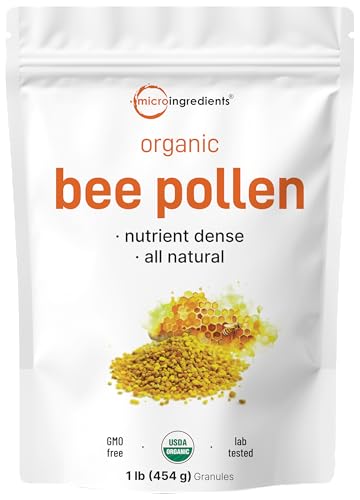
Micro Ingredients Organic Bee Pollen Granules, 1 lb
Micro Ingredients · 4.4
$29.95
Start with what bee pollen actually is, because the name misleads people. It is not the loose pollen that blows off ragweed in August. Foraging honey bees comb pollen out of their body hair, moisten it with nectar and glandular secretions, and pack it into pellets on their hind legs; a beekeeper catches those pellets in a screen trap at the hive entrance, then dries or freezes them. What you buy is therefore a bee-made food product with a floral raw material, described in more detail on the bee pollen entry, and the pellets in one jar can come from dozens of plant species.
That origin explains the two things shoppers notice first. One: the granules are not uniform in color. A good jar looks like confetti, yellow, orange, brick red, gray, near black, because each pellet is a single forager's load from a single plant species. Two: taste varies from batch to batch and season to season, from mildly sweet and floral to frankly bitter. Neither is a defect. A perfectly uniform, uniformly sweet jar is the one worth a second look.
Two disclosures before the picks. First, the plain one: no brand paid for a spot here, links go to Amazon, and a purchase may earn us a small commission at no extra cost to you. Prices are the verified listings on the publication date and drift, so check the live page. Second, the important one: people with allergies to bee products or to pollen can react to bee pollen, sometimes seriously. This is a food we are reviewing as a food. If you have any history of allergy to bee stings, pollen, or honey, talk to a clinician before trying it, start with a very small amount, and stop if anything feels wrong. We are a beekeeping desk, not a medical one, and we make no claims about what bee pollen does in a body.
What to know
- Our pick is Beekeeper's Naturals raw bee pollen ($22.70) for freshness and published sourcing; the Micro Ingredients 2 lb bag ($31.99) wins on price per pound.
- Bee pollen is floral pollen packed with nectar and bee enzymes into pellets, trapped at the hive entrance and dried. It is a bee-made food, not raw airborne pollen.
- Multicolored granules are a good sign: each pellet is one forager's load from one plant, so color variation means floral variation.
- Low moisture is the whole shelf-life game. Properly dried granules stay loose and pourable; damp ones clump, darken, and can ferment.
- Store the jar in the freezer if you are not finishing it in a month or two. Cold storage is what commercial packers do and what beekeepers do at home.
- Allergy caution, seriously: people allergic to bee products or pollen can react. Start with a very small amount and talk to a clinician first.
- Beekeepers can trap their own with a $22.99 entrance trap, which is the cheapest pollen on this page by an order of magnitude.
At a glance
| Product | Best for | Size (listed) | Notable | Price | Check price |
|---|---|---|---|---|---|
| Beekeeper's Naturals Raw Bee Pollen | Our Pick (freshness + sourcing) | Jar, listed | Published sourcing, small-batch | $22.70 | Check Price |
| Micro Ingredients Bee Pollen, 2 lb | Best Value Per Pound | 2 lb bulk bag | Cheapest per ounce here | $31.99 | Check Price |
| Micro Ingredients Organic Bee Pollen, 1 lb | Best Certified Organic | 1 lb | Organic certification (listed) | $29.95 | Check Price |
| Alovitox Bee Pollen Granules | Best Budget Jar | Jar, listed | Lowest entry price | $19.99 | Check Price |
| YS Eco Bee Farms Low Moisture Granules | Best for Shelf Stability | 1 lb (listed) | Low-moisture whole granules | $21.99 | Check Price |
The 2026 bee pollen shortlist at a glance. Weights, sourcing, and processing notes are the sellers' listed figures; prices verified against the live listings on 2026-08-29.
Beekeeper's Naturals 100% Raw Bee Pollen Granules
Beekeepers Naturals · Raw granules, not pressed or heated (listed) · published sourcing program · small jar size keeps it fresh
Our verdict: Beekeeper's Naturals is the brand in this category that behaves like a specialty food company rather than a bulk ingredient reseller: a modest jar, raw granules, and a sourcing story you can read before you spend $22.70. The jar is small enough that you finish it while it is fresh, which is exactly the right way to buy pollen.
Buy pollen the way you buy coffee: small, fresh, and from someone who says where it came from. The Beekeeper's Naturals raw bee pollen granules are the closest thing this category has to that standard. The granules arrive loose and multicolored, they smell floral rather than musty, and the listed handling is raw: dried rather than heat-processed, which is what keeps the pellets whole and the flavor bright. That matters more than any marketing word on the label, because pollen that has been cooked or pressed loses the distinct pellet structure that makes it recognizable as a food in the first place.
The size is the other reason it wins. A big bag is cheaper per ounce and worse in practice, because pollen is best eaten within a couple of months of opening unless it lives in your freezer, and most people do not finish two pounds of anything sprinkled a teaspoon at a time. This jar is a realistic amount of pollen for one household to work through while it still tastes like something. If you know you love it and you are committed to the freezer, the bulk options below are the better arithmetic; if you are trying pollen for the first time, or buying it as part of a gift box with a jar of good honey from our raw honey guide, this is the one.
Who should buy it
Buy this if you are new to bee pollen, if freshness and taste matter more than price per ounce, or if you want a jar you can hand to someone as a gift without explaining a two-pound bulk bag. It is also the right pick for anyone who wants to know something about the supply chain before eating a spoonful.
What we don't like
It is the most expensive pollen here per ounce by a wide margin, and the jar disappears quickly if you use it daily. Floral source and taste still vary batch to batch, as they do with every brand in this category, so the jar you love in spring may taste different in fall. And like all bee products, it is off the table for anyone with a bee-product or pollen allergy.
- Form
- Whole granules (listed)
- Processing
- Raw, dried rather than heated (listed)
- Sourcing
- Published sourcing program (listed)
- Color
- Mixed floral, multicolored pellets
- Best use
- Yogurt, smoothies, oatmeal toppings
- Storage
- Refrigerate or freeze after opening
- Price
- $22.70
Pros
- Freshest-tasting granules in the test group
- Sourcing is published, which is rare here
- Jar size matches how fast people actually use pollen
- Loose, multicolored, properly dried pellets
- Gift-appropriate packaging
Cons
- Highest price per ounce in the guide
- Small jar goes fast with daily use
- Taste varies by batch, as all pollen does
Micro Ingredients Bee Pollen Granules, 2 lb Bulk Supply
Micro Ingredients · 2 lb bulk bag (listed) · raw whole granules (listed) · resealable pouch (listed)
Our verdict: If bee pollen has become part of your morning routine rather than an experiment, the math changes and this bag wins it. A listed two pounds at $31.99 is roughly a third of the per-ounce cost of a boutique jar, and the only real condition is that you portion it out and put the rest in the freezer the day it arrives.
Bulk is the correct way to buy anything you eat every day, provided you solve storage first. The Micro Ingredients 2 lb bee pollen granules arrive as a listed resealable pouch of loose granules, and at $31.99 they undercut every jar in this guide on price per ounce by a wide margin. The trap is that two pounds is a lot of pollen: at a teaspoon a day, it is most of a year's supply, and a bag left open on a warm counter for a year will clump, darken, and eventually ferment. The fix is free. On arrival, decant a two-week supply into a small jar for the counter and put the rest of the bag in the freezer.
Flavor-wise, expect a bulk product: honest, variable, and a little more rustic than the boutique jars, with the same wide color spread you want to see. It is the right pollen for people who blend it into smoothies rather than tasting it off a spoon, for households with more than one person using it, and for anyone who bakes or cooks with it as a topping. Verify the listed weight and packaging on the live page before you buy, since bulk listings revise their pouch sizes more often than jar listings do.
Who should buy it
Buy the 2 lb bag if bee pollen is a habit rather than a trial, if more than one person in the house uses it, or if you blend it into smoothies where subtle floral notes are not the point. Freezer space is the only prerequisite.
What we don't like
Two pounds is genuinely a lot, and pollen left in a warm cabinet will not survive the distance; this bag requires you to commit to freezer storage. Sourcing detail is thinner than the boutique brands provide, and bulk pouches can arrive with more fine dust at the bottom than whole-pellet jars.
- Weight
- 2 lb (listed)
- Form
- Whole granules (listed)
- Packaging
- Resealable bulk pouch (listed)
- Best use
- Daily smoothies, multi-person households
- Storage
- Freeze the bulk, decant a small jar
- Value
- Lowest price per ounce here
- Price
- $31.99
Pros
- By far the best price per ounce in the guide
- Resealable pouch is freezer-ready
- Good color spread across the pellets
- Sensible for households with daily users
Cons
- Requires freezer storage to go the distance
- Less sourcing detail than boutique jars
- More fine dust than whole-pellet jars
Micro Ingredients Organic Bee Pollen Granules, 1 lb
Micro Ingredients · 1 lb (listed) · organic certification (listed) · whole granules (listed)
Our verdict: Organic certification on a bee product is a claim about the beekeeper's inputs and forage radius, not a promise that no bee visited a conventional farm, and it is worth understanding before you pay for it. If it matters to you, this listed-organic pound at $29.95 is the cleanest way to buy it in a size that a normal household finishes.
Organic certification means something specific for bee products, and it is narrower than most shoppers assume. A certifier looks at the beekeeper's practices: what goes into the hive, what the boxes are treated with, and the character of the forage within flight range of the apiary. What no certifier can do is fence a bee. Foragers routinely fly two miles or more, so an organic label on pollen is a statement about a management system, not a guarantee about every flower involved. The Micro Ingredients organic bee pollen carries that listed certification on a one-pound bag, which is the useful size: enough to last, small enough to finish before the freezer question becomes urgent.
Practically, this is the same product family as the two-pound bag above with a certification and a smaller package, and it prices accordingly at $29.95. It is the right buy if organic sourcing is a household rule rather than a preference, or if you want a middle size between a $22.70 jar and a year's supply. As with every listing in this category, confirm the current certification claim on the live page rather than trusting a screenshot; certification status is a thing that changes between listing revisions. If you want to go further upstream on sourcing questions in general, the honest answer is to buy from a beekeeper you can talk to, which is what our raw honey guide argues at length for honey and applies just as well to pollen.
Who should buy it
Buy this if certified organic sourcing is a firm household preference and you want a size between a tasting jar and a bulk bag. It is also a reasonable first bulk step if you already know you like pollen but are not ready for two pounds.
What we don't like
You pay close to bulk-bag money for half the weight, and the certification cannot control where bees fly, which limits what it actually guarantees. Sourcing detail beyond the certification claim is thin, and organic status on marketplace listings should be verified live rather than assumed.
- Weight
- 1 lb (listed)
- Certification
- Organic (listed)
- Form
- Whole granules (listed)
- Best use
- Households with an organic buying rule
- Storage
- Refrigerate or freeze after opening
- Price
- $29.95
Pros
- Listed organic certification
- One pound is a finishable size
- Same loose whole-granule format as the bulk bag
- Middle ground between jar and bulk pricing
Cons
- Near bulk pricing for half the weight
- Certification cannot control forage radius
- Verify certification claims on the live listing
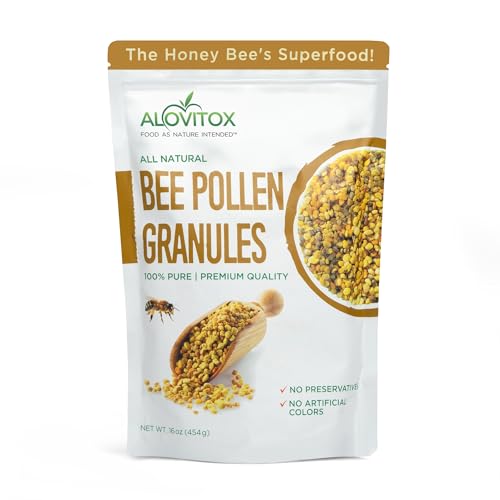
Alovitox Bee Pollen Granules, 100% Pure
Alovitox · Whole granules (listed) · 100% pure, single ingredient (listed) · lowest entry price here
Our verdict: At $19.99 the Alovitox jar is the low-stakes way to find out whether you like bee pollen at all, which is the only question a first purchase needs to answer. It is a straightforward single-ingredient product: whole granules, no blends, no additives, no story.
Bee pollen is a taste you either take to or you do not, and it is worth finding out cheaply. Some people find the granules pleasantly floral and slightly sweet; others find them bitter, chalky, or oddly savory, and no amount of reading settles it in advance. The Alovitox bee pollen granules answer the question for $19.99 with a plain jar of loose whole pellets and a single-ingredient label, which is exactly what a trial purchase should be.
Expect what the price implies. Sourcing information is thin, color spread and pellet size vary between lots more than the pricier jars, and there is no processing story to read. What you get is honest granules at the lowest entry point in this guide, and a clear answer to the only question that matters at this stage. If the answer is yes, the upgrade paths from here are obvious: the boutique jar for flavor, the two-pound bag for economics. If the answer is no, you are out twenty dollars and you know something. Either way, start with a very small amount the first time, and note the standing allergy caution: anyone with a history of reaction to bee stings, honey, or pollen should talk to a clinician before trying bee products at all.
Who should buy it
Buy the Alovitox jar as a first taste: the trial purchase, the curiosity buy, the small addition to a bee-themed gift basket. It answers the like-it-or-not question at the lowest price on this page.
What we don't like
Sourcing and processing detail is minimal, and lot-to-lot variation in pellet size and color is more noticeable than in the pricier jars. It is a fine entry product and not the one we would rebuy monthly if flavor is the reason you are here.
- Form
- Whole granules (listed)
- Ingredients
- Bee pollen, single ingredient (listed)
- Entry price
- Lowest in this guide
- Best use
- First-time trial, gift baskets
- Storage
- Refrigerate or freeze after opening
- Price
- $19.99
Pros
- Lowest entry price in the category
- Single-ingredient, no blends or fillers
- Loose whole granules, not pressed
- Low-stakes way to test the taste
Cons
- Thin sourcing and processing information
- More lot-to-lot variation than pricier jars
- Not the flavor pick for repeat buyers

YS Eco Bee Farms Low Moisture Whole Bee Pollen Granulars
YS Organic · Low moisture, listed · whole granules, not pressed (listed) · long-running US bee products brand
Our verdict: YS Eco Bee Farms puts the specification that actually governs pollen shelf life on the front of the label: low moisture. Properly dried granules stay loose, pour cleanly, and keep far longer than damp ones, and at $21.99 this is the pick for anyone who has previously opened a jar of pollen to find a solid clump.
Moisture is the spec that decides whether your jar of pollen lasts a season or a month. Fresh pellets come off the trap wet, and every packer has to remove that water: gentle drying, freeze drying, or refrigeration from the trap onward. Under-dried pollen clumps into bricks, darkens, and can ferment, which is the failure mode almost everyone in this category eventually meets. The YS Eco Bee Farms low moisture bee pollen makes the dryness claim the headline, and the granules behave like it: loose, rattling, individually distinct pellets that pour out of the jar instead of coming out in pieces.
The whole-granule format matters alongside dryness. Pressed or milled pollen loses the pellet structure that lets you see the floral variation and judge the product with your eyes, and it packs down into a dense mass that traps whatever moisture it meets. YS keeps the pellets whole, which is the format we recommend across the board. This is the jar we would buy for a pantry that gets opened irregularly, for a kitchen without freezer space to spare, and for anyone spooning pollen over honey-sweetened yogurt or oatmeal where the granules stay visible and the texture is part of the point.
Who should buy it
Buy the YS jar if you have ever opened a clumped, caked jar of pollen and want that not to happen again, if freezer space is tight, or if you use pollen irregularly enough that shelf life matters more than price per ounce.
What we don't like
Low moisture also means the granules are hard and crunchy, which is a texture some people dislike on soft foods; blending or a minute in yogurt softens them. Price sits in the middle of the pack, and, as everywhere in this category, floral source and taste still shift between harvests.
- Form
- Whole granules, not pressed (listed)
- Moisture
- Low moisture (listed)
- Weight
- 1 lb (listed)
- Best use
- Pantry storage, irregular use
- Texture
- Firm, crunchy pellets
- Storage
- Cool pantry; freezer for long term
- Price
- $21.99
Pros
- Dryness is the stated, verifiable-in-hand feature
- Granules stay loose and pourable
- Whole pellets show the floral color spread
- Best pick when freezer space is limited
Cons
- Crunchy texture is not for everyone
- Middle-of-pack price per ounce
- Taste still varies between harvests
More gear worth comparing
Beyond this guide: the highest-rated gear across every category and budget, with a live price check on each.



As an Amazon Associate we may earn from qualifying purchases, at no cost to you.
Quick shop: every pick
Skip the scroll: the whole lineup, with a live price check on each.
- Beekeeper's Naturals 100% Raw Bee Pollen GranulesBest OverallBeekeepers Naturals · $22.70Check Price
- Micro Ingredients Bee Pollen Granules, 2 lb Bulk SupplyBest Value Per PoundMicro Ingredients · $31.99Check Price
- Micro Ingredients Organic Bee Pollen Granules, 1 lbBest Certified OrganicMicro Ingredients · $29.95Check Price
- Alovitox Bee Pollen Granules, 100% PureBest Budget JarAlovitox · $19.99Check Price
- YS Eco Bee Farms Low Moisture Whole Bee Pollen GranularsBest for Shelf StabilityYS Organic · $21.99Check Price
How we chose
We judge bee pollen the way we judge honey: by what is in the container and what the seller is willing to tell you about where it came from. Country of origin, harvest handling, and drying method are the specifications that matter, and most brands publish none of them.
Dryness is scored explicitly. Granules should pour like coarse sand and rattle in the jar. Clumping, stickiness, or a compressed brick at the bottom means moisture, and moisture is what ends a jar of pollen early.
Color variation counts in a product's favor. A jar with six or eight visible pellet colors reflects a genuinely mixed floral source; a monochrome jar is worth a question.
We take no position on what bee pollen does in a body and make no health claims of any kind. This is a food buying guide: sourcing, processing, storage, taste, and price per ounce.
Price is normalized per ounce, because this category ranges from small jars to two-pound bulk bags and the sticker price hides a threefold spread.
No brand bought a placement. Prices come from the verified offer table on the publication date and are re-checked on update; a listing that goes dark or doubles in price loses its slot.
Key terms
- Pollen pellet
- The packed ball of pollen a forager carries on her hind leg, bound together with nectar and glandular secretions. One pellet is one bee's load from usually one plant species, which is why a good jar is multicolored.
- Pollen basket (corbicula)
- The smooth, hair-fringed area on a honey bee's hind leg where pollen pellets are packed for the flight home. The structure that makes bee pollen a distinct product rather than loose dust.
- Pollen trap
- A screen fitted at the hive entrance that combs pellets off returning foragers into a collection drawer. Run in short bursts so the colony keeps enough protein for brood rearing.
- Bee bread
- Pollen that has been packed into comb cells by house bees and left to ferment with nectar and hive microbes. Related to bee pollen but a different product; what you buy in a jar is trapped pellets, not bee bread.
- Low moisture
- Pollen dried enough that granules stay loose and separate. The specification that governs shelf life: damp pollen clumps, darkens, and can ferment.
- Freeze drying
- Removing water from frozen pellets under vacuum rather than with warm air. Preserves color and pellet structure, and is one of two accepted ways to stabilize fresh pollen; gentle warm-air drying is the other.
- Floral source
- The plant species a batch of pollen came from. Because bees forage whatever is blooming, most jars are a blend, and blend composition is why color and taste shift between harvests.
- Hygroscopic
- Prone to pulling water out of the air. Dried pollen is hygroscopic, which is why an open jar in a humid kitchen clumps and why the freezer is the default long-term storage answer.
Questions, answered
what is bee pollen actually made of
It is flower pollen that a foraging honey bee collected, moistened with nectar and her own glandular secretions, and packed into pellets on her hind legs. Beekeepers catch those pellets in a screen trap at the hive entrance and dry or freeze them. So it is a bee-made food product with a floral raw material, not the loose airborne pollen that coats a windshield in spring.
how do you eat bee pollen granules
As a topping, in small amounts. The traditional uses are a teaspoon over yogurt, stirred into oatmeal, blended into a smoothie, scattered over granola or a fruit bowl, or eaten straight off the spoon. Heat is usually avoided because the pellets soften and lose their texture. Start with a very small amount the first few times.
why is bee pollen different colors
Because each pellet is one forager's load from usually one plant species, and different flowers produce different colored pollen. A jar with yellow, orange, brick red, gray, and near black pellets came from a genuinely mixed floral source. Color variation is a sign of authenticity, not inconsistency, and a perfectly uniform jar is the one worth questioning.
does bee pollen need to be refrigerated
An open jar you will finish within a month or two is fine refrigerated, and anything larger belongs in the freezer. Dried pollen pulls moisture out of humid air, and moisture is what makes granules clump, darken, and eventually ferment. Beekeepers who trap their own freeze it the same day it comes off the trap.
how long does bee pollen last
Properly dried granules keep for many months in a cool, sealed container and considerably longer frozen. The limiting factor is moisture, not time: a jar kept dry and cold stays loose and pourable, while a bag left open in a warm cabinet can clump within weeks. Discard anything that smells sour or fermented, or that has gone sticky rather than merely clumped.
can you be allergic to bee pollen
Yes. People with allergies to bee products or to pollen can react to bee pollen, and reactions can be serious. If you have any history of reaction to bee stings, honey, or pollen, talk to a clinician before trying it, start with a very small amount, and stop immediately if anything feels wrong. We are a beekeeping desk and this is buying guidance, not medical advice.
is bee pollen the same as bee bread or royal jelly
No, they are three different hive products. Bee pollen is trapped leg pellets. Bee bread is pollen that house bees have packed into comb cells and left to ferment. Royal jelly is a secretion from the glands of young worker bees, fed to larvae, and it is covered in our separate guide to royal jelly and propolis.
how much does bee pollen cost per pound
In this guide, roughly $16 per pound in a two-pound bulk bag up to well over $40 per pound in a small boutique jar. The spread is real and mostly reflects package size, sourcing transparency, and freshness. Beekeepers who run an entrance trap produce it for the cost of the hardware, which is why a $22.99 trap undercuts every jar on this page.
can beekeepers collect their own bee pollen
Yes, with an entrance-mounted pollen trap that combs pellets off returning foragers into a drawer. The rules are to trap in short bursts rather than continuously, since the colony needs pollen as its own protein source for raising brood, and to empty the drawer daily and dry or freeze the pellets immediately. Fresh pellets mold quickly at room temperature.
why does bee pollen taste bitter sometimes
Because taste follows floral source, and some plants produce pollen that is genuinely bitter or savory rather than sweet. A jar blended across many species tastes different from a batch dominated by one bloom, and the same brand can taste different in spring than in fall. If bitterness bothers you, blending into a smoothie or stirring into honey-sweetened yogurt is the usual workaround.
Filed under Buyer's Guide
Part of Honey & Bee Products
Keep reading
The Best Royal Jelly and Propolis (2026)
The other two hive products people buy in jars and tinctures: what they are, how they are graded, and the same allergy caution.
The Best Raw Honey (2026)
The bee product most people start with, and the guide that explains why sourcing transparency matters more than the word raw.
The Best Pollen Patties and Substitutes
The other side of the pollen story: what beekeepers feed colonies when natural protein forage runs short.
Honey Varieties Guide
Floral source drives color and taste in honey the same way it does in pollen. The varietal map, explained.
Cooking and Baking with Honey
Where pollen granules end up in practice: on the yogurt, oatmeal, and toast that honey already sweetens.
How to Start Beekeeping
If trapping your own pollen sounds better than buying it, the supply chain starts with a hive.