Our Pick: VIVO
Check PriceThe Best Honey Strainers (2026)
Our pick is the VIVO Double Sieve Stainless Steel Honey Strainer at $29.99: a two-stage stainless sieve with an adjustable arm that spans a standard five gallon bucket, which is the detail that separates a strainer you can walk away from and one you have to hold. It costs about eleven dollars more than the good budget sieves in this guide, and every dollar of that gap buys stability, rim span, and stainless you can put through boiling water without worrying.
By The BeehiveKits Hive Desk2026-08-2914 min read Fact-checked against verified Amazon listingsHow we research
The value field is genuinely strong. The BEEKNOWS Double Sieve at $18.59, the BeeCastle Double Sieve at $18.39, and the BEEXTM Honey Strainer at $18.66 are all stainless double sieves within twenty-seven cents of one another, and honestly you should buy whichever is in stock the day you extract. They all do the same job: coarse screen on top catching wax cappings and the occasional bee part, fine screen below catching the small stuff, honey landing clean in the bucket. And the bucket matters too, which is why the witbee 2 Pack 5 Gallon Honey Bucket set at $59.99 is here: gated food-grade buckets are what a strainer sits on, and buying two at once is what lets you keep straining while the first one settles.
The argument we want to make loudest is about restraint. Straining is not filtering, and filtering is not settling. A double sieve removes the debris nobody wants to eat. Time and a warm room remove the fine haze and air bubbles for free. Pressure filtration through very fine media removes the pollen grains that let a lab prove your honey came from your county, and once those are gone your honey is chemically identical to the commodity product on the grocery shelf. Straining well means straining exactly enough. Everything else is a downgrade sold as an upgrade.
One disclosure, plainly: no brand paid for placement, nobody's product was placed, and no manufacturer saw this guide before publication. Links go to Amazon; if you buy through one we may earn a small commission at no extra cost to you, and that never moves a ranking. Prices are verified listings at publication, always check the live page.
What to know
- Our pick is the VIVO Double Sieve ($29.99): the adjustable arm actually spans a five gallon bucket rim, which is the difference between a hands-free strain and a two-person job.
- Three excellent budget double sieves sit within a quarter of each other: BEEKNOWS ($18.59), BeeCastle ($18.39), and BEEXTM ($18.66). Buy whichever is in stock.
- The coarse top screen catches wax cappings, propolis crumbs, and bee parts. The fine screen below catches small wax flecks and debris. That is all a home harvest needs.
- Straining removes debris. Settling removes haze and air bubbles for free if you leave capped honey in a warm room for a few days. Filtering under pressure removes pollen, and that is a loss.
- Pollen in honey is the evidence of origin. Melissopalynology, the study of pollen in honey, is how labs verify a floral and geographic source, so over-filtering erases the thing that makes your honey local.
- Buy a gated bucket at the same time. The witbee two pack ($59.99) gives you a strain bucket and a settle bucket, which is how you keep working instead of waiting.
At a glance
| Product | Best for | Type | Fits | Price | Check price |
|---|---|---|---|---|---|
| VIVO Double Sieve | Our Pick | Two-stage stainless sieve | 5 gal bucket, adjustable arm (listed) | $29.99 | Check Price |
| BEEKNOWS Double Sieve | Best Budget | Two-stage stainless sieve | 5 gal bucket (listed) | $18.59 | Check Price |
| BeeCastle Double Sieve | Cheapest Here | Two-stage stainless sieve | 5 gal bucket (listed) | $18.39 | Check Price |
| BEEXTM Honey Strainer | Best Backup Sieve | Two-stage stainless sieve | 5 gal bucket (listed) | $18.66 | Check Price |
| witbee Honey Bucket, 2 Pack | Best Bucket Pairing | Gated food-grade buckets | 5 gal, honey gate (listed) | $59.99 | Check Price |
The 2026 honey straining shortlist at a glance. Materials and dimensions are the manufacturers' listed figures; prices verified against our offer table on 2026-08-29.
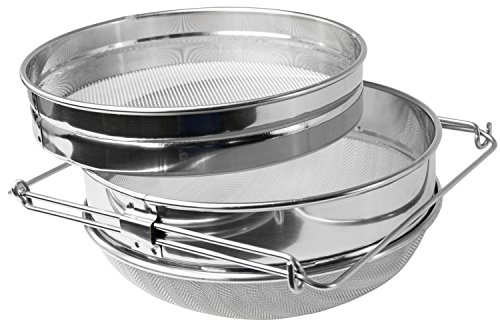
VIVO Double Sieve Stainless Steel Honey Strainer
VIVO · Stainless steel · double sieve · adjustable arm for 5 gal buckets (listed) · BEE-V101H
Our verdict: The VIVO is the strainer we would buy first and stop thinking about. Two stainless stages, sensible mesh grading, and an adjustable support arm that spans a standard five gallon bucket rim so the sieve sits stable while you pour with both hands. At $29.99 it is roughly eleven dollars over the budget field, and the stability alone justifies it for anyone working alone.
The feature that matters is not the mesh, it is the arm. Every double sieve here has a coarse screen over a fine screen, and they all catch what they should. What separates the VIVO Double Sieve Stainless Steel Honey Strainer is that its listed adjustable arm actually spans a standard five gallon bucket and holds the sieve at the rim under load. That sounds trivial until you are alone in a hot garage holding a dripping extractor gate open with one hand and a frame in the other, and the strainer decides to tilt into the honey. A sieve that stays where you put it is a sieve that lets you work.
Build quality is the other half of the price gap. Stainless throughout means you can pour boiling water through it during cleanup, run it through a dishwasher cycle, and store it in a humid shed without discovering rust flakes in June. The frame is rigid enough that the mesh does not deform under a bucket's worth of warm honey, which is the failure that eventually ruins cheaper sieves: a stretched screen lets debris through at the edges and cannot be fixed.
Throughput is good with warm honey and merely acceptable with cool honey, which is true of every gravity strainer ever made. Our routine is to extract into this sieve over a gated bucket, let the bucket settle warm for several days, skim the surface foam, and bottle from the gate. That sequence, with this strainer and a decent bucket, produces jars indistinguishable from commercial packing while keeping every bit of the pollen and character that makes local honey worth more. If you are still building out the rest of the extraction chain, our harvest equipment guide covers uncapping, buckets, and refractometers in order.
Who should buy it
Buy the VIVO if you extract alone, run more than a super or two a season, or have ever had a cheap sieve slide into a bucket. The adjustable arm and rigid stainless frame are worth the premium for anyone who wants to set it and pour rather than hold it.
What we don't like
It is roughly $11 more than three perfectly competent budget sieves that catch the same debris, and the arm adjustment can be fiddly on non-standard or slightly out-of-round buckets. Like every gravity strainer, it slows to a crawl if the honey has cooled below room temperature.
- Material
- Stainless steel (listed)
- Stages
- Two, coarse over fine
- Support
- Adjustable arm for 5 gallon buckets (listed)
- Model
- BEE-V101H (listed)
- Cleanup
- Hot water safe, rinse immediately after use
- Best use
- Solo extraction, multi-super harvests
- Price
- $29.99
Pros
- Adjustable arm genuinely holds position on a 5 gallon rim
- Rigid frame keeps mesh from deforming under a full pour
- All stainless, so boiling water and humid storage are fine
- Mesh grading catches debris without stripping pollen
- The right tool for working alone on harvest day
Cons
- Costs about $11 more than functionally similar budget sieves
- Arm adjustment is fiddly on out-of-round buckets
- Still slow with cool honey, as all gravity strainers are

BEEKNOWS Stainless Steel Double Sieve Honey Strainer
BEEKNOWS · Stainless steel · double sieve · sized for 5 gal buckets (listed)
Our verdict: The BEEKNOWS sieve does the entire job for $18.59. Two stainless stages, a rim that sits on a standard bucket, and mesh that catches wax and debris exactly as it should. What you give up against our top pick is the adjustable arm and some frame rigidity, which matters if you work alone and does not if someone is holding the bucket.
The budget double sieve is one of the genuinely good deals in beekeeping. The BEEKNOWS Stainless Steel Double Sieve Honey Strainer at $18.59 is a complete two-stage stainless strainer, and in terms of what ends up in the bucket it produces the same result as tools costing twice as much. Coarse screen catches cappings and comb. Fine screen catches flecks. Honey comes out clean. There is no secret ingredient in an expensive sieve that changes the chemistry of what passes through it.
We like it as a second sieve regardless of what your primary is. Straining stops when the top screen loads up with wax, and the choice at that moment is either to stop and wash or to swap in a clean sieve and keep going. At under nineteen dollars, buying a spare is cheaper than the hour you would otherwise lose, and the spare doubles as the one you lend to the friend you talked into beekeeping.
Care is the same as any fine mesh: rinse in hot water immediately, never scrub with anything abrasive, and dry completely before storage. Treated that way it lasts many seasons. Treated badly, the fine screen stretches or tears and the tool is finished, which is true at every price point and is the reason we grade frame rigidity at all. Pair it with a gated bucket and the settling routine described above and your first bottling day will go better than you expect.
Who should buy it
Buy the BEEKNOWS if you harvest one or two supers a year, extract with a helper, or want an inexpensive second sieve to swap in when the first one loads with wax. For most backyard beekeepers this is genuinely enough strainer.
What we don't like
It rests on the rim rather than clamping, so it can shift during a heavy pour, and the frame flexes more under load than our top pick does. Nothing about the mesh is worse, but the ergonomics of working alone with it are.
- Material
- Stainless steel (listed)
- Stages
- Two, coarse over fine
- Support
- Rests on 5 gallon bucket rim (listed)
- Cleanup
- Hot water safe, rinse immediately after use
- Best use
- 1 to 2 supers a year, second sieve for swaps
- Price
- $18.59
Pros
- Full two-stage stainless straining under $19
- Produces the same clean result as far pricier sieves
- Cheap enough to own two and swap when one clogs
- Light and easy to store
Cons
- Rests rather than clamps, so it can shift mid-pour
- More frame flex under a full load
- No adjustable arm for odd bucket sizes

BeeCastle Double Sieve Honey Strainer
BeeCastle · Stainless steel · double sieve · sized for 5 gal buckets (listed)
Our verdict: At $18.39 the BeeCastle is the cheapest strainer in this guide by twenty cents, which is to say it is tied. It is a competent stainless double sieve from a company that makes hives, frames, and bottom boards, so if you are already ordering woodenware it is a sensible thing to add rather than a separate decision.
When three products are within twenty-seven cents, the tiebreaker is your cart. The BeeCastle Double Sieve Honey Strainer at $18.39 is a stainless two-stage strainer that catches cappings and wax flecks and lets pollen through, which is the entire specification. It performs the way its competitors perform. What it has going for it is that BeeCastle is a full-line bee equipment brand, so if you are already ordering a screened bottom board or frames from them, this rides along in the same order.
The build is what the price implies: adequate stainless, a serviceable frame, mesh that is properly welded at the perimeter on the units we have handled. Under a full bucket of warm honey it holds shape well enough. Under cool honey that has to be coaxed, you will notice more flex than the top pick, and you will want a hand on the rim during a heavy pour.
Cleanup and longevity are technique-dependent rather than brand-dependent. Rinse hot, immediately, no abrasives, dry fully. Do that and this is a many-season tool. Skip it once, let honey and wax set in the fine mesh overnight, and you are into soaking and soft brushes. Every strainer in this guide lives or dies on the same habit, and it is the cheapest habit in beekeeping to acquire.
Who should buy it
Buy the BeeCastle sieve if you are already ordering BeeCastle woodenware, want the lowest sticker in the guide, or need a straightforward stainless double sieve without further deliberation. It is the definition of adequate in the good sense.
What we don't like
It flexes under load like all the budget sieves, has no arm or clamp, and offers no functional advantage over the two competitors it is tied with on price. Buying it is a logistics decision more than a quality one.
- Material
- Stainless steel (listed)
- Stages
- Two, coarse over fine
- Support
- Rests on 5 gallon bucket rim (listed)
- Brand context
- Full-line bee equipment maker
- Cleanup
- Hot water safe, rinse immediately after use
- Best use
- Adding to an existing woodenware order
- Price
- $18.39
Pros
- Lowest sticker price in this guide
- Stainless two-stage build with properly welded mesh
- Ships alongside the rest of a BeeCastle equipment order
- Does exactly what a home harvest requires
Cons
- Noticeable frame flex under a full pour
- No arm or clamp to hold position
- No advantage over the sieves it is tied with

BEEXTM Stainless Steel Double Sieve Honey Strainer
BEEXTM · Stainless steel · double sieve · sized for 5 gal buckets (listed)
Our verdict: The BEEXTM strainer at $18.66 completes the budget trio and earns its place here as the spare. Owning two sieves changes extraction day more than owning one better sieve does, because the real bottleneck is a top screen packed solid with cappings and the twenty minutes you lose washing it mid-flow.
The second sieve is the upgrade nobody sells you. Everyone shops for a better strainer. Almost nobody shops for a second one, and yet the BEEXTM Honey Strainer at $18.66 will save more time on a real harvest day than any single mesh improvement could. Here is the arithmetic: a double sieve strains beautifully until the coarse screen fills with wax cappings, at which point flow slows to a trickle. Your options are to stop and wash, which takes fifteen to twenty minutes and interrupts everything, or to lift the loaded sieve off, drop a clean one on, and keep pouring.
As a strainer in its own right, the BEEXTM is exactly what its price and its two rivals suggest: stainless, two-stage, adequately welded, sits on a five gallon rim, flexes some under a heavy load. There is no meaningful performance daylight between it and the BEEKNOWS or BeeCastle sieves. We are not going to invent one.
Where it does differ slightly in our handling is finish consistency, which varies more unit to unit in this tier than at the top of the guide. Inspect the mesh perimeter on arrival for any gap between screen and frame, because that gap is a bypass and a bypass makes the fine stage pointless. That inspection takes ten seconds and applies to every budget sieve, this one included.
Who should buy it
Buy the BEEXTM as your second sieve if you already own one, or as your first if it is the one in stock. Anyone extracting more than two or three supers in a session should own two strainers, and this is the price at which that stops being a debate.
What we don't like
Finish consistency varies unit to unit, so check the mesh-to-frame seam before you trust it with a bucket of honey. It flexes under load and has no clamping arm, and it offers nothing the other budget sieves do not.
- Material
- Stainless steel (listed)
- Stages
- Two, coarse over fine
- Support
- Rests on 5 gallon bucket rim (listed)
- Check on arrival
- Mesh-to-frame seam for gaps
- Cleanup
- Hot water safe, rinse immediately after use
- Best use
- Swap-in spare during long extraction sessions
- Price
- $18.66
Pros
- Cheap enough to own as a dedicated spare
- Stainless two-stage build like its budget rivals
- Swapping sieves saves far more time than a finer mesh would
- Easy to store flat with a second unit
Cons
- Finish consistency varies unit to unit
- No clamping arm and noticeable flex under load
- Functionally identical to two cheaper-or-equal options
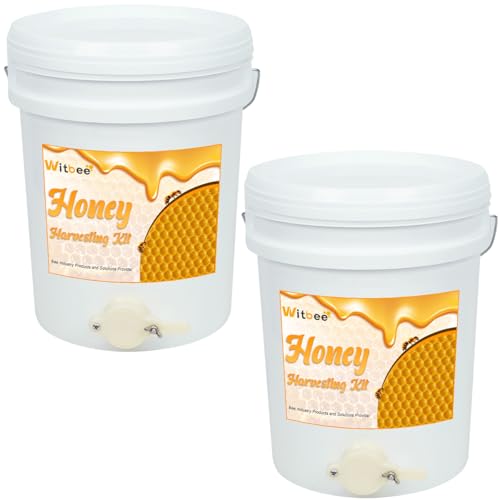
witbee 5 Gallon Honey Bucket with Gate, 2 Pack
witbee · Food-grade 5 gallon buckets · leak-proof honey gate (listed) · 2 pack
Our verdict: A strainer needs something underneath it, and this is the right something. The witbee two pack at $59.99 gives you a strain bucket and a settle bucket with leak-proof gates, which is the configuration that lets you keep extracting while the first batch clarifies. Buying one bucket is a false economy you will discover on your second harvest.
The bucket is not an accessory, it is half the strainer. The witbee 2 Pack 5 Gallon Honey Buckets at $59.99 are food-grade pails fitted with listed leak-proof honey gates, and that gate is what converts a bucket of honey into a bottling station. You strain into the bucket, let it settle warm and covered for a few days, skim the foam that rises, then open the gate and fill jars from the bottom where the honey is clearest. No ladling, no pouring, no mess down the side of every jar.
Gate quality is the thing to actually inspect. A honey gate that weeps is a slow tragedy: it drips into the storage area for weeks and attracts every ant in the county. Check the seal on arrival by running warm water through it, tighten the retaining nut properly, and always close the gate before you pour rather than after. If a gate does start to weep, the fix is usually re-seating the seal rather than replacing the bucket.
Keep the lids. Honey is hygroscopic, meaning it pulls moisture from the air, and an open bucket of ripe honey sitting in a humid garage will gain water content and edge toward the fermentation threshold. Lidded, warm, and undisturbed is the correct storage state between straining and bottling. Once bottled, the containers themselves are a separate decision, and our jars and labels guide covers what actually sells at a market table.
Who should buy it
Buy the two pack if you are setting up a harvest station for the first time, or if you have ever waited on a single bucket to clear before you could extract again. Two gated buckets is the minimum viable bottling setup for anyone harvesting more than one super.
What we don't like
It is the most expensive line item in this guide, and $59.99 buys buckets rather than anything clever. Gate seals need checking on arrival and occasional re-seating, and a full pail at roughly sixty pounds of honey is genuinely heavy to move, so fill it where it will sit.
- Quantity
- 2 buckets
- Capacity
- 5 gallons each (listed)
- Gate
- Leak-proof honey gate (listed)
- Material
- Food-grade plastic (listed)
- Approximate capacity
- About 60 lb of honey per full pail
- Best use
- Strain in one, settle in the other, bottle from the gate
- Price
- $59.99
Pros
- Two buckets means straining and settling can happen at once
- Gates turn a bucket into a clean bottling station
- Food-grade and lidded for safe warm storage
- The correct base for every strainer in this guide
- Doubles as feeding-syrup and wax-rendering storage off season
Cons
- Priciest item here and it is, ultimately, buckets
- Gate seals need checking and occasional re-seating
- A full pail is heavy enough that you fill it where it stays
More gear worth comparing
Beyond this guide: the highest-rated gear across every category and budget, with a live price check on each.




As an Amazon Associate we may earn from qualifying purchases, at no cost to you.
Quick shop: every pick
Skip the scroll: the whole lineup, with a live price check on each.
- VIVO Double Sieve Stainless Steel Honey StrainerBest OverallVIVO · $29.99Check Price
- BEEKNOWS Stainless Steel Double Sieve Honey StrainerBest BudgetBEEKNOWS · $18.59Check Price
- BeeCastle Double Sieve Honey StrainerCheapest HereBeeCastle · $18.39Check Price
- BEEXTM Stainless Steel Double Sieve Honey StrainerBest Backup SieveBEEXTM · $18.66Check Price
- witbee 5 Gallon Honey Bucket with Gate, 2 PackBest Bucket Pairingwitbee · $59.99Check Price
How we chose
We judge a strainer on whether one person can run it alone. That means rim span and stability first: a sieve that slips into the bucket when you pour is a failed tool no matter how good the mesh is.
Mesh quality is graded on weld and frame, not on a claimed micron number. Home sieves rarely publish verified aperture figures, so we describe what each stage catches in practice and mark manufacturer figures as listed.
Material is a pass/fail gate. Stainless only, because honey is acidic, straining gear gets washed constantly, and anything that rusts or leaches has no business in a food chain you are personally responsible for.
We test for cleanup, which is the part nobody thinks about at purchase and everybody thinks about at midnight. Honey-and-wax residue in a fine mesh is stubborn, so frame design and the ability to survive hot water matter.
We evaluate against the settle-and-skim alternative. If patience achieves the same clarity for free, we say so rather than selling a finer screen. Over-filtered honey is a worse product.
Prices come from our verified offer table dated 2026-08-29. No brand has bought a placement, and no manufacturer reviewed this guide before publication.
Key terms
- Double sieve
- A two-stage strainer with a coarse screen above a fine one. The coarse stage takes wax cappings, comb, and debris; the fine stage takes the small flecks that pass. It is the standard home-harvest tool and it deliberately does not remove pollen.
- Settling
- Leaving strained honey undisturbed in a warm covered bucket for several days so fine particles and air bubbles rise to the surface to be skimmed. It achieves clarity for free that filtration achieves at the cost of pollen.
- Ultrafiltration
- Forcing honey through very fine media under heat and pressure to remove microscopic particles including pollen. It produces water-clear, slow-crystallizing honey and destroys the ability to trace the honey's floral and geographic origin.
- Melissopalynology
- The scientific study of pollen contained in honey, used to identify what plants the bees foraged and where the honey was produced. It is the reason pollen in your jar is an asset rather than an impurity.
- Cappings
- The thin wax seals bees build over ripe honey cells, sliced off before extraction. Cappings wax is the cleanest wax a colony produces and is worth saving from the top screen for candles, wraps, and balms.
- Honey gate
- The valve fitted low on a bottling bucket that lets you fill jars from the clearest honey at the bottom rather than pouring from the top. A weeping gate is the most common preventable mess in a honey house.
- Hygroscopic
- Water attracting. Honey pulls moisture from humid air, which is why buckets stay lidded between straining and bottling. Excess moisture is what allows honey to eventually ferment in the jar.
- Ripe honey
- Honey the bees have reduced in moisture and capped, generally below about 18.6 percent water. Straining and settling do not dry honey, so ripeness is decided in the hive and verified with a refractometer, not at the sieve.
Questions, answered
what is the best honey strainer
Our pick is the VIVO Double Sieve Stainless Steel Honey Strainer at $29.99, because its adjustable arm holds position on a five gallon bucket rim so one person can pour with both hands. If you extract with help or only run a super or two, the BEEKNOWS ($18.59), BeeCastle ($18.39), or BEEXTM ($18.66) sieves do the same straining job for around eleven dollars less.
what micron filter do i need for honey
For a home harvest you do not need a micron rating at all. A standard double sieve catches wax, comb, and debris while letting pollen through, which is exactly what you want. Pushing honey through anything finer starts removing the pollen that proves your honey's origin, and that is a downgrade dressed up as clarity.
how do you get honey clear without filtering it
Let it settle. Pour strained honey into a covered gated bucket, keep it somewhere warm for two to five days, and fine wax particles and air bubbles will rise to the top as a foam. Skim the foam, then bottle from the gate at the bottom. The result looks commercially clear and still contains all its pollen.
does straining honey remove pollen
A normal double sieve does not. The mesh in a home strainer is far too coarse to catch individual pollen grains, so what you remove is wax, propolis, and bee parts. Pollen removal requires fine pressure filtration, which is a commercial process and one you should not want for local honey.
why is my honey taking forever to strain
It is too cold. Honey viscosity drops sharply with temperature, so warm honey pours through a sieve in minutes and cool honey can sit on the mesh for an hour. Extract in a warm room the same day you pull supers where possible, and never strain honey straight out of an unheated garage.
can you reuse the wax you strain out of honey
Absolutely, and you should. The wax cappings that collect on the top screen are the cleanest wax a hive produces. Scrape them into a lidded bucket, drain the residual honey, then render them into blocks for candles, food wraps, or balms. It is free product from a byproduct.
what size bucket do i need for straining honey
A standard five gallon food-grade bucket, which holds roughly sixty pounds of honey and is what every home strainer is sized to sit on. Buy one with a honey gate so you can bottle from the bottom, and buy two if you can, so one can settle while you strain into the other.
how do you clean a honey strainer
Rinse it in hot water immediately after use, before the honey and wax set. Honey is water soluble so a fresh sieve cleans in seconds. Never use steel wool or abrasive pads on the fine mesh, since one stretched section makes the whole stage useless, and let it dry completely before storing.
do i need a strainer if i use a honey extractor
Yes. An extractor spins honey out of the comb but sends wax fragments, cappings bits, and the occasional bee part into the tank with it. The strainer sits between the extractor gate and the bucket and is the step that makes the honey presentable. The two tools are a pair, not alternatives.
should you heat honey before straining it
Warm it gently at most. Honey that is still warm from the hive strains easily on its own. If you must warm cooled honey, keep it low and slow, since high heat degrades flavor and aroma and is exactly what separates commodity honey from the raw product you are trying to sell. Never boil or microwave it.
Filed under Buyer's Guide
Keep reading
The Best Honey Harvesting Equipment
Uncapping tools, buckets, refractometers, and everything else in the extraction chain.
How to Harvest Honey
The full harvest-day sequence, from pulling supers to bottling from the gate.
The Best Honey Extractors
The machine that fills the bucket your strainer sits on, from manual two-frame to electric.
The Best Honey Jars and Labels
What to put clarified honey in, and what a market table actually sells from.
How to Sell Honey
Why provenance is your premium, and how pollen in the jar backs the claim up.
How Much Honey Per Hive
How many buckets you should actually plan for in a first and second season.