Our Pick: forcosy
Check PriceThe Best Uncapping Tanks (2026)
Our pick is the Pierce uncapping tub at $260.34: a complete uncapping station rather than a bin, with the tub, the drain, and the frame support that turn the messiest twenty minutes of harvest day into a controlled process. If your harvest is one or two supers a year, the XEJMEOO uncapping kit at $59.01 does the same job at a smaller scale for a quarter of the money. If you are running enough hives that uncapping is a production line, the forcosy 304 stainless uncapping tank at $664.70 is the bench-height, restaurant-grade version.
By The BeehiveKits Hive Desk2026-08-2915 min read Fact-checked against verified Amazon listingsHow we research
Here is what the tank is for, because the name undersells it. When you plane the wax cappings off a frame, roughly a third of what falls is honey, clinging to the wax in sheets. A tank catches all of it in one vessel, supports the frame you are working on so both your hands are free for the knife, and then, over the next day, lets that honey drain out of the wax through a sieve into a reservoir with a gate you can bottle from. Skip the tank and you get three separate problems at once: honey on the floor, wax in your extractor, and several pounds of harvest thrown away with the cappings.
The cappings themselves are worth more than beginners think. Drained cappings wax is the cleanest beeswax a colony produces, because it has never held brood, and it is the raw material for candles, wraps, and food-safe wax of the sort described in the beeswax literature. The honey you drain out of it is ordinary jar-grade honey. A tank is the tool that recovers both instead of composting them, which is why we treat it as harvest infrastructure and not an accessory.
The usual disclosure, plainly: no brand paid for a placement here and nobody saw this guide before publication. Links go to Amazon; a purchase may earn us a small commission at no cost to you and never moves a ranking. Prices are the verified listings on the publication date, always check the live page. Capacity figures below are the manufacturers' listed dimensions, hedged as listed, with our own math about how many frames that realistically covers.
What to know
- Our pick is the Pierce uncapping tub ($260.34): a complete station with tub, drain, and frame support, sized for the serious backyard harvest.
- Budget answer: the XEJMEOO uncapping kit ($59.01) covers a one to two super harvest and is still miles better than uncapping over a bucket.
- A tank is not just a bin. The frame rest is what frees both hands for the knife, and the sieve is what gets your honey back out of the wax.
- Cappings are roughly a third honey by weight when they fall. Draining them for 24 to 48 hours recovers pounds of jar-grade honey per harvest.
- Stainless costs more and lasts forever; food-grade plastic is safe and cheaper but scratches, stains, and eventually gets replaced.
- The forcosy 304 stainless tank ($664.70) is the premium bench: height adjustable, restaurant-grade steel, and overkill below roughly ten hives.
At a glance
| Tank | Material | Best for | Scale | Price | Check price |
|---|---|---|---|---|---|
| forcosy 304 Stainless Uncapping Tank | 304 stainless (listed) | Premium Pick | 8+ hives | $664.70 | Check Price |
| Pierce Uncapping Tub Extraction Kit | Complete set (listed) | Our Pick | 3-8 hives | $260.34 | Check Price |
| TYXMPH Honey Extractor Tank | Listed steel tank | Best mid-size tank | 3-6 hives | $158.99 | Check Price |
| Zonon Uncapping Station | Listed steel station | Best value station | 2-5 hives | $152.99 | Check Price |
| XEJMEOO Uncapping Tool Kit | Kit with tools (listed) | Best budget kit | 1-2 hives | $59.01 | Check Price |
Five uncapping stations, from a $59 starter kit to a $664.70 stainless bench. Prices verified against the live listings on 2026-08-29.

forcosy 304 Stainless Steel Honey Uncapping Tank
forcosy · 304 stainless steel, height adjustable (listed), full uncapping tank
Our verdict: At $664.70 this is the most expensive single item in our harvest coverage, and it is aimed squarely at the keeper whose harvest has become a production run. Listed 304 stainless throughout, height adjustable so you are not stooping over a bin for three hours, and sized to hold a real session's cappings. Below roughly eight hives it is a beautiful indulgence. Above it, it is the piece that makes harvest weekend survivable.
The reason to spend this much is your back, not your honey. Uncapping is repetitive standing work with a hot knife, and the difference between a tank at the correct working height and a tub on the floor shows up around frame thirty as a real ache. The forcosy 304 stainless uncapping tank is height adjustable as listed, which means you set it to your elbows and stay upright through the whole session. That is the same reasoning commercial kitchens use, and it is the single most underrated ergonomic upgrade in a harvest room.
The honest scale test: how many frames do you uncap in a season? At two hives you will uncap perhaps forty frames a year and the $59.01 kit at the bottom of this guide does that completely. At ten hives you are uncapping several hundred frames across a few long days, cappings volume becomes a genuine logistics problem, and a big stainless tank with a working drain stops being luxury. That is the same crossover point where an electric extractor stops being optional, which our extractor guide walks through by hive count.
Who should buy it
Buy the forcosy if you run eight or more hives, harvest across multiple days, and want a permanent stainless uncapping bench at working height. It is the piece that turns a harvest corner into a harvest room.
What we don't like
The price is the entire objection: $664.70 buys an electric extractor with money left for a settling tank. It is large, so it needs a permanent home rather than a shelf. And like every big stainless vessel, it wants proper drying before storage or the fittings will spot.
- Type
- Uncapping tank with drain
- Material
- 304 stainless steel (listed)
- Height
- Adjustable (listed)
- Station
- Uncapping and cappings draining
- Scale suited
- Roughly 8 hives and up
- Cleanup
- Hot water and a scraper, stainless releases wax cleanly
- Price
- $664.70
Pros
- Listed 304 stainless: true food-equipment grade
- Height adjustable, so long sessions stop punishing your back
- Capacity for a genuine multi-super harvest day
- Cleans up faster than any plastic tub here
- Buy-once construction for a permanent harvest room
Cons
- Costs more than most backyard extractors
- Large footprint needs a dedicated space
- Complete overkill below roughly eight hives

Pierce Beekeeping Uncapping Tub Honey Extraction Kit
Pierce · Complete uncapping tub extraction kit (listed), Pierce beekeeping equipment
Our verdict: This is the tank we point most serious backyard keepers toward: a complete station rather than a bare bin, from a name that has been making uncapping equipment for a long time. At $260.34 it costs real money and it removes the entire category of harvest-day mess in exchange. If you run three to eight hives and harvest more than one super at a sitting, this is the right size and the right build.
The word to notice in the listing is "complete." The Pierce uncapping tub extraction kit arrives as a working station rather than a vessel you then have to accessorize: the tub that catches cappings, the drain arrangement that gets honey back out of them, and the frame support that is the difference between uncapping and juggling. That last part is the one people underrate. With a proper frame rest you hold the frame with one hand and plane with the other in a single smooth stroke; without one, you are balancing a ten-pound frame on a bucket rim while wielding a heated blade, which is exactly as bad an idea as it sounds.
On capacity: at three to eight hives you are uncapping somewhere between sixty and two hundred frames a season, usually across two or three sessions, and this tub holds a session's worth of cappings without becoming a bottleneck. Below that, you are paying for headroom you will not use. Above it, look hard at the stainless bench above. And whatever the tank, get the supers into the house nearly bee-free first, which is what an escape board is for; uncapping indoors with a hundred bees in the room is a different and much worse experience.
Who should buy it
Buy the Pierce tub if you harvest three to eight hives and want the uncapping station solved in one order, with a proper frame rest and a working drain. It is the piece that makes harvest day feel organized rather than improvised.
What we don't like
It is a real purchase at $260.34, roughly the cost of a small electric extractor, and a one or two hive keeper genuinely does not need it. It is bulky to store eleven months a year. And as with any drained-cappings setup, you have to actually empty and clean it or next season starts with a wax archaeology project.
- Type
- Uncapping tub with drain (complete kit)
- Contents
- Tub, drain arrangement, frame support (listed)
- Station
- Uncapping and cappings draining
- Scale suited
- Roughly 3 to 8 hives
- Pairs with
- Heated uncapping knife and cappings fork
- Drain time
- 24-48 hours for cappings to give up their honey
- Price
- $260.34
Pros
- Complete station, not a bare vessel
- Frame support frees both hands for the knife
- Right capacity for a multi-super backyard harvest
- Recovers pounds of honey from cappings each season
- Long-standing name in uncapping equipment
Cons
- Priced like a small extractor
- Bulky off-season storage
- More tank than a one or two hive harvest needs

TYXMPH Honey Extractor Tank
TYXMPH · Honey tank, listed 15.74 x 23.6 inch footprint, beekeeping supply grade
Our verdict: The TYXMPH sits in the useful middle at $158.99: bigger than a kit, cheaper than a station, and sized so a three to six hive harvest does not need emptying halfway through. Listing detail is thinner than we like, so verify the material and fittings on the live page, but as a capacity-per-dollar answer for a growing apiary it is a sound buy.
The middle of this category is where most growing apiaries actually land. The TYXMPH honey extractor tank is the sensible answer for the keeper who started with two hives, now has five, and has discovered that the little kit fills up before the first super is done. At a listed 15.74 by 23.6 inches it takes a session's cappings from several supers, and at $158.99 it does not demand the commitment the Pierce tub does.
Workflow note that applies to every tank in this guide: cappings drain far better warm. Wax and honey both thicken as they cool, and a tank left in a cold garage will still be dripping a week later. Uncap into the tank, then let it drain somewhere warm and dry overnight, ideally the same room you are extracting in. If your harvest room runs cold, that is exactly the problem a bucket band heater solves, which is covered in our honey warmer guide, with the standing caution that gentle warmth is the goal and heat above roughly 104F starts costing you aroma.
Who should buy it
Buy the TYXMPH if your apiary has grown past a starter kit but has not become a production line: three to six hives, one or two harvest sessions a year, and a want for capacity without a $260 commitment.
What we don't like
The listing is thin on materials and fittings, so you are verifying the important specs yourself. It is a tank rather than a complete station, so budget separately for a frame rest solution if it does not include one. And it is still a large item to store.
- Type
- Uncapping and honey tank
- Dimensions
- 15.74 x 23.6 inches (listed)
- Station
- Uncapping and cappings draining
- Scale suited
- Roughly 3 to 6 hives
- Verify on listing
- Contact material and drain fitting
- Price
- $158.99
Pros
- Real capacity at a mid-market price
- Right size for an apiary that outgrew a starter kit
- Handles a multi-super session without emptying
- Cheaper commitment than a full station
Cons
- Thin listing detail on material and fittings
- Tank rather than a complete station
- Large to store off season

Zonon Beekeeping Uncapping Station
Zonon · Uncapping station for honey harvesting and extraction (listed)
Our verdict: The Zonon is sold as a station rather than a bin, which is the right framing, and at $152.99 it undercuts the mid-size tanks by a few dollars while covering the same two to five hive range. Expect a lighter build than the premium tier and expect to be gentle with the fittings. As the first real uncapping setup for a keeper past the beginner stage, it is a sensible landing spot.
Station beats bin, at any price. The difference the Zonon uncapping station is selling is workflow: a place to rest the frame, a volume to catch cappings, and a way to get the honey back out afterward, all as one object instead of three improvised ones. At $152.99 that is a fair trade for the two to five hive keeper who has done exactly one harvest over a bucket and decided never again.
Honest expectations at this price: lighter gauge material, fittings that want hand-tightening rather than force, and a build that rewards careful storage. None of that changes the fact that it does the job, and the job is worth doing. The pounds of honey a tank recovers from cappings over a few seasons are real money, as is the wax, which is the input for our wax melter guide and for the rendering walkthrough in how to render beeswax.
Who should buy it
Buy the Zonon if you keep two to five hives and want a genuine uncapping station rather than a bucket, without crossing into premium money. It is the sensible first tank for most growing backyard apiaries.
What we don't like
Lighter build than the premium tier, so treat the fittings gently and store it flat. Listing detail on exact materials is thinner than we like. And at five-plus hives you will start wishing for the extra capacity of the tier above.
- Type
- Uncapping station with drain
- Station
- Uncapping and cappings draining
- Scale suited
- Roughly 2 to 5 hives
- Sieve setup
- Coarse screen over reservoir, add fine mesh if not included
- Verify on listing
- Contact material and included fittings
- Price
- $152.99
Pros
- Sold and built as a station, not a bare bin
- Undercuts the mid-size tanks slightly
- Right scale for two to five hives
- Recovers cappings honey and clean wax
Cons
- Lighter build than premium tanks
- Thin listing detail on materials
- Capacity gets tight past about five hives
XEJMEOO Honey Harvesting Uncapping Tool Kit
XEJMEOO · Honey collecting and uncapping tool kit (listed), includes harvesting tools
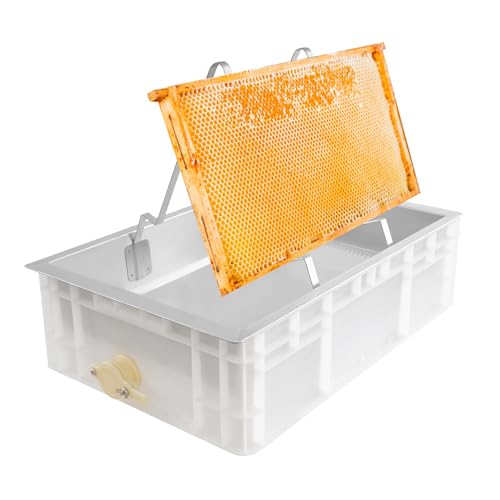
Our verdict: For a one or two hive first harvest, this is the honest recommendation. The XEJMEOO kit bundles the uncapping tools with a catching solution at $59.01, which is a quarter of what a real station costs and a hundred percent better than the bucket-and-hope method most first harvests use. It will not scale, and it does not need to.
The first harvest does not need a bench, it needs a plan. The XEJMEOO uncapping tool kit is that plan for $59.01: tools plus somewhere for the cappings to go, arriving in one box the week before your first harvest. Forty frames off two hives is a job this handles, and doing it with a kit instead of improvising is the difference between an afternoon you remember fondly and one you talk about with a haunted look.
Where it runs out: capacity. At three or more hives you will be emptying it mid-session, which breaks the rhythm exactly when you want rhythm most. That is your signal to move up to the station tier. Until then, run this kit, put the cappings through a strainer, verify the drained honey with a refractometer before it goes in jars, and read the whole sequence in how to harvest honey before the day arrives rather than during it.
Who should buy it
Buy the XEJMEOO kit for a first or second harvest off one or two hives. It is the cheapest way to uncap like you meant to, and it is the right amount of equipment for forty frames a year.
What we don't like
Capacity is the ceiling: it fills up during a three-hive harvest and interrupts your rhythm. Build is light, as the price implies. And listing detail on exactly what is included varies, so read the live page before you count on a specific tool being in the box.
- Type
- Uncapping tool kit with catching vessel
- Station
- Uncapping (small scale)
- Scale suited
- Roughly 1 to 2 hives, about 40 frames a year
- Contents
- Uncapping and harvesting tools (listed, verify on listing)
- Step up when
- You empty it mid-session
- Price
- $59.01
Pros
- Under $60 for a real uncapping solution
- Ends the bucket-balancing method immediately
- Right size for a first or second harvest
- Tools included, so it is one order not three
Cons
- Fills up during a three-hive harvest
- Light build at the price
- Included contents vary, verify on the listing
More gear worth comparing
Beyond this guide: the highest-rated gear across every category and budget, with a live price check on each.




As an Amazon Associate we may earn from qualifying purchases, at no cost to you.
Quick shop: every pick
Skip the scroll: the whole lineup, with a live price check on each.
- forcosy 304 Stainless Steel Honey Uncapping TankPremium Pickforcosy · $664.70Check Price
- Pierce Beekeeping Uncapping Tub Honey Extraction KitBest OverallPierce · $260.34Check Price
- TYXMPH Honey Extractor TankBest Mid-Size TankTYXMPH · $158.99Check Price
- Zonon Beekeeping Uncapping StationBest Value StationZonon · $152.99Check Price
- XEJMEOO Honey Harvesting Uncapping Tool KitBest Budget KitXEJMEOO · $59.01Check Price
How we chose
We judge an uncapping tank on three jobs, in order: does it catch everything that falls, does it hold the frame so both hands are free, and does it separate honey from wax without a second piece of equipment.
Food contact is pass/fail. Everything honey touches must be stainless steel or food-grade plastic as listed; we flag any listing that is vague about the material.
Capacity is judged in frames per session, not in liters. A tank that holds ten frames' worth of cappings before it needs emptying keeps pace with a backyard harvest; one that fills after four does not.
Cleanup is a ranking factor, not a footnote. Wax sets hard on cold steel, and a tank with square internal corners and awkward fittings is a tank that gets skipped next season.
Dimensions and capacities are the manufacturers' listed figures and are hedged as listed. We do not repeat a spec we cannot verify.
No placement is paid. Prices come from the verified offer table on the publication date; picks that go dark or spike lose their slot on update.
Key terms
- Uncapping tank
- The vessel that catches wax cappings as you uncap frames, supports the frame while you work, and drains the honey back out of the wax through a sieve into a reservoir.
- Cappings
- The thin wax caps sliced off ripe honey cells, soaked with honey when they fall. Roughly a third honey by weight, and the cleanest beeswax a colony produces once drained.
- Double sieve
- A coarse screen that holds cappings while honey drips through, over a fine mesh that catches escaped wax flakes. The standard arrangement inside an uncapping tank.
- 304 stainless
- The common food-equipment grade of stainless steel. It resists honey's mild acidity, will not stain or hold odors, and is the reason premium tanks cost what they do.
- Food-grade plastic
- Plastic rated for food contact. Safe and inexpensive for honey, but it scratches and stains over years, which is why it is the hobby answer rather than the buy-once answer.
- Frame rest
- The bar or support that holds a frame steady over the tank so both hands are free for the uncapping knife. The feature that separates a station from a bin.
- Honey gate
- The shut-off valve at the base of a tank or bucket for controlled bottling, and the fitting that turns a drained-cappings reservoir into something you can jar from.
- 18.6% moisture
- The standard honey ripeness threshold. Below it, honey resists fermentation and keeps essentially indefinitely; above it, wild yeasts can ferment it in the jar.
Questions, answered
do I need an uncapping tank
If you harvest more than a handful of frames, yes. The tank catches cappings, holds the frame steady so both hands are free for the knife, and drains the honey back out of the wax. Without one you lose several pounds of honey per harvest to discarded cappings and spend the evening cleaning your kitchen floor.
what size uncapping tank do I need
Size by frames per sitting, not by hive count. Roughly 20 to 40 frames a year is a $59 kit; 40 to 90 is a value station; 60 to 200 wants a complete station; past 200 you want a stainless bench. The failure to design against is having to empty the tank mid-session while a hot knife cools and frames drip on the floor.
how do you get honey out of cappings
Let them drain. Cappings sit on a coarse screen over a fine mesh inside the tank, and honey drips through into the reservoir over 24 to 48 hours in a warm room. Do not press or squeeze the wax, because that forces fine wax particles through the mesh and gives you cloudy honey to re-strain.
stainless steel or plastic uncapping tank
Both are safe if the plastic is food-grade. Stainless, specifically 304, does not stain, hold odors, or build the scratch network that makes old plastic hard to clean, so it is the buy-once material. Food-grade plastic costs far less and is the right call for a hobby harvest, with the understanding that it eventually gets replaced.
can I use a bucket instead of an uncapping tank
You can, and plenty of first harvests do, but it is worse in four specific ways: the rim is too narrow to rest a frame on safely, the bucket tips when you lean on it, cappings slump over the side once it fills, and there is no sieve so recovering the honey means a second improvised step. A $59 kit fixes all four.
how long do cappings take to drain
Usually 24 to 48 hours in a warm room. Both honey and wax thicken as they cool, so cappings left to drain in a cold garage can still be dripping a week later while the yield gets worse. Drain them in the same warm space you extracted in and the job finishes overnight.
how do you clean an uncapping tank
The same day, with water hotter than feels necessary. Scrape the bulk of the wax out with a plastic scraper first, then rinse; wax sets hard on cold metal and turns a ten minute job into a chiseling project. Dry the tank completely before it goes into storage so fittings do not spot.
what do you do with wax cappings after uncapping
Drain them, rinse them in cool water, dry them, and render them. Cappings wax has never held brood, so it renders lighter and cleaner than culled brood comb, and it is the preferred material for candles, wraps, and food-safe wax. A season's cappings from a few hives melts into a genuinely valuable block.
is an uncapping tank the same as a settling tank
No. An uncapping tank catches and drains cappings during uncapping. A settling tank holds already-strained honey for a day or two so air bubbles and fine wax rise into a skimmable film before bottling. They are two stations in the same line, and busy harvest rooms own both.
how much honey do you get back from cappings
More than most beginners expect. Cappings fall as roughly a third honey by weight, so a multi-super harvest can leave several pounds of jar-grade honey sitting in the wax. Draining it is passive, it costs you a day of patience, and it is the fastest payback any piece of harvest equipment offers.
Filed under Buyer's Guide
Part of Honey Harvest
Keep reading
The Best Honey Harvesting Equipment
The whole extraction line in workflow order: uncapping knives, strainers, settling tanks, and the refractometer that clears honey for jars.
How to Harvest Honey
The full sequence this tank sits in the middle of, from deciding a frame is ripe to putting a lid on the jar.
The Best Bee Escape Boards
How the super gets into the house nearly bee-free in the first place, for the price of one evening of planning.
The Best Honey Extractors
The spinner this station feeds, sized by hive count from a 2-frame manual to an 8-frame electric.
The Best Solar Wax Melters
What to do with the clean cappings wax your tank just collected, from free sunshine to a $62 electric melter.
The Best Honey Warmers and Decrystallizers
Gentle heat for cold harvest rooms and crystallized buckets, with the temperature ceiling that protects aroma.